Skeleton — The skeleton supports the body, protects organs and provides attachment points for muscles. The skull protects the brain; ribs protect the heart and lungs. Bone marrow makes blood cells. Tendons attach muscles to bones; ligaments connect bones at joints. Joints allow movement between bones, while cartilage reduces friction at many joints.
Joints and cartilage — A hinge joint allows mainly bending and straightening, as at the elbow. A ball-and-socket joint permits movement in several directions, as at the shoulder. Smooth cartilage reduces friction between bone ends.Joint shape and movement. Original schematic; see the explanation for its limits. Full-size diagram
Tendons and ligaments — Tendons transfer a muscle's pulling force to a bone. Ligaments hold bones together and stabilise a joint. They have different connections even though both are connective tissues.
Antagonistic muscles — Muscles pull when they contract; they cannot actively push. Antagonistic pairs produce opposite movements. At the elbow, contraction of the biceps bends the arm while the triceps relaxes; contraction of the triceps straightens it while the biceps relaxes.
How a muscle moves a bone — A contracting muscle becomes shorter and pulls through its tendon. The bone turns about a joint. The opposing muscle must relax sufficiently for that movement; reversing the pair reverses the movement.
Force measurements — A force meter measures force in newtons. A supervised comparison of grip or muscle force should use the same equipment and posture and suitable repeats. Do not infer an individual's health from one reading; age, body size and technique affect results.
Nutrition and digestion
Balanced diet — Carbohydrates and lipids provide energy; lipids also support insulation and energy storage. Proteins support growth and repair. Calcium helps build bones and teeth; iron is needed for oxygen-carrying haemoglobin; vitamin C supports healthy tissues. Vitamins and minerals are needed in small amounts for specific functions, fibre supports bowel movement and water acts as a solvent and transport medium. A balanced diet supplies appropriate proportions and amounts.
Carbohydrates and lipids — Carbohydrates provide an important source of energy in the diet. Lipids are used in cell structures and longer-term energy storage as well as supplying energy. “Fat-free” does not automatically mean a balanced diet.
Protein, vitamins and minerals — Proteins supply materials for growth and repair. Vitamins and minerals have specific roles and are needed in smaller amounts; they are not interchangeable with protein or a main energy supply.
Water and fibre — Water acts as a solvent and helps transport dissolved substances. Dietary fibre is not digested by human enzymes but helps movement through the gut. Both matter even though neither is a principal energy source.
Food tests as evidence — Under teacher-approved procedures, iodine changing to blue-black supports the presence of starch; Benedict's solution with suitable heating can indicate reducing sugars, a group including glucose. Compare the resulting colour with the teacher’s reference: a positive test changes from blue towards green, yellow, orange or brick-red, depending on the amount present. Include comparison samples and follow chemical and heating precautions.
Energy needs — Energy requirements vary with activity, age and growth. Use food labels in kJ: a portion providing 600 kJ eaten twice contributes 1200 kJ. Add portions across a day and compare with an appropriate requirement; no single allowance suits everyone.
Comparing food labels — If a food provides 900 kJ per 100 g, a 50 g portion supplies 450 kJ. Compare the same mass or stated portions and include the rest of the diet; one label cannot establish nutritional balance.
Diet imbalance — Long-term excess energy intake can contribute to obesity; insufficient food can cause starvation and poor growth. Deficiency diseases result from missing nutrients, such as scurvy from vitamin C deficiency. Body size alone does not establish diet quality or diagnose disease.
Deficiency and energy imbalance — Someone can have enough food energy but still lack a particular vitamin or mineral. A deficiency is about a missing nutrient, whereas long-term energy imbalance compares intake with energy use.
Digestion — Digestion breaks large food molecules into smaller soluble molecules for absorption. Teeth mechanically break food; saliva begins chemical digestion. The oesophagus carries food to the stomach; the stomach mixes food and provides acidic conditions. Enzymes are biological catalysts: they speed up chemical reactions without being used up overall. They are not living organisms.
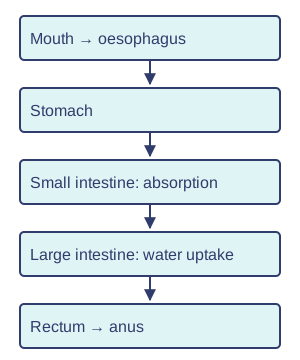
The digestive route — Food travels through the mouth, oesophagus, stomach and small intestine, then remaining material passes to the large intestine, rectum and anus. The liver and pancreas help digestion but food does not travel through them.Food through the alimentary canal. Original schematic; see the explanation for its limits. Full-size diagram
Mechanical and chemical digestion — Chewing breaks food into smaller pieces and increases exposed surface area. Enzymes chemically break large molecules into smaller ones; these are different kinds of breakdown.
Enzymes in digestion — Amylase breaks starch into sugars, proteases break proteins into amino acids and lipases break lipids into fatty acids and glycerol. Each enzyme works on particular types of food molecule.
Intestines — The small intestine completes digestion and absorbs soluble nutrients. Villi increase its surface area and have thin surfaces and a blood supply. The large intestine absorbs water; the rectum stores faeces and the anus releases them. Egestion of undigested food differs from excretion of metabolic waste.Food through the gut. Original schematic; see the explanation for its limits. Full-size diagram
Absorption through villi — Digested, soluble molecules move across the small intestine's surface into the blood. Many villi give a large area; thin walls and a blood supply help transfer. Digestion and absorption are separate steps.A villus supports absorption. Original schematic; see the explanation for its limits. Full-size diagram
Egestion and excretion — Egestion removes undigested material as faeces. Metabolism means the chemical reactions taking place in living cells. Excretion removes waste substances produced by those reactions, such as carbon dioxide from respiration. Not every material leaving the body has the same origin.
Bacteria — Many gut bacteria are useful: they help process some substances and can produce certain vitamins. Not all bacteria cause disease. Gut bacteria do not replace human digestion or make every nutrient; some bacteria can be harmful.
Gas exchange and breathing
Airways — Air passes through the trachea, bronchi and bronchioles to alveoli. Alveoli provide a large, thin, moist exchange surface with a blood supply. Oxygen diffuses into blood and carbon dioxide diffuses out down concentration gradients.
Airway branching — The trachea divides into two bronchi, one to each lung. Smaller bronchioles carry air towards the alveoli. Branching distributes air over many exchange surfaces.
Gas exchange directions — Blood arriving at the alveoli has less oxygen and more carbon dioxide than the air there. Those concentration differences produce net oxygen diffusion into blood and carbon dioxide diffusion out.
Inhalation — During inhalation the diaphragm contracts and flattens and the ribcage moves up and out. Chest volume increases, pressure in the lungs falls below outside air pressure and air enters. Air is drawn in by a pressure difference, not by lungs actively sucking oxygen molecules.Inhalation pressure model. Original schematic; see the explanation for its limits. Full-size diagram
Breathing by pressure changes — Moving the diaphragm and ribs changes chest volume. A larger volume lowers pressure, allowing outside air to enter. The muscles cause the pressure change; the alveoli do not actively pull oxygen in.Ventilation changes volume and pressure. Original schematic; see the explanation for its limits. Full-size diagram
Exhalation — During quiet exhalation the diaphragm relaxes and becomes dome-shaped and the ribcage falls. Volume decreases and pressure rises, moving air out. Breathing is air movement; gas exchange is diffusion; respiration is a chemical process in cells.
Three different processes — Breathing moves air; gas exchange transfers gases across a surface; respiration releases usable energy through reactions in cells. A plant can respire without lungs or breathing movements.
Lung measurements — A supervised lung-volume demonstration can measure exhaled air using suitable hygienic apparatus. Control posture and use repeats, but do not force excessive breathing or share unclean mouthpieces. A classroom estimate is not a diagnosis and does not measure every part of lung capacity.
Exercise and asthma — Exercise increases cells' oxygen demand and carbon dioxide production, so breathing rate and depth usually increase. Asthma narrows airways and can restrict airflow. Use individual medical guidance and teacher supervision; a revision exercise must not replace treatment.
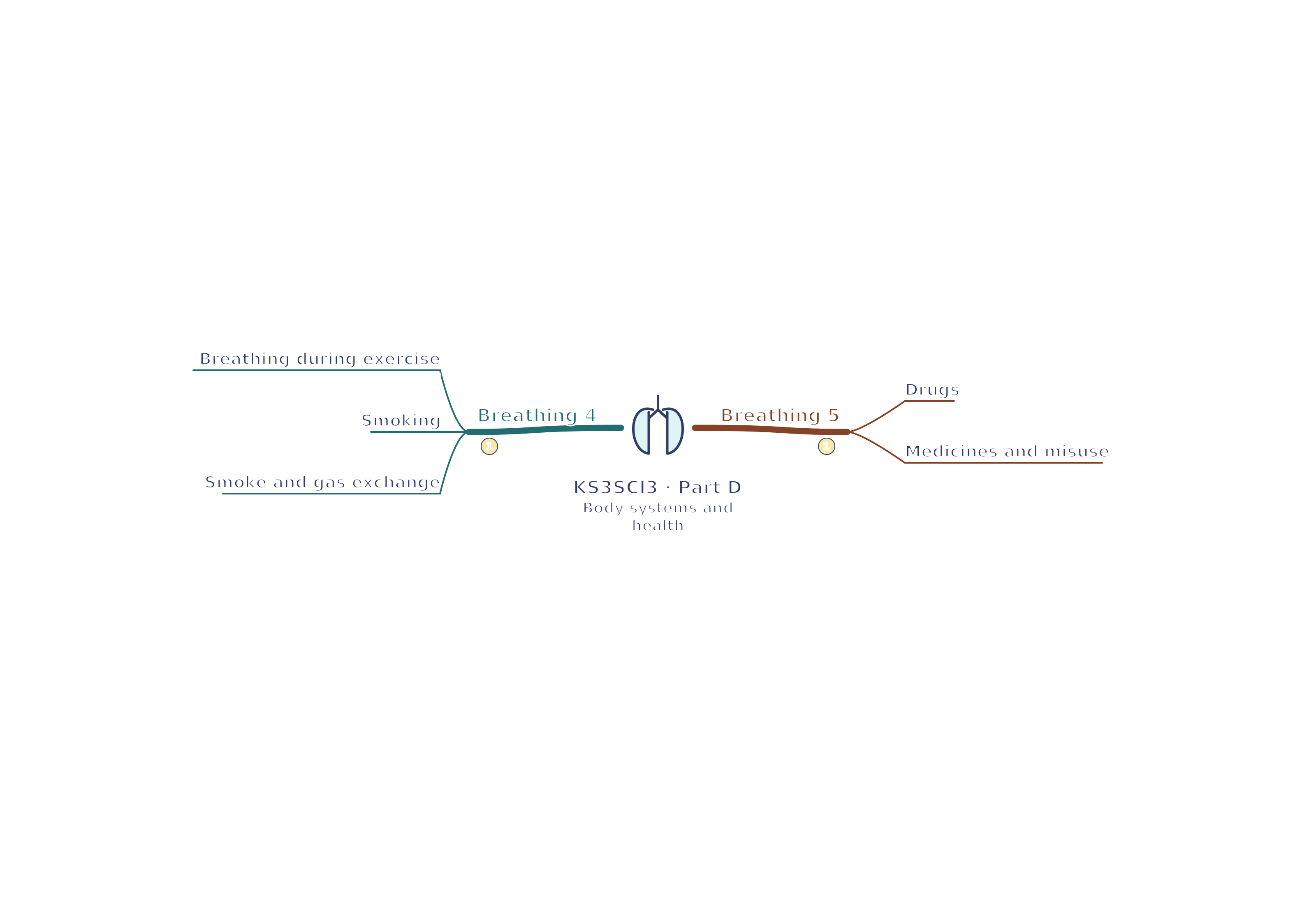
Breathing during exercise — Working muscles respire more rapidly. They need more oxygen and produce more carbon dioxide, so breathing and circulation normally increase. A faster breathing rate does not by itself diagnose fitness or disease.
Smoking — Smoking damages airways and alveoli and increases serious disease risks. Carbon monoxide reduces oxygen transport and nicotine can cause dependence. Damage to the exchange surface makes gas exchange less effective; smoke is not simply harmless water vapour.
Smoke and gas exchange — Damage to alveolar walls reduces the effective exchange area. Carbon monoxide binding to haemoglobin reduces oxygen transport. These are different ways smoking can affect oxygen delivery.
Drugs — Recreational drugs affect the nervous system, behaviour and life processes; alcohol can impair judgement and coordination, and substance misuse can cause dependence and organ damage. Effects vary with substance and dose. Medicines should be taken as directed; legal status does not establish safety.
Medicines and misuse — A medicine has intended effects but can also have side effects and dose limits. Use the prescribed or labelled instructions and appropriate professional advice; sharing medicines or assuming legal substances are harmless is unsafe.
Test yourself
30 questions · Random sets of 10. These quick checks support revision; practise longer explanations and justified judgements too.
Mind map
Use the branches to recall the ideas and explain their connections. Check the revision notes for the full detail.
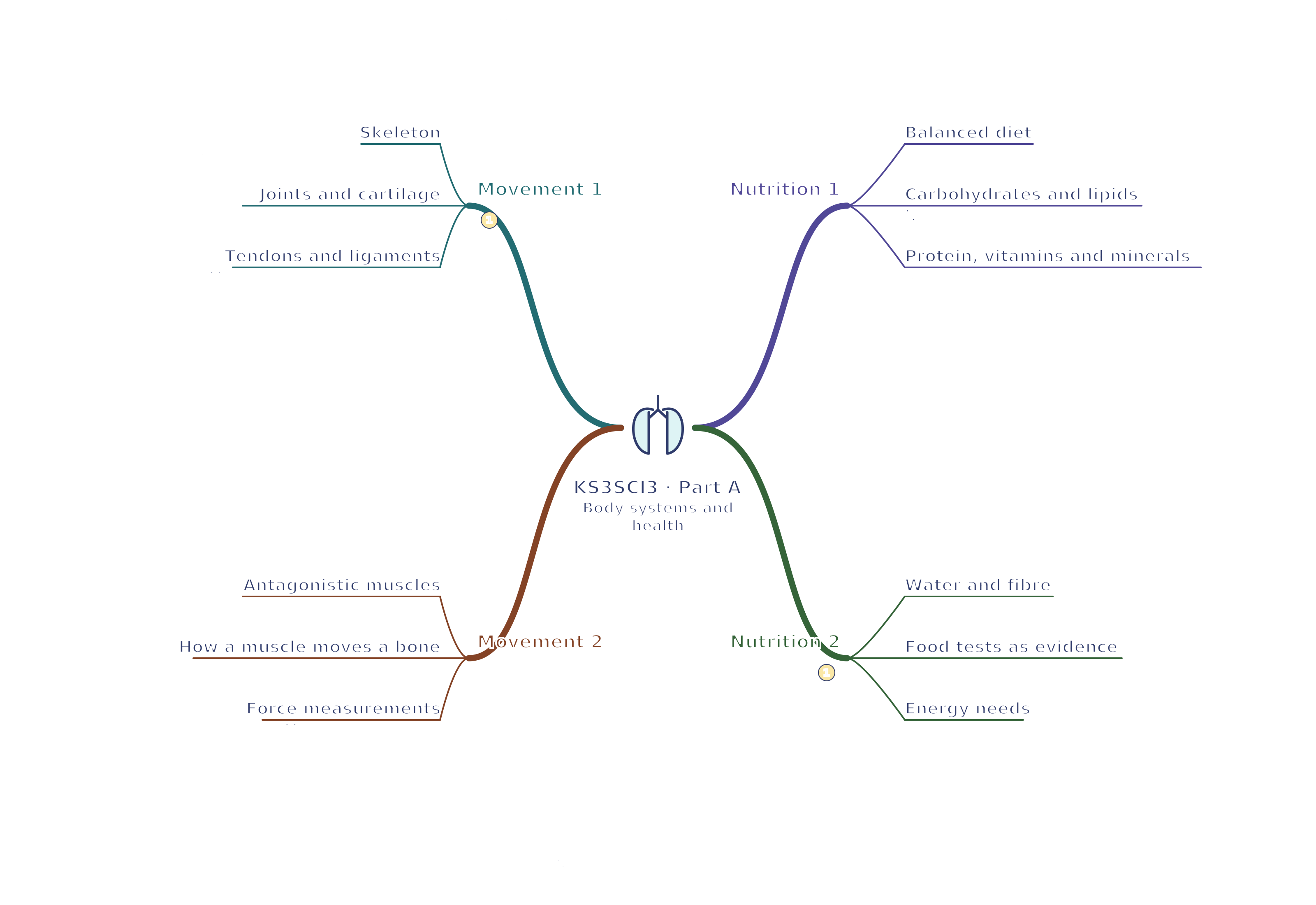
KS3SCI3 · Movement 1 / Movement 2 / Nutrition 1 / Nutrition 2
View KS3SCI3 · Movement 1 / Movement 2 / Nutrition 1 / Nutrition 2 mind mapOpen the full-size map to zoom. Use the printable view for A4 landscape or enlarge to A3.
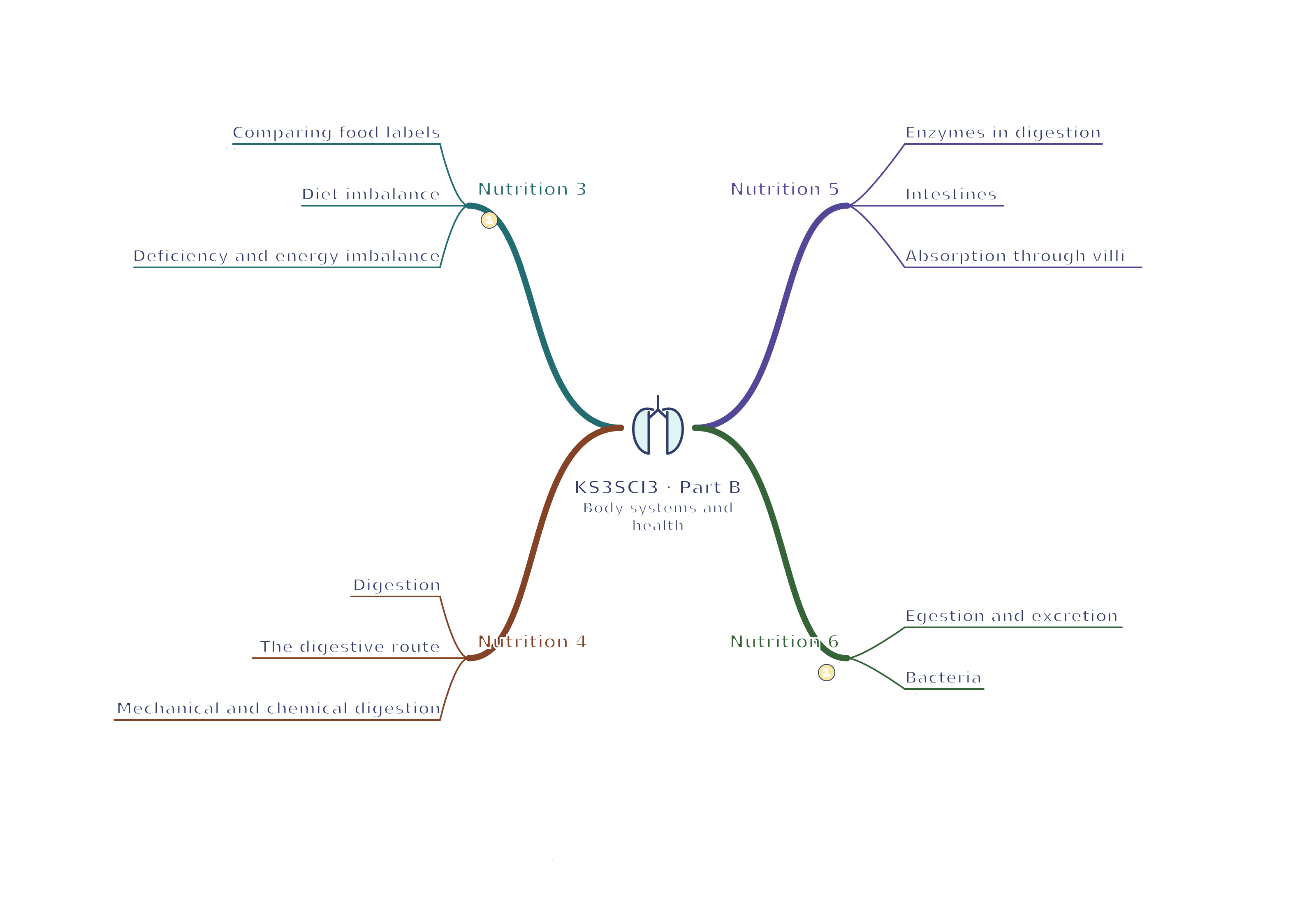
View KS3SCI3 · Nutrition 3 / Nutrition 4 / Nutrition 5 / Nutrition 6 mind mapOpen the full-size map to zoom. Use the printable view for A4 landscape or enlarge to A3.
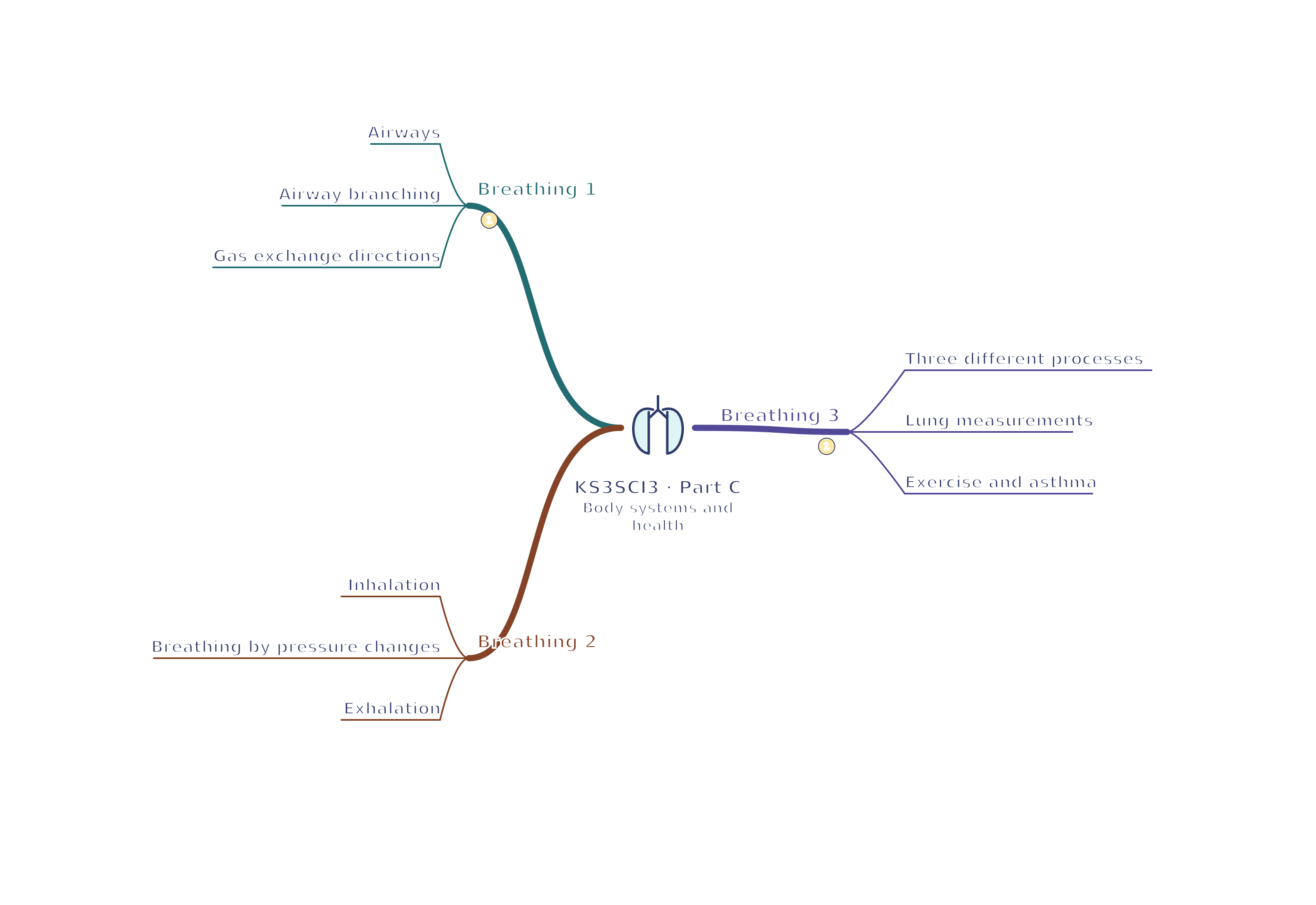
View KS3SCI3 · Breathing 1 / Breathing 2 / Breathing 3 / Breathing 4 mind mapOpen the full-size map to zoom. Use the printable view for A4 landscape or enlarge to A3.
 Mr Kidman's Classroom