Atomic organisation — A small nucleus contains protons and neutrons, with electrons occupying quantum states in the surrounding atom. Most atomic mass is concentrated in the nucleus, while most of the atom's volume lies outside it. A diagram of circular shells is a model for energy levels, not a photograph of electrons following planetary tracks.
Particle properties — A proton has relative charge +1 and relative mass about 1; a neutron has charge 0 and relative mass about 1; an electron has charge −1 and relative mass about 1/1836. Chemical ion formation changes electron numbers, not the number of protons identifying the element. Use relative charge separately from charge in coulombs.
Reading nuclide notation — Atomic number Z counts protons; mass number A counts protons plus neutrons in a specified isotope. Neutrons = A − Z, while a neutral atom has Z electrons. A 27Al3+ ion has 13 protons, 14 neutrons and 10 electrons. A positive charge means electrons have been removed, not extra protons added.
Particles in molecular ions — Count each nucleus using the isotope information, add protons and neutrons across the species, then adjust total electrons for the overall charge. A 14N1H4+ ion has 11 protons, seven neutrons and ten electrons when hydrogen is 1H. The ion's overall positive charge removes one electron from the total neutral-atom count.
Isotopes and chemistry — Isotopes are atoms of the same element with the same proton number but different neutron numbers. Their electronic configurations are the same when neutral, so their ordinary chemical behaviour is very similar, while mass-related physical properties can differ. Isotopes are not different elements or the same thing as differently charged ions.
Relative isotopic mass — Relative isotopic mass compares the mass of one atom of a particular isotope with one-twelfth the mass of a carbon-12 atom. It is a dimensionless ratio, meaning the mass units cancel when one mass is divided by the other, not the atom's mass in grams. Isotopic masses are close to whole mass numbers but accurate mass data need not be exact integers.
Relative atomic mass — Relative atomic mass, Ar, is the weighted mean mass of an atom of an element relative to one-twelfth the mass of carbon-12. Weight by the specified isotopic abundances, which can depend on the sample. A periodic-table value is not the proton count or necessarily a whole number corresponding to a single atom.
Molecular and formula masses — Add the relative atomic masses for all atoms in the formula, respecting brackets and subscripts. In Ca(OH)2, the 2 outside the brackets means two O atoms and two H atoms, so count 40.1 + 2(16.0 + 1.0). For Ca(OH)2 using Ca = 40.1, O = 16.0 and H = 1.0, the relative formula mass is 74.1. Use relative formula mass for a giant lattice rather than implying that solid calcium hydroxide consists of separate Ca(OH)2 molecules.
Mass spectra and isotope calculations
Mass-to-charge interpretation — A mass spectrum records ions at their mass-to-charge ratios, m/z, with relative signal intensities. For singly charged positive ions, the numerical m/z corresponds to their relative isotopic or molecular mass. A spectrum contains detected ions rather than neutral particles; charge state matters if a question supplies multiply charged ions.
Weighted-mean calculation — For illustrative isotopic masses 35 and 37 at abundances 75% and 25%, Ar = (35 × 75 + 37 × 25)/100 = 35.5. If intensities are 3 and 1 instead, divide by their total four. Do not take an unweighted midpoint unless the abundances are equal, or assume peak height itself is a mass.
Finding an unknown abundance — For two isotopes at masses 10 and 11 with mean 10.8, let the fraction of mass-10 atoms be x. Then 10x + 11(1 − x) = 10.8, giving x = 0.2, or 20%. The other isotope is 80%; check that fractions total one and that the mean lies between the isotope masses.
Diatomic isotope combinations — If isotopes A and B have fractions p and q, randomly paired diatomic molecules occur as AA with p², AB with 2pq and BB with q². The mixed peak includes two equivalent orderings, which is why its probability is not simply pq. State the assumption of random combination and suitable equal-response interpretation of the relative signals.
Chlorine molecular peaks — Using an approximate 3:1 abundance ratio for 35Cl and 37Cl, Cl2 molecular-ion peaks occur at m/z 70, 72 and 74 with relative probabilities 9:6:1. Fragment Cl+ signals can separately appear at 35 and 37. The molecular pattern is not the same 3:1 ratio as the atomic pattern, and the most intense molecular peak need not represent the mean mass.
Molecular ions and limits — A molecular ion forms when a molecule loses an electron without fragmenting; its singly charged peak can indicate relative molecular mass. Fragmentation can create lower-mass ions, and a molecular-ion peak can be weak or absent. Distinguish it from the base peak, which is the largest signal and is not automatically the molecular ion.
Ionisation energies and electron evidence
First ionisation energy — First ionisation energy is the energy required to remove one electron from each atom in one mole of gaseous atoms to form one mole of gaseous singly positive ions. Write X(g) → X+(g) + e− and give energy in kJ mol−1. Gas-state species and the one-electron, one-mole meaning are essential.
Successive ionisation — The second ionisation removes an electron from each gaseous X+ ion, producing X2+; later ionisations continue from more positive gaseous species. Successive values generally increase because remaining electrons are held by a more positive ion with less electron repulsion. Do not describe the second value as removing a second electron from a fresh neutral atom.
Attraction, radius and shielding — Ionisation depends on nuclear charge, distance from the nucleus and shielding by other electrons, which reduces the nuclear attraction experienced by the electron being removed, as well as the subshell and pairing involved. More protons can strengthen attraction if the other factors are comparable; extra shells can increase distance and shielding enough to outweigh a larger nuclear charge. A correct explanation compares the relevant factors, not one variable in isolation.
Across and down trends — Across a main-group period, increasing nuclear charge with broadly similar inner-shell shielding usually raises first ionisation energy as the radius contracts. Down a group, an outer electron occupies a higher shell with greater shielding and distance, so first ionisation energy generally falls despite more protons. These general trends need subshell and pairing qualifications.
Subshell discontinuities — Boron has a lower first ionisation energy than beryllium because the removed 2p electron is in a higher-energy subshell than beryllium's 2s electron. The analogous 3s/3p change explains magnesium to aluminium. This is evidence against a model in which every outer electron in one shell has exactly the same energy.
Electron-pair discontinuities — Oxygen has a lower first ionisation energy than nitrogen because one 2p orbital contains a pair, and repulsion makes removing a paired electron easier than removing one from nitrogen's singly occupied 2p orbitals. A comparable explanation applies from phosphorus to sulfur. Do not attribute the decrease to fewer protons or an additional principal shell.
Large jumps and groups — A large jump after the nth ionisation suggests that n outer electrons have been removed before reaching a lower, more strongly held shell. For a suitable main-group atom, a large jump between the second and third values supports two valence electrons, meaning two electrons in the outer occupied shell in this main-group example. Interpret the complete evidence and context rather than applying the inference blindly to every transition species.
Logarithmic ionisation plots — Successive values can span a large range, so a logarithmic vertical scale helps show jumps. Equal vertical distances represent equal ratios rather than equal energy differences. Read the labelled scale carefully, and identify which electron removal starts the inner shell rather than simply counting a plotted step without its index.
Emission spectra and quantisation — An excited atom or ion can emit a photon as an electron moves to a lower allowed energy level. Discrete spectral lines provide evidence for quantised energy differences, restricted to particular allowed values, rather than a continuous range of allowed levels. Heating supplies excitation energy; the emitted light is associated with downward transitions, not electrons orbiting visibly at a particular colour.
Shells, orbitals and configurations
Shell capacities and energy order — The first four principal shells can contain 2, 8, 18 and 32 electrons when their subshells are filled. This does not mean the first 36 elements fill one entire shell before starting the next: relative subshell energies lead to 4s occupation before 3d in the simple neutral-atom filling sequence.
Orbital meaning and shape — An orbital describes an electron state and a region of high probability of finding an electron, not a fixed path. An s orbital is spherically symmetric; a p orbital has two lobes separated by a nodal plane through the nucleus, where the orbital model gives zero probability of finding the electron. The three p orbitals have different spatial orientations and the same capacity of two electrons each.Schematic orbital sections: s is spherically symmetric; a p orbital has two lobes and a nodal plane through the nucleus. Colours distinguish lobes, not positive and negative electric charges, and outlines are not electron trajectories.
Subshell capacities — An s subshell contains one orbital and holds up to two electrons; p contains three and holds six; d contains five and holds ten. A subshell label such as 3p identifies its principal shell and type. Do not confuse the maximum in one p orbital with the maximum in the whole p subshell.
Filling and spins — In the course's orbital model, occupy equal-energy orbitals singly with parallel spins before pairing; two electrons in one orbital have opposite spins. Draw a box for each orbital and arrows for electrons. Nitrogen's 2p3 arrangement has three singly occupied p boxes, while oxygen's 2p4 has one pair and two single electrons.Three equal-energy 2p boxes each hold one electron in nitrogen; oxygen has one opposite-spin pair and two single electrons. Arrow direction represents spin in this notation, not the direction of electron travel.
Writing configurations — Fill 1s, 2s, 2p, 3s, 3p, 4s, 3d and 4p as appropriate up to krypton, checking the total electron count. Calcium is 1s2 2s2 2p6 3s2 3p6 4s2, or [Ar]4s2. Use actual superscripts when writing formal answers; the inline digits here indicate occupancy rather than a chemical formula.
Chromium and copper exceptions — For neutral atoms, chromium is [Ar]3d5 4s1 and copper [Ar]3d10 4s1, not the unmodified filling predictions 3d4 4s2 and 3d9 4s2. The relative energies are close and the observed configurations include electron-interaction effects. Learn the actual results without turning a simplified half-filled-shell explanation into a universal rule for every element.
Main-group ions — Remove electrons for a cation and add them for an anion, then write the resulting configuration and check the charge. Mg2+ is 1s2 2s2 2p6 and Cl− is 1s2 2s2 2p6 3s2 3p6. A stable main-group ion can share a configuration with a noble gas without becoming that different element.
Blocks and reactivity — The block identifies the subshell being filled across that part of the periodic table: s, p or d. Valence configurations help explain recurring chemical patterns, such as Group 2 forming 2+ ions and Group 7 gaining an electron in suitable reactions. A block label is not a complete account of every possible oxidation state or compound.
Periodicity, radius and melting behaviour
Repeating patterns — Periodicity is the recurrence of trends as valence configurations repeat across successive periods. Relate supplied plots of radius, ionisation energy and melting or boiling temperature to electronic configuration and structure. Similar patterns do not mean every property changes smoothly or every element within a group has identical values.
Atomic radii across a period — Across comparable main-group atoms, rising nuclear charge attracts electrons in the same principal shell more strongly, with broadly similar inner shielding, so radius generally decreases. Down a group, additional occupied shells increase radius. Different radius definitions and bonding environments matter when comparing actual data, so use compatible measures.
Period 2 melting and boiling — Lithium and beryllium are metallic, boron and carbon have giant covalent structures in the relevant elemental forms, and nitrogen, oxygen and fluorine are simple diatomic molecules while neon is monatomic. Disrupting an extended covalent structure requires many strong bonds to be overcome; low molecular phase-change temperatures involve weaker attractions between particles. Carbon normally sublimes rather than melts at ordinary pressure, so distinguish the transition and conditions in supplied data. Identify the actual allotrope and supplied conditions rather than treating carbon as a small C molecule.
Period 3 from metals to silicon — Sodium, magnesium and aluminium show metallic bonding with differences in charge, electron availability and size influencing bond strength. Silicon forms a giant covalent network with a high melting temperature. Explain the change in structure as well as bonding strength; comparing only electron count cannot explain the whole period.
Period 3 molecular elements — Phosphorus as P4, sulfur as S8 and chlorine as Cl2 are simple molecular, while argon is monatomic under ordinary reference conditions. Molecular size and electron distribution influence London forces, helping explain sulfur's higher boiling temperature than smaller molecular neighbours. Melting also depends on packing and structure, so use supplied evidence rather than treating particle mass as the sole cause.
Interpreting a periodic dataset — Plot property against the correct atomic number with units and labelled scales, identify general trends and specific departures, then explain them through structure and electrons. A correlation alone is not an atomic mechanism. Compare period 2 and period 3 while distinguishing a repeated pattern from equal absolute values.
Ionic bonding and ionic sizes
Ions and the ionic bond — A cation forms by electron loss and an anion by electron gain. Ionic bonding is the strong electrostatic attraction between oppositely charged ions in a lattice; electron transfer explains ion formation but is not itself the force holding the lattice together. Solid sodium chloride contains a repeating array, not isolated Na–Cl molecules joined only in pairs.
Dot-and-cross ions — Show the final outer-electron configurations in brackets with the ion charges, using different symbols to trace electron origin. For MgCl2, one magnesium loses two electrons and two chlorine atoms each gain one. Dot and cross do not represent physically different kinds of electron, and the formula reflects charge balance rather than a separate three-atom molecule.
Charge and distance — Greater ionic charges and smaller separation generally strengthen electrostatic attraction. Compare MgO with NaCl using charge and size rather than assuming every ionic compound has the same melting point. Actual lattice structure also matters, so a simple comparison is a model rather than a calculation of melting temperature.
Down-group ionic radius — Comparable ions become larger down a group because they have additional occupied shells. A cation is usually smaller than its parent atom after loss of outer electrons, while an anion is usually larger after electron gain and increased repulsion. Compare clearly defined species, not a mixture of neutral and differently charged particles without explanation.
Isoelectronic series — Isoelectronic species have the same number of electrons. N3−, O2−, F−, Na+, Mg2+ and Al3+ each have ten electrons. Increasing proton number attracts that same electron population more strongly, so ionic radius decreases across the series. The charge label alone is not a universal size rule; this inference works because the electron counts are held comparable.
Evidence from conduction — A solid ionic lattice lacks mobile charge carriers and usually does not conduct, while melting or suitable dissolution allows ions to move. Oppositely charged ions migrate towards opposite electrodes in an electric field. This supports the ionic model; it does not mean electrons flow freely through the molten liquid as they do through a metal.
Covalent bonds, electron diagrams and bond properties
Covalent attraction — A covalent bond is the strong electrostatic attraction between a shared electron pair and the two bonded nuclei. The shared pair helps hold nuclei together despite nucleus–nucleus and electron–electron repulsions. Describing atoms as wanting full shells is a mnemonic, not the physical force causing the bond.
Single, double and triple bonds — Single, double and triple bonds contain one, two and three shared pairs respectively. H2, O2 and N2 provide simple examples, with remaining outer electrons shown as lone pairs in dot-and-cross diagrams. Count every atom's valence contribution and the total electrons rather than adding pairs without an electron balance.
Electron counts and charges — For a molecular ion, add electrons for a negative overall charge and subtract for a positive charge before distributing them. Carbon dioxide has two C=O double bonds and two lone pairs on each oxygen in the simple diagram. A valid electron diagram should account for all valence electrons and the stated overall charge, not merely show the correct outline.
Coordinate bonding — In a dative or coordinate covalent bond, both electrons of the shared pair originate from one donor. NH3 donates its nitrogen lone pair to H+ to form NH4+; once formed, the four N–H bonds are equivalent in the simple ammonium ion. A donor arrow points from the lone-pair donor towards the acceptor, not in the direction of an electron's permanent motion.
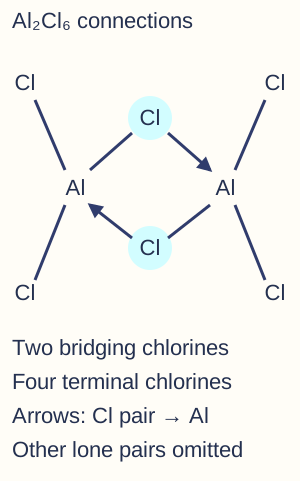
Aluminium chloride dimer — Electron-deficient AlCl3 can form Al2Cl6 through two bridging chlorine atoms, each donating a lone pair to an aluminium centre. In the conventional diagram, each aluminium has two terminal chlorines and shares two bridges; count all six chlorine atoms once. Use the stated phase and conditions because aluminium chloride's structure is condition-dependent.Connectivity scaffold for a conventional molecular Al2Cl6 dimer. Two highlighted chlorine atoms bridge the aluminium centres; four are terminal. Donation arrows point from a bridging chlorine lone pair towards an aluminium acceptor. Remaining lone pairs and full electron counts must be added in the learner task; phase and conditions matter.
Bond length and strength — For comparable bonds between the same elements, higher bond order generally gives a shorter, stronger bond: C≡C is shorter than C=C, which is shorter than C–C. Bond enthalpy also depends on chemical environment. Do not conclude that the shortest bond between any two arbitrary elements must always have the greatest enthalpy.
Electron-pair repulsion and molecular shape
Predicting geometry — Count regions of electron density around the central atom, placing them as far apart as possible in the simple repulsion model. A multiple bond counts as one directional region although its repulsion can differ in detail. Distinguish the arrangement of all electron regions from the molecular shape described by atom positions.
Two and three regions — Two bonding regions with no central lone pair give linear geometry at 180°, as in gaseous BeCl2 and CO2. Three regions with no central lone pair give trigonal planar geometry at 120°, as in BCl3. Do not draw CO2 as bent merely because each oxygen has lone pairs: the relevant central atom is carbon.
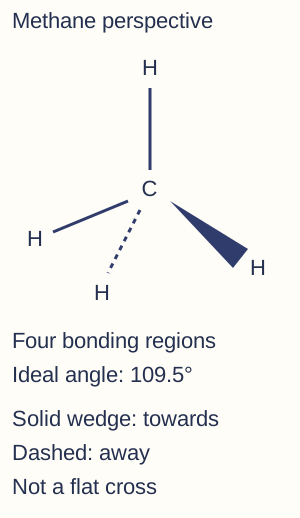
Four bonding regions — Four bonding regions and no central lone pair give tetrahedral geometry at about 109.5°, as in CH4 and NH4+. A perspective drawing uses ordinary lines for the plane, a solid wedge towards the viewer and a dashed wedge away. A flat cross on paper without a key can misleadingly suggest all four bonds lie in one plane.Perspective model of tetrahedral methane: two bonds are drawn in the page, the solid wedge projects towards the viewer and the dashed bond projects away. Ideal three-dimensional angles are 109.5 degrees; angles in the flat projection are not measured molecular angles.
Lone-pair effects — Lone pairs repel more strongly than bonding pairs in this simple model. NH3 has three bonds and one lone pair, giving a trigonal pyramidal shape with angle about 107°; water has two bonds and two lone pairs, giving a bent shape about 104.5°. Electron-region geometry remains approximately tetrahedral, but the atomic shapes are different.
Five regions — Five bonding regions give trigonal bipyramidal geometry in PCl5(g), with 120° between equatorial directions in the central triangular plane, 90° between axial directions above/below that plane and equatorial directions and 180° between axial bonds. Lone pairs in analogous five-region species preferentially occupy equatorial positions in the basic model, producing shapes such as seesaw, T-shaped or linear as their number increases.
Six regions — Six bonding regions give octahedral geometry in SF6(g), with adjacent angles 90° and opposite directions 180°. One central lone pair in a related six-region species gives square pyramidal shape, while two opposite lone pairs can give square planar shape. Octahedral means six surrounding positions, not an eight-bond central atom.
Applying shapes to organic species — A saturated carbon with four single bonds is approximately tetrahedral, an alkene carbon approximately trigonal planar and a carbon in a triple bond approximately linear. Apply the model locally around each atom in a larger molecule rather than giving the entire flexible molecule one universal bond angle or planar shape.
Shape-model limitations — The repulsion model predicts useful arrangements but is not a photograph or a full bonding theory. Check charge, lone pairs, phase and available structural information before applying an analogy. PCl5 gas geometry should not be transferred without qualification to a solid having a different ionic structure.
Electronegativity, polarity and bond character
Electronegativity — Electronegativity is an atom's ability to attract the bonding electrons in a covalent bond. It concerns an atom in a bond, not simply the energy required to remove an electron from a gaseous atom. Compare the relative values supplied and the environment rather than interchanging electronegativity with electron affinity or ionisation energy.
Polar bonds — A difference in electronegativity shifts electron density towards the more electronegative atom, giving partial charges δ− and δ+. H–Cl is polar with chlorine δ−, whereas a bond between identical atoms is nonpolar in the simple model. Partial charges are not automatically whole ionic charges or evidence that an electron has been completely transferred.
Bonding continuum — Ionic and covalent descriptions represent extremes on a continuum rather than two absolutely separate categories. A highly charged small cation can distort an anion's electron distribution and increase covalent character. Use electronegativity differences and evidence appropriately without imposing an invented universal numerical cutoff that fits every compound.
From bonds to molecules — A bond dipole is a separation of partial positive and negative charge along a bond. Molecular polarity depends on both bond dipoles and geometry: the equal C=O dipoles in linear CO2 cancel, while the O–H dipoles in bent water do not. A molecule can therefore contain polar bonds without a permanent overall dipole. Check vector symmetry rather than simply counting polar bonds.Bond-dipole directions towards oxygen cancel in linear carbon dioxide but not in bent water. Teal arrows show electron-density direction towards the negative end, not separate ionic charges. Bond and arrow offsets are schematic; no dipole magnitude is claimed.
Contrasting shapes and dipoles — Tetrahedral CCl4 has four polar bonds whose effects cancel in the symmetric arrangement, while CHCl3 lacks that complete symmetry and is polar. A pyramidal ammonia molecule has a permanent dipole. An asymmetric drawing alone is not proof of polarity if it fails to represent the actual three-dimensional structure.
Intermolecular attractions and physical properties
London forces — Fluctuations in electron distribution create instantaneous dipoles that induce dipoles in neighbouring particles. London forces act between all atoms and molecules, including nonpolar ones. More easily polarised electron clouds and greater effective contact generally strengthen them; a nonpolar molecule does not have zero attraction to its neighbours.
Permanent dipoles — Polar molecules can align with attractive interactions between permanent dipoles, in addition to London forces. Their overall boiling behaviour still depends on all relevant attractions and molecular features. Do not assume any polar molecule must boil above every nonpolar molecule regardless of size or shape.
Hydrogen bonding — In this course model, hydrogen attached to N, O or F can interact strongly with a suitable lone pair, commonly on N, O or F in a neighbouring molecule. Draw the attraction between the δ+ hydrogen and the acceptor lone-pair region, distinguish it from the covalent X–H bond and show the participating partial charges.A schematic O–H···O hydrogen-bond contact between suitable molecular groups. The solid O–H bond is internal covalent bonding; the dashed H···O contact is the intermolecular attraction towards an acceptor lone-pair region. Other bonds and lone pairs are omitted, so this is not a complete displayed molecular formula.
Water, ammonia and HF — Water, liquid ammonia and liquid hydrogen fluoride form hydrogen bonds with different possible network patterns. Water can act as both donor and acceptor, supporting an extensive network and relatively high boiling temperature. Having hydrogen somewhere in a formula is insufficient: an alkane's C–H bonds do not provide the same donor in this model.
Ice density — Hydrogen bonding arranges water molecules into a relatively open structure in ice. Some of that open arrangement collapses on melting, so ordinary ice is less dense than liquid water near its melting point. The individual molecules have not become heavier; the change concerns packing and volume for a given mass.
Chain length and branching — Longer comparable alkane molecules have more electrons and greater potential contact, strengthening London attractions and generally raising boiling temperature. For isomers, greater branching often makes the shape more compact with less effective contact, lowering boiling temperature. Molecular mass alone cannot explain differences between isomers with the same formula.
Alcohols and hydrogen halides — Alcohols can hydrogen-bond, giving lower volatility, meaning less readiness to evaporate, than comparable alkanes with similar electron counts. HF's hydrogen bonding raises its boiling temperature above the simple London-only trend, while HCl to HI generally rise as electron clouds become more readily polarised. Explain the dominant comparison without claiming London forces vanish when a stronger interaction exists.
Boiling versus breaking molecules — A liquid boils when its vapour pressure equals the external pressure. Boiling a simple molecular substance separates its molecules by overcoming intermolecular attractions; it does not normally break all internal covalent bonds. Strong covalent bonds within a small molecule are therefore compatible with a low boiling temperature. Identify the particle being separated and the interaction being overcome in every explanation.
Solvents, hydration and competing interactions
Hydration of ions — Polar water molecules orient their oxygen ends towards cations and hydrogen ends towards anions, forming ion–dipole attractions. Dissolving an ionic lattice requires overcoming lattice attractions while gaining solute–solvent interactions and a change in disorder. Some ionic compounds dissolve, but ionic character alone does not guarantee high water solubility.
Alcohols in water — Small alcohols can form hydrogen bonds with water, helping mixing, while larger nonpolar hydrocarbon parts make water solubility less favourable as chain length increases. Solubility depends on competing interactions, not just whether a molecule has one O–H group. Use relevant size and structure when comparing actual examples.
Polar yet poorly soluble — A halogenoalkane can have a permanent dipole but does not form sufficiently favourable new interactions with water to replace the water network effectively in the simple course explanation. Polarity alone therefore cannot prove water solubility. Inability to donate hydrogen bonds is a useful part of this comparison, not a universal rule that every molecule lacking O–H is insoluble.
Choosing a solvent — A non-aqueous solvent with compatible intermolecular interactions can dissolve substances poorly soluble in water. Consider the whole interaction balance, required selectivity, volatility, flammability, toxicity, environmental impact and recovery. Like dissolves like is a starting heuristic, a useful rule of thumb, rather than a complete thermodynamic law or a substitute for practical risk assessment.
Metallic bonding and giant structures
Metallic attraction — Metallic bonding is strong electrostatic attraction between positive metal ions or ion cores and delocalised electrons throughout the structure. Delocalised means the electrons are not confined to one atom or one bond but can move through the metallic network. Mobile electrons explain electrical conduction in the solid and liquid, while layers can move without destroying all bonding, supporting malleability. Metallic atoms are not held together by attractions between negative ions.
Comparing metals — Bond strength depends on charge, number of delocalised electrons and ion size, with actual structure also relevant. Sodium, magnesium and aluminium provide a useful period comparison. An alloy's disrupted regular arrangement can hinder layer movement and increase hardness, but composition and treatment determine actual properties.
Giant ionic and covalent networks — A giant ionic lattice is a repeating array of charged particles; a giant covalent lattice is an extended network of covalently bonded atoms. Both can have high melting temperatures through strong interactions, but their conduction and chemistry differ. Do not explain a giant covalent solid as separate small molecules attracted by weak intermolecular forces.
Molecular solids — Solid iodine contains I2 molecules, while ice contains H2O molecules connected through intermolecular hydrogen bonds. A crystal can therefore have a large repeating solid structure while its bonding classification remains simple molecular. Distinguish an extended arrangement of molecules from a giant covalent network in which strong covalent bonds extend throughout.
Carbon structures and evidence-led classification
Diamond — Each carbon in diamond bonds covalently to four others in a three-dimensional network, giving high hardness and high-temperature stability. All four valence electrons are involved in the simple bonding model, so there are no freely mobile charge carriers for ordinary electrical conduction. Thermal conduction and electrical conduction are different properties and should not be conflated.
Graphite — Each carbon in graphite bonds to three neighbours in a layer, with delocalised electrons supporting conduction mainly along the layers. Strong covalent bonds within layers explain high-temperature stability, while weaker attractions between layers allow sliding. Saying graphite is soft because all its bonds are weak confuses the two interactions.
Graphene — Graphene is a single layer of the hexagonal carbon network, with three bonds per carbon and delocalised electrons. Its thinness, strength and electrical properties suggest applications, but a proposed use needs evidence about manufacturing, defects, support and scale. A symbolic sheet drawing is not a claim that a macroscopic device is defect-free or effortless to produce.
Silicon dioxide — In the ordinary network model, silicon(IV) oxide has each silicon joined to four oxygen atoms and each oxygen bridging two silicon atoms, giving the overall SiO2 ratio. It is not a solid made of discrete linear O=Si=O molecules. Its strong network helps explain high melting temperature and poor ordinary electrical conduction.
Classifying from several properties — Use melting and boiling temperatures, conduction in different states, solubility and structural evidence together. A high-melting solid conducting only when molten suggests ionic behaviour, while solid conduction can support a metallic or suitable delocalised-carbon model. One property is rarely sufficient; acid reactions, decomposition or electronic semiconductors may need additional context.
Writing a linked explanation — Identify particles, describe their arrangement, name the relevant attraction and explain whether charge carriers can move or what interaction must be overcome. Compare actual states and conditions, distinguish melting from decomposition and use the supplied evidence. A memorised label without the causal link is not a complete structure–property explanation.
Test yourself
50 questions · Random sets of 10. These quick checks support revision; practise longer explanations and justified judgements too.
 Mr Kidman's Classroom