 Mr Kidman's Classroom


Revise the key ideas
Formulae, naming and structural isomers
- Hydrocarbons and functional groups — A hydrocarbon contains only carbon and hydrogen; an alcohol or halogenoalkane is not a hydrocarbon even if most of its atoms are C and H. A functional group is an atom or group associated with characteristic reactions. Molecules can contain several functional groups whose interactions affect classification and reactivity.
- Formula representations — Molecular formula gives actual atom counts; empirical formula gives the simplest ratio; a general formula describes a defined series. Structural formula shows connectivity in a condensed form, while displayed formula shows all bonds. Do not assume one molecular formula uniquely identifies a structure or that a series formula applies after adding rings or extra multiple bonds.

Displayed ethanol formula showing every C–H, C–C, C–O and O–H bond, compared with condensed CH3CH2OH and molecular C2H6O. The flat layout is a connectivity diagram, not a claim that tetrahedral carbon bonds lie in a single plane or have the drawn angles. - Reading skeletal formulae — Each unlabelled line end or vertex represents a carbon, with enough carbon-bound hydrogens implied to give ordinary carbon valency four. Heteroatoms, atoms other than carbon or hydrogen, and their attached hydrogens are shown explicitly as needed. Count carbons before adding implied hydrogens, and distinguish a terminal OH label from an unlabelled carbon vertex.
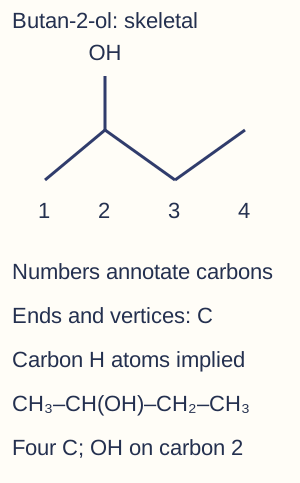
Skeletal butan-2-ol with four carbon endpoints/vertices and an explicitly shown OH attached to the second carbon. The numbers below are explanatory carbon-position annotations, not extra atoms. Carbon-bound hydrogens are implied to satisfy valency, yielding CH3–CH(OH)–CH2–CH3. The zigzag is connectivity notation, not a measured molecular conformation. - Homologous series — Members share a functional group, general formula and similar chemical reactions, with successive members differing by CH2 and gradual physical-property trends. Similar chemistry does not mean identical rates or boiling temperatures. A functional-group change can move a compound into another series even if the carbon count stays unchanged.
- Carbon prefixes and parent chain — Know meth-, eth-, prop-, but-, pent-, hex-, hept-, oct-, non- and dec- for one to ten carbons. Choose a parent chain containing the principal functional group and relevant multiple bond, number to give appropriate locants (numbers showing positions) and identify substituents (groups attached to the parent chain). The longest visible straight line on the page is not necessarily the correct parent chain.
- Naming examples and punctuation — CH3CH(OH)CH2CH3 is butan-2-ol; CH3CH(CH3)CH2CH3 is 2-methylbutane; CH3CHBrCH2CH3 is 2-bromobutane. Use commas between numerical locants, hyphens between numbers and words and appropriate alphabetical substituent order. A name must reconstruct the same connectivity, not merely have the correct carbon total.
Further naming examples are CH3CHO ethanal, CH3COCH3 propanone, CH3COOH ethanoic acid, CH3CN ethanenitrile, CH3COCl ethanoyl chloride and CH3COOCH2CH3 ethyl ethanoate. The carboxyl or nitrile carbon counts within its parent chain; ester naming identifies the alcohol-derived alkyl fragment separately.
- Structural isomerism — Structural isomers have the same molecular formula but different connectivity. Chain isomers differ in carbon skeleton, position isomers in functional-group or multiple-bond position, and functional-group isomers in group type. C3H8O can represent propan-1-ol, propan-2-ol or methoxyethane; rotating a bond does not create another structural isomer.
- Systematic isomer generation — Generate plausible skeletons, place the functional group or multiple bond at distinct positions and remove duplicates caused by symmetry or reversing the drawing. Check every structure against atom counts and valencies. Enumerating drawings without checking equivalence overcounts isomers and can include impossible carbon bonding.
- Reaction families — Addition incorporates atoms across a multiple bond; elimination removes atoms to form one; substitution replaces an atom or group; hydrolysis cleaves through reaction with water or aqueous reagent; polymerisation links many monomers. Organic oxidation often increases carbon–oxygen bonding or decreases carbon–hydrogen bonding, while reduction often does the reverse; use the actual transformation rather than a label alone.
Alkene geometry and stereoisomerism
- Saturated and unsaturated formulae — Open-chain alkanes have CnH2n+2; a single-ring cycloalkane has CnH2n and remains saturated because it has no carbon–carbon multiple bond. An open-chain monoalkene also has CnH2n but is unsaturated. The same general formula therefore does not prove the same structure or reaction type.
- Sigma and pi bonding — A carbon–carbon double bond contains a sigma bond from end-on overlap and a pi bond from sideways p-orbital overlap. The local arrangement is approximately planar with angles near 120°. Rotation would disrupt pi overlap, giving restricted rotation and allowing distinct configurations when each double-bond carbon has two different groups.
- E/Z conditions — For E/Z isomerism, each C of C=C must carry two different substituents. Propene lacks E/Z isomers because its terminal carbon has two hydrogens. In but-2-ene, each double-bond carbon has H and CH3, so distinct arrangements exist. Different drawings obtained by rotating the whole molecule may still show the same configuration.
- Assigning priorities — For each double-bond carbon, compare the atomic numbers of directly attached atoms; if tied, compare the next relevant attached atoms using the priority rules. Higher atomic number means higher priority, not a longer name or larger total group mass. The high-priority groups on the same side give Z; opposite sides give E.
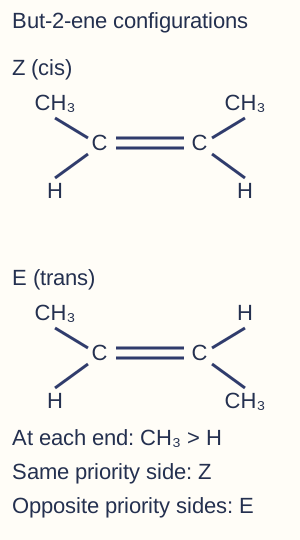
Planar configurations of but-2-ene. At each alkene carbon, the directly attached carbon of CH3 outranks H. Higher-priority groups on the same side give Z, here also cis; opposite sides give E, here also trans. Cis/trans equivalence here is specific to this matched substituent example. For example Cl outranks C, which outranks H when those are the directly attached atoms. If both directly attached atoms are C, compare their next attached atoms in decreasing atomic-number order: a carbon attached to O,H,H outranks one attached to C,H,H. Multiple bonds are handled with the appropriate duplicate-atom convention in a full priority comparison; do not rank only by total group size.
- Cis and trans limits — Cis/trans can identify same-side or opposite-side arrangements when an appropriate identical pair is present, as with the two methyl groups in but-2-ene. E/Z is more general. Do not assume cis always means Z for every complicated substituted alkene; apply the actual priority assignments.
- Electrophiles and fission — An electrophile accepts an electron pair from an electron-rich region such as a pi bond. Heterolytic cleavage gives both bonding electrons to one fragment, producing ions; homolytic cleavage gives one to each, producing radicals. A polar bond and a full ionic charge are distinct, so show partial charges on reagents and full charges on intermediates appropriately.
Alkanes, fuels and radical substitution
- Obtaining fuels — Fractional distillation separates crude oil into boiling ranges without intentionally changing molecules. Cracking breaks larger molecules into smaller useful products including alkenes. Reforming can convert straight-chain hydrocarbons into branched or cyclic structures suited to efficient engine operation. Separation and chemical conversion are different processes.
- Complete and incomplete combustion — A complete hydrocarbon combustion equation forms CO2 and H2O, for example C3H8 + 5O2 → 3CO2 + 4H2O. Limited oxygen or mixing can produce CO, carbon particulates and unburned hydrocarbons. Balance the stated products; incomplete combustion is not represented by one universal product ratio.
- Pollutants and origin — CO is toxic because it interferes with oxygen transport through strong haem binding. Nitrogen oxides can form from nitrogen and oxygen at high combustion temperatures, while sulfur oxides arise from sulfur-containing fuel impurities and contribute to acidity. Carbon particulates and unburned hydrocarbons are additional pollutants; sulfur need not be an atom in a pure alkane molecule.
- Converters and alternative fuels — A catalytic converter can promote oxidation of CO and reduction of NO, such as 2CO + 2NO → 2CO2 + N2, but does not eliminate all emissions. Biodiesel and plant-derived alcohols can reduce reliance on fossil feedstocks; assess cultivation, processing, land use, transport and combustion rather than assuming renewable means zero environmental impact.
- Radical formation — A radical contains an unpaired electron, shown by a dot. In initiation, suitable light can cause Cl2 → 2Cl• by homolytic fission. The dot denotes one unpaired electron, not a negative charge or an extra full lone pair. Radical substitution needs the relevant initiation conditions rather than simply mixing cold reagents in darkness.
- Propagation cycle — For methane chlorination, Cl• + CH4 → HCl + CH3•, followed by CH3• + Cl2 → CH3Cl + Cl•. One radical is consumed and another produced in each propagation step, enabling a chain. Add the steps to obtain the net substitution while preserving all atoms and radical symbols.
- Termination and product mixtures — Termination combines radicals, for example Cl• + Cl• → Cl2 or CH3• + Cl• → CH3Cl. Further substitution can form CH2Cl2, CHCl3 and CCl4; larger substrates can also yield positional products. These mixtures limit selective synthesis, and the existence of a desired product does not mean the process gives only that molecule.
Alkene additions and polymer chemistry
- Hydrogenation and hydration — Hydrogen with a nickel catalyst adds across C=C to form an alkane; this principle is used to modify unsaturated vegetable oils. Steam with an acid catalyst can add H and OH to form an alcohol. Give suitable conditions and actual product connectivity; hydration is not the same as adding water to an insoluble alkene without catalyst.
- Halogen and hydrogen-halide addition — Ethene with bromine forms 1,2-dibromoethane, while ethene with HBr forms bromoethane. The pi bond is replaced by two sigma bonds in the product. For an unsymmetrical alkene such as propene, HBr can give different orientations with different carbocation stabilities, so identify the major product through the mechanism.
- Curly-arrow meaning — A full curly arrow shows movement of an electron pair and must start at a bond or lone pair and end where that pair forms a bond or resides. It is not an arrow showing an atom travelling through space. Include relevant lone pairs, reagent dipoles, intermediate charges and bond cleavage so the mechanism conserves electrons as well as atoms.
- Hydrogen-halide mechanism — For ethene and HBr, a curly arrow runs from the pi bond to H, while the H–Br bond pair moves to Br. This forms a carbocation and Br−; a lone pair on Br− then forms a bond to the positive carbon. Show both events in the first stage and the full charge of the intermediate rather than drawing one unexplained product arrow.
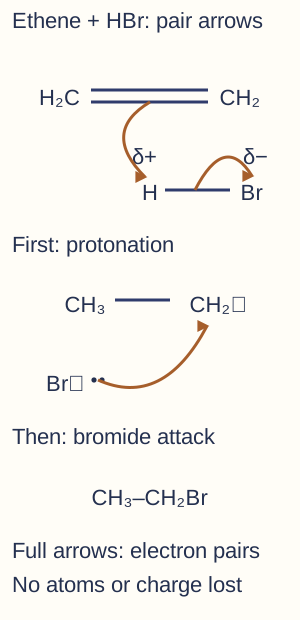
Two-stage simplified electrophilic addition of HBr to ethene. The first arrows start at the C=C pi bond and H–Br bond, giving a carbocation and bromide. The second starts at a bromide lone pair and ends at the positive carbon. A representative reactive lone pair is shown; other lone pairs are omitted. Formula layout is schematic and arrows represent pairs, not atomic motion. - Unsymmetrical addition — For propene with HBr, protonation can form a primary or secondary carbocation. The secondary carbocation is generally more stable through electron donation from attached alkyl groups, favouring 2-bromopropane under the taught conditions. Relative stability usually follows tertiary > secondary > primary; state the actual intermediate rather than memorising an orientation without cause.
- Bromine addition model — The electron-rich alkene polarises Br2 and attacks the δ+ end while the Br–Br bond cleaves heterolytically. A simplified course mechanism can show the relevant positively charged intermediate and subsequent bromide attack; more detailed chemistry can involve a bridged bromonium ion. Use the required representation consistently and distinguish the model from an assertion that every electrophile is already a free Br+ ion.
For an unfamiliar given binary reagent such as ICl, first use its supplied polarity: I is δ+ relative to Cl. Apply the same electron-source reasoning to attack at the electrophilic end, heterolytic cleavage and subsequent nucleophile addition, preserving both added atoms and the substrate skeleton. Use any more detailed intermediate model specified in the question.
- Bromine test and diol formation — An alkene decolourises bromine or bromine water in the appropriate test, providing evidence for C=C alongside other observations. Other reactive groups can also consume bromine, so the test is not unique in every unknown mixture. Under controlled mild conditions, acidified manganate(VII) can oxidise C=C to a diol; hotter or stronger conditions can give further oxidation rather than stopping there.
- Addition repeat units — An addition polymer forms by opening monomer C=C bonds to connect a backbone without eliminating a small molecule. Ethene gives [–CH2–CH2–]n; propene gives [–CH2–CH(CH3)–]n. Show continuation bonds through brackets and preserve each substituent. The polymer repeat unit is not a monomer with an unchanged double bond.
- Recovering the monomer — Identify a suitable two-carbon backbone segment and restore a C=C while preserving side groups and valencies. A different choice of where to cut an equivalent repeat can give the same polymer, so compare connectivity rather than bracket position alone. Not every arbitrary multi-carbon fragment is the minimal informative repeat.
- Polymer resources and disposal — Sorting compatible polymers supports mechanical recycling; selected waste can undergo chemical processing or cracking, or incineration with energy recovery. Assess collection, contamination, repeated processing quality, energy and emissions over the lifecycle. Biodegradability depends on structure and disposal conditions, and toxic incineration gases require appropriate treatment; biodegradable does not mean harmless in every environment.
Halogenoalkane substitution, elimination and Core Practical 4
- Classifying halogenoalkanes — Primary, secondary and tertiary refer to the number of carbon groups attached to the carbon bearing the halogen: one, two or three respectively. Count the local attachments, not the total carbon atoms or number of halogens. Methyl halides are a separate limiting example with no carbon substituent at that carbon.
- Nucleophiles and hydrolysis — A nucleophile donates an electron pair to an electron-deficient centre. Aqueous hydroxide can replace halogen to form an alcohol: CH3CH2Br + OH− → CH3CH2OH + Br−. In aqueous silver nitrate with ethanol as a suitable co-solvent, water can act as the nucleophile while silver ions detect released halide.
- Chain extension with cyanide — Reaction with cyanide under suitable ethanolic conditions can form a nitrile, for example CH3CH2Br + CN− → CH3CH2CN + Br−. The nitrile carbon adds one carbon to the skeleton: bromoethane therefore gives propanenitrile. Cyanide is a highly hazardous school-controlled reagent, not a practical instruction for independent use.
- Ammonia substitution — An ethanolic ammonia reaction can form a primary amine, with excess ammonia helping limit further alkylation. For bromoethane, the overall equation is CH3CH2Br + 2NH3 → CH3CH2NH2 + NH4Br. One ammonia acts as the nucleophile and another removes a proton; omitting the ammonium by-product fails overall atom balance.
- Primary substitution arrows — For a suitable primary SN2 pathway, draw a lone pair from OH− or NH3 toward the carbon bearing halogen and move the carbon–halogen bond pair to the leaving halide. Ammonia initially gives an alkylammonium ion, then deprotonation gives the amine. Show the second step rather than producing a neutral amine without accounting for its extra hydrogen.
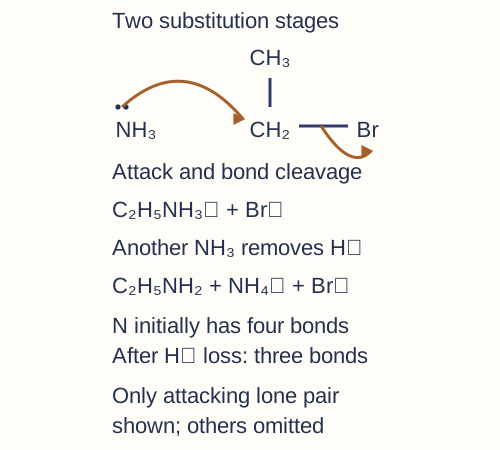
Primary bromoethane substitution by ammonia in the simplified concerted model. A nitrogen lone pair attacks the halogen-bearing carbon while the C–Br pair moves to bromine. The alkylammonium product then loses H+ to another ammonia molecule, producing ethylamine and ammonium bromide overall. Only the attacking ammonia lone pair is shown; deprotonation is summarised in words and formulas rather than an incomplete curly-arrow drawing. - Elimination conditions — Heated ethanolic KOH favours elimination to an alkene: CH3CH2Br + OH− → CH2=CH2 + H2O + Br−. Hydroxide acts as a base removing an adjacent hydrogen in the elimination process, rather than simply replacing Br. Larger substrates can give position or E/Z alkene mixtures; aqueous versus ethanolic conditions influence competing pathways.
- Halogen bond strength and rate — For comparable substrates and conditions, iodoalkanes generally hydrolyse faster than bromoalkanes, then chloroalkanes, because C–I is weaker than C–Br and C–Cl. Do not explain this mainly by C–I being the most polar: bond breaking and the actual mechanism matter. Keep carbon structure and temperature controlled when isolating the halogen effect.
- Substrate structure and rate — Under conditions favouring carbocation formation, tertiary substrates often hydrolyse faster than secondary and primary ones because more substituted carbocations are stabilised. Under SN2 conditions, steric access can give a different ordering: bulky groups around the reacting carbon can obstruct the nucleophile's approach. Link any observed trend to the solvent and mechanism rather than claiming tertiary always reacts fastest with every nucleophile.
- Core Practical 4 evidence — Compare hydrolysis using the prescribed aqueous silver nitrate/ethanol method, controlled temperature and comparable reagent concentrations. Record time and precipitate appearance: AgCl white, AgBr cream and AgI yellow. The signal measures released halide reaching a precipitation threshold, with mixing, solubility and visual judgement affecting comparisons; actual observations are required for practical conclusions.
Alcohols, oxidation and organic preparation
- Classifying alcohols — Count carbon groups attached to the carbon bearing OH: primary has one, secondary two and tertiary three, with methanol a special case. Propan-1-ol and propan-2-ol differ locally even though they share C3H8O. This classification helps predict oxidation products; it does not refer to the number of OH groups.
- Alcohol combustion and substitution — Alcohols burn to CO2 and H2O under complete conditions. PCl5 can replace OH with Cl, producing POCl3 and HCl as by-products: ROH + PCl5 → RCl + POCl3 + HCl. Steamy HCl fumes are evidence used in an appropriate test, but other OH-containing compounds can also react.
- Preparing bromo- and iodoalkanes — Suitable potassium bromide and sulfuric acid conditions generate HBr for replacing alcohol OH with Br; the prescribed acid concentration and method limit unwanted oxidation. Red phosphorus and iodine can generate a phosphorus iodide reagent for OH-to-I conversion. Give reagents and conditions as a reaction route, not an invented unsupervised preparation recipe.
- Primary alcohol oxidation — Acidified potassium dichromate(VI) can oxidise a primary alcohol to an aldehyde, then further to a carboxylic acid. RCH2OH + [O] → RCHO + H2O, followed by RCHO + [O] → RCOOH. Orange dichromate becoming green supports reduction of Cr(VI), but does not by itself identify the organic product.
- Distillation versus reflux oxidation — To favour an aldehyde, use the appropriate limited oxidation and remove the volatile product by distillation as it forms. For further oxidation toward acid, use excess oxidant and reflux under the approved method. Reflux returns condensed vapour, allowing heating without intentionally collecting the low-boiling product; it is not a sealed pressure vessel.
- Secondary and tertiary oxidation — A secondary alcohol gives a ketone: R2CHOH + [O] → R2CO + H2O. Tertiary alcohols lack the carbon-bound hydrogen needed for the usual mild oxidation route and resist that reaction; harsh oxidative cleavage is a different process. Unchanged dichromate under one test is supporting evidence rather than proof that a molecule can never oxidise.
- Alcohol dehydration — Heating a suitable alcohol with concentrated phosphoric acid can eliminate water to form an alkene, for example CH3CH2OH → CH2=CH2 + H2O. Some alcohols give several alkene isomers; identify the possible positions and geometries. The acid is a catalyst in the net dehydration, not a source of an extra carbon in the product.
- Reflux and distillation setup — Reflux uses a vertical condenser returning liquid to the heated flask; distillation uses a condenser delivering a collected fraction. In a water-cooled condenser, water generally enters at the lower connector and leaves at the upper connector to keep the jacket filled. Heat volatile flammable liquids with the approved source and never seal an operating heated apparatus.
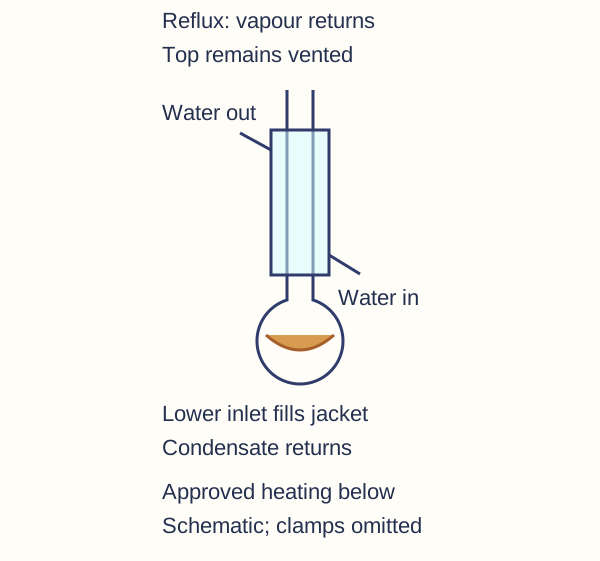
Schematic water-cooled reflux arrangement with an open vented condenser above the flask. Cooling water enters the lower jacket connector and leaves the upper connector; vapour rises and condensate returns. The approved heating arrangement and support clamps are omitted to focus on flow and collection differences. A working heated system must not be sealed. - Separating and drying liquids — Use a separating funnel for appropriate immiscible phases, liquids that form separate layers instead of mixing completely, identify each layer from the actual solvent and density, vent as required by the approved method and separate without assuming the organic phase is always uppermost. A suitable anhydrous salt removes residual water; then decant or filter away the drying material before appropriate further analysis or distillation.
- Boiling temperature and purity — A collected fraction's boiling behaviour can support identity or purity when compared at the same pressure, with correct thermometer placement and heating control. A narrow range near an expected value is useful but not unique structural proof. Residual water, impurities or pressure differences can affect observations, so combine evidence rather than treating one temperature as conclusive.
- Core Practical 5 ethanol evidence — Carry out the prescribed oxidation of ethanol, record actual reagent conditions and isolate or test the intended product. Distinguish aldehyde testing with suitable Fehling's or Benedict's reagent from merely observing dichromate colour. Explain how collection versus reflux affects further oxidation and evaluate actual yield and impurities.
- Core Practical 6 chlorination evidence — The prescribed reaction of 2-methylpropan-2-ol with concentrated hydrochloric acid gives 2-chloro-2-methylpropane under the approved method. Relate the tertiary substrate to suitable substitution chemistry, separate and dry the product and evaluate recovery and purity using actual measurements. Do not replace the specified acid with a guessed PCl5 practical or invent a personal yield.
Chirality, optical evidence and substitution
- Chiral centre — For the single-centre examples here, a carbon attached to four different groups can give non-superimposable mirror-image molecules, mirror images that cannot be made to coincide by rotating them, like left and right hands. Compare the complete substituent chains: two groups beginning with carbon may still be different, while a misleadingly different drawing can represent identical groups. A tetrahedral carbon is not automatically chiral.
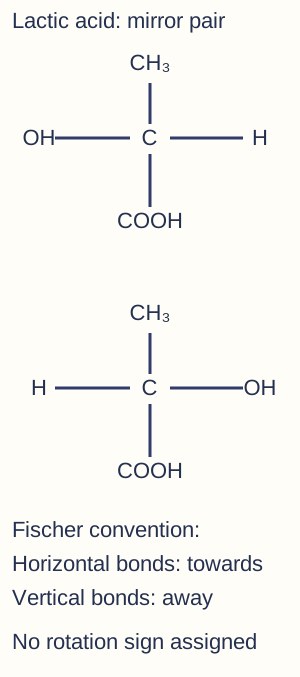
Two Fischer projections of the lactic-acid enantiomer pair. In this explicitly stated projection convention, horizontal bonds point towards the viewer and vertical bonds point away; each central carbon has CH3, COOH, OH and H. Swapping the horizontal OH/H groups gives the non-superimposable mirror arrangement. The drawing assigns neither R/S or L/D labels nor the measured sign of optical rotation. - Enantiomers and optical activity — A pair of non-superimposable mirror images are enantiomers. A single enantiomer can rotate the plane of plane-polarised monochromatic light, light with one wavelength and electric-field oscillations restricted to one plane, with the pair giving equal-magnitude opposite rotations under matching conditions. A drawn wedge or an R/S label alone does not establish the sign of measured rotation.
- Racemic mixtures — A racemic mixture contains equal amounts of the two enantiomers and has no net rotation because their effects cancel. It still contains individually chiral molecules. No observed rotation might also reflect an achiral compound, low concentration or measurement limits, so zero rotation is not unique proof of a racemate.
- Stereochemical substitution evidence — Backside attack at a suitable chiral centre in an SN2 event can invert its geometry. An SN1 route through a planar carbocation can allow attack from either face and produce a racemic or partly racemised product depending on conditions. Combine rotation and composition evidence with kinetics; do not equate inversion with an automatically changed rotation sign or assume exact racemisation in every real solvent.
Aldehydes, ketones and carbonyl tests
- Carbonyl groups and properties — An aldehyde has a terminal –CHO group, whereas a ketone has C=O bonded to two carbon groups. Their polar carbonyls contribute dipole attractions and can accept hydrogen bonds from water, but simple molecules lacking O–H or N–H do not hydrogen-bond to one another in the same donor sense. Increasing hydrocarbon size generally reduces water solubility.
- Aldehyde oxidation tests — Suitable aldehydes reduce Tollens' reagent to silver and Fehling's or Benedict's solution to a brick-red Cu2O precipitate on appropriate warming. Ordinary ketones generally do not give these responses under the test conditions. Combine tests and actual species: not every aromatic aldehyde behaves like an aliphatic one in each copper-reagent test.
- Dichromate and reduction — Aldehydes oxidise to acids with acidified dichromate(VI), while ordinary ketones resist the mild aldehyde test. LiAlH4 in dry ether, followed by appropriate work-up, reduces aldehydes to primary alcohols and ketones to secondary alcohols. Write RCHO + 2[H] → RCH2OH or R2CO + 2[H] → R2CHOH with correct carbon skeletons.
- HCN addition and chain extension — HCN with a suitable cyanide catalyst adds across a carbonyl to form a hydroxynitrile. CN− attacks the δ+ carbon while the C=O pi pair moves to O; the resulting O− is protonated to OH. The added nitrile carbon increases the total carbon count by one. Reagents are highly hazardous and require the approved controlled setting.
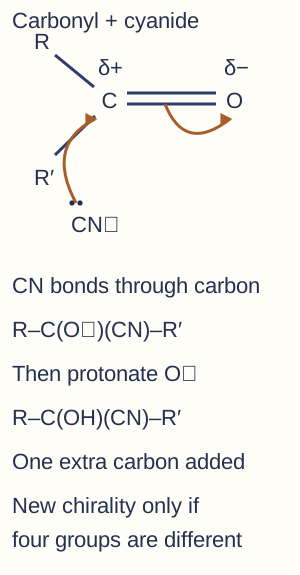
Nucleophilic addition schematic: the cyanide carbon donates a lone pair to the carbonyl carbon, and the C=O pi pair moves to oxygen. The alkoxide is then protonated to the hydroxynitrile. R and R′ denote the original substituents, one of which may be H for an aldehyde. Other lone pairs are omitted; the text explicitly identifies the cyanide donor atom. Reagents require the approved controlled practical setting. 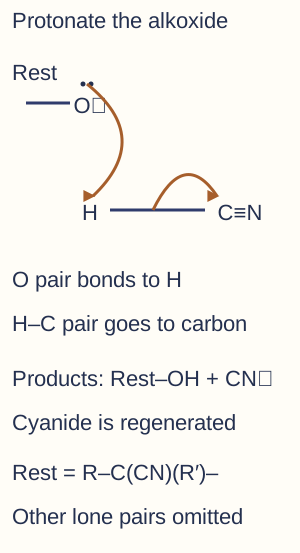
Completion of the hydroxynitrile mechanism: the alkoxide oxygen lone pair forms O–H by accepting a proton from HCN, while the H–C bond pair returns to the cyanide carbon. Rest denotes the unchanged R–C(CN)(R′)– fragment from the preceding addition stage. The resulting alcohol and regenerated CN− conserve atoms and charge; other lone pairs are omitted for clarity. - Carbonyl addition stereochemistry — The planar carbonyl can be attacked from either face. If addition creates one chiral centre from achiral reactants in an achiral environment, the products can be an equal enantiomer pair with no net optical rotation. A ketone with two identical carbon substituents need not give a chiral product, so inspect all four resulting groups.
- 2,4-DNPH identification — 2,4-DNPH means 2,4-dinitrophenylhydrazine. It gives a yellow/orange precipitate with suitable aldehydes and ketones, supporting a carbonyl-group identification. Purifying the derivative and comparing its melting range with suitable reference data helps identify the parent. The precipitate alone does not distinguish aldehyde from ketone; retain the actual reagent's prescribed safe form and method.
- Iodoform test — Iodine with alkali gives pale-yellow CHI3 with methyl ketones RCOCH3 and suitable compounds oxidised to that group, including CH3CH(OH)R alcohols and ethanol. Ethanal also responds. Propanone is positive; pentan-3-one is not a methyl ketone. A positive result identifies a structural possibility, not one unique molecule.
Carboxylic acids, acyl chlorides, esters and polyesters
- Carboxyl group and properties — Carboxylic acids contain –COOH. Hydrogen bonding, including strong associations between suitable acid molecules, contributes to relatively high boiling temperatures. Short-chain acids interact well with water; an increasing nonpolar chain can reduce solubility. Distinguish acid O–H bonding from a ketone carbonyl that can only accept a hydrogen bond from water.
- Preparing acids — Oxidise suitable primary alcohols or aldehydes under appropriate conditions, or hydrolyse nitriles using the specified acidic or alkaline method and work-up. A nitrile carbon becomes the acid carboxyl carbon, retaining the chain extension introduced earlier. Alkaline hydrolysis initially gives a carboxylate salt, requiring acidification if the free acid is the target.
- Acid reactions and reduction — Acids react with bases to give carboxylate salts, for example CH3COOH + NaOH → CH3COONa + H2O. Carbonate gives CO2 as well as salt and water. LiAlH4 in dry ether with suitable work-up reduces a carboxylic acid to a primary alcohol: RCOOH + 4[H] → RCH2OH + H2O in the simplified equation.
- Acyl chloride formation — PCl5 converts a carboxylic acid to its acyl chloride: RCOOH + PCl5 → RCOCl + POCl3 + HCl. An acyl chloride has C=O directly bonded to Cl, unlike a chloroalkane with Cl on a saturated carbon. Correct connectivity predicts its vigorous reactions with suitable nucleophiles.
- Acyl chloride hydrolysis and alcohols — RCOCl + H2O → RCOOH + HCl is hydrolysis; with an alcohol, RCOCl + R′OH → RCOOR′ + HCl forms an ester. Distinguish this acyl route from reversible acid-catalysed esterification of a carboxylic acid and alcohol, which forms water as the small by-product.
- Ammonia and amine acylation — RCOCl + 2NH3 → RCONH2 + NH4Cl produces a primary amide. With a primary amine, RCOCl + 2R′NH2 → RCONHR′ + R′NH3Cl under the simplified excess-amine model. Include the second base equivalent or specified alternative acid acceptor so the released HCl is accounted for.
- Naming esters and esterification — In ethyl ethanoate, the ethyl part derives from the alcohol and ethanoate from the acid. CH3COOH + C2H5OH ⇌ CH3COOC2H5 + H2O is acid-catalysed esterification. Heating, removing an appropriate product or changing reactant proportions can aid preparation; catalyst speeds equilibration rather than directly changing K.
- Acidic and alkaline ester hydrolysis — Acidic hydrolysis is reversible and gives acid plus alcohol. Alkaline hydrolysis consumes hydroxide and gives carboxylate plus alcohol: RCOOR′ + OH− → RCOO− + R′OH, making reversal less favourable under those conditions. An acid work-up can then form RCOOH; do not draw a free acid as the sole alkaline-stage product.
- Polyester formation — A suitable diol and dicarboxylic acid can form repeating ester links by condensation with water elimination; an appropriate diacyl chloride route instead eliminates HCl. A hydroxycarboxylic acid can also supply both functional groups. Each monomer must have suitable functionality for chain growth; an alcohol with only one reactive OH group and an acid with only one COOH group (monofunctional compounds) alone give an ordinary ester rather than an unlimited chain.
- Repeat-unit and hydrolysis reasoning — Draw polyester continuation bonds through the brackets and preserve ester orientation and all carbon groups. Recover the monomers by cleaving ester links and adding the appropriate OH and H, or specify carboxylates for alkaline hydrolysis. Hydrolysable links support some degradation routes, but environmental biodegradation rate still depends on structure and conditions.