 Mr Kidman's Classroom



Revise the key ideas
Criminal behaviour, deviance and sanctions
- Legal and social definitions — A legal definition of crime concerns conduct prohibited by the applicable criminal law. A social definition examines how people identify, interpret and respond to conduct as criminal or unacceptable. These perspectives can diverge: public condemnation is not itself a legal conviction, while a prohibited act may be tolerated within a particular group.
- Norms, values and moral codes — Values are broad ideas about what matters; norms are expectations about behaviour in particular settings; moral codes concern judgements of right and wrong. They influence one another but are not identical to legislation. A school expectation about polite speech, a person's moral belief and a criminal prohibition involve different sources of authority and possible consequences.
- Deviance as a relational concept — Deviance means departure from relevant norms or expectations, not a fixed biological characteristic of a person. The same conduct can be approved within one group and condemned in another. Identify whose norm applies, in what setting and with what response instead of describing a whole person as permanently deviant.
- Crime and deviance overlap — Some conduct can be criminal and widely condemned, some deviant within a group but lawful, and some criminal yet tolerated by a particular group. An unusual lawful fashion choice can breach a local expectation without being an offence. A group accepting unlawful conduct does not remove its legal status; context and law answer different questions.
- Formal sanctions — Formal sanctions are imposed through recognised institutions and procedures, such as a court's lawful sentence or a school's disciplinary process. Not every formal sanction is a criminal punishment: school discipline and professional regulation have their own frameworks. State who imposes the sanction, under what authority and for which conduct.
- Informal sanctions — Informal responses include criticism, ridicule, avoidance, praise or approval in everyday relationships. They can encourage conformity without a court or written rule. Their effects depend on relationships and power: the same criticism may deter one person, reinforce another's group identity or be rejected as unjust.
- Consequences and evidence — An accusation, arrest, charge and conviction are different stages, and no single label substitutes for examining evidence. Social stigma can arise before a legal outcome and can persist after an allegation is disproved. Analyse the actual formal and informal consequences without assuming every accused person committed the offence.
Social construction across time and place
- Construction does not mean imaginary harm — Social construction concerns how definitions, rules, meanings and enforcement are produced through social processes. It does not mean that violence, loss or suffering are unreal. Distinguish the existence of harm from decisions about how to name, prohibit, investigate and punish conduct.
- Variation by place — Jurisdictions can define offences and permitted conduct differently because of legal traditions, political decisions, religion, economic interests and social values. Compare specified places and dates rather than using an entire continent as if it had one law. A traveller's personal approval does not replace the applicable legal framework.
- Change over time — Campaigns, research, social movements and political decisions can alter criminal prohibitions, rights and enforcement. The passage of time alone does not explain change: identify who argued for what, how decisions were made and whose interests were affected. A historical legal rule is not automatically a statement of current law.
- Circumstances and legal meaning — Similar physical actions can have different legal meanings according to intention, consent, authority, necessity and other legally relevant circumstances. A clinician's authorised intervention and an unlawful assault cannot be classified from physical movement alone. Apply the relevant legal framework rather than assuming a personal claim of good intentions creates a defence.
- Rule making and power — Institutions and groups differ in their capacity to define problems, influence legislation and secure enforcement. An analysis can ask whose harms are prioritised and whose conduct is most visible. This does not prove that every law serves only one interest or that all enforcement decisions are deliberately biased; evaluate the particular mechanism and evidence.
- Selective enforcement and visibility — Two similar acts may attract different responses because of surveillance, location, reporting, discretion or resources. An apparent difference in conviction rates can therefore reflect offending, detection, prosecution and other processes together. Separate those stages before claiming that a group is inherently more criminal.
- Media and campaigns — Media can increase visibility, label a problem and shape calls for action; campaigns can challenge accepted conduct or seek new protection. Their influence interacts with institutions, evidence and competing interests. Publicity preceding a policy does not alone prove that the publicity caused it or that every audience interpreted it alike.
Biological explanations and their evaluation
- Biological explanation and mechanism — Biological approaches investigate whether inherited or physiological differences contribute to variation in behaviour. A credible account needs a specified mechanism and appropriate evidence, not simply the observation that offenders have bodies. Crime is a legal category spanning diverse acts; no single physical feature can be assumed to explain them all.
- Genotype, phenotype and environment — Genotype concerns inherited genetic constitution; phenotype concerns characteristics expressed through development and interaction with the environment. Inherited genetic variation can contribute to characteristics, while development and experience also matter. An association between a biological feature and a measured outcome does not show that genes directly specify criminal acts. Explain the proposed pathway and consider environmental exposure, selection and the way the outcome was measured.
- Jacobs and historical XYY research — Jacobs and colleagues' 1965 institutional research is a historical example named in the specification. It examined chromosome patterns in a highly selected setting, not a random sample of every person with an extra Y chromosome. Study it as evidence requiring evaluation; do not convert institutional overrepresentation into the claim that XYY determines aggression or criminality.
Sources: Jacobs and colleagues, 1965; MedlinePlus chromosome-variation explanation.
- Why the XYY inference is limited — A selected institutional sample can differ from the wider population in many ways, including pathways into care or detention. Identification, learning needs, environment and justice-system contact can affect observed associations. Modern recognition of 47,XYY variation does not justify a criminal stereotype, and a chromosome pattern cannot establish guilt or predict an individual's offending with certainty.
- Twin-study logic — Monozygotic (identical) twins share almost all inherited DNA variation, while dizygotic (non-identical) twins share on average about half of segregating genetic variation, like other siblings. Comparing similarity in an outcome can help investigate inherited contributions. Greater similarity among monozygotic pairs is not by itself proof of genetic causation because environments and treatment may also differ.
- Concordance and discordance — Concordance describes both members of a pair showing the specified outcome; discordance describes differing outcomes. State the outcome and the method used to calculate the proportion. For a deliberately simplified exercise, if 12 of 20 pairs in a specified eligible set both have the outcome, the pair proportion is 60%; this is not a published study result or a universal concordance formula for every design.
- Twin evidence and limitations — Assess sample selection, zygosity classification (whether twins are identical or non-identical), shared prenatal and later environments, equal-environment assumptions and the meaning of the offence measure. Concordance below 100% is inconsistent with a simple rule that genetic identity guarantees the same outcome. It does not by itself establish that inherited influences are absent.
- Adoption-study logic — Adoption designs compare an adoptee's outcome with biological and adoptive relatives to help separate inherited and rearing associations. A relationship with biological relatives can be consistent with inherited contribution, while a relationship with adoptive relatives can indicate environmental relevance. Neither comparison automatically controls prenatal exposure, selective placement, contact or every social influence.
- Mednick adoption example — Mednick, Gabrielli and Hutchings' 1984 study compared criminal convictions in a Danish adoption cohort with those of biological and adoptive parents. It is a named empirical example of adoption logic, not an experiment assigning genes or upbringing. Conviction is a legal-system outcome, and a finding about one cohort or offence grouping must not become a universal claim about all crime.

Twin and adoption designs investigate inherited and environmental associations using different comparisons. Environmental similarity, selective placement and prenatal influences can limit inference; conviction is not identical to all offending and no association establishes inevitable individual criminality. Sources: Mednick, Gabrielli and Hutchings, 1984.
- Inheritance is not inevitability — Even a genuine inherited contribution to a measured tendency would not establish that a person must commit an offence. Legal opportunities, relationships, institutions and personal choices remain relevant. Avoid using family history, adoption or a genetic condition as grounds for suspicion; population associations do not identify an individual's guilt.
- Lombroso's historical proposal — Lombroso proposed that some offenders were biological throwbacks identifiable through bodily features, often described through atavism (a supposed return to an earlier evolutionary form) and physical stigmata (the bodily markers he claimed indicated this). This is a historical theory to explain and critique, not a scientifically valid method for detecting criminals by appearance. The proposed connection between anatomy and criminal identity should be clearly attributed to the theory.
- Evaluating Lombroso — Selected offender samples, inadequate comparison groups, measurement judgement and neglected social conditions undermine causal conclusions. A feature observed among detained people might also be common elsewhere or reflect background conditions. His focus on observable evidence helped move explanation beyond purely moral condemnation, but that historical significance does not validate the claimed criminal body type.
- Sheldon's somatotypes — Sheldon classified physiques using endomorphic (relative roundness), mesomorphic (relative muscularity) and ectomorphic (relative slenderness) dimensions, associating them with proposed temperamental tendencies. A mesomorphic build was emphasised in his delinquency account. Treat the association as a historical hypothesis rather than a rule that muscular people are offenders or that other physiques cannot offend.
- Evaluating body-type explanations — Ratings can be subjective, samples selective and social responses to appearance consequential. Body type may relate to nutrition, activity, opportunity or selection into particular settings rather than directly cause crime. An explanation centred on physique has limited purchase on diverse offences such as concealed financial manipulation and cannot identify an individual's legal responsibility.
- Biological evidence and ethical use — Evaluate whether a measure concerns aggression, impulsivity, diagnosis, arrest or conviction; these are not interchangeable outcomes. Claims about group risk require careful design and can be misused to stigmatise people. Ethical evaluation should consider consent, privacy, discrimination and whether an intervention helps people rather than treating a statistical association as destiny.
Individualistic explanations and learning
- Individualistic focus — Individualistic approaches explain offending through processes such as learning, personality, cognition or unconscious conflict. They can connect personal experience to behaviour without assuming every explanation is genetic. Distinguish a proposed mechanism from merely redescribing someone as criminal, aggressive or immoral.
- Learning by consequences — Operant learning concerns how consequences affect the future likelihood of behaviour. A reward can reinforce conduct; removing an unpleasant condition can also reinforce it. Negative reinforcement is not the same as punishment: the former increases behaviour through removal, whereas punishment reduces it through a consequence. Whether something counts as reinforcement or punishment depends on its effect on behaviour, not merely what the person giving it intended.
- Observation and modelling — Social learning approaches examine learning through observing others as well as through direct experience. A person can notice an act and its consequences, remember it and later reproduce aspects when able and motivated. Observation alone does not mean every observer imitates, endorses or commits an offence.
- Attention, retention, reproduction and motivation — A model must be noticed; relevant actions must be retained; the observer needs the capacity to reproduce them; and motivation affects performance. These are analytical processes rather than four independent guarantees of offending. Apply them to a supplied scenario by showing the proposed link at each stage.

Observational learning involves attention, retention, capacity for reproduction and motivation. The schematic identifies processes to analyse; it does not assert that every observer imitates or that any exposure guarantees offending. - Identification and vicarious reinforcement — Observers may identify with a model they see as relevant, admired or similar, and may infer consequences from what happens to that model. Seeing a model rewarded can increase motivation to imitate without the observer receiving the reward directly: this is vicarious reinforcement. Seeing a model punished can instead discourage imitation, termed vicarious punishment. These consequences can affect whether learned behaviour is performed; observation can produce learning even when it is not immediately shown. Identification is a proposed influence, not proof that every member of a peer group behaves alike.
- Bandura's aggression experiment — Bandura, Ross and Ross' 1961 experiment examined children's imitation after exposure to adult models interacting with a Bobo doll. The controlled setting supports analysis of observational learning under those conditions. It did not measure lifelong criminal careers, and aggression towards a toy must not be treated as equivalent to every form of criminal offending.
Sources: Bandura, Ross and Ross, 1961.
- Evaluating the learning evidence — Controlled comparison and observable measures can help test a mechanism, but demand characteristics, setting, short-term measurement and the nature of the target limit generalisation. Children may interpret a toy and adult demonstration as permission to play in a particular way. Consider ethics and ecological validity without claiming the experiment proves that all media causes crime.
- Learning in a fictional offence — In an invented workplace case, a trainee observes a supervisor rewarded for concealing false claims and learns both a method and an apparent benefit. The model helps explain possible acquisition and performance, but the actual cause needs evidence about exposure, interpretation, opportunities and alternatives. The scenario does not establish that every trainee would offend.
- Freud's psychodynamic framework — Freud's account describes conflict between the id, ego and superego, with unconscious processes and early experience influencing behaviour. The id concerns instinctual demands, the ego negotiates reality and the superego internalised moral demands. These are theoretical constructs, not three visible brain organs or a clinical diagnosis supplied by a revision quiz.
- Conscience and offending in psychodynamic accounts — Psychodynamic explanations can propose poorly developed moral restraint, distorted internalised standards or conflict around guilt as routes to offending. Explain the particular mechanism rather than assuming every offence reflects the same unconscious problem. A harsh internal conscience can be theorised to produce guilt rather than simply make a person perfectly law abiding.
- Freud and guilt preceding an offence — Freud's discussion of some people offending from a prior sense of guilt proposed that punishment could give an unconscious conflict a definite focus. This reverses the ordinary assumption that guilt only follows an offence. It is a historical explanatory claim, not evidence that every offender secretly wants punishment or that an observer can infer unconscious motives without support.
Sources: Freud historical text.
- Evaluating psychodynamic explanation — Detailed case interpretation can generate hypotheses about meaning and early experience, but retrospective accounts, selective evidence and hard-to-falsify constructs limit causal testing. An explanation that can accommodate every possible outcome risks making no clear prediction. Avoid assigning blame to a parent or diagnosing an individual from a short vignette.
- Eysenck's personality dimensions — Eysenck's theory connects offending to personality and conditioning, using dimensions of extraversion (sociability and stimulation seeking), neuroticism (emotional reactivity) and psychoticism (traits such as tough-mindedness and low empathy within this theory). In this historical model, the dimensions describe tendencies rather than three exclusive types. The term psychoticism is a personality-scale label and must not be equated with a diagnosis of psychosis or the claim that mental illness implies criminality.
- Conditioning and socialisation in Eysenck — The account proposes that differences in arousal (physiological alertness) and conditionability (how readily learned associations develop) affect how readily people acquire restraints through socialisation, with emotional reactivity also relevant. Explain the proposed biological–learning pathway rather than merely listing letters P, E and N. The theory's predicted associations require empirical testing and are not a reliable verdict about any individual.
- Evaluating personality evidence — Questionnaires can support systematic comparison but depend on validity, honest answers and comparable interpretation. Prisoner samples reflect selection through detection and sentencing; correlations can be affected by institutional experience and other variables. A trait associated with one outcome does not establish a single cause for all offences or justify labelling a learner as a future criminal.
- Comparing individualistic accounts — Learning theories emphasise acquired models and consequences; psychodynamic accounts emphasise unconscious conflict; personality accounts emphasise measured tendencies and conditioning. Compare what each predicts, what evidence could challenge it and which offences it can explain. They are not interchangeable simply because each considers individuals.
Social structure, functionalism and conflict
- Sociological levels of explanation — Sociological approaches examine social organisation, inequality, relationships, rule making and reactions. They can explain patterned opportunities and responses without asserting that every person in the same social position behaves alike. Distinguish a structural influence on risk or opportunity from an automatic cause of an individual's offence.
- Durkheim and the normality of crime — Durkheim treated some rule breaking as a recurring feature of social life because complete uniformity of beliefs and conduct is unrealistic. Normal in this sociological sense does not mean morally desirable or harmless. His account also recognises that excessive disruption can damage social order.
- Boundary maintenance and adaptation — Public reaction to offending can reaffirm a group's norms, while challenges to existing rules can sometimes contribute to social change. These are possible social functions of deviance, not proof that every offence benefits society or that victims' harm is justified. Explain the reaction and context rather than treating function as a moral endorsement.
- Anomie and regulation — Anomie concerns weakened or disrupted regulation by shared norms: the expectations that ordinarily guide behaviour become unclear or less influential. Rapid change can unsettle expectations and the relationship between aspirations and constraints. Distinguish this concept from the assertion that people have no values at all, and explain the relevant social process rather than using anomie as a synonym for any crime increase.
- Merton's strain account — Merton examines tension between culturally emphasised goals and unequal access to institutionally approved means. Where success is strongly valued but legitimate routes are restricted, pressures towards alternative adaptations may arise. The theory concerns social structure and cultural expectations, not a claim that every disadvantaged person commits crime.
Sources: Merton original article.
- Conformity and innovation — Conformity accepts the culturally defined goals and approved means; innovation retains the goals while using unapproved means. A fictional person seeking financial success through fraud can illustrate innovation if the relevant pressures and choices are specified. Innovation here is an analytical label and does not mean every creative business idea is criminal.
- Ritualism and retreatism — Ritualism reduces or abandons the dominant success goals while continuing approved routines. Retreatism rejects both the dominant goals and approved means. These categories describe theoretical adaptations, not diagnoses; an observer should not infer a person's whole relationship with society from one isolated act or stereotype.
- Rebellion and new goals — Rebellion seeks to replace existing goals and means with alternatives, rather than simply withdrawing from them. It is not synonymous with every protest or criminal offence: protest can be lawful, and different movements pursue different arrangements. State what is being rejected and proposed before applying the category.
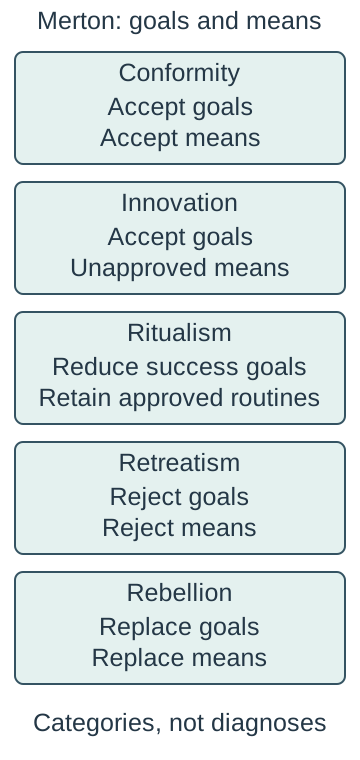
Mertonian adaptations compare responses to dominant goals and institutionally approved means. Innovation retains goals but uses unapproved means; ritualism reduces success goals while retaining routines; retreatism rejects both; rebellion seeks replacements. These are analytical categories, not diagnoses or claims that every protest is criminal. - Evaluating strain — The account links cultural pressure and unequal opportunity, helping explain some acquisitive offending. It is less direct for acts without an identifiable success goal and needs to explain why many people under strain do not offend. Wealthy offenders, differences across cultures and the role of enforcement provide further questions rather than automatic disproof of every structural influence.
- Marxist accounts of crime — Marxist criminological approaches examine how capitalist relations, inequality and class power can shape law, opportunity and enforcement. They can direct attention towards harms by powerful organisations as well as offences by disadvantaged people. Do not claim that Marx supplied one complete modern criminological theory or that all Marxist authors agree about every policy.
- Law, interests and selective visibility — A conflict account may ask how property relations and political influence affect which harms are criminalised or enforced. A company's harmful conduct can be less visible than street offending, while some laws also protect workers and the public. Evaluate the particular pattern; not every law simply benefits one class in exactly the same way.
- Criminogenic conditions and variation — Competition, insecurity, exclusion or pressure for profit can create opportunities and incentives for offending in a Marxist analysis. The pathway can differ between corporate concealment and theft under hardship. Economic position alone does not establish an offence, and an adequate explanation must address variation among people and organisations facing similar pressures.
- Evaluating conflict explanations — These approaches broaden attention to power and inequality but need evidence about specific mechanisms, legal decisions and conduct. They can understate individual agency, non-economic motives or crimes across different economic systems if applied mechanically. Compare their explanatory contribution with alternatives rather than assuming every pattern is either entirely class determined or unrelated to power.
Interactionism, labelling and realist approaches
- Becker and labelling — Becker's interactionist approach examines how groups make rules and apply labels to people, shaping who is treated as an outsider. It shifts attention towards social reaction and enforcement rather than taking official categories as a transparent measure of intrinsic criminal identity. It does not establish that the original conduct or harm never occurred.
Sources: Becker original extract.
- Primary and secondary deviance — In Lemert's distinction, primary deviance does not necessarily reorganise a person's identity around a deviant role; secondary deviance develops through responses and adjustment to that role. Keep the attribution distinct from Becker's contribution. A label can influence a trajectory without making a second offence inevitable.
- Stigma and self-fulfilling processes — Labelling may restrict employment, relationships or legitimate opportunities and encourage identification with an excluded group. If those responses increase later offending, the reaction can contribute to a self-fulfilling process. Show the sequence and evidence; do not assume people passively accept labels or that supportive responses cannot interrupt the pathway.

An illustrative labelling pathway connects social reaction with possible opportunity and identity changes. People can resist labels and support can interrupt the sequence. It is not a deterministic rule, an explanation of every initial offence or a denial of victims' harm. - Evaluating labelling — The approach helps explain selective enforcement and the consequences of social reactions. It is less complete as an account of the initial act and may understate the harm experienced by victims if used to discuss only the offender's label. Evaluate agency, resistance and actual evidence of the proposed trajectory.
- Realism and the seriousness of crime — Left and right realist approaches both take crime and its effects seriously and seek practical responses, but differ over causes and policy emphasis. Neither is adequately summarised as one side caring about victims and the other not. Identify the proposed mechanism, social context and evidence before comparing their prescriptions.
- Left realism and relative deprivation — Left realist accounts connect offending to relative deprivation, marginalisation and subcultural responses. Relative deprivation concerns perceived disadvantage against a reference group or expected standard, not simply absolute lack of essentials. It can exist amid rising overall living standards and does not make offending an inevitable response.
- Marginalisation and subculture — Marginalisation concerns limited effective representation, influence or integration. A subculture can provide shared meanings and responses to circumstances, potentially including offending, but many subcultures are lawful and supportive. Explain how exclusion and group expectations might interact in the specific case rather than treating youth culture itself as criminal.
- The square of crime — Left realism considers relations between offenders, victims, the state and the public or wider community. The framework encourages attention to both formal and informal responses and to victims' lived effects. It is an analytical map, not a rule that those four categories are internally uniform or that people occupy only one role throughout life.
- Right realism and choice — Right realist approaches emphasise control, responsibility and opportunities for offending, often considering how perceived costs and rewards influence decisions. Rational choice does not require perfect calculation or imply all offences are carefully planned. A person can act with limited information, emotion or habit while still responding to opportunities and constraints.
- Routine activity and opportunity — Cohen and Felson's routine-activity account focuses on convergence of a motivated offender, a suitable target and absence of capable guardianship. It concerns opportunities for a specified event, not a complete explanation of how all motivation develops. A guardian can be a person or arrangement that discourages the event; the framework does not transfer blame from offenders to victims.
Sources: Cohen and Felson original article.
- Disorder and broken-windows arguments — Wilson and Kelling's broken-windows argument proposes that neglected disorder can signal weak informal control and contribute to further problems. Distinguish the mechanism from proof that every minor offence causes serious crime or that any aggressive enforcement strategy is justified. Association between disorder and crime may also reflect underlying disadvantage or other influences.
- Comparing realist limits — Left realism can be challenged over the measurement and explanatory scope of deprivation and group responses; right realism can be challenged over unequal constraints, displacement, fairness and limited treatment of structural causes. Evaluate particular claims and policies with evidence rather than assuming either approach supplies a universal solution.