The investigative question — A criminal investigation seeks reliable information about an alleged offence, who may be responsible and what alternatives remain. Success is not simply obtaining a confession or making an arrest: accurate exclusion of an innocent suspect, preservation of evidence and a fair process matter. Evaluate a person's contribution against the actual investigative problem and available resources.
First responding police officers — Initial officers assess immediate danger, obtain an early account, seek medical help and protect people and potentially relevant locations. Preserving life takes priority over a perfect scene. Their prompt observations can identify witnesses and transient evidence, but emergencies, public access and limited specialist knowledge constrain what can initially be established.
Detectives and investigative management — Detectives develop and test lines of inquiry, coordinate interviews and examination, seek relevant records and construct a case file. A senior investigator must review competing explanations and allocate resources, rather than interpreting every new fact as confirmation of the first suspect. Good coordination depends on accurate records and communication between specialists.
Crime scene investigators — Crime scene investigators document and examine scenes and recover relevant material using suitable methods. Photographs, location records and exhibit labels connect an object to its context. A skilful recovery cannot repair an undocumented earlier disturbance, and collecting many objects is not itself evidence that the central question has been answered.
Forensic specialists and scientists — A forensic specialist brings expertise in a particular activity, such as digital examination or bloodstain analysis; a forensic scientist applies and evaluates scientific methods to relevant material. Roles can overlap, and not every practitioner performs every discipline. Competence must match the actual examination and interpretation, with limitations communicated to investigators and courts.
Forensic pathologists — A forensic pathologist examines a body in a suspicious death and interprets medical findings concerning injury, disease and cause of death. Findings can challenge an initial account, but an estimated time or mechanism may have uncertainty. A cause of death does not by itself identify a perpetrator or establish every element of an offence.
Prosecutors within an investigation — The Crown Prosecution Service can advise investigators on evidence and prosecution requirements and makes charging decisions within its responsibilities. It is distinct from the police and from the court deciding guilt. Advice can identify weaknesses early; however, prosecutors depend on the quality and completeness of the material supplied and must evaluate it independently.
Specialist investigative agencies — Agency choice depends on the alleged criminality and legal powers. HM Revenue and Customs investigates relevant tax and customs offences, while the National Crime Agency addresses serious and organised crime with partners. The specification's Serious Organised Crime Agency (SOCA) example is historical: SOCA ceased in October 2013 and should not be described as the present national agency.
Cost and opportunity cost — An examination uses staff time, equipment and funding that cannot simultaneously serve another case. An expensive specialist test may be justified if it can distinguish important competing accounts, while indiscriminate testing can delay more useful work. Compare the expected investigative contribution and urgency rather than assuming either the cheapest or most advanced method is always best.
Expertise and availability — Specialist competence and practical access are separate limits. A technique may be scientifically appropriate but unavailable quickly enough to answer an urgent question; an available practitioner may lack the particular expertise required. Evaluate waiting times, training, laboratory capacity and the risk of proceeding without the needed specialist advice.
Cooperation and critical review — A coordinated investigation passes contextual information needed for safe, relevant work while managing information that could bias an examiner. Records should distinguish observations, interpretations and assumptions. Quality review and an alternative line of inquiry can expose error; neither professional status nor agreement between people using the same mistaken assumption guarantees accuracy.
Techniques across crimes and settings
Choosing and comparing techniques — The five specification families are forensic examination, surveillance, profiling, intelligence databases and interviewing. Their usefulness changes between a scene, laboratory, police station and street, and between violent, property and electronic crime. State what a technique could establish, how that would advance this inquiry, what resources it needs and which uncertainty would remain.
Forensic traces and transfer — Contact can transfer material such as fibres, biological traces or particles, but recoverable transfer is not inevitable in every encounter. Persistence, environmental conditions, collection and background material affect what is found. The presence of a trace needs an account of origin and activity; its absence does not automatically prove that no contact occurred.
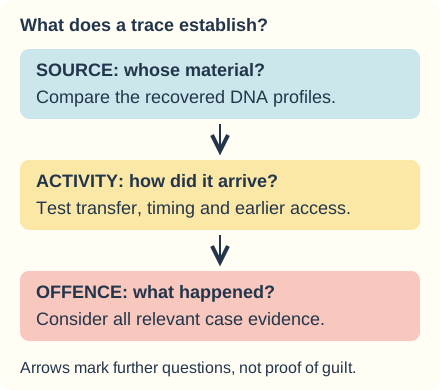
DNA comparison — DNA profiling compares features of recovered biological material with reference profiles and can strongly discriminate between competing possible sources when suitable material and methods are available. Mixtures, small quantities, degradation and interpretation assumptions can complicate the result. A source comparison does not by itself show when or how material arrived or whether an offence occurred.
Source, activity and guilt — Distinguish whose DNA might be present, what activity could have transferred it, and whether the accused committed the alleged offence. Suppose a fictional suspect previously visited a shared room: their DNA on a movable object may fit innocent contact as well as an allegation. Strong source evidence can coexist with uncertainty about the relevant activity.A source comparison, an activity explanation and an offence conclusion answer different questions. Each step needs relevant support.
Fingerprint and impression evidence — Friction-ridge detail or footwear impressions can connect a person or object with a surface when the mark supports an appropriate comparison. Partial marks, distortion, background access and examiner judgement affect weight. Even a supported identification requires context: a mark on a publicly accessible object need not date from the alleged offence.
Digital forensic examination — A lawful digital examination can recover or interpret device records, messages and metadata (information about a file or communication, such as its recorded time or sender) relevant to electronic crime or other offences. Attribute a particular account or device to a user cautiously: shared access, inaccurate clocks, incomplete records and interpretation affect conclusions. A preserved copy helps examination, but technical integrity alone does not establish authorship or meaning.
Laboratory usefulness and limits — Laboratory conditions permit controlled methods and specialist equipment beyond the scene. Appropriate validation, contamination controls and independent checking improve confidence. Results still depend on sample quality, the questions asked and the method's limits; an impressive laboratory result cannot restore lost context or turn an irrelevant sample into proof of the allegation.
Surveillance and CCTV — CCTV or other lawful surveillance can reconstruct movements, identify potential witnesses and test an alibi. Coverage, lighting, camera angle, image quality and the continuity of the recorded sequence matter. A person appearing near a location is different from a clear record of the alleged act, and an area outside the camera view remains unobserved.
Timing and interpretation of recordings — Recorded time can be wrong or inconsistent between devices. Before combining a shop camera, telephone record and witness account, establish their time bases and any supported adjustment. Do not interpret missing footage as proof that an event did not happen without checking whether the recording system was operating and covering the relevant place.
Surveillance proportionality — Monitoring can intrude on privacy and requires an appropriate lawful basis and applicable authorisation. Its potential to identify a suspect does not remove safeguards or justify unlimited collection. Evaluate necessity, proportionality and practical contribution alongside cost, especially where many uninvolved people could be recorded.
Behavioural profiling — Profiling develops reasoned hypotheses about an unknown offender or the circumstances of an offence. It can help prioritise inquiries or compare cases, particularly where behavioural information is relevant. It is investigative advice, not an individual identification test: fitting a profile does not prove guilt and failing to fit one does not automatically exclude a suspect.
Profiling approaches and assumptions — A top-down approach applies categories or patterns drawn from previous cases; a bottom-up approach seeks patterns from case information, including geographical relationships. Categories can oversimplify behaviour and the earlier cases may be selective. Compare the evidence and assumptions behind a particular prediction rather than treating one label as inherently scientific or infallible.
Geographical and behavioural inference — Locations of connected offences may help focus a search, but patterns depend on transport, opportunity, place familiarity and whether the offences are genuinely linked. The most central point is not automatically an offender's home. An inference can guide a proportionate inquiry while remaining open to a different explanation and independent evidence.
National DNA Database — A DNA database search compares an eligible recovered profile with stored profiles and can generate an investigative lead or connect scenes. A reported match needs appropriate checking and contextual investigation; it is not a conviction. An absent match can reflect database coverage or unsuitable material rather than the innocence of every possible suspect.
Intelligence databases and information quality — Intelligence systems can connect incidents, people, vehicles and information held by different teams. A recorded allegation is not necessarily a verified fact; inaccurate, outdated or duplicated entries can mislead prioritisation. Assess provenance, reliability, lawful access and corroboration, avoiding a feedback loop in which repeated copies appear to be independent support.
Interviewing witnesses — An interview seeks an accurate account of what a person actually perceived and remembers. Open prompts and an opportunity for an uninterrupted account can reduce imposed assumptions; later questions can clarify important detail. Confidence, vividness or repeated retelling does not guarantee accuracy, and an honest witness may misremember an event.
PEACE as an interview structure — PEACE organises planning and preparation, engagement and explanation, obtaining and clarifying an account with appropriate challenge, closure and evaluation. The purpose is reliable information rather than pressure to agree with an accusation. Evaluation includes checking the account against other evidence and considering how interviewer conduct may have affected the response.
Cognitive interviewing — A cognitive interview uses appropriate memory-retrieval techniques, such as carefully reinstating the event context, to support a witness's account. Additional detail must still be checked; asking someone to speculate can introduce error. Use trained, suitable interviewing rather than treating every memory technique as equally appropriate for every witness or as a guarantee of truth.
Suspect interviews and experts — Suspect interviewing requires applicable safeguards and an opportunity to explain or challenge allegations. An expert interview asks a competent specialist to clarify methods, findings and limits rather than merely endorse the investigator's conclusion. Neither a suspect's admission nor an expert's confident account removes the need to examine reliability and independent evidence.
Violent-crime comparison — In a fictional serious assault, scene traces may test contact, witness accounts may address actions and CCTV may help reconstruct sequence. A profile could prioritise a line of inquiry, but cannot replace evidence of this suspect's involvement. Compare each method's actual contribution and limits; do not assume all violent offences produce usable DNA or clear footage.
Property-crime comparison — In a fictional burglary, a footwear mark may connect footwear to an entry point while a recovered item and reliable timeline test possession and opportunity. Background access and innocent transfer remain relevant. Interviews and recordings can supply context a laboratory comparison alone lacks; the strongest combination answers different questions using genuinely independent information.
Electronic-crime comparison — A fictional fraud inquiry may require transaction records, device examination and interviews about account access. Network or account information can direct an inquiry without proving which person acted. Large data volumes, technical expertise, cross-border access and lawful retrieval affect usefulness; a physical scene examination alone may miss the offence's central mechanism.
Processing physical and testimonial evidence
Physical and testimonial evidence — Physical evidence concerns material objects, traces or recorded material; testimonial evidence is an account supplied by a person. Their treatment differs but both require accurate provenance and preservation. Distinguish what was originally observed from an inference later drawn, and remember that a recording can be authentic while an account recorded within it is inaccurate.
Scene recording and collection — Record the relevant location, condition and context before recovery where practicable, with suitable photographs and notes. Use a method appropriate to the material and the question, considering contamination and the order of examinations. A labelled object without reliable recovery context may be harder to interpret than a carefully documented trace.
Contamination and secondary transfer — Contamination introduces extraneous material during handling or examination; secondary transfer can move material through an intermediary. They are possibilities to evaluate using the actual circumstances, not automatic explanations for every trace. Appropriate protective equipment, separation and procedural controls reduce risk but should not be described as making contamination logically impossible.
Packaging, transfer and storage — Packaging and storage should suit the material, preserve its condition and separate items that could contaminate one another. Seals and labels must be supported by records of collection, movement and access. There is no universal storage method for every exhibit: the relevant trained personnel follow appropriate validated procedures.
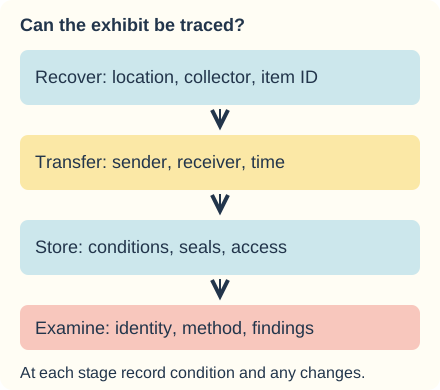
Continuity of evidence — Continuity records show who recovered, handled, transferred, received and examined an exhibit and when. They support the claim that the item analysed is the one recovered and help investigate an unexplained change. A gap needs examination of its consequences; it does not by itself prove deliberate tampering or automatically decide the whole case.Continuity links an identified exhibit across stages. A missing record requires inquiry into its significance; it does not automatically settle the case.
Analysis and interpretation — Analysis produces observations or test results using a method; interpretation assesses what those findings support under relevant competing explanations. Document the method, limitations and any quality problems. A report should not silently turn a result concerning one possible source into a conclusion about the entire alleged event.
Recording a witness account — Keep an accurate original record of the account and its questioning circumstances, preserving earlier versions and later corrections. Transfer recordings or statements through documented, authorised channels; retain secure copies with access controls, version identities and appropriate backup. Investigators and relevant specialists compare accounts with other evidence, checking discrepancies and possible suggestion. A combined composite story can hide disagreement and make apparent corroboration difficult to assess.
Handling digital material — Document acquisition and work on a suitable preserved copy where appropriate, recording processes that protect integrity and permit verification. A cryptographic hash is a calculated digital fingerprint of data. Comparing hashes can check whether the compared bytes changed; it does not prove the truth of a message, the accuracy of a clock or which person used an account. Interpretation still requires context.
Expert evidence and Sally Clark — Sally Clark's convictions were quashed, meaning overturned by the appeal court, in 2003. The later Cannings appeal judgment distinguishes Clark's undisclosed medical material and flawed statistical evidence from the issues in Cannings. The teaching point is to test disclosure, expert assumptions and evidential weight separately: rare events or an authoritative opinion alone do not calculate the probability of an accused person's guilt.
Expert disagreement and Angela Cannings — Angela Cannings's convictions were quashed in December 2003; the reasoned judgment followed in January 2004. It examined disputed expert interpretations of infant deaths and the absence of other cogent evidence supporting the allegation. Do not collapse the case into Clark's flawed statistic or infer a universal rule that any expert disagreement automatically defeats a prosecution.
Connecting stages to case conclusions — When examining a case, trace a specific item from origin through collection, transfer, storage, analysis and use. Explain how an identified defect could change its reliability or significance and what other evidence remains. A procedural weakness is an argument requiring consequences, rather than a name to attach to every miscarriage of justice.
Individual rights through investigation and appeal
Suspects and the presumption of innocence — Suspicion, arrest and charge are different from a conviction. Safeguards protect a fair investigation and test state power, including where the allegation is serious. Evaluate how a safeguard can protect the accuracy of evidence and the person affected; do not treat rights as rewards available only to people already known to be innocent.
Information and legal advice — Applicable Police and Criminal Evidence Act 1984 (PACE) safeguards include information about the reason for arrest and detention, access to independent legal advice and information about rights. A solicitor can advise and challenge improper questioning; their role is not to manufacture an account. Specific exceptions and procedures exist, so avoid presenting every custody rule as unconditional or identical across jurisdictions.
Silence and qualified inference — A suspect need not answer every police question. The standard caution also warns that failing to mention something later relied on in court may harm a defence; any inference depends on applicable legal conditions. Silence is not itself a confession, and the prosecution still has to establish its case under the criminal standard.
Welfare, vulnerability and communication — Custody safeguards address treatment, rest, food, medical attention and communication needs. Children and vulnerable suspects may need an appropriate adult, whose role differs from legal advice; interpretation may be needed for effective understanding. An apparently fluent or compliant response should not automatically be treated as proof that the person understood the question.
Limits on detention — Detention must have a lawful basis, appropriate authorisation and continuing justification under the applicable rules. Review and time limits constrain investigative convenience. Different regimes and extensions have conditions, so explain the principle of accountable detention without applying one remembered number to every offence or category of suspect.
Victims' information and support — The Victims' Code sets out rights concerning understanding the process, information, support, needs assessment and treatment with respect. Enhanced rights apply to specified groups. Support and regular explanations can reduce avoidable distress and enable participation, but a victim's needs do not remove the accused's fair-trial rights or establish guilt.
Witnesses and special measures — Witness arrangements can include assessment of vulnerability or intimidation and, where applicable, court-approved measures such as screens or live links to help give evidence. They support participation and evidence quality; they do not guarantee that an account is accurate or remove legitimate testing of it. The Witness Charter and Victims' Code have related but distinct scopes.
Review and appeal distinctions — A qualifying victim can request review of a police or CPS decision not to prosecute or to stop a case through the relevant scheme. This differs from a defendant appealing conviction or sentence and does not guarantee prosecution. Applicable appeal information and witness-care arrangements support victims and witnesses, including knowing the outcome and whether further evidence is needed. A witness is not automatically entitled to every victim-specific right.
Balancing and applying rights — For a fictional case, identify the person, stage, relevant safeguard, possible failure and realistic consequence. A pressured admission, missing interpreter or unsupported assumption about a witness should prompt a reliability and fairness inquiry. Explain the mechanism and remaining evidence rather than asserting that either police efficiency or one procedural label automatically settles justice.
Reviewing an unduly lenient sentence — The Unduly Lenient Sentence scheme allows anyone, including a victim or witness, to ask the Attorney General's Office to consider an eligible Crown Court sentence thought unduly low. Eligibility and applicable time limits matter; the Law Officers decide whether to refer and the Court of Appeal determines the review. A request does not itself increase a sentence, apply to every disposal or overturn an acquittal. Consult the current official scheme rather than assume an announced deadline change is already operative.
Test yourself
50 questions · Random sets of 10. These quick checks support revision; practise longer explanations and justified judgements too.
 Mr Kidman's Classroom