Law and social rules — A law is an enforceable legal rule within a jurisdiction; a norm is an expectation of behaviour, while morality concerns judgements of right and wrong. Their boundaries overlap without being identical. Conduct can attract informal disapproval without being criminal, and a criminal prohibition can remain contested. Specify place and time before describing what the law requires.
Government and Parliament — Government develops policy and commonly introduces legislation, but Parliament scrutinises and enacts primary legislation through its constitutional processes. The Commons, Lords and Crown have distinct roles. A minister's announcement is not itself an Act, and disagreement with a policy does not prove that a court has ruled it unlawful.
From proposals to a Bill — A proposal can develop through consultation, policy preparation and drafting into a Bill. Government Bills, private members' Bills and other categories follow relevant procedures; consultation does not guarantee a particular response becomes law. Identify the proposed rule, its intended mechanism and who would be affected before evaluating whether it is justified.
First and second readings — In the ordinary passage of a public Bill, first reading formally introduces it, while second reading debates its general principles. Do not confuse either with final enactment. A successful debate at one stage leaves detailed scrutiny, potential amendments and later decisions; legislative progress is a sequence rather than a single vote producing immediate enforcement.
Committee and report stages — Committee scrutiny examines detail and can consider amendments; report provides further consideration by the House. Scrutiny may identify unintended effects, ambiguous wording or enforcement problems. Party discipline and limited time can constrain examination, so the existence of stages is evidence of a process rather than proof that every consequence was fully anticipated.
Third reading and the other House — Third reading considers the Bill at the relevant final stage in that House. The other House usually conducts its own stages, with agreement on the text required through the applicable constitutional arrangements. The Houses can exchange amendments. Do not assume a Commons vote automatically means the Lords has accepted identical text or that ordinary procedures have no exceptions.
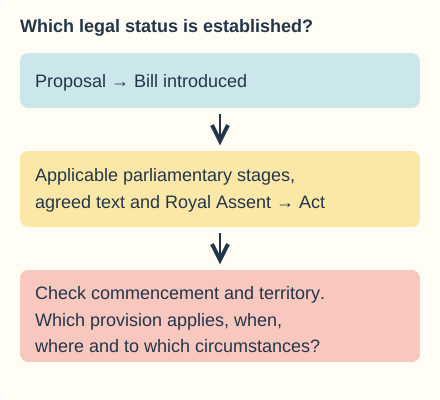
Royal Assent and commencement — Royal Assent makes an agreed Bill an Act, but provisions can come into force on different dates or through commencement arrangements. Read territorial extent, application and transitional rules before applying a new offence or power. An enacted change and an operative change are distinct: an announcement, Bill, Act and commencement notice need separate status checks.The sequence distinguishes legal status. Royal Assent and the date a particular provision becomes operative need not coincide.
Delegated legislation — An Act can authorise a minister or another body to make secondary legislation within defined powers. This permits detailed rules and updates without a new full Act for every adjustment, but raises questions about scrutiny and accountability. An affirmative procedure normally requires explicit parliamentary approval; a negative procedure normally allows the instrument to operate unless annulled through the applicable process. The exact procedure depends on the enabling Act; neither means a minister has unrestricted authority to invent criminal powers beyond the enabling law.
Legislative strengths and limits — Parliament can create broad policy change, consult interests and amend detailed statutory schemes. Complexity, pressure, unequal influence, implementation costs and unintended consequences can limit effectiveness. Evaluate the particular route from a legal rule to changed behaviour rather than assuming that passing an Act guarantees compliance, resources or public acceptance.
Judicial precedent — Courts develop and apply legal principles through decisions, with binding authority depending on hierarchy and the relevant reasoning. The ratio is distinguished from other observations. Precedent can promote consistency and predictability, but identifying the principle and whether facts materially differ requires interpretation; the same case name does not automatically resolve every later dispute.
Following distinguishing and overruling — A court follows a binding principle where applicable, distinguishes a case where material differences prevent its application, and a court with the relevant authority may overrule a legal principle. Reversing a decision within the same litigation differs from overruling a precedent. Explain what changes and which court has authority rather than treating every successful appeal as abolition of the old law.
Judicial development and Jogee — The Supreme Court's 2016 Jogee decision corrected the treatment of foresight in secondary liability. Foresight can support an inference of intention to assist or encourage, but is not an automatic replacement for that intention. This illustrates judicial development of common-law principle while also showing why a correction does not automatically overturn every earlier conviction.
Statutory interpretation — Courts determine how enacted wording applies to a dispute. Literal reasoning emphasises ordinary language, the golden approach avoids an unacceptable result from a literal reading, and mischief or purposive reasoning considers the problem or aim addressed. These are approaches to reasoned interpretation, not permissions to ignore statutory language whenever a judge dislikes a policy.
Judicial strengths and limits — Case decisions can clarify ambiguity and respond to disputed situations through reasoned authority. Change is tied to litigation, evidence, hierarchy and the issue before the court rather than an elected policy programme. Judicial independence supports decisions under law, while accountability includes reasons, open justice and appropriate challenge; independence does not mean every judge is infallible.
Parliamentary authority and rights — Courts interpret legislation and review public action within applicable constitutional powers. Under the Human Rights Act framework a declaration of incompatibility about primary legislation is different from striking the Act down. Do not import another country's constitutional arrangements into England and Wales or assume every adverse rights judgment automatically repeals Parliament's wording.
Organisation and working relationships
An interdependent system — Criminal justice consists of distinct agencies with connected functions rather than one organisation deciding everything. Information passes through investigation, prosecution, court decisions, sentence implementation and review. Failures at a handover can undermine otherwise competent work; explain the particular record, responsibility or decision linking agencies instead of listing names without a relationship.
Police and prosecutors — Police investigate and submit evidence and relevant unused material; the CPS advises and makes decisions within its responsibilities, while reviewing prosecution sufficiency independently. Requests for additional inquiries can strengthen or undermine the allegation. Cooperation does not make a prosecutor the lead scene examiner or remove the obligation to pursue reasonable lines away from a suspect.
Prosecutors and courts — Prosecutors present cases and make applications; courts rule on law, determine cases and sentence through the applicable arrangements. Prosecutors may make representations on legal sentencing issues, but do not impose punishment or supervise the offender's rehabilitation. Judicial independence separates lawful adjudication from the interests of the party bringing the charge.
Courts and probation — Probation can provide pre-sentence information and assessments to assist a court with risk, needs and the suitability of relevant disposals. The court decides the sentence; probation implements relevant supervision and requirements and reports applicable breaches. A recommendation is not an order, and breach does not mean a probation officer privately adds a new prison term.
Courts and prisons — A lawful custodial sentence is implemented by the relevant prison service or provider under the applicable warrant and release framework. A prison does not normally return to the sentencing court for permission at every routine release date. Distinguish court sentence, prison administration, statutory release and any Parole Board decision that the particular sentence requires.
Prison probation and release — Prison staff, probation and relevant partners exchange information for risk management, sentence planning and resettlement. Housing, education, treatment and contact arrangements can affect post-release stability. The existence of a referral does not prove support was available; evaluate timing, communication, continuity and actual engagement rather than merely naming a partnership.
Police probation and public protection — Relevant agencies can share information and coordinate management of eligible high-risk cases under public-protection arrangements. Their roles remain distinct, and sharing must have an appropriate legal basis. A risk assessment supports proportionate decisions; it is not a prediction that a person will certainly reoffend or permission to disregard every civil right.
Escort and specialist partners — Prisoner escort and custody services are commonly delivered through contracted arrangements managed within the justice framework, rather than routine transport always being performed by police. Health services, councils and voluntary providers also contribute specialist support. State responsibility and contractual delivery are different questions; assess coordination and accountability at the actual interface.
Inspection and review — Independent inspection examines institutions and practices, while courts and specialist review bodies have distinct legal powers over decisions. An inspectorate report can identify conditions, safety or service failures without itself acquitting a defendant. Accountability requires an appropriate response to evidence, not simply the publication of a report or an assumption that all agencies share one remedy.
Due process and crime control
Models as analytical tools — Crime control and due process are contrasting models of priorities, not exact descriptions of two entirely separate legal systems. Real institutions can combine efficient processing with rights safeguards. Use the models to identify a tension in a policy or decision and explain how practice may depart from the idealised account.
Crime-control priorities — The crime-control model prioritises suppressing crime, effective investigation and efficient processing. It places considerable confidence in administrative screening of suspects and can favour speed and finality. Its descriptive presumption of guilt concerns confidence in earlier screening; it is not the ordinary legal rule permitting a court to convict without proof.
Due-process priorities — The due-process model emphasises fallibility, lawful limits, participation and formal testing before the state imposes criminal punishment. The obstacle-course analogy draws attention to safeguards and opportunities to challenge an allegation. Delay and resource demands can be criticisms, but a safeguard's purpose is to prevent unjust coercion rather than merely obstruct every investigation.
Presumption and legal burden — The presumption of innocence and ordinary prosecution burden are central protections in a fair criminal process. An arrest, file or professional opinion does not establish the charge. Distinguish these legal safeguards from an analyst's account of how crime-control thinking may trust earlier screening; the two meanings of presumption should not be collapsed.
Efficiency and its measures — Fast case completion, a high conviction proportion or more arrests can indicate activity but do not alone establish accurate justice or lower crime. A rushed erroneous conviction can be administratively efficient and socially damaging. Choose outcomes matching the aim, including error, timeliness, fairness, harm and reoffending rather than treating throughput as the only measure.
Safeguards in practice — Legal advice, custody review, disclosure, exclusion rules, independent adjudication and appeals can expose error and constrain state power. Safeguards require usable access, resources and appropriate enforcement; their written existence is not proof of effective participation. Explain how a specific protection could improve accuracy or fairness and any legitimate operational cost.
Applying the models to investigation — A fictional proposal extends rapid questioning before legal consultation to clear a backlog. Crime-control analysis may emphasise immediate information and speed; due-process analysis examines coercion, unreliable admissions and practical challenge. Assess the actual evidence and conditions, avoiding a blanket assumption that speed necessarily improves detection or that rights inevitably reduce public safety.
Applying the models to review — A review of a final conviction can expose a grave error but also consumes resources and challenges finality. The Birmingham Six's 1991 reversal illustrates why earlier processing cannot be assumed infallible. Evaluate review thresholds and fresh information rather than concluding that every conviction should be reopened without reason or that finality outweighs every demonstrated defect.
Internal and external social control
Social control and conformity — Social control concerns processes encouraging conformity to rules and expectations. It includes informal family or peer responses and formal legal institutions. Conformity is not necessarily moral approval, and nonconformity is not always crime. Explain which rule, group and behaviour are involved before claiming a mechanism causes or prevents offending.
Internalisation and conscience — Internal control operates when rules and values become part of a person's own judgement, including guilt or conscience even without an observer. Socialisation through family, school, peers and other settings can contribute. It is a proposed process, not evidence that every member of a group shares identical values or that internal conflict proves criminality.
Rational ideology — A person may follow a rule because it fits a reasoned belief system or understanding of legitimate conduct. For example, returning lost property may reflect a commitment to reciprocity and other people's rights. The motive differs from compliance solely because police are visible, and a reasoned ideology can also justify challenging a law regarded as unjust.
Tradition and moral commitment — A practice may be followed because it is learned as normal within a community or family, reinforced through habits and moral expectations. Tradition can sustain cooperation but does not itself establish that a practice is lawful or just. Explain how a norm is transmitted and accepted, recognising disagreement and social change rather than treating culture as fixed.
External control and coercion — External control uses responses from other people or institutions, including disapproval, exclusion, legal penalties and physical restraint under lawful authority. Coercion influences behaviour through imposed constraint; fear of a possible consequence can operate before any sanction occurs. Compliance under pressure does not establish acceptance of the rule or a lasting change after supervision ends.
Formal and informal sanctions — Formal sanctions are imposed through recognised institutional procedures, such as a court's sentence; informal sanctions include peer disapproval or praise. Both can reward conformity or discourage deviance. An informal response can be powerful, and a formal rule can be ineffective if detection, legitimacy or enforcement is weak; formal does not mean automatically severe or successful.
Hirschi and social bonds — Hirschi's social-bond account asks why people conform, proposing that attachment, commitment, involvement and belief connect individuals to conventional society. Weaker bonds can reduce restraints on offending. This is a theory requiring evidence and careful application, not a diagnostic checklist proving that a socially isolated or unemployed person is criminal.Each bond proposes a different restraint. Evaluate causation, conventional opportunities and crime type instead of using the theory to label individuals.
Attachment — Attachment concerns valued emotional connections and sensitivity to others' expectations. A young person may avoid conduct that would disappoint someone whose opinion matters. The quality and norms of the relationship matter: close attachment to an offending peer group need not produce conventional conformity, so the mechanism cannot be reduced to counting friends.
Commitment — Commitment concerns investment in conventional goals and achievements that could be jeopardised by offending, such as a valued training place. The proposed cost is losing something worth maintaining. Unequal access to opportunities complicates the explanation, and strong employment or status does not prevent every form of occupational or corporate crime.
Involvement — Involvement concerns time and participation in conventional activities reducing some opportunities for deviance. Structured activities may provide support as well as occupy time, so distinguish those mechanisms. Being busy is not a complete explanation for all offences, particularly where a conventional workplace or institution supplies the opportunity to offend.
Belief — Belief concerns acceptance of the legitimacy or moral validity of conventional rules. It can support conformity even without immediate surveillance, but people may endorse some rules and reject others. An opinion survey's stated approval is not the same as observed compliance, and acceptance can change through treatment perceived as unfair.
Evaluating social-bond explanations — Associations between weak bonds and offending do not alone establish causation: offending can damage relationships, and deprivation or exclusion may affect both. Evaluate temporal order, measurement and crime type, including hidden occupational offences. A helpful account of some conformity should not become a claim that every offender lacks all four bonds.
Combining controls in policy — A youth activity project may build attachment, conventional commitment and involvement, while supervision and agreed rules supply external control. Explain each proposed mechanism and measure outcomes rather than assuming attendance proves success. Support, opportunity and legitimacy can complement proportionate enforcement; interventions need not rely on fear alone.
Control and contested rules — A workplace group might enforce a harmful norm through peer pressure, while an individual resists it from internal moral conviction. This shows why social control and justice are separate questions: conformity can maintain harmful practices, and nonconformity can support lawful reform. Relate the example to norms, power and legal status without treating every act of resistance as criminal.
Comparing internal and external explanations — For an original fictional scenario, distinguish genuine acceptance, habit, valued relationships, fear of detection and physical inability to act. Similar behaviour can have different motives, so one observed act cannot identify the controlling process. Defend an explanation with evidence and specify what would happen if observers or sanctions were removed.
Test yourself
50 questions · Random sets of 10. These quick checks support revision; practise longer explanations and justified judgements too.
 Mr Kidman's Classroom