Integrated analysis — Integrated language and literary study connects precise language choices with the form, organisation and meanings of a text. It does not require two disconnected paragraphs labelled language and literature. An account of a narrator's restricted viewpoint can combine pronouns, modality, selected detail and narrative structure. Choose methods that explain the actual text rather than forcing every framework into every answer.
Text and discourse — A text is a bounded instance of communication for the analysis being undertaken; discourse also directs attention to language in use and patterns beyond individual sentences. A spoken exchange, a webpage and a dramatic scene have different boundaries and conditions. Define what evidence is available, including any missing audio, layout or surrounding material. An extract is not automatically the complete interaction or work.
Mode, medium and genre — Mode concerns how communication is realised, including speech, writing and combinations with visual or other resources; medium concerns the channel or technology; genre concerns recognisable conventions associated with recurrent purposes. For example, a news podcast uses spoken mode through an audio medium and may follow interview or news-report genres. Boundaries overlap and terminology can vary. A prepared spoken lecture is not spontaneous conversation, and a written chat may use conversational features. Explain the actual configuration rather than claiming speech and writing are absolute opposites.
Audience and purpose — Consider intended, implied and actual audiences separately, together with overlapping purposes such as informing, persuading, entertaining or maintaining a relationship. Evidence may suggest an audience but does not prove every reader's age, education or response. Specialist terminology can assume shared knowledge, create authority or require explanation. Test a proposed purpose against wording, structure, publication conditions and possible alternative readings.
Production and reception — Production context includes who creates, edits, performs or publishes a text and the conditions shaping those decisions. Reception concerns how audiences encounter and interpret it, potentially at different dates or in different media. A later reader may understand an implication differently from an original audience. Use relevant context to explain specific choices rather than attach an unrelated historical paragraph.
Writer, speaker and persona — The real author, a represented narrator, a fictional character and a public persona are not automatically the same person. First-person wording can construct sincerity, expertise, vulnerability or a selective account without proving factual truth. Distinguish who speaks, who is represented and who organises the whole text. A confident voice can still be challenged by structure, irony or other voices.
Observation and interpretation — Observation identifies a feature that can be checked in the text; interpretation explains its possible significance in context. In the original sentence 'Perhaps the gate was still open', 'perhaps' marks uncertainty, but its precise narrative function depends on surrounding events and perspective. Move from quoted detail through grammatical or semantic explanation to a supported claim. Avoid using terminology as a substitute for reasoning.
Evidence and quotation — Select a short, accurate detail that supports the particular claim and explain its role in the passage. Preserve relevant negation, modality, punctuation and speaker attribution; removing them can reverse meaning. Longer quotation is useful only when the pattern needs it. There is no universal quotation quota or rule that one isolated word always supplies enough evidence for a whole-text judgement.
Patterns and exceptions — A repeated pronoun, image or sentence pattern can organise a voice or theme, while a later break may complicate it. Establish a pattern from sufficient relevant evidence before calling a feature dominant. An exception can be analytically important rather than an error to ignore. Compare local detail with the extract's development and, where available, the complete work.
Effects as argued possibilities — A feature can invite, foreground or make available a response, but it does not mechanically make every reader feel the same emotion. A short sentence can emphasise a decision, represent hesitation or create contrast depending on placement and content. Explain why the proposed effect is plausible for the relevant audience and purpose. Distinguish textual positioning from measured audience reaction.
Context without determinism — Social roles, institutions, historical conditions and genre expectations can shape choices without determining every utterance. Do not infer a person's beliefs directly from demographic identity or assume one audience shares a single interpretation. Use contextual evidence proportionately and recognise uncertainty. A dated convention can be followed, adapted or challenged, so show how the text actually relates to it.
Building a comparative claim — Compare meaningful functions as well as the presence of techniques. Two texts can use first person for different purposes, or different grammatical resources to construct a similar appeal to authority. Establish a clear basis, analyse evidence from both and qualify the connection. A comparison should develop an interpretation rather than alternate unrelated feature lists.
Lexis, semantics and figurative meaning
Lexis and lexical choice — Lexis concerns vocabulary and patterns of word choice. Analyse a word's particular sense and relationships in the passage, not an invented universal effect. An apparently ordinary verb such as 'wait' can become significant through repetition, contrast or narrative delay. Lexical sophistication alone does not prove a writer is intelligent or an audience belongs to a particular social group.
Denotation and connotation — Denotation is a word's relatively direct meaning in use; connotation is an association it can carry in context. The original alternatives 'home' and 'property' can frame the same building through belonging or ownership, but neither has one fixed emotional effect in every passage. Explain the textual and cultural evidence for the association rather than treat a dictionary label as the full analysis.
Semantic fields and lexical sets — A semantic field groups meanings related to an area, while lexical sets identify relevant vocabulary items under the analysis being used. For example, route, crossroads and destination might frame a decision as a journey, but a single word does not establish a sustained field. Identify the pattern, its development and exceptions. Related words can also contrast or conflict rather than reinforce a simple theme.
Polysemy and ambiguity — A word is polysemous when it has related senses; ambiguity allows more than one plausible interpretation of a relevant expression. Context often narrows meaning but can deliberately sustain uncertainty. The original phrase 'a clear case' could refer to evidence or an object depending on context. Do not assume every possible dictionary meaning is active at once; justify which readings the passage supports.
Synonymy, antonymy and gradation — Synonyms have related meanings but are rarely interchangeable in every register and collocation. Antonyms establish contrasting meanings, sometimes on a scale such as warm/cold rather than absolute alternatives. Choosing 'slender' rather than 'thin' can change evaluative associations in a particular context. Explain nuance and perspective rather than assign all related words the same intensity.
Collocation and expectation — Collocation concerns words tending to occur together under the relevant variety or register. An unusual combination can attract attention or create a new association, while familiar wording can signal conventionality. In the original phrase 'a patient storm', the adjective creates tension with an expected image of force. Explain what expectation is being challenged and avoid assuming unfamiliar wording is automatically effective.
Register and technicality — Register concerns language associated with a situation, activity and relationship, not only a formal/informal scale. Legal, scientific, intimate and ceremonial language can use different conventions or combine them. Technical lexis can achieve precision or position an expert audience, while glossing can include non-specialists. Establish the actual role of the vocabulary rather than equate long words with education or short words with simplicity.
Evaluative and emotive wording — Words can encode approval, disapproval, intensity or emotional framing. Compare who evaluates what and whether the judgement is asserted, quoted, questioned or attributed to another voice. A report mentioning a 'disaster' may name a documented event rather than simply attempt manipulation. Explain the relation between wording, evidence and perspective instead of calling any strong adjective bias without analysis.
Metaphor — Metaphor frames one thing through another without treating the expression as a literal identity. In the original phrase 'the deadline stalked her', the deadline is construed through threatening pursuit, potentially connecting time pressure with fear. Explain the mapping and its fit with the passage. Calling it a metaphor is the start of analysis, not proof that every reader feels threatened.
Simile and comparison — A simile makes an explicit comparison, often using 'like' or 'as', but those words have other grammatical uses. In 'the corridor narrowed like a funnel', the shape comparison can focus movement towards a confined point. Identify the actual shared property and context. 'I like the corridor' contains a verb, not a simile simply because the word appears.
Personification and agency — Personification attributes human-like qualities or agency to something non-human. The original 'the windows watched' can animate a setting or suggest a perceiver's unease, depending on the narrative. Distinguish figurative agency from a literal actor in the story. It can overlap with metaphor; related labels do not require separate unsupported effect claims.
Metonymy and synecdoche — Metonymy uses an associated element to stand for something, such as Downing Street announced for an announcement from the UK prime minister's office rather than from the street itself. Synecdoche uses a part-whole relationship, as in 'extra hands' for workers; classifications sometimes overlap. Explain what is substituted and what the framing foregrounds or suppresses. Naming a device does not remove the need to identify the actual referent.
Irony, humour and understatement — Irony involves a discrepancy between an expressed surface and another relevant meaning or perspective, supported by context. Understatement presents something as less significant or intense than expected; humour can use incongruity, timing or shared knowledge. Neither a negative event nor every joke is automatically irony. Explain how audiences recognise the contrast and where interpretation remains uncertain.
Allusion and intertextuality — An allusion refers indirectly to another text, event or cultural resource; intertextuality concerns relationships between texts more broadly. Recognition can add meaning for some audiences while remaining unavailable to others. Identify credible evidence and explain the connection's function without inventing a source because two phrases resemble one another. A reader's possible association is not proof of deliberate authorial borrowing.
Morphology, grammar and sentence organisation
Form and function — A grammatical form describes a structure; a function describes what it does in a larger structure or communicative context. A noun phrase can function as subject or object, while an interrogative can function as a request rather than a genuine information question. Keep levels distinct when explaining meaning. A useful analysis states the relevant structure and its role in the actual example.
Word classes in context — Nouns, verbs, adjectives, adverbs, determiners, pronouns, prepositions and conjunctions behave differently, but one written form can belong to different classes in different uses. Compare original 'a clean room' with 'clean the room': the first 'clean' modifies a noun, the second heads a verb phrase. Classify by grammar and distribution rather than memorise a word's most familiar use.
Morphemes and word structure — A morpheme is a minimal meaningful or grammatical unit in an analysis; a free morpheme can stand independently, while a bound one attaches to another element. In the original 'unhelpful', 'help' is a free base and 'un-' and '-ful' are bound affixes. Count meaningful units rather than letters or syllables. Not every spelling sequence is a separate morpheme, and word history is not necessarily the same as a current speaker's structure.Original synchronic teaching analysis: unhelpful contains bound prefix un-, free base help and bound suffix -ful. These are three meaningful units, not counts of letters or syllables; historical origins and other complex formations can require a different analysis.
Inflection and derivation — Inflection marks grammatical distinctions such as plural or tense without normally creating a new lexeme (a distinct vocabulary item treated as one dictionary entry); derivation creates a related lexeme and can change word class or meaning. Compare 'walk'/'walked' with 'help'/'helpful'. English has irregular forms too, so an absent '-ed' does not mean a verb lacks past tense. Explain what the form contributes in context rather than assuming an affix always has one literary effect.
Compounding and conversion — Compounding combines lexical bases, as in 'doorbell'; conversion changes a word's class without an overt derivational affix, as when the noun text is used as a verb in I will text you. New formations can support precision, informality or creative framing, but their significance depends on use and conventionality. Distinguish a phrase from a compound with the relevant evidence rather than judging solely by whether a publisher inserts a hyphen or space.
Nouns and nominal reference — Nouns can refer to people, places, objects, processes or ideas, with common/proper and concrete/abstract distinctions useful where relevant. An abstract noun such as 'failure' can package an event without specifying who failed. Do not assume every abstract noun has the same emotional meaning. Analyse reference, modification and the wording's place in the argument or narrative.
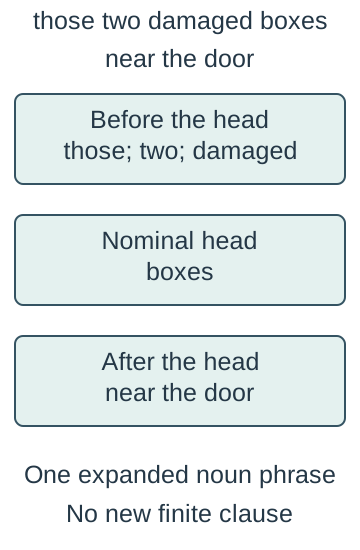
Noun phrases and modification — A noun phrase contains a head noun or pronoun, with possible determiners and modifiers. The head is the central word; premodifiers add detail before it and postmodifiers after it; a phrase can also consist of one word. In original 'those two damaged boxes near the door', 'boxes' is the head, with detail before and after it. The expanded phrase can specify or accumulate information. Explain which detail matters rather than equate every long phrase with vivid description.Original phrase: those two damaged boxes near the door. Boxes is the nominal head, with relevant specification/modification before it and a preposition phrase after it. Expanding this phrase adds detail without creating an additional finite clause. Terminology for individual dependent elements should remain consistent with the grammatical framework used.
Determiners and pronouns — Determiners help specify a noun's reference through articles, demonstratives, quantity or possession in the framework used. Pronouns can refer to participants, earlier expressions or contextually understood entities, but their referents need checking. Original 'our street' can claim affiliation without proving everyone shares the speaker's view. Some grammatical descriptions classify possessives or demonstratives differently; use a coherent terminology and show the function.
Verbs and processes — Verbs can represent actions, states, relations, perception and mental activity. Subject and verb choice can foreground agency, experience or condition: original 'Mara broke the lock' differs from 'Mara noticed the lock'. Avoid classifying every verb as physical action. Connect the process and participants to the text's perspective and what it reveals or leaves uncertain.
Auxiliaries, tense and aspect — Auxiliaries help construct distinctions such as progressive, perfect, passive and modality. Tense relates grammatical form to time reference, while aspect presents an event's temporal character or relation. Original 'she was waiting' presents an ongoing past situation; 'she had waited' relates an earlier situation to a past reference point. Grammatical past can also serve other functions, so use surrounding context rather than equate form and time mechanically. UCL discussion of English verb constructions.
Modality and commitment — Modality expresses meanings such as possibility, probability, obligation, permission or ability through modal verbs and other resources. Original 'she must be home' can express an inference, while 'she must return home' can impose an obligation. 'Must' therefore has no single fixed function or intensity independent of context. Distinguish a speaker's commitment to truth from attempts to influence action. Cambridge explanation of modality.
Adjectives and adverbs — Adjectives commonly modify nouns or complement a subject, while adverbs modify verbs, adjectives, other adverbs or clauses under the relevant analysis. Original 'a remarkably quiet room' places degree modification within the noun phrase; 'fortunately, it was quiet' evaluates the clause. Analyse scope and stance rather than assume every adjective describes appearance or every adverb ends in '-ly'.
Phrases and heads — A phrase is organised around a head such as a noun, verb, adjective, adverb or preposition and may contain other phrases. Original 'beside the newly painted door' is a preposition phrase containing a noun phrase. A phrase does not need several words and does not automatically equal a clause. Show how the grouping contributes to the sentence before interpreting a list of labels.
Clauses, subjects and predicates — A clause presents something about a subject, such as what it does or what it is like; this relationship is called predication, commonly with a subject and verb phrase, though imperatives and non-finite clauses can lack an expressed subject. In original 'the bell stopped', 'the bell' functions as subject and 'stopped' as predicate. Subject is a grammatical role, not always a deliberate human agent. Avoid defining every clause as a complete standalone sentence.
Finite and non-finite clauses — Finite verb forms mark tense or participate in finite modal constructions; non-finite forms include infinitives and participles without independent tense marking. Original 'although she waited' is a finite subordinate clause, while 'to avoid the crowd' is non-finite. A dependent finite clause still cannot normally stand alone as an independent sentence in standard prose. Analyse its relationship to the main clause rather than call every verb ending '-ing' a full sentence.
Coordination and subordination — Coordination links units of comparable grammatical status; subordination embeds or makes one clause dependent within another structure. Original 'he called and she answered' coordinates main clauses; 'when he called, she answered' presents a temporal relation through subordination. Neither pattern has an automatic emotional effect. Explain hierarchy, relation and placement in the particular text.Original alternatives: He called and she answered coordinates two main clauses. When he called, she answered makes the temporal clause dependent and the answer clause main. The second is not merely a longer version: its grammatical relationship foregrounds timing. Neither structure has an automatic emotional effect.
Sentence complexity and fragments — A simple sentence has one main clause, a compound coordinates main clauses and a complex includes subordination under the school framework. Length and complexity are different: a long simple sentence can contain expanded phrases without several clauses. A minor sentence or fragment can be deliberate in conversation, headlines or creative writing. Evaluate its function and conventions rather than automatically call it incorrect or dramatic.
Sentence forms and speech functions — Declaratives, interrogatives, imperatives and exclamatives are grammatical forms: declaratives commonly put the subject before the verb, interrogatives often change that order or use a question word, imperatives use a base verb to direct action, and exclamatives include forms such as What a day it was. These are forms, while statements, questions, commands and exclamations are communicative functions. Original 'Could you close the window?' has interrogative form but can act as a polite request. A declarative can imply a warning in context. Do not infer function from punctuation or sentence form alone.
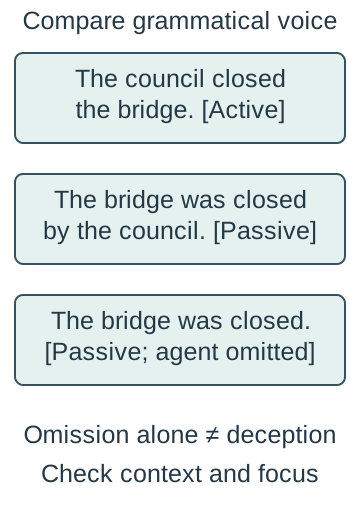
Active, passive and agency — In original active 'the council closed the bridge', the subject foregrounds an actor; passive 'the bridge was closed by the council' foregrounds the affected bridge. A passive can omit the agent, but not every passive hides responsibility: the actor may be known, irrelevant or introduced later. Distinguish grammatical voice from the broader literary concept of voice and explain information focus in context.Original active/passive alternatives show how subject and information focus can change. The passive can express the agent in a by-phrase or leave it unexpressed. Omission does not alone establish concealment; surrounding knowledge, relevance and discourse organisation must be considered.
Nominalisation and information focus — Nominalisation presents a process or quality as a noun, such as original 'the closure of the bridge'. It can package prior material, support abstraction or leave agency and timing implicit unless supplied. That does not automatically make a text deceptive. Compare the alternative wording, grammatical possibilities and argumentative context before judging what the choice achieves.
Parallelism, listing and punctuation — Parallel structures can align ideas, establish contrasts or build a rhythm; lists can accumulate, categorise or juxtapose. Punctuation helps organise written relationships and can suggest pauses, boundaries or interruptions without being an exact recording of speech. A semicolon is not automatically a dramatic pause and an ellipsis does not always mean suspense. Explain the actual structure and context.
Phonetics, phonology, prosody and patterned sound
Speech sounds and spelling — Phonetics studies speech production and perception; phonology studies how sounds pattern and contrast within a language or variety. A phoneme is a contrastive sound category, while a grapheme is a writing unit. In ship, the letters sh together represent one consonant phoneme /ʃ/ in a common pronunciation, while ship and sip differ in a phoneme that changes the word. English spelling does not map one letter to one phoneme in every case. Analyse audible or textually justified sound evidence and avoid treating letter repetition as automatic sound repetition.
IPA and transcription — The International Phonetic Alphabet provides symbols for speech sounds, with conventions such as slashes for phonemic analysis and square brackets for more detailed phonetic representation. Transcription depends on the variety and level of detail; it is not ordinary spelling in another font. Use a reliable chart and recorded evidence where available. A written extract alone cannot establish exactly how every speaker pronounced it. International Phonetic Association chart; choose the relevant variety and transcription detail.
Consonants and vowels — Consonant description uses properties such as voicing, place and manner of articulation; vowels can be described through tongue position, lip rounding and other phonetic properties. Voicing concerns vocal-fold vibration, place identifies where airflow is affected, and manner describes how. For example, /p/ and /b/ are made by closing and releasing the lips; /b/ is conventionally classed as voiced and /p/ as voiceless. Only use detail relevant to the analysis and evidence. A voiced consonant is not automatically louder or more threatening than a voiceless one. Explain how sound patterning works in the specific sequence rather than assign universal emotions to sound classes.
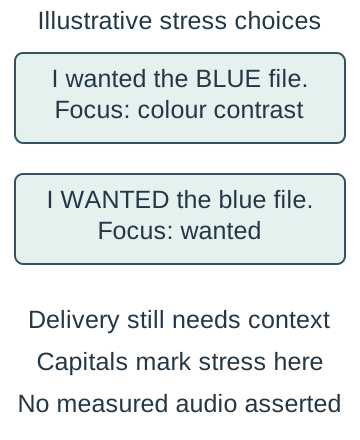
Syllables and stress — A syllable organises speech around a nucleus, commonly a vowel, with possible surrounding consonants. Word stress and sentence stress can distinguish emphasis or focus depending on variety and delivery. Original 'I wanted the BLUE file' contrasts the colour, while 'I WANTED the blue file' can foreground desire or contrast another action. Capitalisation here marks an illustrative stress choice, not measured speech.Two original illustrative stress choices in the same wording foreground colour or the wanting process. Capitals are a local teaching convention marking stress, not evidence of an actual recording, shouting or a guaranteed emotion. A real prosodic analysis needs delivery and context.
Prosody and intonation — Prosody includes features such as stress, rhythm, pitch and intonation operating beyond individual segments. Rising pitch can mark a question, continuation, uncertainty or other meanings depending on the system and context. Falling pitch does not prove confidence in every utterance. Where audio is absent, distinguish an interpretation suggested by punctuation or stage direction from a verified delivery.
Pace, pause and silence — Pauses and changes in pace can organise thinking, turn-taking, emphasis or performance, but a pause alone does not prove anxiety or deception. A transcript needs a key explaining how timing and interruption are represented. Distinguish actual measured silence from a printed gap or an editor's choice. Interpret delivery with surrounding language, relationship and communicative conditions.
Alliteration and consonance — Alliteration repeats relevant initial consonant sounds; consonance concerns recurring consonant sounds more broadly under the analytical convention used. Original 'cold keys clicked' offers an initial sound pattern that may link objects and action. It does not establish one guaranteed effect such as aggression. Check sound rather than spelling and explain prominence, rhythm and meaning in context.
Assonance and sibilance — Assonance involves repeated vowel sounds; sibilance involves recurring hissing sounds such as /s/, /z/ and /ʃ/ under the stated convention. These patterns can connect wording, texture or rhythm but do not automatically produce softness, threat or any fixed emotion. Pronunciation and variety matter. Explain the actual sequence and its relation to the passage rather than identify every repeated letter as a meaningful pattern.
Rhyme and rhythm — Rhyme concerns relevant sound correspondences, often at line endings; rhythm concerns patterns of beats, stress and timing across language. Both occur beyond poetry, including slogans, speeches and conversation. Regularity can create expectation and a break can become salient, but its function depends on placement and meaning. Do not assume a regular pattern is always harmonious or an irregular one always chaotic.
Metre and performance — Metre is an organising pattern of strong and weak positions in verse, while an actual reading can vary stress, pace and emphasis. An iambic pattern normally alternates weak then strong positions; individual lines can depart from it. Analyse a sufficient stretch and acknowledge plausible alternatives. A metrical label alone does not explain a speaker's mood or the meaning of an entire poem.
Sound, graphology and access — Written layout, typography and punctuation can suggest emphasis or performance, while audio provides different evidence. A capitalised word can signal emphasis without fixing its exact pitch or loudness. Readers may encounter a transcript, print, screen or performance with different access to cues. State what the available version permits and what would need additional evidence.
Variation and representation — Pronunciation, dialect and stylistic choices vary systematically and can index identities or relationships without proving intelligence, morality or social worth. A literary spelling may represent an author's construction of a voice rather than a transparent recording of a community. Distinguish authentic data, stylisation and stereotype. Analyse the context and positioning without treating a variety as inherently deficient.
Pragmatics, cohesion and discourse organisation
Pragmatics and inferred meaning — Pragmatics examines meaning in use, including how context supports inferences beyond literal wording. Original 'It's cold in here' can state a temperature, complain or indirectly request action depending on participants and circumstances. Do not assume every utterance has a hidden meaning. Explain the evidence making the relevant inference plausible and consider alternative functions.
Deixis and the contextual centre — Deictic expressions such as 'I', 'you', 'here', 'now' and 'tomorrow' require a contextual reference point. In original 'I'll meet you here tomorrow', speaker, addressee, place and time must be known to interpret the plan. A reported or fictional passage can shift that centre. Deixis is not simply any descriptive word or every reference to the past.Original sentence: I will meet you here tomorrow. Interpreting person, place and time requires the contextual centre and addressee; reporting, quotation and narrative can shift that centre. The diagram does not assign one fixed real place or date to the wording.Cambridge account of contextual reference.
Reference and anaphora — Anaphoric reference points back to a relevant earlier expression, while cataphoric reference anticipates one supplied later. Original 'Lena arrived. She was early' links 'she' to Lena under the intended reading. For cataphora, compare Before she spoke, Lena stood up: under the intended reading, she points forward to Lena. Reference can be ambiguous or deliberately delayed. Distinguish textual reference from deixis, while recognising that a form such as a pronoun can work through both context and text.
Presupposition — A presupposition is an assumption treated as already in place through a particular expression or construction under an analysis. Original 'When did the noise stop?' normally assumes a relevant noise existed and stopped, though a listener can challenge that premise. It is not proof that the assumed event really occurred. Identify the trigger and how accepting or rejecting it affects the interaction.
Implicature — An implicature is an inferred meaning supported by utterance, context and communicative expectations rather than fully stated literal content. Original 'Some seats are free' may suggest not all are free in a suitable context, but that inference can be cancelled: 'in fact, all of them are'. Distinguish a possible inference from a necessary logical meaning. Not every interpretation requires a named theory.
Speech acts and indirectness — Utterances can perform actions such as requesting, promising, apologising, warning or asserting when relevant conditions are met. An indirect request can use a question about ability or circumstances. Its politeness and force depend on relationship, entitlement, delivery and context. Saying the word 'promise' does not automatically create a successful sincere commitment in every quotation or fictional situation.
Cooperation and conversational expectations — Participants often interpret contributions with expectations about relevance, truth, informativeness and clarity, as described in Gricean approaches. An apparent departure can invite inference, humour or conflict, but may also reflect misunderstanding or different norms. Treat the model as an analytical tool rather than a universal rulebook. Do not label every short answer a deliberate violation without considering the actual exchange.
Cohesion and coherence — Cohesion concerns linguistic links such as reference, substitution, ellipsis, conjunction and lexical patterning. Coherence concerns how a text makes interpretable sense in context, which depends also on shared knowledge and organisation. A passage can contain many cohesive links yet remain confusing, or be coherent with few explicit connectives. Explain the particular link and relation rather than assume adding 'therefore' proves a logical conclusion.
Ellipsis, substitution and recoverability — Ellipsis omits material recoverable from grammar or context; substitution uses a replacement expression such as 'one' or 'do so'. Original 'Mara chose the red folder; I chose the blue one' avoids repeating 'folder'. For grammatical ellipsis, compare Mara chose the red folder; I, the blue one: chose is omitted from the second part but can be recovered from the first. Recoverability and ambiguity affect interpretation. An ellipsis in grammar is not identical to every printed three-dot punctuation mark.
Discourse markers and progression — Expressions such as 'well', 'however' or 'anyway' can organise turns, relations or topic changes, depending on use. A marker's function is not fixed by its dictionary label: 'well' can delay, qualify or initiate a response. Trace the text's development, openings, transitions and ending. Do not assume every connective establishes the relation it announces successfully.
Foregrounding and information structure — A text can make material salient through position, repetition, contrast, unusual form or a break in a pattern. End-weight places a heavier or more complex element later in a sentence. Fronting moves an element to the beginning, as in That letter, she never opened, rather than She never opened that letter. These choices, or an isolated line, can redistribute attention without guaranteeing one reader response. Identify the normal expectation and the actual contrast. Salience is an argument about textual organisation, not a count of how many technical labels can be attached.
Synthesising an interpretation — Connect selected evidence across levels to an arguable account of voice, meaning, relationships or development. For example, uncertainty can emerge through a modal, restricted reference, pauses and withheld narrative detail working together. Test counter-evidence and avoid overclaiming intention or audience response. A strong interpretation explains how the text works in context, with terminology supporting rather than replacing the argument.
Test yourself
50 questions · Random sets of 10. These quick checks support revision; practise longer explanations and justified judgements too.
 Mr Kidman's Classroom