Voice as a constructed effect — A voice emerges through choices in wording, grammar, stance, organisation and, where available, delivery or visual presentation. It can suggest an identity without transparently revealing the producer's whole personality. A narrator, interview participant and institutional webpage construct voices under different conditions. Analyse how the effect is made and whose perspective controls it rather than describe a voice only as strong or weak.
Persona and selective presentation — A persona selects aspects of identity relevant to a particular purpose or relationship. Original 'I have repaired these boats for thirty years' can present experience as authority, but the claim still needs evaluation and does not prove expertise in every field. Compare assertion, evidence and audience positioning. Selection is a normal feature of communication, not automatically proof of dishonesty.
Stance and commitment — Stance concerns a speaker's or writer's position towards propositions, events and other people. Modals, evaluative wording, reporting verbs and adverbs can mark certainty, doubt, approval or distance. Compare original 'the plan will work', 'may work' and 'is said to work': each positions commitment differently. Explain attribution and context instead of ranking all modals on one universal confidence scale.Original alternatives distinguish direct assertion, modal qualification and attribution to Lee. An attribution locates a represented source; it does not necessarily establish the reporter’s agreement or the truth of the claim. The diagram reports no real road condition.
Personal pronouns and alignment — First person can claim experience or responsibility, while second person can address, generalise or construct an imagined audience. Inclusive 'we' can invite shared membership; an exclusive use can separate a group from outsiders. Determine who is included rather than assume every 'we' means everyone. A pronoun's grammatical person alone does not prove intimacy, sincerity or power.
Naming and forms of address — Names, titles, kinship terms and other address forms can establish distance, affiliation, respect or conflict depending on relationship and setting. Original 'Dr Vale' and 'Nina' can position the same person differently, but familiarity is not automatically disrespect. Consider who chooses the form and whether it is accepted or challenged. Absence of a title does not by itself reveal a speaker's social attitude.
Expertise and epistemic authority — Participants can claim or attribute knowledge through experience, credentials, technical language or access to evidence. Epistemic authority means a recognised or claimed basis for being treated as knowledgeable about the topic. Authority is relative to the topic and can be negotiated or contested. A specialist explaining uncertainty may be more responsible than a confident non-specialist. Separate how expertise is represented from whether its claim is warranted, using the actual context and evidence.
Power as situated interaction — Institutional role, control of resources, topic selection and entitlement to act can shape an exchange. These do not guarantee that one participant controls every turn or that a long turn always indicates greater power. A patient may supply unique experience while a clinician controls the consultation format. Trace what participants can do, how others respond and where control is resisted or shared.
Face and relationship management — In Brown and Levinson's politeness model, face concerns socially valued aspects of self-image: positive face concerns approval or affiliation and negative face concerns freedom from imposition, not an unfriendly personality. Requests, disagreement and criticism can place pressure on these wants, but cultures, settings and individuals vary. Use the concepts as a qualified analytical lens, not proof that everyone values the same strategy equally. For example, a refusal can threaten someone's wish for approval, while a request can restrict their freedom to act. A speaker might acknowledge the relationship or offer a choice, but the context determines whether either is appropriate. Politeness is not simply a count of 'please'. Brown and Levinson’s account of politeness.
Mitigation and directness — Hedges such as perhaps or a little make a claim or request less categorical. Hedges, explanations, tentative questions and options can soften an imposition, while direct wording can be efficient, caring or hostile depending on entitlement and circumstances. Original 'Could we move this slightly?' differs from 'Move it now', but an emergency can make directness appropriate. Explain the relationship, stakes and response. Indirect language is not automatically more polite in every setting.
Positive affiliation and disagreement — Shared references, inclusive wording, agreement and supportive responses can build affiliation. Disagreement can also maintain honesty or protect someone rather than destroy a relationship. Original 'I see the problem, but this figure needs checking' combines acknowledgement with challenge. Analyse how the sequence develops and how participants receive it instead of treating every contrastive conjunction as aggression.
Represented and competing voices — Quotation, reported speech, mimicry and shifts of register can introduce another voice into a text. The surrounding narrator or editor can frame that voice sympathetically, critically or ambiguously. A quoted opinion is not necessarily endorsed by the reporting writer. Examine selection, reporting verbs, placement and the possibility of a response before assigning one viewpoint to the whole text.
Credibility and uncertainty — Specific examples, acknowledgement of limits, verifiable sources and consistent reasoning can support credibility. They can also be imitated rhetorically, so the appearance of evidence needs scrutiny. A confident tone is not the same as a reliable account. Evaluate how the text constructs trust and what independent information would be needed to assess its claims.
Identity without stereotypes — Accent, dialect, register and digital style can index affiliations or roles, but meaning varies across contexts and audiences. A non-standard form is not evidence of lower intelligence, and a formal style does not prove high social status or sincerity. Distinguish a text's construction of identity from claims about every member of a group. Consider adaptation, stylisation and audience expectations.
Comparing voice across settings — Compare the function of resources in their settings: a first-person memoir can organise remembered experience while a public-service announcement uses an institutional 'we'. Similar forms can serve different purposes and different forms can establish related positions. Build the comparison around a conceptual question such as authority, distance or vulnerability. Keep local evidence and contextual limits in view.
Spoken interaction, transcription and sequence
Spoken communication is varied — Conversation, interviews, lectures, performances and broadcasts vary in planning, turn allocation, audience and purpose. Speech may be scripted, rehearsed or edited; writing may be rapid and interactive. Do not explain a feature solely by calling a text spoken. Identify the actual production conditions and what participants know about one another.
Transcription as representation — A transcript selects aspects of speech using a declared convention. An orthographic transcript foregrounds words; a detailed interaction transcript may represent overlap, timing, stress or repair. Every version omits something, and notation varies. State the key and available audio before interpreting a symbol; punctuation in an edited transcript may reflect editorial judgement rather than a speaker's exact pause.
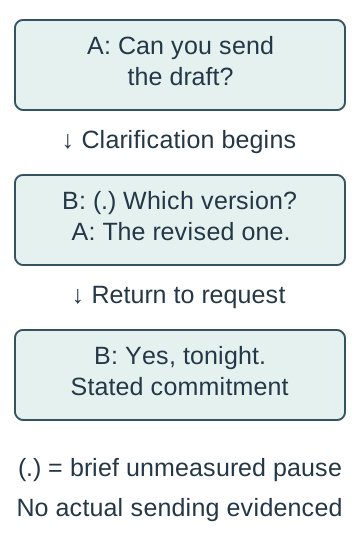
Original transcript convention — For these invented practice lines, '(.)' means a brief unmeasured pause, '(2.0)' a two-second pause, and aligned square brackets across speaker lines mark the start and end of overlapping speech. A hyphen marks a cut-off. Capitals mark an illustrative stressed word, not shouting by definition. This is a local simplified key, not a universal transcription standard or measured recording. Keep it attached to any example so the evidence is interpretable.
Turns and allocation — A turn is a contribution within an interaction, which may contain one or several units. A current speaker can select another participant, someone may self-select at a suitable point, or the current speaker may continue. Actual patterns depend on activity and participants. Institutional exchanges can allocate turns more explicitly, so a conversation model should not be imposed unchanged on every broadcast or meeting. Sacks, Schegloff and Jefferson’s turn-taking study.
Transition relevance and cues — Syntax, intonation, pragmatic completion, gaze or other cues can make a point relevant for a possible speaker change. Completion is judged through context and can be anticipated or misread. A silence or overlap can occur even when participants cooperate. Identify the available cues and avoid treating each sentence boundary as a guaranteed end of turn.
Adjacency pairs — Some actions project a relevant next action, such as greeting/greeting, question/answer or invitation/acceptance or refusal. These are action relationships, not a requirement that the two parts be literally adjacent with no intervening material. An answer may be delayed, challenged or expanded. Explain what response is made relevant and how its actual delivery shapes the exchange.
Insertion and expansion — An exchange can include clarification before a projected response. In the original 'Can you come on Friday?'/'What time?'/'At six'/'Yes', the inserted question/answer helps resolve the invitation. The sequence is not automatically incoherent because the first answer is delayed. Analyse how local organisation supports the larger action rather than count isolated question marks.
Preference in conversation analysis — Preference describes a structural tendency in how alternative responses are organised, not simply what a person privately likes. Acceptance may be produced directly while refusal can involve delay, qualification or explanation in a particular activity. These patterns are not universal obligations or proof of emotion. Examine the actual sequence and avoid inferring a private attitude from one pause alone.
Backchannels and listener response — Minimal responses such as 'mm', 'right' or 'yes' can show attention, receipt, encouragement or other local functions without taking a full turn. They do not always mean agreement with every proposition. Consider timing, intonation and the next response. A transcript without audio can limit distinctions between acknowledgement, scepticism and acceptance.
Overlap and interruption — Overlap is simultaneous talk; interruption is an interpretation of how an entry affects another's turn or rights. Overlap can be supportive completion, shared laughter, repair or competition. A participant speaking before another finishes is not automatically hostile or dominant. Examine whether the speaker continues, yields, resists or treats the overlap as problematic and state the evidence available.
Repair — Repair addresses problems of speaking, hearing or understanding. A speaker can initiate and complete a correction themselves, ask another to clarify or respond to another's repair initiation. Original 'Tuesday—sorry, Thursday' repairs a prior item without proving incompetence. Distinguish what is corrected and who initiates it; repair can display attentiveness and support shared understanding.
Filled pauses and reformulation — Forms such as 'um', repetitions, false starts and reformulations can help planning, manage a turn or qualify wording. They can also reflect uncertainty or other conditions, but do not automatically prove low confidence or dishonesty. Locate the feature in the action and topic. A polished edited transcript may remove these details, changing the impression of fluency.
Topic management — Participants can introduce, maintain, shift or close topics through questions, markers, summaries and responses. Topic control can contribute to power but may also follow an agreed activity, such as an interviewer moving through a schedule. Check whether a shift is accepted or resisted. A long contribution about one subject is not itself proof that the speaker controls every aspect of the interaction.
Prosody and embodied evidence — Stress, pitch, pace, laughter, gaze and gesture can contribute to interactional meaning where the recording or description supplies them. The same words can perform different actions with different delivery. Do not invent gestures or exact tone from an orthographic transcript. Distinguish an argued reading from an observation and identify what fuller evidence would test it.
Original sequence analysis — In invented 'A: Can you send the draft? B: (.) Which version? A: The revised one. B: Yes, tonight', the clarification delays and enables the requested response. The final commitment supplies timing. The pause could support planning or clarification and does not prove resistance. Explain the whole request/clarification/response sequence with the local notation key, not a detached feature label.Original invented interaction, not a recording: a request is followed by an inserted clarification question and answer before an affirmative response with timing. The clarification need not be resistance. The pause notation is a local key and the commitment does not prove that the draft was actually sent.
Comparative spoken analysis — Compare turn allocation, action sequences, repair, stance and relationship in relation to the activities and audiences. Differences may arise from editing, task design or recording rather than personality. Select a small amount of detailed evidence, then test the wider pattern. A quantitative count such as turn length needs interpretation and cannot alone prove gendered behaviour or institutional dominance.
Scripts, interviews, broadcasts and public performance
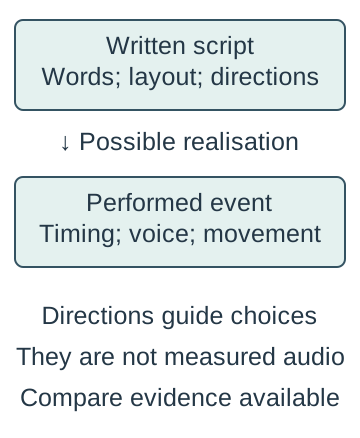
Script and performance — A script organises possible speech and action, while an actual performance adds delivery, timing and embodied choices. Directions, speaker labels and layout serve readers, performers or production staff as well as a potential audience. Do not describe a suggested pause as a measured performed silence. Analyse what the written form enables and what remains an interpretive choice.A script supplies wording and any written directions. Performance can realise timing, vocal delivery, gesture and movement, with choices that a bare written extract does not fully determine. Analyse directions as written evidence; do not claim to have heard an unprovided performance.
Represented conversation — Screenplays, radio drama and literary dialogue can select conversational features to create plausibility, pace or character without reproducing every hesitation of ordinary talk. Their voices are crafted within a larger structure. Naturalistic appearance is not proof of spontaneous recording. Compare how interruptions, omissions or responses shape dramatic information and relationships in the scene.
Radio and audio scripting — Audio-only forms can use voice, sound cues, music, silence and verbal signposting because audiences cannot see the action. A cue is not decorative if it helps establish a place, transition or perspective. Evaluate how information is made available without assuming every listener attends under identical conditions. Where only a script is supplied, distinguish planned sound from a verified production.
Screenplay and visual dependency — A screenplay can divide information between dialogue, action description, scene headings and visual sequencing. A viewer may infer something shown without its being spoken, while a reader sees production instructions. Analyse the available version and the relation between channels. Do not attribute a director's or actor's particular realisation to the writer without evidence.
Interviews as designed encounters — Interviews involve purposes, roles, question design and selection, varying across research, journalism, entertainment and employment. Questions can invite narrative, constrain an answer or challenge an assertion. Participants can resist a premise or redirect a topic. The interviewer's institutional role does not prove absolute control or that the interviewee's first-person account is unmediated truth.
Open, closed and leading questions — An open question allows a relatively broad response; a closed question narrows the response options under the relevant use. Leading or loaded wording can steer interpretation or embed a contested premise. Compare original 'What happened next?' with 'Why did you ignore the warning?': the latter presupposes conduct that may need challenging. The effect depends on context and how the respondent answers.
Editing and framing — Selection, cuts, sequencing, introductions and captions can alter how an interview or broadcast voice is encountered. A published extract may omit hesitations, explanations or challenges present in the full recording. Do not assume an edited text is false, but assess the evidence for framing and its possible consequences. Separate the participant's words from the presenter's or editor's interpretation.
Podcasts and intimacy — A podcast can construct conversational accessibility through direct address, anecdote, informal markers or shared references while remaining planned, edited and commercial. Audience relationships can feel personal without being reciprocal private friendship. Compare actual production choices and topic expertise. Not every podcast is informal, and apparent spontaneity does not establish absence of scripting.
Broadcast audiences and overhearers — A broadcaster or interview participant may address an immediate partner while also performing for a wider unseen audience. Explanations that seem redundant to the interlocutor can help listeners who lack shared knowledge. Identify the different audience positions and communicative purposes. A transcript may conceal music, visuals, timing or distribution context important to the original reception.Original schematic interview: interviewer and guest address each other while a wider audience can overhear the mediated exchange. Questions and responses may also orient towards that audience. Editing, framing and delivery affect access; this model does not prove any particular audience reaction.
Public speeches and rhetoric — Public speeches can coordinate argument, identity and audience response through structure, repeated wording, contrast, narrative, evidence and delivery. A speech's persuasion is not proved by naming a list of techniques. Connect each relevant choice to the issue, speaker's role, audience and occasion. Separate a rhetorical invitation to agree from evidence that everyone did agree.
Repetition and parallel constructions — Repetition and syntactic parallelism can make a claim memorable, align alternatives or build cumulative emphasis. A three-part pattern can create expectation, but not every list is a persuasive triad or every repetition effective. Examine semantic relations, placement and variation. A break in a pattern can matter as much as its regularity.
Rhetorical questions and response — A rhetorical question can guide reflection or assert an implied position without seeking a straightforward answer, but functions can shift in interaction. An audience may respond, reject the premise or supply another reading. Look at surrounding argument and delivery evidence rather than classify every question in a speech as rhetorical. A question mark alone does not establish its intended function.
Ethos, pathos and logos — Ethos concerns constructed credibility, pathos appeals involving emotion, and logos reasoning or argument. They can overlap and do not divide a speech into three compulsory sections. A personal story can both support credibility and frame an argument emotionally. Evaluate the quality and relevance of the reasoning instead of assuming the presence of an appeal proves ethical or effective persuasion.
Evaluating mediation and authenticity — Ask what version is available, who selected it, which channels are missing and what claims can be verified. A polished public voice may be genuine in its commitments while carefully constructed in form; construction and sincerity are not simple opposites. Compare evidence and acknowledge uncertainty. Do not invent private motives or present old anthology examples as current prescribed material without checking the course update.
Digital texts, participation and multimodal voice
Affordances and constraints — A digital platform offers possibilities such as rapid publication, links, comments, search or multimedia while constraining length, visibility and interaction through its design. An affordance permits an action; it does not make every user perform it. Compare the actual platform, version and use rather than call all online writing one genre. Access, moderation and audience knowledge influence what becomes meaningful.
Synchronous and asynchronous interaction — Synchronous communication occurs with participants engaging in roughly real time; asynchronous exchanges allow delay, editing and discontinuous participation. Actual platforms can combine both, and a message sequence does not reveal exactly how long someone composed a reply. Time stamps, notifications and threaded order affect interpretation. Do not treat every digital delay as a purposeful social rejection.
Addressivity and imagined readership — Usernames, direct address, tagging and references can aim wording at one person, a group or a public. Others can read or redistribute it, producing overlapping audiences and context collapse: people from normally separate settings, such as friends, relatives and employers, encounter the same message. A private tone in a public post does not prove privacy. Identify who is invoked and who can actually access the version, with evidence rather than assumptions about the platform's whole user population.
Graphology and navigation — Headings, spacing, typography, placement, menus and links can organise attention and routes through a digital text. Screenshots can preserve a layout while losing interaction, and copied text can omit important visual cues. Explain how the actual arrangement shapes access or emphasis rather than count decorative features. Accessibility and device differences can alter the experience.
Hyperlinks and intertextual routes — A hyperlink can provide evidence, attribution, navigation or commercial direction, with its destination relevant to interpretation. Link text and destination need not convey the same framing. The possibility of following a link does not prove every reader does so. Distinguish the main text's assertion from material hosted elsewhere and assess source credibility separately.
Emoji, punctuation and stance — Emoji, repeated punctuation, capitals and spacing can cue stance, affiliation or interpretation in digital writing, but meanings vary across users and contexts. A symbol can be ironic, conventional or ambiguous rather than a transparent emotion label. Check sequence, audience and available evidence. Replacing a complex interaction with a single universal emoji meaning loses relevant detail.
Hashtags and discoverability — Hashtags can group discussion, signal stance, index an event, add commentary or seek visibility. Their function depends on wording, platform and circulation. A hashtag is not automatically an endorsement of every associated post, and popularity does not establish accuracy or consensus. Analyse its role in the specific text and how it connects to possible audiences.
Comments, replies and threads — Digital response structures can display agreement, challenge, repair or parallel conversations, with ordering affected by time, ranking or moderation. A visible top reply is not necessarily the first or most representative response. Quote and attribute contributions accurately rather than treat all users as one collective voice. Missing or deleted material limits conclusions about the entire exchange.
Blogs and personal authority — A blog can combine personal narrative, commentary, advice, reporting and commercial functions. First person and informal presentation can construct experience-based authority without verifying every claim. Compare evidence, links, disclosure and audience purpose. A blog is a publication format with varied genres, not a guarantee of authenticity, amateur status or diary-like privacy.
Institutional and promotional voices — Organisations can adopt conversational wording, humour or personal address to appear accessible while pursuing service, reputational or commercial aims. That does not make all informal institutional language manipulative. Evaluate the relation between tone, information quality, practical action and interests. Distinguish an apparent individual signature from the wider organisation's editorial and publication role.
Circulation, permanence and change — Digital texts can be edited, copied, archived, deleted or redistributed to new audiences, affecting context and apparent authority. A screenshot records one version but may omit surrounding links or later corrections. Record source, date and version for analysis. Do not assume every online item remains unchanged forever or that deletion prevents further circulation.Original possible circulation path, not a universal platform sequence: a post is reproduced in a screenshot or repost and encountered in another setting. Selection can remove surrounding comments, dates, links or layout. Trace the actual version and provenance; redistribution alone does not demonstrate endorsement or the size of an audience.
Comparing multimodal meanings — Analyse how words, image, layout, sound or interaction work together where available, including tensions between channels. A caption can guide an image's interpretation without exhausting it; an image can challenge a verbal claim. State what the supplied extract includes and avoid inventing unseen colours, animation or audio. Evidence from one mode cannot automatically prove an effect in another.
Source judgement and inference — Distinguish what a digital text claims, how it constructs credibility and what independent checking establishes. Engagement metrics measure defined interactions, not truth, complete audience agreement or real-world action. Avoid personal or demographic inferences unsupported by the available text. A strong account analyses the voice and medium while remaining precise about evidence and uncertainty.
An integrated digital comparison — Compare two actual digital examples through a shared question such as expertise, participation or intimacy, using relevant wording, layout and response structure. Account for audience, platform and version rather than attribute every difference to personality. Test alternative readings and distinguish intended interaction from observed response. The aim is a connected explanation of meaning-making, not a platform feature inventory.
Test yourself
50 questions · Random sets of 10. These quick checks support revision; practise longer explanations and justified judgements too.
 Mr Kidman's Classroom