What independent literary enquiry involves — An independent enquiry develops a question through sustained reading, evidence and reasoned interpretation. Independence does not mean ignoring scholarship or teacher guidance; it means making and explaining your own accountable decisions. A prepared answer copied from another reader cannot demonstrate that process. These notes teach methods and use original miniature examples; they do not supply a candidate's assessed essay or invent the school's selected works.
Confirm the actual texts and controls — Before committing to a project, check the centre's current requirements, approved texts and task with the teacher. The course's examined choices and independent texts must satisfy its eligibility rules; a compelling comparison does not repair an ineligible selection. Do not assume another centre's online coursework title has been approved for your course. No personal text pair has been selected in these resources.
Read both complete works — A viable comparison needs knowledge of each complete selected work, rather than summaries and a few isolated quotations. Track relevant developments, exceptions and endings while noting where an initial question no longer fits. For a collection, confirm what counts as the selected complete text with the teacher. Unread chapters or scenes can contain evidence that changes an attractive opening thesis.
From broad interest to a focused question — Begin with a meaningful interest, then identify a relation that both works can support through literary analysis. Power is a broad topic; how institutions distribute knowledge and justify restriction is a more focused possible enquiry. The example does not prescribe a candidate task or named pair. Test its scope, available evidence and capacity for comparison before deciding whether it is workable.
An open and answerable enquiry — An enquiry should allow investigation rather than assume its conclusion. A question claiming that both writers always condemn a group may pre-empt counter-evidence and treat complex voices as direct authorial statements. Reframe towards how representations develop and differ. A focused question can lead to a qualified judgement without promising an exhaustive account of every theme or an unsupported statement of the authors' private intentions.
A whole-work reading record — Keep accurate locations, brief relevant quotations or paraphrases and an explanation of each entry's possible significance. Separate a character's claim from the narrator's framing and your interpretation. Revisit the record as the question changes; more entries are not automatically better evidence. An exception or apparent contradiction can become important to the eventual argument rather than be removed because it is inconvenient.
Research, interpretation and contextual evidence
Primary and secondary evidence — The literary works are primary evidence for an interpretation of their construction. Reviews, scholarship, performances and historical documents have different relations to the enquiry: a review written when the work first appeared can be primary evidence of that particular reception while remaining a critical interpretation of the novel. Identify what a source can establish for the question instead of assigning one permanent hierarchy to every research use.
A research question before a search — Break the enquiry into precise questions about textual features, contexts or interpretations. Search by relevant author, work, concept and period, then refine the terms as evidence develops. A result ranking is not a measure of scholarly authority. An efficient search includes looking for challenges to a promising idea rather than gathering only pages that repeat it.
Evaluate the actual source — Check authorship, publication setting, date, argument, evidence and relevance. A university-hosted page may contain a student project rather than peer-reviewed research; a respected critic can still make a claim that does not fit your passage. Read beyond an isolated search snippet and locate the actual claim. An unavailable source cannot be cited as if personally read in full.
Context as a supported relationship — Use verified contextual evidence to illuminate a particular literary choice, tension or reception. Distinguish the work's represented period from its production and later readings. Explain the mechanism of the relationship rather than add a detached historical paragraph. A law, belief or institution may affect the available conditions without determining every character's action or proving what all contemporary readers believed.
Different interpretations and AO5 — Different interpretations are evidence-led readings to be understood, tested and evaluated. They can arise from different textual emphases, theoretical approaches, performances or historical responses. AO5 in this Literature course concerns interpretations, not the creative-writing objective used in Language and Literature. A critic's name alone supplies no explanation, and disagreement is not automatically more independent than qualified agreement.
Represent a critical claim fairly — Record the critic's actual proposition, scope, supporting evidence and relevant context. Distinguish a quotation from your paraphrase, and avoid extending a comment on one scene into a claim about the entire work. Explain what the interpretation makes visible, then test it against the primary text. Do not invent a quotation or attribute your own reading to a critic who did not make it.
Evaluate, adapt and synthesise — A critical approach can illuminate some features while obscuring others. Test its explanatory power through supporting and resistant details in both works, then state your own judgement about its usefulness and limits. Synthesis can retain part of a reading and qualify another part. Combining several names without explaining their relationship does not create a reasoned critical debate.
Research notes that preserve provenance (where ideas and wording came from) — Label exact quotation, paraphrase, summary and your own developing idea separately at the time of note-taking. Record the author, title, publication details and precise location or stable link. Returning later to identify an unlabelled borrowed phrase is unreliable. Keep notes and relevant draft history so that the development of the enquiry and the origins of its claims remain traceable.Three research-note statuses require different treatment: exact words remain clearly marked with a location; independently restated borrowed ideas retain attribution; the learner’s own inference is identified and supported through evidence. A source list alone does not disclose where wording or ideas were borrowed.
Comparative argument, evidence and revision
A thesis that responds to reading — A thesis proposes a defensible comparative relation in response to the enquiry. Treat it as revisable while testing both works rather than decide it before reading. A useful claim explains a connection and a consequential distinction with appropriate scope. It need not reduce each work to one opposing label or imply that every chapter exemplifies an identical moral.
Plan through analytical relationships — Organise the argument into developments that answer the enquiry and advance or qualify the thesis. Decide which moments, methods and critical or contextual evidence each development needs. A plan based only on plot order can obscure the comparative reasoning, but an account of changing narrative structure may legitimately need sequence. The appropriate organisation follows the actual question and evidence.
Keep both works in the argument — A sustained comparison gives both works sufficient detailed attention and explains their relationship throughout the reasoning. Paragraphs can integrate the works or develop one before an explicit return, depending on the argument. Avoid mechanical alternation of titles, identical quotation quotas or a long isolated essay on each work without a developed connection. Balance concerns evidential adequacy rather than equal page fractions.
Integrate textual evidence accurately — Introduce a brief relevant quotation or accurately described formal relation, then explain how its actual wording or organisation supports the claim. Preserve meaning when omitting words, and mark omissions according to the chosen convention. Check punctuation and location against the selected edition. A quotation that appears to fit only after changing a pronoun or silently removing a qualification is misleading evidence.
Explain methods and judgement together — Analyse how language, form, structure or dramatic/narrative organisation creates the relation under discussion. A feature label is not itself an explanation, and plot description alone does not establish a method. Connect the evidence to a warranted interpretive step, then to the comparative enquiry. More terminology is not necessarily more precise; use concepts whose application can be demonstrated.
Counter-evidence and revised scope — Choose a serious detail or interpretation that challenges the thesis and explain why it matters. Decide whether it supplies an exception, reveals a limitation or requires a more substantial revision. Do not protect the opening claim by ignoring a later scene. A narrowed, evidence-led judgement can be stronger than an impressive-sounding universal statement the works cannot sustain.
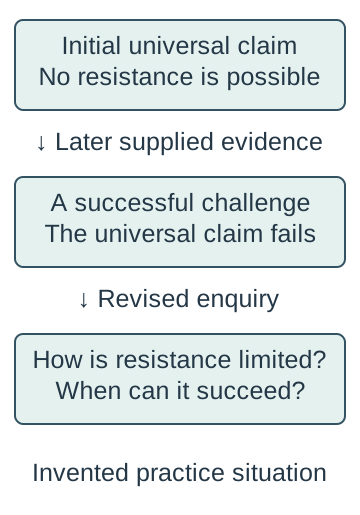
An original miniature research example — Suppose two invented teaching passages distinguish a public rule from unequal practical access, but one later includes a successful challenge. A provisional claim that rules make all resistance impossible must change. A better question asks how rules constrain resistance and what conditions make a challenge possible. This example models a decision about evidence; it is not a selected-text claim, supplied assessment title or completed coursework paragraph.Original research-method example: a later successful challenge is incompatible with a claim that all resistance is impossible. Revision investigates both constraints and conditions of challenge. The figure supplies neither a selected-text claim nor a student’s approved coursework question.
Draft for argument before polishing — A first working draft tests the sequence of claims, comparative links and evidence. Review whether each section advances the enquiry and whether an apparently fluent passage rests on an unsupported assumption. Revise missing reasoning before polishing its adjectives. Keep records of substantial changes, and ensure the eventual phrasing expresses your own understanding rather than a borrowed model's sentence pattern.
Editing and proofreading have different jobs — Editing improves selection, structure, reasoning and expression, while proofreading checks remaining surface accuracy such as spelling, punctuation, references and formatting. An accurate bibliography cannot repair a weak argument; a strong argument still needs readable prose and reliable attribution. Work through a focused sequence rather than assume a spellchecker recognises every author, title, quotation or conceptual error.
An earned conclusion — A conclusion answers the enquiry in the form the evidence now supports, explaining the significance of the developed comparison. It can acknowledge an important limit without declaring every reading equally valid. Avoid adding a major unanalysed quotation or historical claim at the end. The final judgement should reflect revisions made during the argument rather than simply repeat the initial thesis unchanged.
Referencing, authentic authorship and project control
Quoting, paraphrasing and attribution — An exact quotation uses the source's words and needs clear quotation marking and a reference. A paraphrase restates an idea independently in your own wording and syntax but still needs attribution. Replacing a few words in another person's sentence is not independent paraphrase. Distinguish common factual knowledge from a specific borrowed interpretation, and seek guidance where the attribution boundary is uncertain.
Citations and bibliography — Use the centre's agreed established referencing system consistently. A citation identifies the relevant source and precise location where available; the bibliography supplies the publication details needed to locate it. Record editions because pagination and editorial features can differ. A bibliography entry alone does not identify which particular words or ideas were borrowed at a particular point in the essay.
Sources you have not directly read — If a critic is quoted by another author and the original cannot be consulted, make the indirect route clear under the chosen referencing convention. Do not imply direct access to a whole work when only an excerpt or report was read. A fabricated page number or plausible-looking publication is not an acceptable way to complete a missing reference. Trace and check a source before relying on it.
Independent writing and permitted support — Research discussion and teacher guidance must follow the course and centre's current controls, while the written assessment remains the learner's own. Keep guidance general and documented as required; another person rewriting an argument prevents it from demonstrating independent authorship. Distinguish practice feedback from support allowed on the actual submission. Check the applicable rules before using generated text, shared drafts or third-party rewriting.
Digital tools and accountable evidence — A search tool or language system can produce inaccurate quotations, invented sources and confident interpretations unsupported by the work. Verify claims through actual sources and retain the required acknowledgement of assistance. Pasting generated analysis into assessed writing does not demonstrate your own reading simply because it has been reworded. Follow the centre's current rules and explain your own reasoning in drafts and discussion.
Plan and monitor a viable project — Allocate time for complete reading, focused research, planning, independent writing, revision, reference checking and the centre's review process. Check milestones against progress rather than measure success by accumulated pages. If the evidence makes the enquiry unworkable, discuss a revised scope early. Do not invent a teacher deadline or claim the site can certify a candidate's eligibility or final mark.
Final check through evidence and ownership — Before submission, check that the actual approved task and works are used, both receive developed analysis, claims and quotations are accurate, critical/contextual material is fairly handled and attribution is complete. Follow the centre's word-count and authentication arrangements. Be able to explain how the argument developed and why the evidence supports it; a checklist helps preparation but does not replace teacher assessment or the required formal declarations.
The specific Literature NEA route — Edexcel 9ET0/04 contributes 20% of the qualification and is marked out of 60. It requires one extended comparative essay on two complete works, with all five literary assessment objectives applying. The advisory length is 2,500–3,000 words excluding footnotes and bibliography. These figures describe this qualification's assessed assignment, not a ceiling on website notes or keywords. Build a concise sustained comparison rather than pad to a number or confuse this essay with 9EL0's two creative pieces and commentary.
Text choice and documented guidance — The two 9ET0 NEA works must differ from those studied by the centre for the examined components, and works in translation are not allowed. Complete poetry, drama, prose or literary non-fiction can be considered under teacher guidance for suitable standard and scope. Teachers review at least one draft to support and verify authorship, giving general advice rather than solutions or provisional assessment. Follow the current recorded-feedback and signed-authentication requirements; the school's actual text choices and essay remain unselected here.
Test yourself
50 questions · Random sets of 10. These quick checks support revision; practise longer explanations and justified judgements too.
 Mr Kidman's Classroom