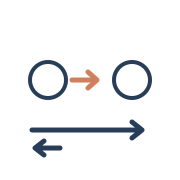
The line of impact — For a direct collision between smooth spheres modelled as particles, incoming motion is along the line joining the centres at contact. Use one positive direction for both particles before and after impact. A labelled before-and-after sketch is especially useful when a particle rebounds or there are successive impacts.
Approach and separation — Label A to the left of B at contact and take right positive. The approaching relative speed is u_A − u_B, which must be positive for contact under the stated straight-line approach. After impact the separating relative speed is v_B − v_A, nonnegative for a physically separating pair.
Newton's restitution law — The coefficient of restitution is e = (v_B − v_A)/(u_A − u_B) for the stated orientation, so v_B − v_A = e(u_A − u_B). It relates relative speeds along the impact line, not the ratio of the individual speeds. Use 0 ≤ e ≤ 1 for the specified passive impact model, in which the contact releases no extra stored energy to increase relative separation speed.
The meaning of e = 1 — An impact with e = 1 is perfectly elastic: relative separation speed equals relative approach speed and the pair's kinetic energy is conserved under the usual isolated translational model. Momentum conservation still needs negligible external impulse. An adjective in a chapter title does not imply every problem has e = 1.
The meaning of e = 0 — If e = 0, the pair has equal immediate post-impact velocities and maximum kinetic-energy loss for the same incoming state. They need not be permanently glued together: later forces can separate them. A zero relative speed does not require zero shared velocity.
Intermediate restitution — For 0 < e < 1, the separation speed is smaller than the approach speed and translational kinetic energy is lost. This loss can become deformation, thermal energy or sound. The value of e belongs to the particular contacting pair and model; different pairs in a sequence may have different coefficients.
Solving two-sphere impacts
Two independent equations — With negligible external impulse, m_Au_A + m_Bu_B = m_Av_A + m_Bv_B. Combine this with v_B − v_A = e(u_A − u_B). These two scalar equations determine the two final velocities when masses, incoming velocities and e are given. Keep all velocities signed until interpreting the result.
General outgoing formulas — Solving the simultaneous equations gives v_A = [(m_A − em_B)u_A + (1 + e)m_Bu_B]/(m_A + m_B) and v_B = [(1 + e)m_Au_A + (m_B − em_A)u_B]/(m_A + m_B). Derivation and substitution checks are safer than memorising a formula with exchanged labels.
A worked impact — Let m_A = 2 kg, m_B = 3 kg, u_A = 5 m s⁻¹, u_B = 0 and e = 0.5. Restitution gives v_B − v_A = 2.5; momentum gives 2v_A + 3v_B = 10. Thus v_A = 0.5 m s⁻¹ and v_B = 3 m s⁻¹. They separate because 3 > 0.5.The 2 kg and 3 kg example keeps right positive. Momentum gives 2vA+3vB=10 and restitution gives vB−vA=2.5. Both particles move right after impact, with B faster so the gap opens. Arrow lengths are schematic and not proportional to the unequal speeds.
Rebound is not guaranteed — A moving particle can continue forward, stop or rebound depending on masses, e and incoming velocities. For B initially at rest, v_A = (m_A − em_B)u_A/(m_A + m_B), so with u_A > 0, A rebounds exactly when em_B > m_A. Derive the inequality before assigning a negative result.
An opposing-motion example — For equal masses with u_A = 4 m s⁻¹, u_B = −2 m s⁻¹ and e = 0.5, total velocity sum is 2 and relative separation is 3. Solving gives v_A = −0.5 m s⁻¹, v_B = 2.5 m s⁻¹. The approach speed was 6, not 2.
Equal masses and elastic exchange — For equal masses and e = 1, the equations give v_A = u_B and v_B = u_A: the signed velocities exchange. If B starts at rest, A stops and B takes A's original velocity. This special case does not extend to unequal masses or inelastic impacts without checking.
Inferring restitution — If incoming and outgoing signed velocities are measured, first calculate their relative approach and separation speeds. With u_A = 6, u_B = 1, v_A = 1 and v_B = 4 m s⁻¹, e = (4 − 1)/(6 − 1) = 0.6. Check consistency with momentum as a separate condition when masses are supplied.
Impulse on each sphere — Contact impulse on A is m_A(v_A − u_A), opposite to the impulse on B. For the 2 kg and 3 kg example the impulses are 2(0.5 − 5) = −9 N s and 3(3 − 0) = +9 N s. Restitution alone would not establish that cancellation if an external impulse acted.
Kinetic-energy loss and interpretation
Calculate loss explicitly — Compute K_before − K_after using ½mv² for each particle. In the worked 2 kg and 3 kg collision, initial K = 25 J; final K = ½×2×0.5² + ½×3×3² = 13.75 J. The loss is 11.25 J, not a loss of momentum.
Relative and centre of mass motion — Write total mass M = m_A + m_B, centre of mass velocity V = (m_Au_A + m_Bu_B)/M and reduced mass μ = m_Am_B/M, an effective mass used for the relative-motion energy. Total kinetic energy equals ½MV² + ½μ(u_A − u_B)². The impact preserves V but multiplies the relative speed magnitude by e.
Deriving the loss formula — The centre of mass contribution cancels between before and after states, leaving ΔK_loss = ½μ(1 − e²)(u_A − u_B)². For m_A = 2, m_B = 3, μ = 6/5 and incoming relative speed 5, the loss is ½×(6/5)×(3/4)×25 = 11.25 J, agreeing with direct calculation.
Limits and misconceptions — For 0 ≤ e ≤ 1, the loss formula is nonnegative; it is zero at e = 1 or zero relative approach speed. The fraction of the pair's total kinetic energy lost is not generally 1 − e², because centre of mass motion retains energy. That fraction applies to the relative-motion energy contribution.
Checking a proposed outcome — Substitute outgoing velocities into momentum and restitution separately, check e lies in its allowed range, ensure the pair separates and compare kinetic energies. A set of velocities can satisfy one equation while violating another. Negative signed velocity is not a failure; negative speed or an unjustified negative energy loss is.
Fixed walls and successive direct impacts
Impact with a fixed wall — For a smooth fixed wall perpendicular to the incoming line of motion, v = −eu for signed normal velocity. If u = +8 m s⁻¹ towards a wall on the right and e = 0.75, v = −6 m s⁻¹. Momentum of the ball alone is not conserved because the wall supplies external impulse.
Wall impulse and energy loss — For mass m, wall impulse is m(v − u) = −m(1 + e)u under that sign convention. The kinetic-energy loss is ½m(1 − e²)u². For m = 0.2 kg, u = 8 and e = 0.75, J = −2.8 N s and energy loss = 2.8 J. These quantities share a number here but have different dimensions.
Organising a sequence — Draw each state, record current positions and velocities, identify the next contact and apply the appropriate coefficient for that pair. The outgoing velocity from one impact becomes the incoming velocity for the next; it must not be replaced by the original launch velocity. External wall impulses mean momentum is conserved only within each appropriate sphere-pair collision.
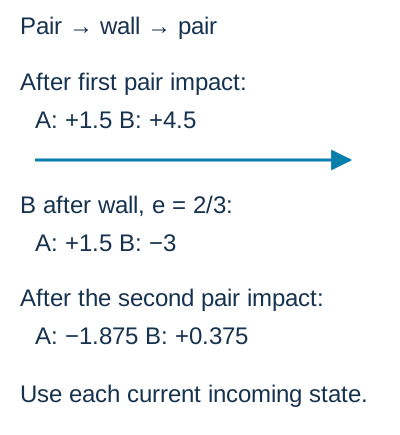
A pair then wall example — Two equal masses have u_A = 6 and u_B = 0 m s⁻¹ and e_AB = 0.5. They leave their first collision with v_A = 1.5 and v_B = 4.5. B then reaches a wall to the right with e_wall = 2/3 and rebounds at −3. A is still moving right at 1.5 if there are no intervening forces.
The next sphere collision — In that example A and B approach again at relative speed 1.5 − (−3) = 4.5. With equal masses and e_AB = 0.5, the outgoing velocity sum is −1.5 and separation speed is 2.25. Thus the next velocities are −1.875 and +0.375 m s⁻¹ respectively. Check the new momentum total, not the original pre-wall total.This state record uses the equal-mass example with pair restitution 0.5. The wall changes the balls’ combined momentum, so the second sphere collision uses the current 1.5 and −3 velocities. Positions and times still determine whether this event order occurs.
Does another collision occur? — After each event compare position ordering and relative motion. For A left of B, another direct contact without an intervening event requires v_A > v_B. For example, v_A = −1 and v_B = −3 make the gap close at 2 m s⁻¹ because the particle on the right moves left faster. Use signed relative separation rather than assuming two negative velocities imply separation.
Timing an event — For constant velocities between impacts, write positions as x_A(t) = a + v_At and x_B(t) = b + v_Bt from the same time origin. Solve for equal positions and require positive time within the current stage. A wall may be reached first, changing which equations apply; particles cannot pass through a fixed wall to complete a hypothetical earlier calculation.
An inequality for a later event — If A is behind B with gap d > 0 and v_A > v_B, their catch-up time is d/(v_A − v_B). Compare it with B's wall-arrival time or another event time. Equal times can represent simultaneous contacts outside a simple isolated two-body sequence; do not arbitrarily impose an order without a justified model.
Different restitution coefficients — Keep separate e_AB, e_BC and e_wall when they belong to different contact pairs. Do not infer a second coefficient from the first merely because the particles share material or mass. If a problem states a common coefficient, then and only then use the same value through the sequence.
Scope of the model — Direct smooth-particle impacts omit spin, frictional tangential impulses, deformation dynamics and prolonged multi-body contact. Coefficients greater than one would require an energy-releasing model outside the stated passive range. Full solutions need event order, signed calculations, energy checks and physical interpretation, not just formula substitution.
Test yourself
50 questions · Random sets of 10. These quick checks support revision; practise longer explanations and justified judgements too.
 Mr Kidman's Classroom