Defining sinh and cosh — For real x, sinh x = (eˣ − e⁻ˣ)/2 and cosh x = (eˣ + e⁻ˣ)/2. These are hyperbolic functions, not sine/cosine with a changed angle unit. Both accept every real input. Their exponential definitions allow exact algebraic derivations of identities, values and derivatives.
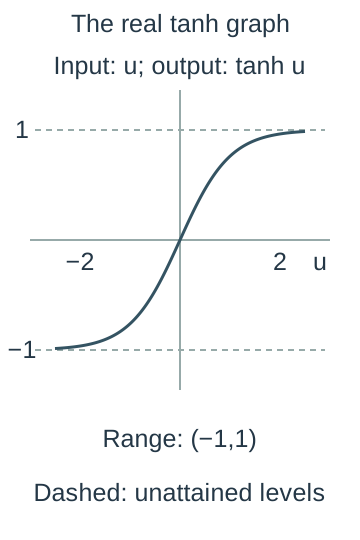
Defining tanh — Tanh x = sinh x/cosh x = (e²ˣ − 1)/(e²ˣ + 1). The denominator is positive for every real x, so tanh is defined on the whole real line. Its range is strictly −1<tanh x<1; the limiting values ±1 are horizontal asymptotes, not attained outputs at finite inputs.
Parity and central values — Sinh is odd because sinh(−x) =−sinh x, while cosh is even. At zero, sinh0 =0,cosh0 =1,tanh0 =0. Tanh is also odd. These facts help distinguish a sinh graph crossing the origin from a cosh graph with its positive minimum at (0,1).
The fundamental identity — Expand cosh²x − sinh²x using the exponential definitions: the e²ˣ and e⁻²ˣ terms cancel, leaving one. Thus cosh²x − sinh²x =1. The sign is a difference, unlike the circular identity cos²x + sin²x =1. Rearranging gives cosh²x =1 + sinh²x.
Ranges and graph shapes — Sinh is strictly increasing from −∞ to ∞ and has range ℝ. Cosh decreases to its minimum one at zero and then increases, with range [1,∞). Tanh is strictly increasing through zero and approaches −1 and 1 at the two infinite ends. None of these functions is periodic on the real line.The plotted real sinh u is odd and strictly increasing through zero, with domain and range both all real numbers. Only the finite input window −2.5≤u≤2.5 is drawn; the curve continues unbounded in both directions. Axis labels use independent input/output scales.Cosh u is even, reaches its minimum 1 at u=0 and increases without bound in both input directions. Its real domain is all real numbers and its range is [1,∞). The graph window is finite and the horizontal axis is output zero, below the whole curve.Tanh u is odd and increasing through zero. Dashed lines at ±1 are horizontal asymptotes and are not attained for finite u; its range is therefore the open interval (−1,1). The finite plotted endpoints do not mark the function’s domain boundaries.
Exact logarithmic inputs — For x = ln2, eˣ =2 and e⁻ˣ =1/2. Hence sinh(ln2) =3/4,cosh(ln2) =5/4 and tanh(ln2) =3/5. These values satisfy 25/16 −9/16 =1, giving an independent identity check. A calculator approximation is unnecessary for these exact inputs.
Addition formulas from exponentials — Expanding the definitions gives sinh(u + v) = sinh u cosh v + cosh u sinh v and cosh(u + v) = cosh u cosh v + sinh u sinh v. The plus sign in the second formula differs from the circular cosine sum. Substituting v =−u and using parity checks their consistency.
Double arguments and squared functions — Setting v =u gives sinh2x =2sinh x cosh x and cosh2x =cosh²x +sinh²x. Combined with the fundamental identity, cosh²x =(cosh2x +1)/2 and sinh²x =(cosh2x −1)/2. These reductions simplify integration of squares.
Solving hyperbolic equations exactly — For cosh x =5/4, the exponential equation eˣ + e⁻ˣ =5/2 becomes 2u² −5u +2 =0 with u =eˣ>0. Its roots u =2 and 1/2 give x =±ln2. Both signs matter because cosh is even; a principal inverse later selects only the nonnegative branch.
Differentiation and integration
The basic derivatives — Differentiating the exponential definitions gives (sinh x)′ =cosh x and (cosh x)′ =sinh x. There is no minus sign in the cosh derivative. By the quotient rule, (tanh x)′ =(cosh²x −sinh²x)/cosh²x =1/cosh²x, which is positive for every real x.
Reciprocal notation — Write sech x =1/cosh x where useful, so the tanh derivative is sech²x. Likewise cosech x =1/sinh x and coth x =cosh x/sinh x are defined only for x≠0. The named compulsory functions are sinh,cosh,tanh; reciprocal notation is a convenient explanation rather than a separate optional syllabus claim.
Chain and product rules — For tanh3x, the derivative is 3/cosh²3x. For x sinh²x, the product rule gives sinh²x +2x sinh x cosh x. Every inner multiplier and both product terms remain necessary; the resemblance to trigonometric names does not change the general differentiation rules.
A compound quotient derivative — For f(x) =cosh2x/√(x +1), x>−1, write cosh2x·(x +1)⁻¹⁄². Its derivative is 2sinh2x/√(x +1) −cosh2x/[2(x +1)³⁄²]. The original positive square-root denominator restricts the real domain; simplification does not remove that restriction.
Basic antiderivatives — ∫cosh x dx =sinh x +C, ∫sinh x dx =cosh x +C and ∫sech²x dx =tanh x +C. For a nonzero constant k, integrating cosh(kx) or sinh(kx) introduces 1/k. A positive sign appears in both hyperbolic sine/cosine primitives (antiderivatives), unlike the cosine primitive associated with ordinary sine.
Integrating squared functions — Use the double-angle reductions: ∫cosh²x dx =sinh2x/4 +x/2 +C and ∫sinh²x dx =sinh2x/4 −x/2 +C. Their derivative difference is one, matching cosh²x −sinh²x =1. Omitting the frequency factor two would double the sinh2x contribution.
A derivative-over-function hyperbolic integral — Since (cosh x)′ =sinh x, ∫tanh x dx =ln(cosh x) +C for all real x. Cosh is always positive, so this logarithm needs no absolute value. For ∫coth x dx, the answer is ln∣sinh x∣ +C on intervals excluding zero, reflecting its denominator restriction.
Principal inverses and logarithmic derivations
The inverse of sinh — Sinh is one-to-one on ℝ: each output comes from exactly one real input. Therefore arsinh x has domain ℝ and range ℝ. If y =arsinh x, then sinh y =x. This inverse is not the reciprocal 1/sinh x. The notation asinh may occur on calculators; state the function intended rather than confusing a superscript −1 with reciprocal notation.
Deriving the arsinh logarithm — From x =(eʸ −e⁻ʸ)/2, set u =eʸ>0. The equation u² −2xu −1 =0 gives u =x±√(x² +1). Since √(x² +1)>∣x∣, only the plus choice is positive. Therefore arsinh x =ln(x +√(x² +1)) for every real x, including negative x.
Restricting cosh for its inverse — Cosh is not one-to-one on the whole real line. The principal arcosh uses the branch y≥0, meaning the nonnegative-input portion of cosh, giving domain x≥1 and range y≥0. Thus arcosh(cosh y) =∣y∣ for real y, whereas cosh(arcosh x) =x for x≥1. The principal branch does not return both signs of a cosh equation.The direct graph cosh u has two inputs for most outputs above 1. Its solid u≥0 branch is used for the principal inverse arcosh, while the negative-u branch is shown dashed for comparison. Thus arcosh has input domain [1,∞) and nonnegative output; arcosh(cosh u)=∣u∣ rather than u for every real input.
Deriving the arcosh logarithm — From x =(u +u⁻¹)/2 with u =eʸ≥1, solve u² −2xu +1 =0. For x≥1 choose u =x +√(x² −1), giving arcosh x =ln(x +√(x² −1)). The other positive root is the reciprocal and corresponds to the negative y branch, which the principal inverse excludes.
The inverse of tanh — Tanh maps ℝ strictly increasingly onto (−1,1), so artanh x has domain −1<x<1 and range ℝ. Solve x =(e²ʸ −1)/(e²ʸ +1) to obtain e²ʸ =(1 +x)/(1 −x)>0. Hence artanh x =(1/2)ln((1 +x)/(1 −x)) on that domain. Endpoint inputs±1 do not give finite real inverse outputs.
Exact inverse values — Arsinh(3/4) =ln2,arcosh(5/4) =ln2 and artanh(3/5) =ln2. These follow from the previously checked sinh/cosh/tanh values, with the nonnegative arcosh branch respected. Also arcosh1 =0, while arsinh0 =artanh0 =0.
Differentiating the inverse relations — Implicit differentiation gives (arsinh x)′ =1/√(1 +x²) for all real x, (arcosh x)′ =1/√(x² −1) for x>1 and (artanh x)′ =1/(1 −x²) for ∣x∣<1. The principal cosh branch makes its sinh nonnegative; at arcosh's endpoint x=1 the finite derivative formula is not defined.
Hyperbolic substitutions and associated integrals
The sum-of-squares root integral — For a>0, ∫dx/√(x² +a²) =arsinh(x/a) +C, valid for every real x. Differentiating gives (1/a)/√(1 +x²/a²) =1/√(x² +a²). The logarithmic alternative is ln(x +√(x² +a²)) +C; its difference from arsinh(x/a) is the constant ln a.
The positive difference-of-squares root integral — For a>0 and x>a, ∫dx/√(x² −a²) =arcosh(x/a) +C =ln(x +√(x² −a²)) +C after absorbing ln a. The principal arcosh expression cannot simply be used for x<−a because x/a is then outside its domain.
The negative branch needs its own sign — For x<−a, a valid primitive of 1/√(x² −a²) is −arcosh(−x/a) +C. A single logarithmic expression ln∣x +√(x² −a²)∣ +C differentiates correctly on either separate branch ∣x∣>a. State the interval: crossing the excluded middle region does not produce one connected real domain.
Choosing x = a sinh u — For expressions involving √(x² +a²), set x =a sinh u. Then dx =a cosh u du and √(x² +a²) =a cosh u because cosh u>0. This substitution covers all real x and turns the reciprocal-root integral into ∫du. The positivity removes an absolute-value ambiguity automatically.
Integrating a sum-of-squares root — Using x =a sinh u, ∫√(x² +a²)dx =a²∫cosh²u du. Back-substitution gives (1/2)[x√(x² +a²) +a²arsinh(x/a)] +C. Differentiate the result to check both the product and inverse terms; the plus sign matches the positive a² inside the root.
Choosing x = a cosh u — For x>a, use x =a cosh u with u>0. Then dx =a sinh u du and √(x² −a²) =a sinh u. The quotient simplifies without a sign change. The negative branch requires a signed substitution such as x =−a cosh u and the resulting negative differential; do not reuse the positive branch blindly.
Integrating a difference-of-squares root — On x>a, ∫√(x² −a²)dx =(1/2)[x√(x² −a²) −a²arcosh(x/a)] +C. The minus sign follows from integrating sinh²u =(cosh2u −1)/2. A sum-of-squares root has the opposite inverse-term sign, so verify by differentiation rather than memorising only the outer shape.
Shift and scale before substitution — For ∫dx/√(4x² +9), set v =2x and obtain (1/2)arsinh(2x/3) +C. For a shifted quadratic, complete the square first. If the differential supplies an additional constant, retain it through the inverse function and differentiate the final expression to confirm the scale.
An exact definite hyperbolic integral — For ∫03/4 dx/√(1 + x²), the primitive arsinh x gives ln 2. Alternatively use x = sinh u with bounds u = 0 and u = ln 2. Bounds must be transformed to the new variable or applied only after returning to x; mixing the two types gives the wrong answer.
Real-domain verification — Before applying a formula, identify the root's sign, the inverse's principal branch and every denominator restriction. Negative inputs are allowed for arsinh but not for principal arcosh; artanh requires strict ∣x∣<1. State the integration constant and the connected valid interval, and use exponential definitions or differentiation as independent checks.
Test yourself
50 questions · Random sets of 10. These quick checks support revision; practise longer explanations and justified judgements too.
 Mr Kidman's Classroom