Expansion about zero — A Maclaurin series is a power series centred at x = 0, written Σ from r = 0 to infinity of aᵣxʳ. It represents the function only where equality with the infinite sum is valid. A finite truncation keeps only a specified number of terms. It is an approximation, not the entire function. Functions with undefined values or derivatives at zero cannot simply be inserted into the usual derivative formula.
Deriving the coefficients — If a power-series representation can be differentiated term by term near zero, evaluating at zero gives a₀ = f(0), a₁ = f′(0), 2!a₂ = f″(0) and generally r!aᵣ = f⁽ʳ⁾(0), where f⁽ʳ⁾ means the rth derivative, not the rth power. Hence the proposed Maclaurin expansion is Σf⁽ʳ⁾(0)xʳ/r!. Calculating derivatives supplies coefficients; it does not by itself establish equality at every real x.
Factorials and the constant term — For nonnegative integer r, r! = 1×2×…×r with 0! = 1. Thus the r = 0 term in the derivative formula is f(0), and the coefficient of x³ is f‴(0)/6, not f‴(0). Factorials grow quickly and must be included when comparing derivative tables with power coefficients.
A systematic derivative table — Record f(0), f′(0), f″(0),… in a table, divide each by its factorial and attach the corresponding power of x. For f(x) = e²ˣ, its rth derivative at zero is 2ʳ, giving coefficient 2ʳ/r!. A table should distinguish a derivative value from the resulting coefficient, even when the first two happen to coincide.
Finding a genuine general term — A general term specifies every coefficient and its index range, not only a few visible terms. For example sin x has term (−1)ʳx²ʳ⁺¹/(2r + 1)!, r = 0,1,… . The exponent, alternating sign and factorial all depend on r. Test r = 0 and r = 1 against the first two nonzero terms to detect an indexing error.
Parity and missing powers — An even function has f(−x) = f(x), so a valid Maclaurin representation has only even powers; an odd function has only odd powers. Cos x is even and sin x is odd. A missing term has coefficient zero; it does not shift the factorial index of the next nonzero derivative.
Standard series and their domains
The exponential series — eˣ = 1 + x + x²/2! + x³/3! + … = Σxʳ/r!, valid for every real x. All derivatives at zero equal one. The series also makes exact coefficients straightforward after scaling the argument, but a low-order truncation can be inaccurate far from zero even though the infinite series converges there.
The logarithm series — ln(1 + x) = x − x²/2 + x³/3 − x⁴/4 + … = Σ from r = 1 to infinity of (−1)ʳ⁺¹xʳ/r. For real x its equality range is −1 < x ≤ 1. At x = 1 it gives the alternating harmonic sum ln 2; at x = −1 the logarithm is undefined and the resulting negative harmonic series does not converge.
The sine series — sin x = x − x³/3! + x⁵/5! − …, valid for all real x when x is measured in radians. Its derivatives cycle through sin, cos, −sin, −cos. A degree-valued input cannot be placed directly into this series without conversion to radians.
The cosine series — cos x = 1 − x²/2! + x⁴/4! − … = Σ from r = 0 to infinity of (−1)ʳx²ʳ/(2r)!, valid for all real x in radians. The constant one and zero linear term follow from cos 0 = 1 and −sin 0 = 0, rather than a choice to omit the first derivative arbitrarily.
The general binomial expansion — For fixed real exponent a, (1 + x)ᵃ = 1 + ax + a(a − 1)x²/2! + a(a − 1)(a − 2)x³/3! + … . The rth coefficient is a(a − 1)…(a − r + 1)/r!, with the empty product at r = 0 taken as one. The exponent parameter is fixed while r counts terms.
Terminating versus nonterminating binomial cases — For a nonnegative integer a, a later numerator factor becomes zero and the binomial expansion terminates as a polynomial. For other real a the usual guaranteed open interval is ∣x∣ < 1; endpoint behaviour needs its own check and must not be inferred merely by substituting into a truncated polynomial. The original real-valued function also needs its domain respected.
The reciprocal geometric case — Setting a = −1 gives (1 + x)⁻¹ = 1 − x + x² − x³ + … for ∣x∣ < 1. Neither endpoint converges: at x = 1 the terms do not tend to zero, and at x = −1 the original reciprocal is undefined. Replacing x by −x gives 1/(1 − x) = 1 + x + x² + … on the same open interval.
A square-root expansion — For a = 1/2, (1 + x)¹⁄² = 1 + x/2 − x²/8 + x³/16 − 5x⁴/128 + … . The guaranteed interior is −1 < x < 1. The signs follow from the successive numerator factors; they do not simply alternate from the constant term. Do not apply the finite expression to a negative radicand (the number inside the square root) and call it a real square root.
Compound functions and exact order
Scaling an argument — Replace the whole standard-series input, not just its first power. Thus e²ˣ = 1 + 2x + 2x² + (4/3)x³ + …, and sin 2x = 2x − (4/3)x³ + (4/15)x⁵ + … . The nth power of 2x contains 2ⁿ. Both series are valid for all real x, with trigonometric arguments in radians.
A nonlinear substitution — Using u = x² in eᵘ gives eˣ² = 1 + x² + x⁴/2 + x⁶/6 + …, general term x²ʳ/r!. Terms of order x⁶ arise from u³, not u⁶. This even composition has no odd powers; the original exponential's full real domain permits every real x after substitution.
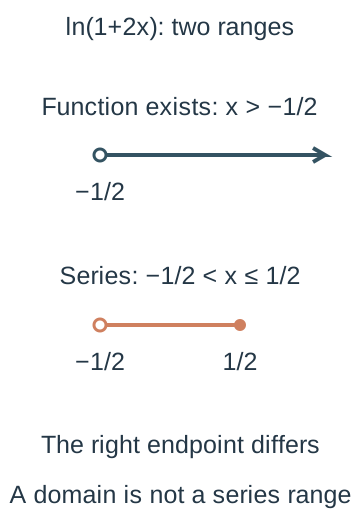
Translating the logarithm range — For ln(1 + 2x), replace the standard input by 2x: 2x − 2x² + (8/3)x³ − 4x⁴ + … . Translate the equality condition −1 < 2x ≤ 1 to −1/2 < x ≤ 1/2. The function itself exists on x > −1/2, but the series does not represent it throughout that whole function domain.For ln(1+2x), the function exists for x>−1/2, while its zero-centred logarithm series represents it only for −1/2<x≤1/2. Open circles exclude the left endpoint; the filled series endpoint includes x=1/2, where the alternating sum is ln2. The arrow indicates the wider function domain continues to the right. The two interval displays are schematics, not function graphs.
A logarithm with a negative input substitution — For ln(1 − 3x), the expansion is −3x − (9/2)x² − 9x³ − (81/4)x⁴ − … . The signs are all negative because the sign of the substituted input combines with the alternating coefficients. The series range −1 < −3x ≤ 1 becomes −1/3 ≤ x < 1/3, with inequality directions handled carefully.
Factoring a nonunit constant — To expand √(4 + x), write 2(1 + x/4)¹⁄². This gives 2 + x/4 − x²/64 + x³/512 + … with guaranteed interior ∣x∣ < 4. Forgetting the outer factor two changes every coefficient. Factoring first also makes the correct substitution and its convergence restriction visible.
An inverse-power compound — For (1 − 2x)⁻², the binomial formula gives 1 + 4x + 12x² + 32x³ + …, general term (r + 1)2ʳxʳ for r ≥ 0, valid for ∣x∣ < 1/2. The original function exists at many points outside that interval, but this expansion about zero cannot be assumed equal there.
Multiplying two series — To obtain terms through xᵐ, multiply every pair of terms whose powers add to at most m. For eˣsin x, through x³ the contributions give x + x² + x³/3. Specifically the cubic coefficient is 1/2 − 1/6, not simply the product of the two cubic coefficients. Do not multiply matching positions only.
Deriving a quotient expansion — Let eˣ/(1 + x) = a₀ + a₁x + a₂x² + a₃x³ + … . Multiply by 1 + x and match the coefficients of eˣ, yielding a₀ = 1, a₁ = 0, a₂ = 1/2, a₃ = −1/3. Thus the expansion is 1 + x²/2 − x³/3 + … on ∣x∣ < 1. The denominator must be nonzero, and the relevant series domains intersect.
Composing an exponential and a logarithm — For eˣln(1 + x), multiply (1 + x + x²/2 + …)(x − x²/2 + x³/3 + …). Through cubic order the result is x + x²/2 + x³/3. The relevant logarithm range still restricts the equality; multiplication does not extend it to all real x merely because eˣ has a global expansion.
Composing through an inner polynomial — For sin(x + x²), set u = x + x² and use u − u³/6 + … . To cubic order, u³ contributes x³, giving x + x² − x³/6. Terms such as 3x⁴ from expanding u³ are beyond that requested order. The size of the inner variable controls what may be neglected near zero.
Cancellation can require more input terms — To find the leading behaviour of sin x − x near zero, the linear terms cancel and the first nonzero term is −x³/6. Keeping only sin x ≈ x would give zero and lose the actual leading order. Inspect possible cancellation before deciding how many terms to calculate.
Dividing after cancellation — For (1 − cos x)/x² with x ≠ 0, first expand the numerator to x²/2 − x⁴/24 + …, then divide to obtain 1/2 − x²/24 + … . Its limit as x tends to zero is 1/2, although the original quotient is undefined at zero. The expansion describes values arbitrarily close to zero while excluding zero itself (a punctured neighbourhood), not an existing original value at the excluded point.
Differentiating a known series — Within an open interval of convergence, a power series can be differentiated term by term. From 1/(1 − x) = Σxʳ obtain 1/(1 − x)² = Σ from r = 1 to infinity of rxʳ⁻¹. Reindexing gives Σ from j = 0 to infinity of (j + 1)xʲ. Endpoint validity must be reassessed after differentiation, rather than carried over automatically.
Integrating a known series — Termwise integration within the convergence interval gives −ln(1 − x) = x + x²/2 + x³/3 + …, with the constant determined by the value at zero. The open interval ∣x∣ < 1 is secure; direct endpoint equality, if needed, requires its own valid check. An integration constant cannot simply be omitted when the value at zero is not known.
Approximation, validity and error awareness
Order notation near zero — Writing f(x) = Pₘ(x) + O(xᵐ⁺¹) means the omitted difference is bounded in magnitude by a fixed constant times ∣x∣ᵐ⁺¹ for sufficiently small ∣x∣. It does not assert that the error equals xᵐ⁺¹ or provide a numerical error bound at every x. State the limit context x→0 when using this notation.
Keeping the correct requested order — An expansion through x³ includes every power up to three, even if some coefficients are zero. If the next actual term is x⁵, sin x = x − x³/6 + O(x⁵) is sharper than a generic O(x⁴), though both can hold near zero. Use the first omitted nonzero order where the structure makes it available.
An exact decimal-input approximation — For e⁰·¹, keeping terms through x³ gives 1 + 0.1 + 0.005 + 0.000166666… = 1.105166666… . The next term is positive, so this finite positive-term truncation underestimates e⁰·¹. The next term alone is not automatically a complete error bound because further positive terms remain.The shared-coordinate graph compares eˣ with 1+x+x²/2+x³/6 on 0≤x≤2. Both start at one and are close near zero, but the finite cubic remains below the exponential for positive x as omitted positive terms accumulate. At x=2 their values are approximately 7.389 and 6.333. The exponential series itself is valid for all real x; the illustration concerns truncation accuracy, not a finite convergence boundary.
An alternating-series error check — At x = 0.2, ln(1 + x) is an alternating series with decreasing term magnitudes tending to zero. Through x³ it gives 0.2 − 0.02 + 0.008/3 = 0.182666666… . The true value is lower and the error magnitude is at most the next term 0.2⁴/4 = 0.0004. This bound uses the stated alternating/decreasing conditions, not just any missing coefficient.
A square-root numerical approximation — To estimate √4.04, use x = 0.04 in the expansion of √(4 + x). Through cubic order the result is 2 + 0.01 − 0.000025 + 0.000000125 = 2.009975125. The actual substitution into the standard square-root series is x/4 = 0.01, which is small; confusing it with 0.04 in the already factored expression changes the result.
Function domain versus series range — The reciprocal 1/(1 − 2x) exists whenever x ≠ 1/2, yet its Maclaurin geometric expansion is valid only for ∣x∣ < 1/2. At x = 1 the function equals −1 while the terms 1 + 2 + 4 + … do not converge. A defined function value is not evidence that its zero-centred expansion converges there.
The centre matters for accuracy — A Maclaurin approximation uses information around zero. For a transformed small input u, it may remain effective even when the original quantity is not near one, as with factoring √(4 + x). If an input is outside the expansion's valid range, adding more terms does not repair that particular series representation.
Rounding and verification — Keep exact fractions during algebra and round only the final requested numerical result. Compare a small test input with a calculator where useful and check parity, the constant value and derivative coefficients independently. Numerical agreement at one point supports error detection but cannot prove a general expansion or its convergence range.
What a final series answer should state — Give the requested coefficients or general term, a clear equality or approximation sign, the order retained where relevant and the appropriate variable restrictions. Explain any cancelled leading terms or excluded original value. Proof of the standard series ranges is not required by this core clause, but recognising and applying those ranges correctly is required.
Test yourself
50 questions · Random sets of 10. These quick checks support revision; practise longer explanations and justified judgements too.
 Mr Kidman's Classroom