Mass times velocity — Momentum is the vector p = mv. Mass is a scalar measured in kilograms; velocity has direction, so momentum has the same direction as velocity and units kg m s⁻¹. Doubling speed doubles momentum, whereas it quadruples kinetic energy. A stationary object has zero momentum but still has mass.
Choose a sign convention — On a straight track choose one positive direction and use it for every velocity before and after an interaction. A 0.4 kg ball moving at 5 m s⁻¹ right has momentum +2 kg m s⁻¹ if right is positive; the same ball moving left at that speed has momentum −2 kg m s⁻¹. Speed alone cannot supply the sign.
Adding vector momenta — Total momentum is the vector sum, not the sum of momentum magnitudes. For masses 2 kg and 3 kg with velocities (4i − j) and (−i + 2j) m s⁻¹, P = (8i − 2j) + (−3i + 6j) = (5i + 4j) kg m s⁻¹. Its magnitude is √41, not 9.
What counts as the system? — Define the particles whose combined momentum you calculate. Contact forces between two included particles are internal; a force from a wall outside that system is external. Their distinction is about the chosen boundary, not whether a force is large. Changing the boundary can change which conservation statement is justified.
Internal impulses cancel — For a pair, equal and opposite interaction forces act over the same interval. Adding m₁(v₁ − u₁) = J₁ and m₂(v₂ − u₂) = J₂ cancels their internal impulses because J₁ + J₂ = 0. The combined change in momentum equals the remaining external impulse.
Conservation needs a reason — Total momentum is conserved when resultant external impulse is zero, or approximately when it is negligible over a short collision. The individual particles generally change momentum. For horizontal impacts on a smooth horizontal track, the vertical weight and reaction balance, while there is no horizontal external impulse.
Impulse and changes of velocity
Impulse is accumulated force — Impulse J is the integral of force with respect to time, and equals change in momentum for constant mass: J = m(v − u). For a constant force, J = FΔt. Its units N s equal kg m s⁻¹. An impulse is neither a force nor an energy, so quote the appropriate units.
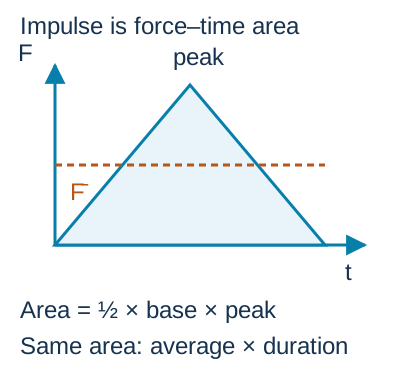
Average force — For a time-varying contact force, F̄ = J/Δt is the constant force with the same impulse over that interval. It need not equal the peak force. A signed force–time graph gives signed impulse as area, with contributions below the axis negative; use separate components for vector forces.A schematic triangular contact-force profile has the same impulse as the dashed average force maintained over the same full duration. The average is half the peak for this triangle only; other force profiles need not share that relation.
Reversing direction — A 0.2 kg ball strikes a wall at +8 m s⁻¹ and rebounds at −6 m s⁻¹. J = 0.2(−6 − 8) = −2.8 N s, directed away from the wall. Subtracting speed magnitudes would give the wrong change; write the final signed velocity before subtracting the initial one.The same positive axis is used before and after contact. Arrows show direction, not a distance or time scale. For mass 0.2 kg, the velocity change −14 m/s gives impulse −2.8 N s; subtracting unsigned speeds is incorrect.
Finding the final velocity — Rearrange J = m(v − u) to v = u + J/m. If a 2 kg particle has u = (3i − 2j) m s⁻¹ and receives J = (−4i + 6j) N s, its velocity becomes (i + j) m s⁻¹. Check each component and use the unchanged mass throughout.
Magnitude and direction of impulse — For J = (−6i + 8j) N s, the magnitude is 10 N s and the direction is in quadrant II, making arctan(8/6) above the negative i direction. A negative component describes direction; a negative magnitude is impossible. A sketch prevents a calculator's principal arctangent selecting the opposite direction.
Impulse from a vector change — A 0.5 kg ball changes velocity from (6i + 2j) to (−2i + 5j) m s⁻¹. The change is (−8i + 3j), so J = (−4i + 1.5j) N s, magnitude √18.25 N s. It is the change vector whose magnitude is needed, not the difference of the two speed magnitudes.The change vector joins the tip of the incoming velocity u to the tip of the outgoing velocity v when both start at the same origin. This schematic illustrates v−u rather than any particular numerical example. Multiply this directed change by mass to obtain impulse.
Weight during an impact — For a vertical collision, the resultant impulse includes weight as well as the contact force. If upward is positive, m(v − u) = J_contact − mgΔt. The contact impulse is therefore m(v − u) + mgΔt. Neglecting gravity requires a justified short-contact approximation; it is not an identity.
Longer stopping time — To stop a fixed incoming momentum, the required resultant impulse is fixed, but increasing stopping time reduces the magnitude of average resultant force. Padding can achieve this by extending deformation time. Momentum reasoning alone does not determine peak force, detailed deformation or injury risk.
Direct collisions and unknowns
Conservation equation for a pair — For a direct collision with negligible external impulse, m₁u₁ + m₂u₂ = m₁v₁ + m₂v₂, using a common sign convention. This is one equation in the two unknown final velocities. Unless additional information is supplied, conservation alone cannot determine both; restitution is developed in the collision chapter.
Particles moving together — If bodies are specified to move together after impact, v₁ = v₂ = v and v = (m₁u₁ + m₂u₂)/(m₁ + m₂). A 2 kg trolley at +5 m s⁻¹ joins a 3 kg trolley at rest: v = 10/5 = +2 m s⁻¹. The equation uses total mass after joining.
Opposite incoming directions — A 2 kg particle at +6 m s⁻¹ and a 1 kg particle at −3 m s⁻¹ move together. Their total momentum is 12 − 3 = 9 kg m s⁻¹; v = 9/3 = +3 m s⁻¹. A positive result means the chosen positive direction, not that both original velocities were positive.
Unknown outgoing velocity — A 1 kg particle at +7 m s⁻¹ hits a stationary 2 kg particle. If the first leaves at −1 m s⁻¹, conservation gives 7 = −1 + 2v, hence v = +4 m s⁻¹. Check the outgoing momenta sum to 7; do not assume the first particle must continue forward.
Inferring an unknown mass — If an unknown mass m travelling at +4 m s⁻¹ joins a 3 kg stationary mass and they move at +1 m s⁻¹, 4m = m + 3, giving m = 1 kg. Include m in the final combined mass; treating the final mass as 3 kg loses the moving particle.
Equal and opposite contact impulses — In the 1 kg and 2 kg example, the first particle's impulse is 1(−1 − 7) = −8 N s; the second's is 2(4 − 0) = +8 N s. Equal impulses in magnitude do not imply equal velocity changes when the masses differ.
Vector systems, checks and model limits
Component equations are independent — In a two-dimensional isolated interaction, conserve total i and j momentum separately. If 2 kg at (3i + j) combines with 1 kg at (−3i + 4j), the final common velocity is (i + 2j) m s⁻¹. Taking magnitudes before adding would destroy the directional information.
Zero total momentum — Two equal masses moving with opposite velocities have zero total momentum although both can carry positive kinetic energy. If they join, they stop in this frame. The initial kinetic energy can transfer into deformation, thermal energy and sound; zero net momentum does not imply no motion before impact.
Centre of mass velocity — For a system of fixed total mass M, V = P/M is the centre of mass velocity: the velocity of the system’s mass-weighted average position. Internal interactions may redistribute particle velocities but do not change V without external impulse. For total momentum (8i − 6j) and mass 2 kg, V = (4i − 3j) m s⁻¹ and its speed is 5 m s⁻¹.
Energy is a separate check — For the 2 kg trolley at 5 joining the 3 kg trolley, initial kinetic energy is ½×2×25 = 25 J and final is ½×5×4 = 10 J. Momentum is conserved while kinetic energy decreases by 15 J. Do not add kinetic-energy conservation unless the model explicitly permits it.
Walls and the Earth — For a ball alone striking a fixed wall, the wall supplies external impulse, so the ball's momentum is not conserved. Including the wall and Earth can make the system effectively isolated, with their huge mass giving negligible speed change. The fixed-wall approximation does not set the ball's impulse to zero.
Particle idealisation — Treating spheres as particles neglects their rotational motion and deformation geometry while retaining mass and translational velocity. A smooth contact transmits no tangential impulse, meaning no impulse parallel to the touching surfaces. Real friction, spin, prolonged contact or substantial external impulse can invalidate this simple model; state which effects are omitted.
Physical and dimensional checks — Every momentum term has units kg m s⁻¹; every impulse term has N s. Substitute final velocities into both component totals, retain signs, and distinguish a velocity from a speed. A conservation result can be algebraically correct yet physically inappropriate if the particles never meet or the stated system receives external impulse.
Written justification — A complete solution names the system and positive directions, justifies negligible resultant external impulse, writes the vector or signed conservation equation, solves using the extra information and interprets the answer. A quiz can sample these elements; it cannot replace a fully justified collision model and calculation.
Test yourself
50 questions · Random sets of 10. These quick checks support revision; practise longer explanations and justified judgements too.
 Mr Kidman's Classroom