Why choose contact axes? — An oblique impact has velocity components both normal (perpendicular) and tangential (parallel) to the touching surfaces. For smooth spheres, the normal is the line of centres at contact; for a smooth plane, it is perpendicular to the surface. Resolve along these axes because only the normal component receives an impulsive change in the ideal smooth model.
Smoothness and impulse — With no tangential contact force, each particle's tangential velocity component remains unchanged through the brief impact. Its normal component changes because of the normal impulse. This is an individual component statement, stronger than merely conserving the sum of tangential momenta for the pair.
Orthonormal basis — Choose a unit normal n and a perpendicular unit tangent t. For velocity u, the scalar normal component is u_n = u·n and the tangential component is u_t = u·t. Reconstruct u = u_n n + u_t t. Non-unit direction vectors must be normalised by dividing by their lengths before using dot products as scalar components.
Normal from sphere centres — For centres A = (1,2) and B = (4,6), B − A = (3,4), length 5, so n = (3/5,4/5). One tangent is t = (−4/5,3/5). These are perpendicular unit vectors. Reversing the normal is allowed if signs and labels are changed consistently throughout.
Resolving a velocity — With n = (3/5,4/5), t = (−4/5,3/5) and u = (5,0) m s⁻¹, u_n = 3 and u_t = −4. Reconstructing gives 3(3/5,4/5) − 4(−4/5,3/5) = (5,0). Components along oblique contact axes are not simply the original Cartesian coordinates.
Equal-radius geometry — For two equal-radius spheres, at contact the centre separation is twice the radius. If one sphere's path has a stated offset from the other's centre, use this right-triangle geometry to find the line-of-centres angle. Do not use the tangent to the path as the impact normal merely because the moving sphere travels along it.
Oblique impact with a fixed plane
The plane reflection rule — With unit normal n, the incoming scalar normal component u_n becomes v_n = −eu_n, while v_t = u_t. Hence v = u − (1 + e)(u·n)n. Either orientation of n gives the same vector formula. This rule applies to a smooth fixed plane, not an arbitrary moving surface.
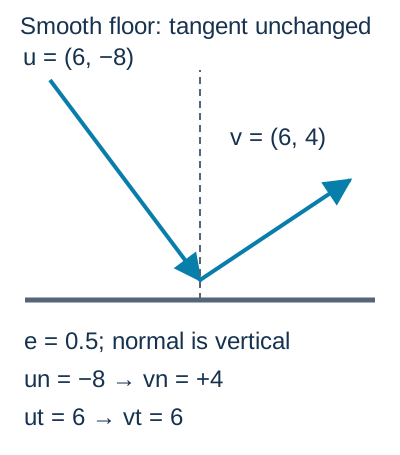
A horizontal plane example — Take upward j as the normal to a horizontal floor. An incoming velocity (6i − 8j) m s⁻¹ and e = 0.5 give outgoing velocity (6i + 4j). The tangential component 6 is unchanged and the downward normal component reverses and halves. The speed falls from 10 to √52 = 2√13 m s⁻¹.The incoming and outgoing arrows have matching horizontal components, while the vertical component reverses and halves. Their slopes represent the stated 6:−8 and 6:4 component ratios. The contact and arrows are placed schematically; the dashed line is the floor normal, not a trajectory.
Impulse at the plane — For a mass 0.2 kg in that example, J = m(v − u) = 0.2(12j) = 2.4j N s, entirely normal. The floor supplies external impulse, so ball-only vector momentum is not conserved. Gravity's impulse during the contact is neglected under the short-impact approximation, not because gravity ceases to act.
Energy loss at a plane — Only the normal kinetic-energy contribution changes, so loss = ½m(1 − e²)u_n². For m = 0.2, u_n = −8 and e = 0.5, loss is ½×0.2×0.75×64 = 4.8 J. The unchanged tangential contribution means the fraction of total energy lost is not generally 1 − e².
Angles measured from the normal — Let the acute incoming and outgoing angles to the normal be α and β, with magnitudes of the components. Then tan α = |u_t|/|u_n| and tan β = |u_t|/(e|u_n|), so tan β = tan α/e when e > 0. For e < 1 the reflected path is farther from the normal. State which line defines each angle.
Angles measured from the plane — If incoming and outgoing acute angles to the plane are θ and φ, tan θ = |u_n|/|u_t| and tan φ = e tan θ when the ratios are defined. These are complementary-angle conventions to the normal version, not contradictory laws. Handle zero tangential or zero outgoing normal components separately.
Special reflection cases — For e = 1, equal acute incidence and reflection angles follow from unchanged tangential and reversed normal components. For e = 0, the particle has no outgoing normal component and moves tangentially or rests if its tangential component is also zero. A grazing path with u_n = 0 has no normal impact impulse in this model.
An inclined plane in vector form — For a plane with tangent direction (3,4), take n = (−4/5,3/5). With u = (5,0) and e = 0.5, u·n = −4. Then v = (5,0) + 6n = (0.2,3.6) m s⁻¹. Its normal component is 2 and the component along tangent (3/5,4/5) remains 3; check by dot products.
Oblique impact of two spheres
Normal pair equations — Take n from A to B and assume (u_A − u_B)·n > 0 immediately before contact. Along n conserve m_Au_An + m_Bu_Bn and apply v_Bn − v_An = e(u_An − u_Bn). These are the direct-impact equations for scalar normal components only.
Tangential pair equations — For smooth spheres, v_At = u_At and v_Bt = u_Bt separately. Solve the normal pair equations, then combine each result with its own unchanged tangent component. Applying restitution to the full speeds or to the tangential relative component introduces a false frictional effect.This schematic uses contact-normal and tangent axes, which need not coincide with horizontal and vertical Cartesian axes. For a smooth pair, solve normal momentum and restitution while preserving each particle’s own tangent component. Reconstruct the full vectors afterwards.
A worked oblique pair — Let m_A = 2 kg, m_B = 1 kg, n = i, u_A = (4i + 3j) and u_B = (−2i + j), with e = 0.5. Normal momentum gives 2v_An + v_Bn = 6 and restitution gives v_Bn − v_An = 3. Thus v_An = 1 and v_Bn = 4, while tangent components remain 3 and 1. Final velocities are (i + 3j) and (4i + j).
Independent vector checks — In that example, initial total momentum is (6i + 7j) and final total is 2(i + 3j) + (4i + j) = (6i + 7j). Impulses are −6i on A and +6i on B. Their equal/opposite normal direction checks both momentum and smoothness.
Energy loss for a sphere pair — Let μ = m_Am_B/(m_A + m_B) and q = (u_A − u_B)·n. The kinetic-energy loss is ½μ(1 − e²)q², since both tangential energies and the normal centre of mass energy remain unchanged. For the worked example μ = 2/3 and q = 6, giving loss 9 J.
Direct energy verification — Initial kinetic energy in the worked pair is ½×2×(16 + 9) + ½×1×(4 + 1) = 27.5 J. Final energy is ½×2×(1 + 9) + ½×1×(16 + 1) = 18.5 J. The 9 J difference agrees with the normal relative-motion formula.
Impulse formulation — For a normal n from A to B, a positive contact impulse magnitude I gives v_A = u_A − (I/m_A)n and v_B = u_B + (I/m_B)n. Restitution gives I = (1 + e)q/(1/m_A + 1/m_B). This form is useful with Cartesian vectors because the impulse direction is explicit.
Separation and contact validity — After solving, verify (v_B − v_A)·n = eq ≥ 0, but also check that the assumed spheres really contact with the stated line of centres. A negative incoming q for A-to-B normal describes separation rather than approach. Equal radii, smooth contact and particle translation are the specified idealisations.
Successive plane impacts and geometry
Update the whole velocity vector — For each fixed-plane impact, use its own unit normal and coefficient: v_next = v_current − (1 + e)(v_current·n)n. A component unchanged at one plane can be normal to the next plane and change there. Keep positions and directions as well as speeds to establish the next contact.
Two perpendicular walls — For successive impacts with x = constant and then y = constant, the x component first reverses and is multiplied by e₁, while y is unchanged; the second impact reverses y and multiplies it by e₂. From (8,−6), first a right wall with e₁ = 0.5 then a floor with e₂ = 2/3 gives (−4,4), provided the geometry permits that order.
Nonperpendicular surfaces — When normals are not perpendicular, transform using the current full vector at each contact. In general the two reflection operations need not commute; changing their order can change the final direction and speed. Resolving once along the original incoming axes and reusing those scalar components at every plane is unsafe.
Finding the next collision point — Between impacts in a uniform-velocity model, use r(t) = r₀ + vt and solve the plane equation n·r(t) = c. The candidate time is (c − n·r₀)/(n·v) when the denominator is nonzero. Require positive time and a point on the actual finite surface; compare all candidate events.
Repeated impacts and total loss — Sum the energy losses calculated from the current incoming normal component at each event. Do not multiply total speed by e at every oblique contact. On perpendicular walls with a common e, each wall only scales its own normal component; the timing and intervening external forces may still affect subsequent incoming components.
Gravity between impacts — Negligible gravity impulse during contact does not imply negligible gravity during a long flight between surfaces. If projectile motion is specified, update position and velocity using the flight time before applying the next impact law. A constant-velocity segment must be stated or justified in its context.
Limits and complete reasoning — Smooth ideal oblique impacts omit spin and tangential friction, and fixed planes omit recoil. Draw contact normals and tangent directions, use unit vectors, establish event order, reconstruct each outgoing velocity and check momentum, energy and geometry. Short component questions provide partial checks rather than evidence of a full geometric impact solution.
Test yourself
50 questions · Random sets of 10. These quick checks support revision; practise longer explanations and justified judgements too.
 Mr Kidman's Classroom