Factoring a polynomial by its roots — If a degree-n polynomial has leading coefficient a ≠ 0 and roots r₁,…,rₙ counted with multiplicity, it factors as a∏(x − rⱼ) over the complex numbers. The symbol ∏ means multiply all the listed factors. Expanding and comparing coefficients relates symmetric root expressions to the polynomial without solving for each root. Repeated roots appear repeatedly in these sums and products.
Quadratic coefficient relations — For ax² + bx + c = 0 with roots α,β, expansion a(x − α)(x − β) gives α + β = −b/a and αβ = c/a. Retain the leading coefficient: for 2x² − 3x − 5 = 0 the sum is 3/2 and the product is −5/2, not 3 and −5.
Cubic coefficient relations — For ax³ + bx² + cx + d = 0, let s₁ = α + β + γ, s₂ = αβ + αγ + βγ and s₃ = αβγ. Then s₁ = −b/a, s₂ = c/a, s₃ = −d/a. The second relation is a sum over unordered pairs, with each pair included once.
Quartic coefficient relations — For ax⁴ + bx³ + cx² + dx + e = 0, the elementary symmetric sums (sums of products using distinct positions in the root list, unchanged when the roots are relabelled) are s₁ = −b/a, s₂ = c/a, s₃ = −d/a, s₄ = e/a. Here s₃ sums all four triple products and s₄ is the product of all four roots. The signs alternate; the constant coefficient's sign depends on degree.
A worked cubic summary — For 2x³ − 3x² − 5x + 7 = 0, s₁ = 3/2, s₂ = −5/2 and s₃ = −7/2. These statements remain exact even if the individual roots are awkward or nonreal. Dividing the entire polynomial by its leading coefficient is a useful first step before comparing monic coefficients.
The sum of squared roots — For any root list, (Σr)² = Σr² + 2Σpair products. Hence p₂ = Σr² = s₁² − 2s₂. For the worked cubic, p₂ = 9/4 + 5 = 29/4. The expression (Σr)² is not the sum of the squares, because its mixed products must be accounted for.
The sum of cubed roots — For three or more roots, p₃ = s₁p₂ − s₂p₁ + 3s₃, where p₁ = s₁ and pⱼ means the sum of the jth powers of the roots. For the worked cubic this is (3/2)(29/4) − (−5/2)(3/2) + 3(−7/2) = 33/8. The threefold-product coefficient comes from how often each distinct triple appears in the expansion.
Higher powers from the equation — Every root r of a monic cubic x³ + Bx² + Cx + D = 0 satisfies r³ = −Br² − Cr − D. Multiply by rᵐ and sum to relate later power sums: pₘ₊₃ = −Bpₘ₊₂ − Cpₘ₊₁ − Dpₘ, with p₀ = 3. This is an algebraic reduction using the root equation, not a separate requirement to learn a general named theorem.
Reciprocal sums and exclusions — For a cubic with nonzero roots, 1/α + 1/β + 1/γ = s₂/s₃. For the worked cubic, it is 5/7. The nonzero-root condition is equivalent to a nonzero constant term. If zero is a root, its reciprocal is undefined and the quotient formula cannot rescue the original expression.
Squared reciprocal sums — For nonzero cubic roots, Σ1/α² = (s₂/s₃)² − 2s₁/s₃, because the pair products of reciprocal roots sum to s₁/s₃. For the worked cubic this gives 25/49 + 6/7 = 67/49. State which root list the symmetric identities are being applied to rather than mixing reciprocal and original pair sums.
Pair-product squares — For cubic roots, (αβ)² + (αγ)² + (βγ)² = s₂² − 2s₁s₃. Each cross product of two pair-products contains αβγ times one root. For the worked cubic this is 25/4 + 21/2 = 67/4. A term like α²β² is not the same as α² + β².
Evaluating a product without expanding roots — For a monic cubic P(x) = ∏(x − r), P(−t) = −∏(t + r), so ∏(t + r) = −P(−t). For a nonmonic cubic divide by its leading coefficient as well. With the worked polynomial and t = 3, the product (3 + α)(3 + β)(3 + γ) is 59/2. Check the degree-dependent sign before substitution.
A quartic worked example — For x⁴ − 2x³ − 7x² + 8x + 12 = 0, the roots are −2,−1,2,3, giving s₁ = 2, s₂ = −7, s₃ = −8, s₄ = 12. Thus p₂ = 18 and p₃ = 26. The reciprocal sum is s₃/s₄ = −2/3. In a quartic, the reciprocal pair sum is s₂/s₄ and reciprocal triple sum is s₁/s₄.
Symmetry and what coefficients determine — Coefficient relations directly determine expressions unchanged when root labels are permuted. They do not identify an arbitrary labelled difference α − β without further information about which root is which. Preserve complex roots and multiplicities; do not discard nonreal roots when applying a degree-four sum relation.
Forming polynomials with transformed roots
Substitute the inverse transformation — If y = pr + q for each original root r and p ≠ 0, then r = (y − q)/p. Substitute x = (y − q)/p into the original degree-n equation P(x) = 0, then multiply by pⁿ to clear denominators. The resulting polynomial has exactly the transformed roots, counted with multiplicity.
The scaling factor of the polynomial — Multiplying a polynomial equation by a nonzero constant does not change its roots. Clearing denominators may give a nonmonic polynomial; divide by a common nonzero factor if appropriate. Never divide by an expression involving the new variable without checking whether roots would be removed.
A cubic shift worked through — For P(x) = x³ − 2x² − x + 2 with roots −1,1,2, let y = x + 3. Substitution P(y − 3) gives y³ − 11y² + 38y − 40 = 0. Its roots are 2,4,5, so their sum 11 and product 40 independently check the coefficients. Using P(y + 3) instead shifts the roots in the wrong direction.
A cubic stretch worked through — For the same P, let y = 2x. Then 8P(y/2) = y³ − 4y² − 4y + 16 = 0, with roots −2,2,4. Only multiplying each coefficient by two would not produce the same root transformation because different powers scale differently.
A combined linear transformation — For y = 2x + 1, calculate 8P((y − 1)/2) = y³ − 7y² + 7y + 15. The transformed roots are −1,3,5, whose pair sum is −3 − 5 + 15 = 7. This verifies a coefficient beyond just the sum and product; expansion errors can preserve one check while failing another.The original roots −1,1,2 all undergo the same map y=2x+1, producing −1,3,5. To form the new equation, substitute the inverse x=(y−1)/2 into the original cubic and multiply by 8. The arrows are value mappings, not distances on a plotted scale.
A quartic shift — For Q(x) = x⁴ − 2x³ − 7x² + 8x + 12 and y = x − 1, substitute x = y + 1. The result is y⁴ + 2y³ − 7y² − 8y + 12, with roots −3,−2,1,2. The transformed root sum is −2, agreeing with the new cubic coefficient. Degree-four transformations use the same inverse-substitution principle.
An independent transformed-sum check — For n roots transformed by y = pr + q, their sum becomes ps₁ + nq. For three roots, the transformed pair sum is p²s₂ + 2pqs₁ + 3q². Use these as independent checks on an expanded cubic, not as replacements for a complete transformed polynomial when all coefficients are needed.
The zero-slope exception — If p = 0, every transformed value is q and the inverse substitution is invalid. A monic polynomial listing n transformed values with multiplicity is (y − q)ⁿ, but it has only one distinct root. The nonzero-p method must not divide by zero or claim the original distinctness is preserved in this exception.
Standard finite sums and changed bounds
The index and the number of terms — In Σ from r = a to b of f(r), a and b are integers with a ≤ b, and the number of terms is b − a + 1. A constant c contributes c(b − a + 1). An index is a dummy variable: renaming r to j changes nothing, but shifting its values changes the summand and limits together.
The three standard power sums — For positive integer n, Σr = n(n + 1)/2, Σr² = n(n + 1)(2n + 1)/6 and Σr³ = [n(n + 1)/2]², with r from 1 to n. The last equality means the sum of cubes equals the square of the sum of the first integers; it does not assert that a sum of cubes is generally a cube of a sum.
Linearity of a finite sum — For fixed constants a,b,c, Σ(ar² + br + c) = aΣr² + bΣr + cΣ1. Keep the number of constant terms explicit. For example Σ from r = 1 to n of (3r² − 2r + 4) = n(n + 1)(2n + 1)/2 − n(n + 1) + 4n.
A polynomial-sum numerical check — At n = 3, the terms of 3r² − 2r + 4 are 5,12,25 and sum to 42. The closed form gives 42 as well. Such a check detects arithmetic/index mistakes but is not a proof for all n; the derivation from established standard sums supplies the general equality.
Removing an initial block — For integer bounds 1 ≤ a ≤ b, Σ from r = a to b of f(r) equals Σ from 1 to b minus Σ from 1 to a − 1. The subtracted upper limit is a − 1, not a, because the first required term must remain. For Σ from r = 4 to 8 of r², subtract the square sum through three from that through eight, giving 190.
Even-indexed and odd-indexed sums — Σ from r = 1 to n of (2r)² = 4Σr². For odd squares, (2r − 1)² = 4r² − 4r + 1, giving n(4n² − 1)/3. There are n odd terms, so the constant contribution is n. Distinguish the largest odd number 2n − 1 from the number of terms n.
Shifting a polynomial summand — To sum (r + 1)² from r = 1 to n, either expand to r² + 2r + 1 or set j = r + 1 and change the limits to j = 2,…,n + 1. Both yield the square sum through n + 1 minus one. Keeping the old limits after changing the variable creates a different sum.
Summing over two n-dependent bounds — For Σ from r = n + 1 to 2n of r, subtract n(n + 1)/2 from 2n(2n + 1)/2, giving n(3n + 1)/2. There are n terms, not n + 1. A closed form may have higher degree than an individual summand because both the number and sizes of terms depend on n.
Method of differences and partial fractions
What makes a sum telescope — If f(r) = F(r) − F(r + 1), then writing consecutive terms shows internal cancellation. For r = a,…,b, the result is F(a) − F(b + 1). The sign/order of the difference controls the surviving endpoints. Show enough initial and final terms to establish the cancellation pattern.
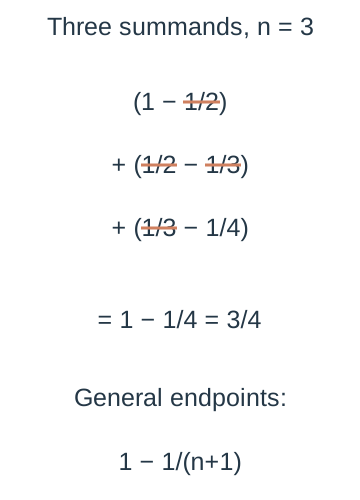
A reciprocal example — Since 1/[r(r + 1)] = 1/r − 1/(r + 1), summing from r = 1 to n leaves 1 − 1/(n + 1) = n/(n + 1). The identity follows by a common denominator and assumes neither denominator factor is zero. These conditions hold on positive integer r.For n=3, expand the reciprocal-difference sum as (1−1/2)+(1/2−1/3)+(1/3−1/4). Matching internal halves and thirds cancel, leaving 1−1/4. The highlighted strokes identify the paired internal contributions; the first one and final negative quarter survive. For general n, the same indexing leaves 1−1/(n+1), with the final reciprocal retained at finite n.
A two-step reciprocal difference — Partial fractions give 1/[r(r + 2)] = (1/2)(1/r − 1/(r + 2)). Summing from one to n leaves (1/2)[1 + 1/2 − 1/(n + 1) − 1/(n + 2)]. Two terms survive at each end. The formula also works at n = 1 when apparently overlapping terms are combined correctly.
Changing the lower bound in a telescoping sum — For Σ from r = 3 to n of 1/[r(r + 1)] with n ≥ 3, cancellation leaves 1/3 − 1/(n + 1). The surviving first reciprocal matches the actual first index. Starting the answer with one would import terms that were never in the original sum.
A cubic denominator — The identity 1/[r(r + 1)(r + 2)] = (1/2)[1/(r(r + 1)) − 1/((r + 1)(r + 2))] makes the sum telescope directly. From one to n the result is 1/4 − 1/[2(n + 1)(n + 2)]. This is equivalent to a full three-term partial-fraction expansion but has a clearer cancellation structure.
Differences of squares — Since (r + 1)² − r² = 2r + 1, summing from r = 1 to n gives Σ(2r + 1) = (n + 1)² − 1. This sum starts at three, whereas Σ(2r − 1) starts at one. A forward difference F(r + 1) − F(r) leaves the final value minus the initial one.
Differences of cubes and the square sum — Expand (r + 1)³ − r³ = 3r² + 3r + 1. Summing from one to n yields (n + 1)³ − 1 = 3Σr² + 3Σr + n. Substitute the known integer sum and rearrange to derive the square-sum formula. The method connects polynomial differences with sums without guessing the final coefficients.
Factoring before partial fractions — For a rational summand, factor the denominator and determine an exact decomposition before summing. For 2/[(r + 1)(r + 2)], use 2/(r + 1) − 2/(r + 2). A shifted starting denominator changes the first surviving term; from r = 1 to n the result is 1 − 2/(n + 2).
An expression need not telescope as guessed — The decomposition of 1/[r(r + 2)] needs the coefficient 1/2; omitting it doubles the original term. Check a proposed partial fraction by recombining or substituting a valid small r. Cancellation of an incorrectly decomposed expression proves a statement about the wrong sum.
Finite identities and infinite limits — After deriving a valid finite sum, a limit may be considered where appropriate. For Σ1/[r(r + 1)], the partial sums n/(n + 1) tend to one. Do not discard final terms at finite n merely because they later tend to zero. A finite telescoping identity alone does not justify convergence of an unrelated infinite series.
Verifying scope and boundary terms — Retain integer/domain restrictions, write the actual first and last denominators, and test a smallest allowed n when a compact expression has overlapping endpoints. Explain why internal cancellation occurs and how many terms survive each end. A numerical total or a string of ellipses without valid endpoint reasoning is not a complete derivation.
Test yourself
50 questions · Random sets of 10. These quick checks support revision; practise longer explanations and justified judgements too.
 Mr Kidman's Classroom