Place is more than a coordinate — Location identifies where something is; place also concerns the physical and human setting, activities and meanings people attach to it. The same street can be a route to work, a meeting place, a site of memory or a source of exclusion. A geographical explanation connects material characteristics with experience rather than substituting either coordinates or feelings for the whole account.
Sense of place is experienced and made — Sense of place concerns the meanings, attachments and understandings associated with a setting. It can arise through repeated routines, relationships, memories, sensory experience and public narratives. It is not one measurable feeling held identically by everyone. Explain whose sense, how it developed and which evidence supports the interpretation.
Attachment can be positive negative or mixed — People may value a place for security and familiarity while also experiencing restriction, discrimination or loss there. Some have weak attachment or multiple attachments. Avoid assuming that long residence guarantees affection or that recent arrival prevents belonging. Personal histories, social relationships, rights and opportunities shape experience.
Insider and outsider are contextual positions — An insider may have familiarity or recognised belonging in a particular setting, while an outsider may lack access or local knowledge. Neither is a fixed category determined solely by birthplace. A person can be an insider in one social network and excluded from another within the same place. Ask how the category is defined and who has power to apply it.
Near and far depend on more than kilometres — Near places may be physically close or experienced as familiar through frequent relationships; far places can be geographically distant yet important through family, work or media. State whether distance is physical, social or experiential. A short travel distance does not guarantee access, while a distant family connection can create strong everyday significance.
Experienced and media places overlap — An experienced place is encountered directly through activity, while a media place is understood through representations such as film, news, images or stories. People commonly know a setting through both. Prior media expectations can shape what is noticed during a visit, and personal experience can challenge a representation. Neither category guarantees a complete or unbiased account.
Identity and place influence one another — People may connect identity with home, language, occupation, religion, generation or other relationships, while place narratives can include or exclude particular identities. Individuals have overlapping identities that change through time. Do not infer a person's beliefs or experience from one census category or assign one authentic voice to an entire neighbourhood.
Place boundaries can be contested — Administrative lines, neighbourhood names, service catchments and lived territories need not coincide. Different groups can describe the same boundary differently or use overlapping areas. Define the area used for a statistical comparison, then distinguish it from the place experienced by respondents. A change in an official boundary can alter a dataset without a corresponding sudden change in everyday life.
Lived experience connects routine and structure — Daily journeys, work, housing, leisure and social encounters reveal how people use and interpret a place. Wider conditions such as transport provision, employment, policing and accessibility shape those routines. A vivid memory can explain meaning but needs context before wider generalisation. Connect individual accounts with material conditions and different opportunities.
Endogenous and exogenous character and change
Endogenous factors describe local characteristics — Location, topography, physical environment, land use, built form, infrastructure and demographic or economic characteristics contribute to a place's character. These are categories for analysis, not proof that local characteristics arose independently of outside connections. A factory or housing layout can be physically local while reflecting an earlier national policy or international investment decision.
Exogenous factors connect places — Relationships beyond the locality include migration, commuting, investment, resource supply, information, institutions and policy. They operate at local, regional, national and international scales. Identify an actual flow or decision and show how it changes local opportunities or meanings. Simply labelling a factor global does not explain its effect.
Physical and human factors interact — Relief, a river or coastal position can influence routes, building, employment and identity, while engineering and planning reshape access and exposure. The physical setting constrains and enables without determining one inevitable social outcome. Compare how institutions and different groups use the same environment and which historical decisions made the present pattern possible.
Past connections leave material traces — Transport corridors, industrial buildings, street patterns and housing can retain evidence of earlier economic and social relationships. Some traces are reused, celebrated, neglected or removed. Current appearance therefore reflects both past and present processes. Establish dates and functions before assuming an old-looking feature proves uninterrupted use or a single historical meaning.
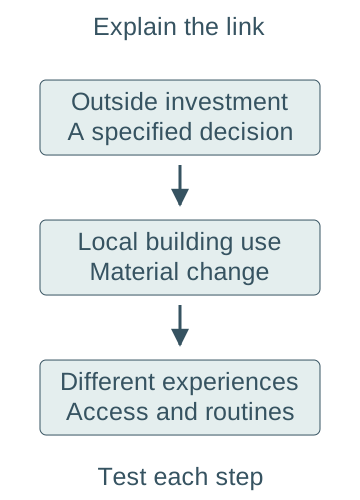
Present flows can reinforce or redirect change — New investment, commuting, migration or digital connections can change employment, services, land use and representation. Effects may reinforce existing advantage or create new opportunities and tensions. Distinguish a flow from its mechanism: investment can alter a building, which changes access or activity, which affects different users' experience.A specified outside investment can change local building use, which can affect access and routines differently for different people. The diagram separates a decision, intermediate material change and lived consequences so each link can be tested. It is a general explanatory framework rather than a claim about either unprovided school place.
Government decisions connect scales — Transport funding, planning, housing, education or service decisions made beyond a neighbourhood can affect daily routines and opportunity within it. Implementation, local budgets and community responses mediate the outcome. Compare the stated aim with actual change and alternatives rather than treating a policy announcement as a completed local transformation.
Corporate and institutional decisions have local consequences — A firm opening, relocating or closing an operation can affect jobs, supplier links, identity and use of space. International or national institutions can also shape funding, rules and investment. Different groups may gain or lose and responses can change the trajectory. A headquarters decision is a starting cause to investigate, not a complete explanation of every later outcome.
Communities also exercise agency — Agency means the ability to act and influence events. Residents, workers, businesses and local organisations can campaign, adapt, conserve, reinterpret or resist proposed changes. Their influence depends on resources, representation and access to institutions. Do not describe local people merely as passive recipients of external forces or assume a campaign group speaks for everyone. Seek evidence of participation, disagreement and actual influence.
Continuity can coexist with transformation — A locality may retain a name, street network or ritual while its employment, population or meanings change. Conversely, a new building can serve an enduring social function. Specify what changed and what persisted, for whom and over what interval. Avoid judging continuity only from visual resemblance or equating every new investment with total cultural replacement.
The school's confirmed thematic emphases — The school teaches both demographic/cultural change and economic change/social inequalities, so students can apply the emphasis relevant to the examination question. Use common concepts, connections, representations and evidence methods for both lenses rather than assuming every answer needs identical material. K5G18 applies both emphases to Wickford/Wickford North and Detroit using located evidence and qualified comparisons.
Meanings, representations and external agencies
Representations select and frame — A representation is an account or image constructed through choices about content, viewpoint, language, timing and audience. A photograph, map, statistic or song can reveal something important while omitting other aspects. Selection does not automatically make a source false; analyse what it can support, what it leaves out and how its form shapes interpretation.
Photographs require spatial and temporal context — Camera position, field of view, framing, lighting, season and time of day affect the image. A busy festival photograph cannot establish typical footfall every weekday. Compare viewpoints and repeated images where suitable, identify location and date, and distinguish visible observation from inferred cause or emotion. Cropping can change the story without altering individual pixels.
Words create associations and expectations — Advertising, reporting, planning documents and local accounts choose labels, metaphors and descriptive contrasts. Calling an area vibrant, neglected, exclusive or traditional frames expectations and can influence decisions. Examine who uses the term, the audience, supporting evidence and omitted voices rather than accepting loaded language as a neutral measured characteristic.
Artistic sources reveal situated meanings — Songs, stories, film, visual art and exhibitions can express memory, identity, aspiration or critique. Their genre and purpose differ from a survey of average residents. Interpret imagery, viewpoint and context without assuming a fictional narrator is the author or an artistic work records a literal typical event. Compare its meaning with other sources rather than reducing it to an opinion score alone.
Maps are constructed representations — Projection, scale, area boundaries, selected features, class intervals, colours and labels shape a map's message. A map can provide systematic spatial evidence yet omit lived routes or perceived danger. A mental map and a land-use map answer different questions. Critique the method and intended use rather than treating either every map as objective truth or every map as useless.
Statistics also involve choices — Indicator selection, categories, collection dates, missing responses and geographical aggregation affect what a statistical account shows. An average can hide substantial within-area variation; one neighbourhood rate does not describe each individual resident. Formal methods improve transparency but do not remove the need to question definitions, quality and interpretation.
External agencies can promote particular meanings — Government, tourist bodies, property interests, corporations and community groups may present a place to attract visitors, investment, residents or support. Their aims can overlap or conflict. Identify the agency, its intended audience, the mechanism by which representation might alter behaviour, and evidence of response. A successful slogan is not automatically improved well-being for every existing resident.
Rebranding and lived change can diverge — A new name, campaign or visual identity may accompany redevelopment or attempt to shift perceptions without comparable material improvement. Compare promised outcomes, actual services and spaces, who can access them and whose histories are retained. Promotion can attract resources yet also obscure exclusion or create expectations that conflict with residents' experience.
Media stereotypes can be challenged — Repeated images and labels may make one narrative seem representative while excluding ordinary experiences or internal diversity. Counter-representations can provide alternative accounts but also have selective purposes. Analyse production, circulation, audience and evidence rather than replacing one unsupported universal story with another. A place can support several partly conflicting meanings.
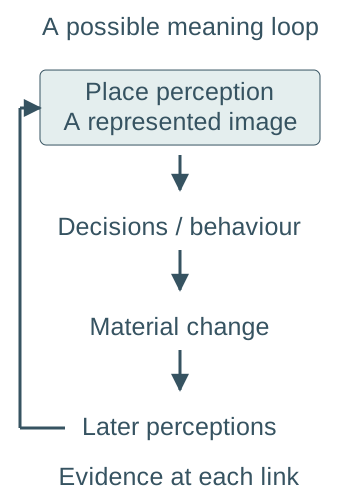
Meaning can influence material outcomes — Perceptions may affect visiting, investment, housing demand, policy priorities or feelings of safety. Those decisions can then change the built environment and later representations. This is a possible feedback loop, not proof that publicity alone caused a measured change. Trace intermediate steps and competing explanations using dated evidence.A represented image can influence behaviour or investment, contributing to material change that then affects later perceptions. The return arrow closes a possible feedback loop. Evidence, timing and competing causes must be checked at each link; the schematic does not show that every promotion causes improvement.
Evidence, methods and critical comparison
Combine quantitative and qualitative evidence — Counts, rates and mapped indicators can establish patterns, while interviews, observations and representations help investigate meanings and processes. These sources can corroborate, complement or contradict. Do not force them into agreement or assume a numerical source automatically outranks an account of experience. Match each source to a claim it can legitimately support.
Census comparison needs consistent definitions — Check the exact population, question wording, categories, geographical coverage and date. ONS guidance for Census 2021 in England and Wales explains that changing questions or response classification can affect comparison with 2011. Historical datasets describe their collection context; they should not be presented as an up-to-date count of every present resident.
Collection context can affect apparent change — Census 2021 in England and Wales took place during the coronavirus pandemic, and some patterns of work, travel or residence differed from a typical non-pandemic period. This does not make the data worthless: it identifies what the observation represents. Use suitable later or complementary evidence before attributing every difference solely to a long-term place process.
Keep boundaries and denominators comparable — An area's population can change because people move or because its boundary is redrawn. Rates require the correct base population, and counts need appropriate spatial context. In invented data, 40 of 200 respondents and 60 of 400 represent 20% and 15%, so a higher count can accompany a lower share. Neither result alone explains why opinions differ.In invented practice samples, 40 of 200 is 20%, while 60 of 400 is 15%. The count rises but the share falls because the second denominator is larger. These are not measured opinions in either school place and do not themselves explain any difference in views.
Repeated photographs need a fair comparison — Match location, camera direction, coverage and relevant season or time before interpreting change. Record differences that cannot be controlled and distinguish permanent alteration from an event or temporary obstruction. A vanished object within a changed frame may have moved outside the image rather than disappeared from the place.
Interviews need purposeful and ethical design — Use clear, open questions, avoid leading assumptions and explain participation, consent and confidentiality. Seek variation in relevant experiences rather than interviewing only convenient friends. A small purposeful sample can illuminate processes without representing population percentages. Record how recruitment, setting, language and researcher position may affect responses.
Coding can make qualitative analysis transparent — Identify meaningful themes in transcripts or representations, define how codes are applied and retain contradictory or minority accounts. Explain whether themes were developed from the material or guided by theory. Counts of coded mentions can describe the sample but do not automatically measure the prevalence of a view among all residents.
Sensory and participant observation need reflexivity — Walking routes, sound descriptions, field notes and participation can reveal everyday meanings and barriers. Reflexivity means examining how your own position and choices influence the research. The researcher chooses when and where to observe and may influence an encounter. Record position, access, expectations and limitations; do not claim a brief visit reproduces everyone's lived experience. Avoid collecting identifying or intrusive material without suitable permission.
Geospatial sources connect pattern and context — A geographical information system (GIS) can overlay dated land use, transport, boundaries and indicators; geolocated photographs or accounts can connect a narrative with a route or site. Coordinate accuracy, scale, licensing, privacy and metadata matter. A point pin on a map does not prove that an experience occurs only there or that an area average applies to the person beside it.
Evaluate sources with provenance and purpose — Record author, date, location, method, intended audience and why the source was produced. Compare public statistics, promotional material, archival records and personal accounts without assuming any is automatically complete. A contemporary recollection of the past is evidence of present memory as well as a possible historical account, requiring appropriate corroboration.
Two place studies and evidence-based judgement
One local and one contrasting place are required — The local setting can be a neighbourhood, locality or community near home or the study centre. The second must offer meaningful contrast and may be in the same country or abroad. Contrast can concern development, density, cultural context or political/economic organisation. Distance alone does not establish an analytically useful comparison.
The confirmed Wickford and Detroit studies — The school has confirmed Wickford, especially Wickford North, and Detroit. K5G18 develops located past-and-present quantitative and qualitative evidence through both taught thematic lenses. Distinguish ward/town and city/metropolitan boundaries, reporting dates and source perspectives. No resident's quotation, attitude, school interview or collected field result is invented; fictional practice values must retain their label.
Build a dated evidence trail for each place — Establish boundaries and context, then connect historical records with current maps, indicators and situated accounts. Trace changes in flows, decisions, built form and meanings, including continuity and contrasting experiences. Use comparable claims across the two places while allowing evidence appropriate to their contexts. Record missing information instead of filling it with a plausible invented history.
Explain rather than list change — A stronger account links a specified connection or agency decision to material change and lived experience through a sequence supported by evidence. Test whether timing, scale or alternative causes weaken the inference. Two simultaneous trends do not by themselves establish causation. Distinguish an interviewee's explanation from a verified claim about what caused the whole pattern.
Make a conditional comparative judgement — Assess the significance of change for different people across local and wider scales, weighting evidence and acknowledging uncertainty. Compare the usefulness and limits of competing representations, not merely whether a source is positive or negative. Return to the question and state where the conclusion applies, which perspectives are underrepresented and what further evidence could alter it.
Test yourself
50 questions · Random sets of 10. These quick checks support revision; practise longer explanations and justified judgements too.
 Mr Kidman's Classroom