Governance is wider than government — Governance includes the rules, institutions and practices through which collective affairs are managed. States are important, but international organisations, firms, scientific bodies, non-governmental organisations (NGOs) and communities also influence decisions and implementation. Global governance does not imply one world government with uniform authority. Identify which actor can make a rule, implement it, monitor behaviour or challenge a decision.
Norms, laws and institutions have different roles — A norm is an expectation about appropriate conduct; a legal obligation arises under an applicable legal system; an institution organises repeated cooperation and decision-making. Voluntary guidance and a binding treaty article do not have identical status. Norms can influence reputation and later law, while a written legal rule still needs implementation and compliance.
Cooperation addresses cross-border problems — Pollution, financial instability, disease, trade and shared ecosystems can cross boundaries that individual governments cannot manage alone. Cooperation may pool evidence, coordinate standards and reduce incentives to shift harms elsewhere. Interests can nevertheless conflict over who pays, whose priorities count and how benefits are divided. A shared problem does not guarantee agreement on a shared response.
The post-1945 UN provides a framework — The United Nations, founded in 1945, supports cooperation through bodies with different mandates and decision procedures. Environmental coordination, development support and peace/security functions are not interchangeable powers. The presence of the UN in an issue does not mean it directly governs every site or enforces every related treaty. Match a claimed action to the relevant body's actual authority.
Growth and stability can accompany unequal power — International agencies can support information, finance, capacity and predictable cooperation. Their priorities, membership influence, funding and policy conditions may also reproduce inequality or neglect less powerful groups. Evaluate a specified mechanism and outcome rather than assuming an international label proves fairness or, conversely, that every institution is ineffective.
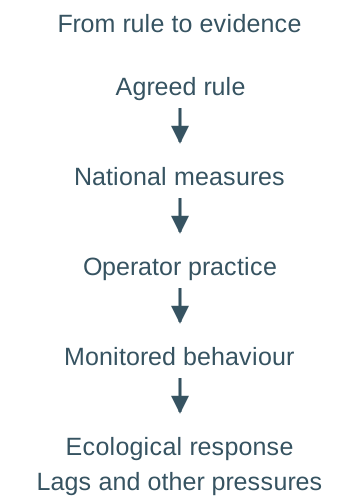
Rules operate through multiple scales — An international agreement may require national legislation, permits, budgets and inspections, implemented through operators and local decisions. A local observation can enter national scientific advice and influence international policy. Scale is a relationship, not a ladder on which only the highest level matters. Trace the chain from rule-making to on-the-ground behaviour and feedback.
Sovereignty and consent create constraints — States negotiate obligations while retaining important powers and interests. Membership, reservations (formal limits on accepting particular treaty provisions), jurisdiction (the reach of legal authority) and dispute procedures affect whom a rule binds and how it operates. A treaty may create real commitments without a central police force. Distinguish legal scope, practical ability and political willingness rather than treating absence of global police as absence of all regulation.
Representation and capacity shape participation — Formal access to meetings does not give all participants equal scientific, legal, financial or logistical resources. A small delegation may struggle to assess lengthy technical proposals or sustain monitoring. Collective representation, assistance and transparency can improve participation. Ask whose knowledge and interests are represented, including people affected far from the negotiation venue.
Evaluate implementation as well as ambition — A strong objective on paper is different from implementation, compliance and ecological outcome. Track obligations, funding, reporting, monitoring, responses to breaches and observed change. A lack of immediate environmental recovery does not alone prove a rule failed if damage has long lags; equally, announcing a protected area does not establish that threats have ceased.
Global commons and Antarctic geography
Commons involve shared benefits and responsibilities — The global commons concept concerns areas or systems with interests and benefits extending beyond any one state. Legal arrangements differ among ocean spaces, atmosphere, outer space and Antarctica; the label does not create identical ownership or access rights. Sustainable development must be considered alongside protection and the interests of other users and future generations.
Shared use can create collective-action problems — An actor may gain a private benefit from extra extraction while spreading environmental costs among others. If every actor reasons similarly, cumulative pressure can damage the shared resource. This is a risk model rather than an inevitable fate: rules, monitoring, cooperation and legitimate institutions can change incentives and behaviour. Explain the assumptions rather than declaring all commons doomed.
Antarctica is a continent surrounded by ocean — Unlike the Arctic's ocean-centred geography, Antarctica contains a substantial landmass covered by extensive ice and surrounded by the Southern Ocean. Mountains, plateaus, coastal margins, islands and ice-free areas create varied settings. Ice cover does not mean there is no land, rock, ecology or human activity. Distinguish continent, surrounding seas and the wider study region.
The Antarctic Convergence is a physical boundary — The Antarctic Convergence, associated with the Antarctic Polar Front, marks a meeting zone between colder Antarctic and warmer sub-Antarctic waters. Its position varies geographically and through time rather than following one fixed latitude circle. The specified geographical study includes the Southern Ocean north to this zone; that physical boundary is not identical to every treaty's legal limit.
Different legal maps overlap — The Antarctic Treaty applies south of 60°S, while the marine conservation convention defines its own wider area using specified coordinates associated with the Antarctic ecosystem. A shifting ocean front and a fixed legal boundary answer different questions. When assessing an activity, locate it and identify the relevant instrument rather than assuming one outline governs every operation in the Southern Ocean.
Cold, dryness and elevation interact — High latitude brings seasonal solar variation; a high, ice-covered interior and atmospheric conditions contribute to extreme cold and low precipitation in many interior areas. Coastal and peninsula environments differ from the interior. A cold desert can retain enormous accumulated ice because low temperatures limit losses, so dryness and extensive ice are not contradictory.
Seasonality shapes access and life — Long summer daylight and winter darkness influence productivity, weather, field operations and access, with latitude-dependent variation. Seasonal sea ice expands and retreats, affecting habitats and navigation. One season's conditions or one coastal station do not represent the whole continent. Date observations and distinguish long-term climate from event weather.
Winds and ocean circulation connect the region — Strong westerly circulation over the Southern Ocean and cold-air drainage from elevated ice influence regional environments. Ocean fronts, currents, mixing and sea-ice processes connect Antarctica with wider heat, carbon and nutrient exchange. A katabatic wind flows downhill as cold, dense air drains under gravity. Not every Antarctic wind is katabatic, and the circumpolar system is not one impermeable wall isolating every substance and organism.
Land ice, shelves and sea ice differ — An ice sheet rests largely on land; an ice shelf is a floating extension of land ice; sea ice forms by freezing seawater. Loss of grounded land ice adds water to the ocean, while floating ice loss has a different direct sea-level effect. Ice shelves can restrain grounded ice flow, so their thinning can matter indirectly for future discharge.
Marine food webs link threats across scales — Phytoplankton support consumers including krill, which provide food for many fish, seabirds, seals and whales. Not every species depends on the same pathway to the same degree. Harvesting, sea-ice change, temperature and pollution can interact. A food-web explanation follows dependencies and spatial/seasonal overlap rather than treating a harvested species as isolated from its predators.
Global importance is not measured only by visitors — Antarctic ice influences sea level and albedo; Southern Ocean processes affect circulation and carbon exchange; research records inform understanding of Earth-system change. These create interests for distant coastal communities and future generations. A place with few permanent residents can therefore have large global significance, without granting every actor an unrestricted right to exploit it.
Pressures, vulnerability and conflicting uses
Climate impacts vary within Antarctica — Atmospheric and ocean changes affect regions differently. Warm water reaching ice-shelf cavities can increase basal melting in vulnerable sectors, while snowfall and circulation also affect ice balance. Distinguish grounded ice mass, ice-shelf condition, sea-ice extent and air temperature. One measure or one region should not be used as proof that every part is changing at the same rate.
Sea-ice change affects ecology and access — Changes in seasonal ice timing and distribution can alter habitat, food-web processes, breeding conditions and human navigation. Effects vary among species and places; less ice is not universally beneficial access or uniformly harmful to every organism. Use the appropriate season, location and biological mechanism, and avoid equating sea-ice area with the mass of the continental ice sheet.
Fishing has direct and ecosystem effects — Krill and finfish harvesting can affect target populations, dependent predators, bycatch and local food availability. Total annual catch alone may hide concentrated pressure near breeding colonies or during sensitive seasons. Stock uncertainty, illegal activity, changing climate and fleet behaviour complicate management. Assess where and when extraction occurs as well as its overall amount.
Whaling has a distinct historical and governance context — Historical commercial exploitation depleted many whale populations, with species-specific recovery and continuing threats such as bycatch, ship strikes and environmental change. Whale regulation differs from krill or toothfish management. Distinguish a species, population, period and jurisdiction rather than claiming every whale has recovered equally or that one moratorium ends all threats.
Mineral interest does not equal permission to mine — Potential resource interest can be driven by commodity demand, strategic concerns and technological change, but the Environmental Protocol prohibits Antarctic mineral-resource activities other than scientific research. Physical conditions, costs and uncertain knowledge also constrain prospects. A news claim about a deposit is not proof of a commercially recoverable reserve or lawful extraction.
Tourism concentrates activity unevenly — Visitors, ships, aircraft and landing sites create pressures through disturbance, trampling, emissions, waste, accident risk and movement of organisms or pathogens. Many visits concentrate at accessible coastal sites rather than spreading evenly across the continent. Visitor totals should distinguish passengers, landings and voyages; repeating visits to one sensitive site can matter more than the continental average density.
Scientific activity also has a footprint — Stations, fuel storage, runways, field camps, sampling and resupply support valuable research but can disturb habitats, generate waste or create spill and biosecurity risks. Scientific purpose does not automatically remove environmental obligations. Compare alternatives, necessity, cumulative effects, restoration and monitoring while recognising the global public value of reliable evidence.
Small introduced organisms can have large effects — Seeds, soil, microbes or pathogens can travel on clothing, footwear, equipment or cargo. Cleaning, checks and operational controls reduce risk, but efficacy depends on implementation and follow-up. A low visitor headcount does not imply zero introduction risk. Warming and disturbance may alter establishment opportunities, so prevention and monitoring should be considered together.
Cumulative impacts can exceed separate assessments — Several operators may each have a modest local footprint yet together increase disturbance, traffic, pollution or pressure on the same wildlife. Effects can interact with climatic change and recovery times. Evaluate the combined place and period rather than adding only independent project claims. The absence of a single dramatic incident does not establish long-term sustainability.
Treaty system, environmental protection and compliance
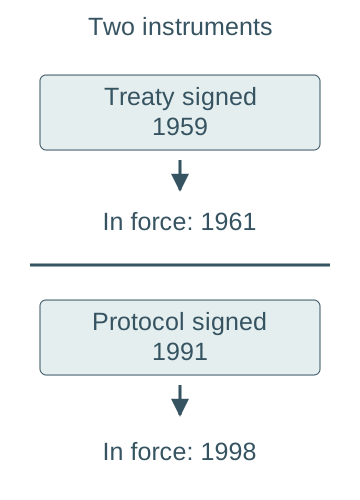
Separate signing from entry into force — The Antarctic Treaty was signed in 1959 and entered into force in 1961. The Environmental Protocol was signed in 1991 and entered into force in 1998. The dates refer to different legal stages, not conflicting versions of one event. Keep a dated chronology when explaining how scientific cooperation and later environmental governance developed.The Antarctic Treaty was signed in 1959 and entered into force in 1961; the Environmental Protocol was signed in 1991 and entered into force in 1998. These paired stages belong to two different instruments. Arrow lengths do not represent elapsed time.
Peace and science are central treaty purposes — The Treaty reserves the region for peaceful purposes and protects scientific investigation and cooperation. It prohibits military measures while allowing military personnel or equipment for peaceful purposes such as logistical support. It also addresses nuclear explosions and radioactive waste disposal. Do not infer that any military aircraft automatically proves a prohibited military activity.
Sovereignty claims were put into a protected status quo — Article IV preserves parties' positions concerning territorial claims rather than resolving them or granting one state ownership of the continent. New claims and enlargement of existing claims are barred while the Treaty is in force. Scientific occupation is not a new legal basis for sovereignty under that arrangement. A map of claims is therefore different from a map of internationally settled borders.
Consultative participation and decisions need context — Consultative parties participate in treaty decision-making through the relevant arrangements, while other parties and observers have different roles. Consensus means reaching agreement without a formal objection blocking the decision under the relevant procedure. It can support shared commitment but can also slow agreement where interests conflict. Scientific capacity and operational presence affect influence. Avoid equating accession with identical decision status or treating an observer's participation as a governmental vote.
Inspection is a real transparency mechanism — Under Article VII, designated observers from consultative parties can inspect Antarctic areas and facilities within the treaty provisions. Inspection reports can identify shortcomings and inform later responses. The existence of inspection rights is not proof that every facility is inspected continuously. Remote distances, resources, cooperation, reporting and follow-up affect practical oversight.
The Protocol adds environmental duties — The 1991 Protocol frames protection through environmental principles and annexed rules, including impact assessment, wildlife, waste, marine pollution and protected areas. Its mineral-activity prohibition has an exception for scientific research. Different annexes have their own legal histories; a negotiated annex is not automatically in force. Identify the applicable obligation instead of assuming every announced instrument already binds every activity.
The Protocol does not expire in 2048 — Neither the Treaty nor the Protocol has a termination date. From 2048 a consultative party can request a review conference under the Protocol's procedures; this is not automatic expiry or automatic permission to mine. Amendment and entry-into-force requirements remain, and removal of the mineral prohibition faces additional conditions. A date for possible review must not be taught as a sunset clause.
Environmental assessment precedes decisions — Article 8 and the relevant annex require assessment of Antarctic activities, with levels linked to potential impacts. Assess alternatives, likely direct and cumulative effects, mitigation and monitoring before deciding. Completing paperwork does not establish that an activity has no effect; compare the assessment with implementation and observed results. Scientific operations and tourism both need appropriate consideration.
National implementation connects agreements to operators — Parties use their legal and administrative systems to authorise, regulate and monitor relevant expeditions, operators and nationals. Permits, reporting, inspections and national responses form part of compliance. There is no single Antarctic government issuing every operational instruction. A failure in one implementation chain can weaken a collectively agreed objective.
Marine conservation involves CCAMLR — The marine living-resources convention was adopted in 1980 and entered into force in 1982. The Commission for the Conservation of Antarctic Marine Living Resources (CCAMLR) uses a precautionary ecosystem approach, taking action to limit ecological risks despite incomplete knowledge and considering target, dependent and associated species; conservation includes rational use rather than a universal ban on fishing. Its geographic scope and instruments differ from the land-focused shorthand often used for the Treaty System.
Marine rules need monitoring and enforcement — Catch limits, spatial or seasonal controls, scientific observation, vessel monitoring, reporting and inspection arrangements can support marine conservation. States and operators have practical responsibilities, while illegal, unreported or unregulated activity creates challenges. The adoption of a measure is different from documented compliance and ecological outcome. Use dated official measures rather than inventing a timeless quota or protected-area percentage.
IWC, UN agencies, NGOs and critical appraisal
The IWC is a separate intergovernmental body — The International Whaling Commission derives from the 1946 whaling convention. It is not a UN agency or a department of the Antarctic Treaty Secretariat. Its whale-related mandate intersects with wider Southern Ocean protection but does not make it the regulator of every fishery, mineral project or research station. Institutions can cooperate while retaining distinct legal foundations and powers.
The whaling moratorium has a precise scope and chronology — The IWC adopted its commercial whaling moratorium in 1982, applying from the 1985/86 season. It is a pause in commercial catch limits under the whaling regime, not a simple statement that every whale catch by every state everywhere is prohibited. Objections, reservations, membership and separate subsistence provisions matter. Check current activities separately rather than copying a historical research-whaling account as present practice.The commercial whaling moratorium decision was adopted in 1982 and applied from the 1985/86 season. Its commercial scope and legal qualifications must be retained. The diagram does not claim that every whale catch everywhere became prohibited.
Monitoring whales does not remove enforcement limits — Scientific advice, catch reports, population assessment and review of infractions support the regime. States implement relevant obligations, while disputes over scope, membership and compliance can constrain collective action. Compare evidence of population outcomes, reporting and practical restrictions instead of assuming the word moratorium guarantees universal enforcement or that exceptions make every part of the regime meaningless.
UNEP contributes through evidence and coordination — The UN Environment Programme is within the UN system and supports environmental assessment, agenda-setting, cooperation and capacity. It can contribute to understanding global pollution, climate and ecosystem pressures affecting Antarctica, but it does not replace treaty parties, CCAMLR or the IWC as the specific decision-making bodies for their mandates. Distinguish influence and coordination from direct permitting or policing power.
NGOs can monitor advocate and widen scrutiny — Environmental groups can analyse threats, publish evidence, campaign, propose stronger protection and participate through authorised observer arrangements. The Antarctic and Southern Ocean Coalition provides a named example of coordinated environmental advocacy. NGOs do not automatically hold state votes or legal enforcement powers. Assess evidence methods, independence, expertise and the difference between an advocacy proposal and an adopted rule.
Industry cooperation is not independent regulation — Tourism operators can coordinate guidance, training and operational practices, potentially improving behaviour beyond a minimum rule. An industry association represents participating businesses and should not be treated as the same actor as an independent conservation NGO or a treaty authority. Voluntary membership and monitoring coverage affect reach. Compare self-reported compliance with independent evidence and applicable national obligations.
Judge outcomes through a chain of evidence — A convincing appraisal identifies the threat, legal scope, decision, implementation, monitored behaviour and ecological response. Consider a counterfactual (what might have happened without the rule), time lag, uncertainty and competing pressures such as climate change. More inspections or a new protected designation can be relevant evidence without alone proving recovery. Conversely, continuing damage can coexist with some avoided harm relative to an unregulated alternative.A rule is translated through national measures and operator practice, then assessed through monitored behaviour and ecological response. This schematic evidence chain is not proof that every stage succeeds. Other pressures, response lags, uncertainty and the counterfactual remain necessary in evaluation.
Global consequences extend beyond Antarctic operators — Protection affects scientific knowledge, marine ecosystems, global sea-level risk and the interests of distant communities, while restrictions can impose costs on fishing, tourism and national programmes. Decisions involve current livelihoods and future generations with unequal influence. A geographical judgement should connect these scales and identify whose sustainable-development interests are advanced or constrained, rather than treating Antarctica as remote from ordinary lives.
Test yourself
50 questions · Random sets of 10. These quick checks support revision; practise longer explanations and justified judgements too.
 Mr Kidman's Classroom