The financial inheritance of 1558 — Elizabeth inherited debts, the effects of earlier currency debasement and the cost of war and government. Royal income depended on a limited fiscal structure, the arrangements for raising and spending government money, rather than a modern national income tax. Distinguish an inherited debt, a year's revenue and the expenses of a particular campaign; each measures a different aspect of the financial position.
Ordinary revenue — Customary Crown income included rents from royal lands, customs duties and feudal rights, inherited obligations linked to landholding and status, or other established rights. These receipts could support ordinary government but did not automatically grow at the same pace as prices or military expenditure. Identify the source and its limits rather than assuming the queen could simply raise any sum without political or economic consequences.
Extraordinary parliamentary grants — Subsidies and other parliamentary grants helped meet exceptional expenditure, especially war. The Crown had to secure consent and organise assessment and collection. Parliamentary taxation was important without being the whole of royal income. A grant voted in one year might arrive in instalments, so its nominal total was not necessarily ready cash available immediately for a campaign.
Customs and the Book of Rates — Customs receipts depended on trade, rates and administration. The revised Book of Rates of 1558 increased valuations used in assessing duties and helped the early Elizabethan fiscal position. It was an inheritance of that year, not proof that Elizabeth invented customs taxation. Revenue could grow with trade while remaining vulnerable to disruption and the practical costs of collection.
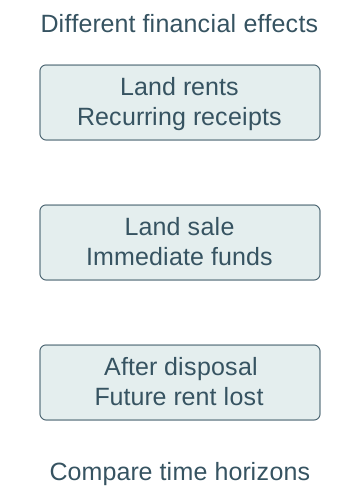
Crown lands and asset sales — Rents provided recurring income, while selling land could raise a large immediate sum. Disposal could also sacrifice future rent and influence, so sale proceeds should not be treated as a permanently improved annual income. Assess the timing and alternatives: an urgent wartime need could make asset sales attractive even when their long-term consequences were undesirable.Keeping an estate can provide recurring rent, whereas selling it raises immediate funds but may remove future receipts and influence. This is a distinction between financial effects, not a claim that every estate had equal value or that no urgent sale could be justified.
Wardship and other feudal rights — The Crown derived income and patronage from rights including wardship over some underage heirs and arrangements involving their estates or marriages. These were legal features of the contemporary system, not modern general welfare provision for all children. Their financial yield and political sensitivity help explain why revenue and patronage often overlapped.
Purveyance — Purveyance was the Crown's right to obtain goods and transport for royal needs on privileged terms. It could reduce immediate government costs while imposing burdens or delayed payment on suppliers. Distinguish a saving to the Crown from a saving to society as a whole. Complaints reflected the distribution and administration of burdens, not merely hostility to every royal household expense.
Loans and anticipation — Borrowing could bridge the gap between expenditure and incoming receipts, while anticipation committed future revenue to current needs. These mechanisms improved liquidity, the cash available when payments fell due, without creating free income. A loan must eventually be repaid or refinanced and may involve interest or political obligations. Assess the debt's terms and purpose instead of counting borrowed funds as evidence that underlying annual revenue had permanently risen.
Inflation and royal finances — If prices and wages paid by government rose faster than fixed or slowly adjusted receipts, the real value of revenue fell. Inflation also affected households and the yield of assessments based on outdated valuations. Separate nominal pounds from purchasing power. An increase in cash receipts might coexist with worsening ability to fund ships, provisions or administration.
Underassessment and taxation limits — Tax assessments could fail to reflect the full value of wealth or changing economic circumstances. Local officials and taxpayers had interests in how liabilities were recorded and collected. A statutory rate alone therefore does not reveal actual revenue. Explain assessment, collection and evasion or understatement before claiming that parliament's grant solved a financial problem.
Economy and restraint — Limiting household expenditure, avoiding unnecessary war and scrutinising officials could reduce costs. Such restraint helped early financial recovery but could create problems if it withheld resources needed for defence or administration. Frugality is a policy to evaluate, not an automatic explanation of success. Compare what was saved with the consequences of delayed or inadequate spending.
Cecil and financial administration — William Cecil's work, particularly as Lord Treasurer from 1572, linked financial records, control of commitments and political judgement. Effective administration could improve the use of existing income without abolishing structural limits. Distinguish a minister's effort to restrain costs from the much stronger claim that he could make a long war inexpensive or remove inflation from the economy.
Recoinage of 1560–1561 — Recoinage sought to replace debased money with sounder coinage and restore confidence in the currency. It addressed a monetary legacy of earlier reigns and could support trade and financial credibility. It did not by itself remove population pressure, harvest shortages or every source of inflation. A successful currency reform should not be inflated into a complete cure for poverty.
Monopolies as grants and grievances — Exclusive rights over trade or production could reward service and provide benefits to recipients without an immediate cash payment from the treasury. They might also raise prices, restrict competition or encourage abuses. Their apparent low direct cost to the Crown did not mean there was no burden on consumers or producers. Analyse the particular grant and its operation rather than assuming every exclusive right had identical effects.
Financial success across the reign — Early recovery and restraint need comparison with the exceptional strains of the later wars. The Crown survived and financed major commitments, but dependence on grants, borrowing and asset sales reveals limits. Assess debt, recurring income, liquidity and military outcomes separately; survival is not the same as freedom from financial pressure, and later difficulty does not erase earlier administrative achievements.
Trade, work and the causes of poverty
Overseas trade and royal policy — Trade could generate customs, employment, investment opportunities and diplomatic interests. Its benefits were uneven across merchants, workers and regions, and commercial expansion could coexist with insecurity. Connect a particular development to revenue or livelihoods through a mechanism rather than using the existence of voyages as proof that every household became prosperous.
Cloth exports and changing markets — Cloth remained central to English exports, but demand, market access and competition could fluctuate. Producers, merchants and workers were affected differently by a disrupted market or changing product. A national export total cannot directly describe every weaving district. Explain how sales, wages and employment were connected before attributing all poverty to one commercial downturn.
Chartered trading companies — Royal charters gave companies privileges to organise trade in particular areas. The Muscovy Company predated Elizabeth, while the Levant and East India companies illustrate later expansion, with the East India Company chartered in 1600. Distinguish a company's legal foundation from immediate commercial dominance or the later scale of empire. A charter created opportunities, not a guarantee of successful voyages or equal national benefits.
Privateering and war — Government-authorised private maritime attacks could damage enemy commerce and bring profits, but returns were uncertain and intertwined with diplomacy and conflict. A profitable seizure was not a stable annual tax stream. Consider investment, risk, retaliation and effects on neutral or civilian interests rather than celebrating every expedition as uncomplicated economic development.
Expansion, violence and enslavement — Some English maritime ventures involved the trafficking and enslavement of African people, violence and coercive exchange. Commercial gains for participants must not be treated as equivalent to general well-being. Analyse who profited and who suffered, while keeping the scale and organisation of Elizabethan activity distinct from the much larger later British slave-trading and imperial systems.
Population and resource pressure — Population growth increased demand for food, land, housing and work. If supply and employment failed to keep pace, rents and prices could rise while real wages suffered. Population growth was a structural pressure, not an automatic explanation of every local disturbance. Its effects depended on harvests, access to land, markets, household composition and opportunities for employment.
Harvest failures and subsistence — Poor harvests could reduce grain availability and raise food prices, placing the greatest pressure on households spending much of their income on food. Successive failures in the 1590s intensified hardship. Distinguish aggregate scarcity from unequal access: grain might exist elsewhere but be costly or difficult for a particular household to obtain.
Real wages and uneven prosperity — A worker's real wage depends on what earnings can buy, not only the cash amount paid. Rising prices could reduce living standards even if nominal earnings rose. Landowners or successful merchants might gain while labourers struggled, so one group's prosperity is not evidence of uniform national improvement. Use compatible dates, places and price measures when comparing incomes. In an explicitly invented practice comparison, a wage index rises from 100 to 110 while a living-cost index rises from 100 to 120. Relative real earnings become 110/120, about 0.917 of the starting level, a fall of about 8.3%. These are teaching numbers, not a measured Elizabethan wage series.In invented practice indices, wages rise from 100 to 110 while living costs rise from 100 to 120. Real earnings become 110/120 of their initial level, about 0.917, so purchasing power falls about 8.3%. These are not measurements from an Elizabethan wage series.
Enclosure, work and mobility — Changes in landholding and land use could alter employment, common rights and household security. Not every enclosure had the same effects or produced immediate displacement, but losses of access could combine with price pressures and insecure work. People might move in search of employment; movement itself was not proof of criminal intention, despite official suspicion of uncontrolled mobility.
The Statute of Artificers — The 1563 statute sought to regulate employment, apprenticeship, service and wages within an ordered labour system. It reflected assumptions about discipline and the proper organisation of work, with responsibilities for local officials. Regulation did not guarantee full employment or a wage sufficient for every household; distinguish the law's purposes and provisions from its uneven practical effects.
Apprenticeship and labour discipline — Apprenticeship could provide training and a route into a trade while also regulating entry and binding young people to service. Requirements could restrict some workers' opportunities. Analyse training, social order and access together rather than treating regulation as either universal protection or simple oppression. Local implementation and the kind of work mattered.
Contemporary categories of the poor — Officials distinguished people considered unable to work from those regarded as able-bodied or disorderly. Terms such as “deserving” and “undeserving” express contemporary judgements rather than neutral facts about moral worth. Illness, age, disability, low wages and lack of employment could all create need. Explain the assumptions behind a policy without adopting its stereotypes as the historian's own description.
Relief, regulation and local order
Relief developed over time — Elizabethan poor relief grew from earlier local and national measures rather than beginning suddenly in 1601. Charity, municipal experiments and legislation interacted. A chronological explanation should show how registration, taxation, work provision and punishment developed; avoid attributing every element of the final framework to one original Act or one individual minister.
The legislation of 1572 — The 1572 law combined provision for the registered poor with punishment of people classified as vagabonds, a contemporary label for people moving without recognised work or support. Local assessment and contributions made relief a governing responsibility as well as a matter of voluntary charity. Its punitive language reveals anxieties about mobility and order. The combination of assistance and coercion is essential to explaining policy, rather than describing only one side.
Work provision in 1576 — Measures in 1576 sought stocks of materials to set the able-bodied poor to work and arrangements for correction. Providing materials could help organise employment but depended on local finance, markets and administration. A legal requirement to create work did not itself create profitable demand for every product or remove the wider causes of unemployment.
The poor-law framework of 1597–1598 — The parliament that began in 1597 produced legislation receiving assent in 1598, often referred to as the 1597 poor-law measures. These organised parish responsibilities and relief more systematically. Explain the dating convention rather than treating 1597 and 1598 references as necessarily different reforms. The context included severe hardship and concern about disorder in the later reign.
The 1601 poor law — The 1601 framework developed earlier measures through parish overseers, locally raised funds, relief for those unable to work, work provision and apprenticeship arrangements. Justices of the peace supervised important aspects of administration. It created a framework of obligation rather than a modern centrally funded welfare service. Local wealth, attitudes and administrative capacity continued to affect what people received.A national legal framework assigned local obligations. Parish resources, overseers and supervision affected practical relief and work provision. The chain does not imply equal resources, identical assistance or the elimination of poverty.
Parish rates and unequal capacity — A compulsory local rate could make funding more reliable than purely voluntary giving, but a poor parish might face great need with a weak tax base. Household assessments and enforcement could also provoke resistance. Separate the existence of legal powers from the adequacy and fairness of provision. A national framework did not necessarily yield identical entitlements or experiences everywhere.
Order, relief and legitimacy — Assistance could reduce desperation and support stability, while punishment aimed to deter behaviour authorities regarded as threatening. These purposes were related but could conflict if coercion harmed people genuinely seeking work. A judgement should consider resources, actual provision and treatment of recipients alongside the government's stated desire for an orderly commonwealth.
Evaluating the response to poverty — Compare policy development with the scale and causes of hardship, implementation and outcomes. The survival of a framework beyond Elizabeth suggests institutional importance, but later longevity does not prove that poverty ended in her reign. Distinguish managing need, controlling mobility and preventing unrest from eliminating structural poverty.
War, hardship and rebellion in the later years
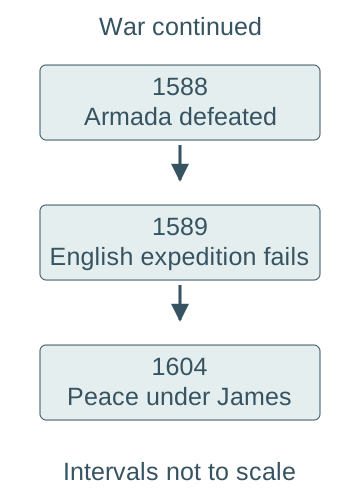
1588 was not the end of war — The defeat of the Armada was a major success but did not end conflict with Spain. War continued beyond Elizabeth's death, with peace concluded under James in 1604. Later expeditions, naval commitments and involvement in the Netherlands and Ireland continued to demand money and people. Do not let the iconic victory stand for the whole military or financial record.The defensive victory of 1588 was followed by a failed English expedition in 1589 and continued war. Peace came under James in 1604, after Elizabeth died. The three dates distinguish different outcomes; arrow lengths are not a time scale.
The failed expedition of 1589 — The English expedition against Spain and Portugal in 1589 failed to achieve its main objectives and incurred heavy costs and losses. It qualifies a narrative of uninterrupted naval success after the Armada. Compare aims, preparation, disease, supply and outcomes rather than assuming that the successful defensive campaign of 1588 guaranteed every subsequent offensive operation.
Wartime burdens at home — Taxation, recruitment, billeting (requiring households to lodge soldiers), shipping losses and demands for provisions affected communities and trade. Effects varied by region, occupation and time. A shipowner might profit from a successful venture while a recruited labourer's household lost income. Connect the particular wartime demand to its social consequences rather than treating war as one uniform national experience.
Hardship in the 1590s — Repeated harvest difficulties, high food prices, disease and insecure employment combined with war's demands. These pressures could undermine confidence and encourage unrest without producing a single coordinated national rebellion. Explain interaction and timing: the presence of long-term population growth does not remove the importance of particular bad harvests or local employment conditions.
Food riots and local protest — Crowds might contest prices, grain movements or perceived failures of local authorities. Some actions claimed to defend a fair order rather than overthrow monarchy. Distinguish protest's language, organisation, target and geographical reach. The existence of a food riot can reveal strain and political expectations without proving that all participants shared a national revolutionary programme.
The Oxfordshire rising of 1596 — The attempted rising was linked to enclosure, poverty and food pressures but attracted only a small group and failed to become a mass movement. Authorities nevertheless treated it seriously within the wider climate of insecurity. Compare intentions, actual mobilisation and official reaction; neither a grand label nor its tiny scale alone explains its historical significance.
Ireland and the limits of English power — The Crown's attempts to extend control in Ireland confronted existing lordships, land interests, religion and resistance to encroachment. Irish actors had their own aims and strategies, not simply roles as instruments of Spain. Conflict could connect local power with international Catholic alliances while also reflecting the disruptive effects of English expansion and military coercion.
Tyrone and the Nine Years' War — Hugh O'Neill, Earl of Tyrone, became central to resistance in the 1590s, with Hugh Roe O'Donnell and other allies important to the conflict. Their mobilisation exposed the costs and difficulties of extending Crown authority. Do not collapse different Irish interests into one timeless unified position or assume that rebellion resulted only from religious instruction abroad.
The Yellow Ford, 1598 — The English defeat at the Yellow Ford strengthened the rebels' position and intensified the crisis of control. Military geography, tactics and supply mattered alongside political alliances. Its consequences included the need for further resources and a stronger response, illustrating how an event in Ireland could aggravate fiscal and political problems at the English centre.
Essex in Ireland, 1599 — Robert Devereux, Earl of Essex, took command in Ireland but failed to deliver the decisive result expected and made a truce with Tyrone. His return to England without authorisation deepened the breach with Elizabeth. Distinguish military difficulties, disagreement over strategy and court rivalry; the expedition's failure should be explained rather than attributed solely to either personal vanity or impossible circumstances.
Mountjoy and Kinsale — Lord Mountjoy's later command combined military pressure with measures that devastated resources available to resistance. Spanish intervention at Kinsale and the defeat of the relieving Irish forces in the winter of 1601–1602 marked a major turn. English accounts commonly date the battle to December 1601, while Gregorian dating places it in January 1602. Keep the convention clear rather than treating the dates as separate battles.
Victory and human consequences in Ireland — Tyrone submitted in 1603 after a prolonged campaign involving destruction and severe suffering. Restoring Crown control had a substantial fiscal, military and human cost. A judgement about effectiveness must distinguish the achievement of a governing objective from a claim that the policy was benign or that Irish society had simply welcomed English rule.
Essex's position after Ireland — Disgrace, loss of favour, financial pressures and rivalry with Robert Cecil narrowed Essex's options. The loss of valuable patronage, including his sweet-wine monopoly, had practical consequences as well as symbolic importance. These pressures help explain escalation, but explanation is not proof that rebellion was inevitable or that every court rival planned it.
Essex's rebellion, 1601 — Essex attempted to mobilise support in London in February 1601 but failed to secure the backing needed to challenge the government and was executed. His claims concerning enemies at court must be distinguished from evidence of their actual intentions. The rising demonstrates the danger of a disaffected favourite while its rapid defeat reveals limits to his wider support and continuing governmental strength.
Prerogative and parliament in the later reign — War, revenue needs and grievances over monopolies created tension in the later parliaments. Elizabeth defended royal authority while offering remedies and presenting herself as responsive to subjects. Explain this combination of assertion and concession rather than assuming either absolute inflexibility or wholesale surrender of the prerogative. The institutional relationship continued despite serious disagreements.
The Golden Speech and political presentation — Elizabeth's speech to MPs in November 1601 formed part of the management of monopoly grievances and her relationship with parliament. It presented an image of mutual care and royal service. Analyse its occasion, audience and purpose; eloquence and later fame do not by themselves prove that all abuses ceased or that every subject accepted its claims.
Reputation and the later reign — The image of an Armada victor and Protestant ruler coexisted with complaints about taxation, hardship, patronage and military failure. Court display, printed accounts, official statements and later commemoration selected different evidence. A historian should explain whose reputation is being studied and when, rather than substituting a later national legend for contemporary diversity.
Was there a decline after 1588? — Test the argument using finance, administration, court relations, social order, military outcomes and succession. Identify genuine new pressures and losses of experienced servants while weighing continuing capacity, policy development and survival. A final judgement should compare early and late periods through consistent criteria, not assume that ageing or a few dramatic failures prove universal decline.
Test yourself
50 questions · Random sets of 10. These quick checks support revision; practise longer explanations and justified judgements too.
 Mr Kidman's Classroom