Industrialisation women and workers: opportunity and unequal power
The depth-study question — This compulsory study evaluates the nature and extent of civil-rights progress around 1875–95 across women, African Americans, workers and Native Americans. It requires more precise contextual testing of interpretations than a broad thematic chronology alone. Economic growth is not a complete measure of rights: ask who could participate, organise, hold resources and obtain enforceable protection in particular places.
The period's boundaries — The approximate dates frame a period of industrial expansion, Reconstruction's retreat and contested western transformation. Relevant earlier context can explain a development, but do not import the New Deal, the later Great Migration or 1960s protections as conditions already operating here. Plessy in 1896 lies just beyond the central range and may illustrate a subsequent direction; it cannot explain a decision made in 1883 as an existing precedent.
Growth and the distribution of gains — Railways, mining, steel and expanding firms increased production, connected markets and generated employment. These developments could improve particular opportunities while concentrating property and bargaining power. Distinguish total wealth, individual income, security and civil rights: describing the era as prosperous does not identify which workers or communities controlled the gains or the costs.
Workplace power and dependence — A worker's formal ability to leave an employer could have limited value where alternative jobs, savings and housing were scarce. Employers could coordinate hiring and dismissals and use blacklists or replacement labour. Explain why a nominal contract between legally free parties need not imply equal practical power, while avoiding a claim that wage employment was legally identical to slavery.
Skill technology and organisation — Scarce craft skills could give particular workers leverage, while mechanisation, division of tasks and a larger labour supply could weaken some older controls. Industrial growth also concentrated workers and made shared organisation possible. Compare sectors and occupations rather than assuming one universal decline in skill or one automatic political effect of technology.
Immigration and solidarity — New immigrants supplied labour and built communities and organisations, while differences of language, religion and occupation complicated coordination. Employers could exploit divisions without wholly determining workers' choices. A convincing interpretation must recognise migrant agency and varied union practices rather than treating immigrants either as inherently unorganisable or as a uniformly united workforce.
Women in expanding paid employment — Factory, domestic, retail, teaching and clerical work offered different opportunities, with entry shaped by skills, education, location, race and resources. Earning an income could strengthen bargaining within a household while low wages and restricted occupations sustained dependency. Do not infer equal pay, senior authority or universal preference for paid work from an employment increase alone.
Household resources and legal change — Changes in married women's property rights and access to education could widen control in particular states, while marriage rules, caring responsibilities and costs limited use of opportunities. The experience of a professional entrant differed from that of a poorly paid domestic worker. Compare formal access, practical resources and social expectations rather than ranking progress through one exceptional career.
Reform and women's public role — Temperance, women's clubs and community provision offered experience of organisation, speaking and lobbying. The WCTU, founded in 1874, expanded influence through an argument about family and social wellbeing. This could challenge exclusion from public life while retaining conventional claims about women's domestic responsibilities; public action and a complete rejection of existing gender ideals are not identical.
Suffrage gains and exclusions — The 1890 NAWSA merger supported coordination, while Wyoming statehood retained women's voting rights and Colorado adopted suffrage in 1893. Such gains were real without establishing national enfranchisement or removing racial and citizenship barriers. Assess local and regional possibilities, continuing opposition and exclusions within movements rather than describing either universal success or total political inactivity.
The Knights and broader reform — The Knights of Labor offered a programme extending beyond narrow craft interests, with broad recruitment ambitions and significant organisation during the 1880s. Their ability to represent varied workers was constrained by exclusions, coordination problems, disputes and hostile responses. Evaluate both the opportunity to mobilise and the organisation's durability instead of judging all labour solely through the later AFL.
Haymarket and the politics of reputation — The 1886 bombing and prosecution intensified associations between radicalism and labour violence. The Knights were not organisationally identical with every accused person, but public reaction could still damage their position. Assess the use and effects of a security narrative while distinguishing allegations, evidence of responsibility and the wider causes of organisational decline.
The AFL's narrower strategy — Founded in 1886, the AFL emphasised craft organisation and practical bargaining gains under Gompers. A narrower membership could strengthen some negotiations but leave many workers outside. Compare inclusiveness, resources, leverage and achieved conditions: neither broader rhetoric nor a moderate strategy alone demonstrates the extent of civil-rights progress across the entire workforce.
State and private force in disputes — The 1877 railway conflict, Homestead in 1892 and Pullman in 1894 show how employers, private guards, militia, courts and federal troops could affect disputes. Separate the institutions and mechanisms rather than listing violence as an unexplained fact. The defeat of a major strike can reveal limits to collective rights without proving that workers had made no organisational gains anywhere.
Industrialisation as a mixed mechanism — An argument emphasising opportunity can point to jobs, resources, urban networks and organising; an argument emphasising hierarchy can point to exclusion, unsafe conditions and concentrated power. Test both against particular groups and outcomes. The two accounts may describe connected effects of the same development, so an evaluation should specify the question and criteria rather than assume only one effect could exist.
African Americans federal retreat and divided government
Reconstruction's inheritance — By the mid-1870s, emancipation and constitutional amendments had transformed formal status and enabled political participation, while violence and economic insecurity threatened their exercise. These inherited protections help explain both the scale of subsequent retreat and the possibilities used by later campaigners. Do not begin from an assumption that no rights or institutions existed before the retreat.
The 1875 Act and its limits — Grant signed a measure protecting specified public accommodations and prohibiting racial exclusion from juries. Its ambitions demonstrate that national policy was not uniformly indifferent at the period's opening, but enforcement and hostility constrained effects. An interpretation must distinguish enactment, practical operation and the later judicial invalidation of public-accommodations provisions.
Hayes and the 1877 settlement — The disputed 1876 presidential election and the settlement associated with Hayes's accession accompanied withdrawal of remaining troops protecting Southern Republican governments. Explain the significance of reduced protection within a retreat already developing unevenly. It did not repeal the Reconstruction amendments or mean that every local struggle and Black institution disappeared at one moment.
Southern state and local power — Democratic control, intimidation and discriminatory administration narrowed political participation and security. Officials, employers and violent groups could reinforce one another, but their precise relationships require evidence in a particular case. The concept of state power includes election administration, policing and courts as well as statutes passed by a legislature.
Voting restrictions towards the endpoint — Mississippi's 1890 constitution used devices including poll-tax and literacy requirements that operated to suppress Black participation, with discriminatory administration crucial. Other Southern restrictions developed on different timetables. Avoid placing every mature Jim Crow mechanism in operation everywhere by 1875 or using a later state's constitution as if it governed the whole region throughout the study.
The 1883 Civil Rights Cases — The Supreme Court invalidated the 1875 Act's public-accommodations provisions, restricting federal action against the private discrimination at issue. This was a substantial limitation on protection without a declaration that every aspect of citizenship or every legal claim ceased to exist. Explain the legal distinction and practical effects, not just the year of a supposed general abolition of rights.
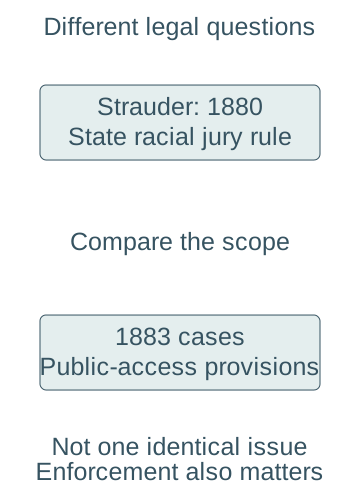
Juries as a qualified counterexample — In Strauder v West Virginia in 1880, the Supreme Court rejected a state law excluding Black men from jury service. This contrasts with a claim of completely uniform judicial hostility while not proving that every jury became representative in practice. Courts could distinguish state discrimination from other conduct, and their decisions still needed enforcement and could leave other exclusions untouched.Strauder rejected a state racial exclusion from jury service, whereas the 1883 Civil Rights Cases invalidated the public-accommodations provisions of the 1875 Act. The contrast qualifies uniform-hostility claims without suggesting equal practical access or treating one decision as the simple reversal of an identical earlier case.
Congressional possibilities and failure — The proposed federal elections legislation associated with Lodge in 1890 sought stronger national protection but failed to become law. The episode shows that some national politicians still pursued intervention, while opposition and institutional obstacles limited outcomes. A failed proposal is evidence of conflict and political possibilities, not a protection actually available to voters after successful enactment.
Presidents and different fields of action — Grant's support for the 1875 measure, Hayes's retreat and Cleveland's intervention at Pullman illustrate varied national choices, not one permanent governmental attitude to all groups. Presidential policy towards one right or community does not automatically predict every other action. Compare initiative, constitutional powers, political coalitions and willingness to enforce rather than judging solely by party label.
Work land and Northern opportunities — Black workers sought income and security through farming, skilled trades, service and urban work, with discrimination and resources shaping access. Some Northern settings offered different electoral and occupational possibilities from the South, but exclusion and hostility persisted. Do not import the scale and conditions of the First World War Great Migration into this earlier period as an already completed transformation.
Community institutions and political agency — Churches, schools, newspapers, associations and remaining political activity sustained collective life under pressure. Their survival matters to a judgement about progress even when national protection weakened. Compare what institutions could achieve with the limits imposed by violence, finance and local authority rather than assuming either universal empowerment or complete political silence.
Wells and economic rivalry — The 1892 lynching of Black businessmen in Memphis helped prompt Ida B. Wells's anti-lynching investigation and campaigning. She challenged racist allegations and connected violence with wider power and economic conflict. Use this to explain resistance and evidence gathering without treating the presence of a published critique as proof that protection had already been secured.
Washington's 1895 strategy — Washington's Atlanta address emphasised practical skills, economic advancement and accommodation under hostile conditions. His prominence illustrates a strategy responding to limits as well as pursuing development. Evaluate its aims, audience and concessions rather than treating the address as either an achieved settlement binding all authorities or proof that all Black people accepted exclusion.
Westward expansion and north south east west divides
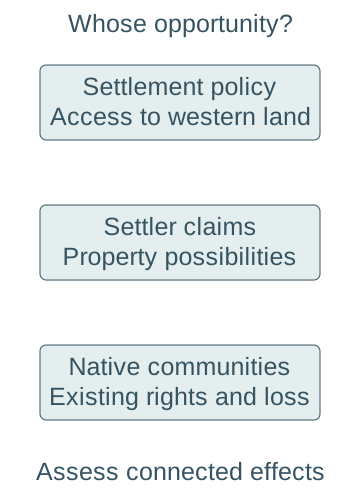
The West was not empty — Settlement schemes, mining and railways depended on access to lands already used and claimed by Native nations. Describing opportunity for settlers without examining dispossession presents only one group's perspective. Compare whose rights were expanded and whose control was reduced through the same policy, rather than assuming national economic expansion was a neutral benefit shared equally.Settlement opportunities must be assessed alongside existing Native uses, claims and political authority. Access for some settlers could be connected with dispossession of others. The boxes identify perspectives and mechanisms rather than equal benefits, a uniform community experience or a scaled territorial map.
Native resistance and constrained choice — The Fort Laramie commitments, renewed Black Hills pressure, the 1876 victory and subsequent campaigns reveal both agency and unequal resources. Negotiation and resistance represented different attempts to protect communities under changing constraints. A battlefield victory cannot stand for secure sovereignty, and eventual coercion does not make all earlier choices or concessions meaningless.
Dawes and competing concepts of property — The 1887 allotment framework promoted individual holdings and assimilation, while opening so-called surplus land to outside acquisition. Officials could present this as individual opportunity, yet the process undermined collective land and authority. Test the claimed protection against material conditions, initial scope and later implementation, not against an assumption that individual ownership always meant greater freedom.
Culture schools and Wounded Knee — Assimilation programmes and boarding schools challenged language, family relationships and religious practice, while the 1890 massacre exposed the continuing use of force. These were civil-rights issues alongside property, not separate cultural details without political consequences. Distinguish the massacre from the later 1973 occupation and avoid assuming the main Plains Wars endpoint meant the end of coercion.
Women's homesteading opportunities — Unmarried women and women qualifying as heads of household could pursue claims under relevant homestead provisions, creating opportunities unavailable under a simple account of universal legal dependency. Costs, labour, resources and local conditions affected success. Explain that settlers' property opportunities could coexist with Indigenous loss and that eligibility did not automatically make a viable farm or equal political power.
Black migration to Kansas — The Exoduster movement, especially associated with 1879, sought security and opportunity away from Southern conditions. Organisers including Benjamin Singleton and migrants' own decisions demonstrate initiative, while resources and conditions limited outcomes. Compare aspirations, legal possibility and actual livelihood rather than describing the movement as either universal escape from racism or an absence of meaningful agency.
Workers on the western economy — Railway, mining and agricultural workers could find employment and opportunities for organisation, while dangerous conditions, employer power and ethnic divisions constrained rights. Frontier imagery of independent opportunity does not describe every wage-dependent worker. Compare workers' dependence with land claimants' ambitions rather than treating all migrants west as self-sufficient proprietors.
Immigration exclusion and race — Anti-Chinese hostility and the Chinese Exclusion Act of 1882 show how labour, settlement and citizenship debates could produce racial restriction rather than universal rights. Some worker organisations supported exclusion, complicating an assumption that labour solidarity necessarily promoted equal treatment for all workers. Keep the specific law and its targets distinct from every later immigration restriction.
The South and the North — Southern political retreat and racial coercion were particularly severe, while Northern cities could offer different electoral access and economic possibilities. Northern segregation, labour exclusion and racial hostility prevent a simple free-North versus oppressed-South division. Compare mechanisms, groups and local evidence, recognising differences within each region as well as between them.
East and West as overlapping comparisons — Eastern industrial concentration and established institutions differed from some Western settlement opportunities and conflicts over sovereignty. Yet workers, women and racial minorities existed in both settings, and national capital and federal policy connected them. Regional labels should organise comparisons, not replace causal explanation with a geographical stereotype.
Evaluating interpretations and the extent of progress
Identify the interpretation's claim — Ask what an author argues about progress, causes, groups, time and region, not merely which events are mentioned. An account can recognise growth while arguing that rights remained insecure. Separate its overall judgement from examples and qualifications before testing it; criticism aimed at a claim the passage does not actually make has little evaluative force.
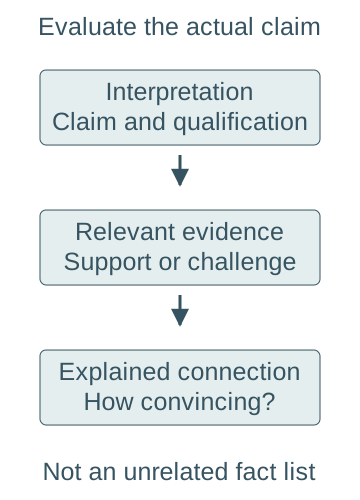
Contextual testing rather than a knowledge list — Select precise evidence that supports or challenges a passage's reasoning and explain how it bears on the claim. For an assertion of uniformly hostile courts, Strauder is a relevant qualification; a general fact about steel output is not directly sufficient. The value comes from the connection between evidence and argument, not the number of unrelated dates supplied.Identify what the interpretation argues, select contextual evidence suited to its scope and explain how the evidence supports or limits the reasoning. This is an analytical sequence for practice rather than a guaranteed marking formula or a claim that one fact settles every interpretation.
Omission scope and convincingness — Every short passage selects. An omission matters when it makes the explanation misleading for the question, not simply because another event could be mentioned. Assess whether evidence about one group or region is overgeneralised, whether temporary access is mistaken for secure rights, and whether a later outcome is being projected backwards. Accuracy and explanatory reach are distinct criteria.
Two original practice interpretations — The next two accounts are original schematic practice arguments written for this resource. They are not quotations from historians, extracts from an OCR examination or authentic contemporary sources. Both address whether economic expansion generated significant civil-rights progress around 1875–95; their contrasting emphases are designed for contextual evaluation, not memorisation as the only acceptable historical positions.
Practice interpretation A: openings and agency — Economic expansion mattered because it created jobs, institutions and networks through which excluded people could act. Women entered new occupations and organised reform, migrants formed labour associations, and Black communities sustained education and public argument despite retreat. Western claims offered some women and African Americans alternatives to earlier dependency. The outcome was uneven, but opportunities and organisation were themselves significant changes; an account focused only on repression understates the resources and agency that could support later demands.
Practice interpretation B: unequal power and control — Industrial growth and western settlement did not distribute rights in proportion to output. Employers could defeat major strikes, racial violence narrowed practical freedom, and public institutions often protected existing power. Allotment offered individual opportunity in official language while weakening Native collective resources. Some women or migrants obtained openings, but insecure work, restricted participation and unequal enforcement limited their meaning. An account treating new opportunities as substantial rights progress risks confusing the possibility of action with durable control over decisions and protection from coercion.
Testing A with qualifications — A is supported by specific evidence of employment, reform networks, labour organisation and migration choices, but its move from opportunity to significant progress needs a stated criterion. Test whether resources were usable, broadly distributed and secure, and ask whose opportunity depended on others' loss. Acknowledging unevenness strengthens scope but cannot alone answer every counterexample about coercion or collective dispossession.
Testing B with qualifications — B can use strike defeats, weakened protection and allotment to explain durable inequalities, but it must not erase existing amendments, remaining political agency or regional gains. Strauder, Western suffrage and community organising qualify any implication of completely uniform institutional hostility. Its strongest argument concerns the difference between growth and secure control, not a claim that nothing changed at all.
Compare directly and reach a judgement — The accounts agree that agency and inequality coexisted but differ over the weight and meaning of opportunity. A convincing evaluation compares them on the same criteria and uses specific contextual tests from more than one relevant group or setting. It can prefer one overall while retaining a valid qualification from the other; merely announcing that both are partly true does not establish which better answers the question.
Different assessment tasks — Y319's sample structure requires evaluation of two interpretations in Section A and two thematic essays in Section B. The depth response tests the given arguments against relevant context, while a thematic essay needs synthesis across 1865–1992. Do not answer a c.1875–95 depth claim through a chronological account ending in 1992 or treat provenance routines for Tudor primary sources as a substitute for evaluating historical interpretations.
What the quiz can and cannot show — The questions check chronology, institutions, mechanisms and interpretation concepts. Extended work must also compare actual arguments, select contextual evidence and weigh convincingness through a sustained response. Use the PLC tasks to demonstrate this reasoning; identifying a correct multiple-choice statement is a partial check, not proof of completed AO3 competence, the ability to analyse and evaluate historical interpretations.
Test yourself
50 questions · Random sets of 10. These quick checks support revision; practise longer explanations and justified judgements too.
 Mr Kidman's Classroom