A contested description of crisis — The phrase “Mid-Tudor crisis” proposes that the problems of 1547–1558 threatened the stability of monarchy and government. Test that proposition through religious division, rebellion, economic pressures and succession, rather than treating the label as a fact requiring agreement. Compare moments of acute danger with the ability of institutions and local elites to restore order; survival alone does not prove that serious instability was absent.
Kingship during a minority — Edward VI became king in 1547 aged nine. Royal authority remained vested in the king, but a child could not exercise government as an experienced adult ruler would. Henry VIII's arrangements envisaged executors, people appointed to carry out his will, governing collectively; Edward Seymour, Duke of Somerset, instead secured the position of Lord Protector. Distinguish the continuing legitimacy of hereditary kingship from arguments about who should control its exercise.
Somerset's power and vulnerability — Somerset combined proximity to the king, the protectorship and patronage, control over appointments and rewards, to dominate government. His military and religious ambitions required money and cooperation. His attempts to appear receptive to complaints over enclosure could raise expectations among common people while alarming landowners. These tensions help explain elite opposition; they do not mean that every councillor or rebel shared one coherent programme against him. His brother Thomas Seymour also sought access to the young king and an independent political position. Thomas was executed in March 1549. The conflict illustrates rivalry within a kinship connection, not simply between unrelated religious camps; Somerset and Thomas must not be confused as one person.
Faction as a struggle within government — A faction was a shifting connection of people seeking influence, office or policy advantage, rather than a modern disciplined political party. Kinship, patronage, religion, personality and access to the monarch could intersect. Explain which particular issue joined or divided councillors at a particular moment; do not label every decision “faction” without identifying actors, resources and consequences.
The fall of Somerset in 1549 — Military costs, unrest and the handling of the rebellions weakened Somerset's authority. His removal in autumn 1549 resulted from councillors acting against his dominance as well as failures of policy. The restoration of collective council authority can be read as evidence of institutional resilience, while the removal of a protector during widespread unrest illustrates the danger of personal concentration of power. Somerset later returned to political activity but was arrested again and executed in January 1552. Distinguish his removal as protector in 1549 from his subsequent execution; compressing the two events erases the continued contest for influence.
Northumberland and conciliar government — John Dudley, subsequently Duke of Northumberland, emerged as the leading figure after Somerset. He relied on the council, alliances and influence over the developing king rather than adopting Somerset's title of Lord Protector. Reduced military commitments and financial retrenchment, cutting back expenditure, helped stabilisation. Continued Protestant reform means that a more economical government should not be mistaken for reversal of Edwardian religion.
Edward's own religious agency — As Edward grew older, his Protestant convictions mattered increasingly to policy and succession. The king was neither a fully independent adult ruler from 1547 nor merely a passive puppet until his death. Assess how his age, access to information, personal writings and councillors' influence changed over the reign; distinguish a young ruler's stated commitments from his practical control of administration.
The legal and religious stakes in 1553 — Henry VIII's succession arrangements restored Mary and Elizabeth to the succession after Edward, although their legitimacy remained contested. A Catholic Mary succeeding a Protestant Edward threatened the durability of the religious changes. Dynastic entitlement, parliamentary authority, the king's testamentary intentions, those expressed through his will, and religious conviction therefore pulled in different directions. Avoid assuming that support for Mary's hereditary right automatically meant agreement with every Catholic policy.
Edward's Devise — During his final illness Edward developed a succession scheme that excluded his half-sisters and ultimately favoured Lady Jane Grey. Northumberland's son Guildford Dudley had married Jane, giving the duke a direct family interest. Explain Edward's religious purpose alongside Northumberland's political stakes; reducing the episode to one man's ambition obscures the king's involvement and the problem of changing arrangements grounded in statute.
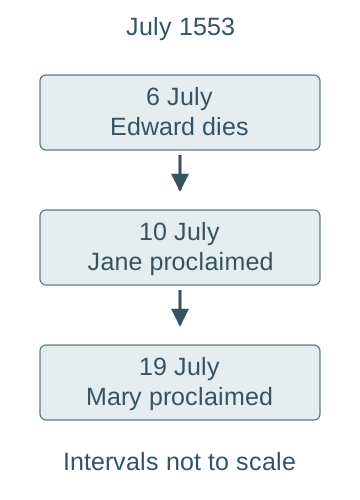
Why Jane's regime failed — Edward died on 6 July 1553; Jane was proclaimed on 10 July, and the council proclaimed Mary on 19 July. Mary gathered support in East Anglia while Jane's backers could not secure durable national allegiance. Hereditary legitimacy, local mobilisation and defections within the political elite undermined the attempted settlement. The speed of its collapse shows the limits of possessing the council and capital without wider acceptance.Edward died on 6 July 1553, Jane was proclaimed on 10 July, and the council proclaimed Mary on 19 July. The sequence distinguishes death, proclamation and the transfer of allegiance; arrow lengths are not a time scale.
Mary's accession and female rule — Mary became England's first crowned queen regnant: she held sovereign authority in her own right, unlike a queen consort married to a king. Gender created questions about command, counsel, marriage and succession, but accession support demonstrates that female rule was not automatically unacceptable. Analyse particular political constraints and Mary's responses instead of using a general claim that Tudor society simply refused a woman monarch.
Marriage as a domestic and international issue — Mary's intended marriage to Philip raised fears about foreign influence, offices, England's resources and involvement in Habsburg conflicts, as well as hopes of a Catholic heir and a powerful alliance. Philip was not yet king of Spain when the marriage took place in 1554. A retrospective label can conceal the precise diplomatic circumstances; distinguish his later titles from his position at the time.
Marriage safeguards and their limits — The marriage settlement sought to protect English laws, offices and interests and to limit Philip's independent authority. Such formal protections mattered, but they could not remove popular suspicion or guarantee freedom from international pressure. Judge both the negotiated constitutional position and what happened in practice; a protective clause is evidence of an intention and a legal framework, not proof that everyone trusted it.
Paget, Gardiner and policy choices — William Paget and Stephen Gardiner illustrate disagreements within Mary's governing elite over political strategy, marriage and religious restoration. Gardiner's Catholic commitment did not require wholehearted support for a Spanish marriage; Paget's advocacy of the match cannot be inferred simply from a religious label. These disagreements show that diplomatic preferences, experience and access to the queen cut across a neat Catholic-versus-Protestant faction model. Gardiner initially preferred an English marriage with Edward Courtenay, whereas Paget supported the Spanish connection. Gardiner subsequently participated in negotiating safeguards and officiated at the marriage. Opposition at an earlier stage did not prevent later implementation, and political alignments could shift as Mary settled her decision.
Succession in 1558 — Mary's pregnancies did not produce a surviving child. Elizabeth's hereditary position and political acceptance therefore became central as Mary approached death in 1558. Elizabeth succeeded without a repetition of Jane's attempted regime. This continuity suggests the strength of dynastic and institutional mechanisms, although it left a new government to confront the religious and financial consequences of the preceding reigns.
Religious change, enforcement and local responses
The religious inheritance of 1547 — Henry VIII had broken with papal jurisdiction but retained important traditional beliefs and practices. Edward's government could use royal supremacy and existing administrative machinery to pursue more Protestant change. Avoid treating the English Church in 1547 as already identical to that of 1552, or equating rejection of the pope with agreement on every doctrine of worship and salvation.
Early Edwardian reform — Royal injunctions, preaching, changes to church images and the dissolution of chantries accelerated reform after 1547. Chantries were endowments associated with prayers for the dead, so suppression had theological, financial and local social effects. Trace what changed in parish life and who benefited or lost; national legislation did not produce the same immediate experience in every community.
The first Prayer Book and uniformity — The 1549 Book of Common Prayer established an English liturgy, an authorised form and order of worship, under the first Edwardian Act of Uniformity. Worship was made more uniform by law, but the settlement retained formulations that could receive different religious readings. A common English service was a major change without necessarily satisfying reformers who wanted a clearer break with traditional sacramental understanding.
The second Prayer Book — The 1552 Prayer Book and second Act of Uniformity moved worship in a more explicitly Protestant direction. Changes to communion language and practice were doctrinally significant, rather than merely a new translation. Compare the trajectory from 1547 through 1549 to 1552; collapsing all Edwardian reform into one event hides its pace and the different pressures on successive governments.
Doctrine, worship and church organisation — A useful comparison distinguishes belief, the performance of services and the structure of ecclesiastical authority. Royal supremacy concerns jurisdiction; communion concerns the Christian meal using bread and wine to recall or participate in Christ’s death, with traditions disagreeing about his presence in it; clerical marriage concerns both church personnel and religious assumptions. These categories interact, but a change in one is not automatically evidence that all others changed to the same extent.
Protestant commitment and uneven reception — Reform benefited from committed preachers, patrons, print and some urban or regional networks. Elsewhere communities retained attachments to traditional worship or complied outwardly without sharing official conviction. Evidence of an altered church interior can show obedience to an injunction but cannot directly measure every parishioner's private belief. Distinguish active support, accommodation, resistance and survival of older habits.
Mary's initial restoration — Mary's first repeal legislation in 1553 reversed Edwardian religious legislation and restored traditional worship. Restoration of papal authority was a further step, not an automatic consequence of the first repeal. Keeping stages distinct helps explain negotiation with parliament and the political importance of people who held former monastic property acquired during earlier changes.
Reconciliation with Rome — Cardinal Reginald Pole's mission and the reconciliation with Rome in 1554 restored papal jurisdiction. Assurances concerning former church property helped secure elite acceptance without a wholesale return of all alienated lands. A Catholic restoration therefore operated within political and property constraints, rather than recreating every feature of the Church before Henry VIII's break.The Edwardian Prayer Books of 1549 and 1552 were followed by repeal of Edwardian religious legislation in 1553 and reconciliation with Rome in 1554. Repeal and restoration of papal jurisdiction were distinct stages, not one simultaneous event.
Marian reform as well as reversal — The government pursued clerical standards, education and Catholic preaching as well as restoring services and authority. These constructive measures complicate a description based only on persecution. Their potential longer-term effect is difficult to establish because Mary's reign was short; distinguish policies actually implemented from projects whose eventual success cannot be observed.
Persecution and its purposes — Revived heresy legislation, laws punishing religious beliefs judged false by the authorities, enabled the burning of roughly 280 Protestants during Mary's reign, beginning in 1555. Persecution sought to defend religious truth and deter dissent within the government's assumptions. Explaining that purpose does not justify the violence. Assess intended deterrence alongside martyr narratives, sympathy, regional variation and the continuing existence of Protestant communities.
Prominent victims and historical memory — Bishops Hugh Latimer and Nicholas Ridley were burned in 1555, and Thomas Cranmer in 1556. Later Protestant accounts made their deaths central to an enduring image of Marian rule. Such memory matters historically, but an account's subsequent influence is different from proof that all contemporaries reacted in the same way or that it preserves every event without editorial shaping.
Exile and networks of opposition — Some Protestants escaped abroad, maintaining religious commitments, publishing and forming connections that later mattered under Elizabeth. Exile reduced some immediate opposition within England while preserving alternative religious leadership. Surviving exile writings are evidence of organised conviction, but their authors were not a representative sample of all English people.
Local resistance and accommodation — Rebellions, petitions, parish records, prosecutions and reports can reveal responses to religious change. Each source has selection problems: a prosecution records people noticed by authorities, whereas a churchwardens' account records expenditure rather than the full range of private beliefs. Combine different kinds of evidence and distinguish regional examples from claims about national opinion.
Religious change and political stability — Successive governments used law, council, bishops and local officeholders to transform religion. Repeated reversals could create uncertainty and opposition, yet the same administrative continuity enabled enforcement. A balanced argument can therefore identify both conflict generated by policy and the capacity of government to pursue major change without permanent collapse of the monarchy.
Rebellion, social pressures and the balance of stability
Inflation as a pressure on households — Rising prices could erode the purchasing power of wages and fixed incomes. Population growth, harvest conditions, monetary debasement (reducing the precious-metal content of coins) and market disruption contributed in different ways. Distinguish a long-term rise in the price level from an especially bad harvest year; the same percentage price increase would affect households differently according to earnings, food purchases and access to land.
Enclosure and competing interests — Enclosure involved changes to the use, consolidation or control of land and could restrict common rights or alter employment. It was not one identical process everywhere. Some landlords benefited, while tenants and labourers could fear loss of access or security. Specific local grievances help explain unrest more effectively than assuming every enclosed field immediately caused rebellion.
Poverty and limited relief — Poor households faced insecure work, food costs and illness, while changing religious institutions affected older patterns of assistance. Government responses combined concern for relief with attempts to control begging and movement. Avoid importing the later Elizabethan poor-law settlement into the 1540s or assuming that legislation necessarily provided adequate help in every locality.
Western rebellion: religion and locality — The Western or Prayer Book rebellion in Devon and Cornwall in 1549 strongly opposed religious innovations, particularly the new service. Traditional liturgy, local identity and wider social grievances interacted. The rebellion demonstrates substantial resistance in a particular region; it cannot by itself prove that all England rejected Protestantism or that every participant shared exactly the same demands.
Reading the Western demands — Rebel demands defending traditional worship reveal priorities that differed from those of official reformers. Compare demands with government replies to identify both substantive disagreement and the authorities' presentation of obedience. Neither side offers a neutral survey: demands seek concessions, while a royal reply aims to defeat resistance and uphold the legitimacy of policy.
Kett's rebellion and enclosure — Kett's rebellion in Norfolk in 1549 centred on grievances including enclosure and abuses associated with local government and landholding. Rebels organised at Mousehold Heath near Norwich and formulated demands. Their actions challenged authority, but some language appealed to the king and a better-ordered commonwealth, the political community understood through its common welfare. Distinguish attacking perceived abuses in the king's name from an explicit programme to abolish monarchy.
Why compare the two rebellions? — Both Western and Kett's rebellions exposed the government's difficulties in 1549, but their leading grievances and local contexts differed. Religious conservatism was particularly prominent in the west, while Norfolk demands focused heavily on social and agrarian issues. Comparison should retain overlap and difference; assigning one single cause to every participant loses the relationships between policy, subsistence and local power.
Suppression and consequences — Royal forces defeated both major rebellions. The need to mobilise armies, the deaths and disruption, and the damage to Somerset's position made 1549 a severe crisis. Successful suppression also shows that the state could regain control. Weigh the cost and difficulty of recovery against its outcome, rather than treating victory as proof that no genuine threat existed.
Jane Grey and the category of rebellion — The 1553 succession struggle involved a regime established through elite political action and opposed by Mary's mobilisation. Calling it simply a popular rebellion hides the contest over lawful sovereignty. Explain whose authority each actor claimed to defend and how allegiance changed. This episode differs in origin and mechanism from a regional rising against an established government's policy.
Wyatt's rebellion in 1554 — Sir Thomas Wyatt's rising opposed Mary's Spanish marriage amid concerns about foreign influence and religion. The wider projected opposition failed to coordinate effectively, leaving the Kentish force isolated. Distinguish the motives of leaders, supporters and government allegations; an apparently shared opposition to the marriage could contain different religious and dynastic hopes.
Why Wyatt failed — Mary retained the support needed to defend London, and Wyatt's advance failed to secure the capital or cause a decisive collapse of loyalty. Her public appeal and the limits of rebel coordination mattered alongside military decisions. Failure does not establish that the marriage was popular; it shows that hostility did not translate into a successful transfer of power.
Repression after Wyatt — The rising intensified the government's perception of dynastic danger. Jane Grey was executed in February 1554, and Elizabeth faced imprisonment and scrutiny. Distinguish suspicion from proven involvement: later accession does not justify retroactively treating every accusation against Elizabeth as established fact. Repression could deter opposition while also revealing the regime's insecurity.
War, finance and Calais — War with France and the loss of Calais in 1558 damaged the reputation of Mary's government and placed pressure on resources. The marriage and Habsburg connection are relevant to the decision for war, but analyse English political decisions and circumstances rather than assuming that treaty safeguards mechanically prevented all foreign-policy involvement. International failure could deepen domestic criticism without itself causing immediate dynastic collapse.
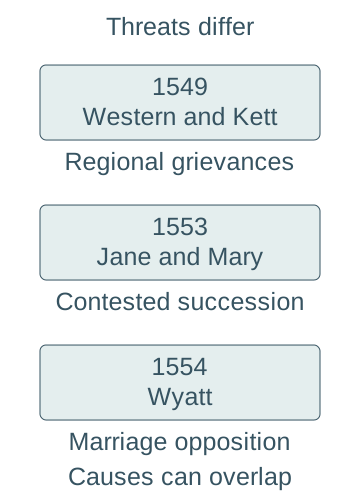
Testing continuity against crisis — Compare 1549 rebellion, 1553 succession and 1554 rebellion using common criteria: scale, geographical reach, elite division, proximity to the monarch and ability to restore order. Then assess the less dramatic continuity of council, parliament, law and local government. The strongest judgement explains why some dangers were contained and identifies which problems persisted into 1558.Regional risings in 1549, contested succession in 1553 and opposition to the marriage in 1554 involved different mechanisms. The labels identify prominent issues, not exclusive motives shared by every participant.
Evaluating contemporary sources in their historical context
Begin with the exact proposition — A source question asks how far a particular view is supported. Break the view into its relevant claims before reading for evidence. A passage describing one local disturbance may support the existence of unrest while offering little evidence about its national scale or seriousness. Relevance must be established before a source is labelled useful or unreliable.
Separate content and provenance — Content is what a source says or shows; provenance concerns its author, date, audience, circumstances and purpose. Explain how a particular feature of provenance affects a particular claim. Writing “the author is biased” without connecting position to the evidence does not evaluate its weight. Interested testimony can still reveal accurate information or important perceptions.
Use contextual knowledge to test claims — If a source describes obedience to the king in 1549, compare its language with the rebels' actual actions, demands and the chronology of government policy. Context should test, qualify or corroborate the source, rather than becoming a detached narrative of everything known about the period. Avoid rejecting a source merely because it does not discuss an event that occurred after its composition.
Purpose can shape both emphasis and silence — An official reply may stress treason to discourage rebellion; a petition may stress hardship to secure intervention. These purposes can influence selection and rhetoric without making every factual detail false. Identify what the author was trying to achieve, what readers were expected to know and which relevant evidence would need corroboration.
Corroboration is not vote counting — Two sources agreeing may strengthen a claim, but they may also depend on the same report or share a political interest. Conversely, disagreement can reflect different dates, places or access to information. Explain the relationship between evidence and the proposition; three supportive extracts do not automatically outweigh one detailed, well-positioned contrary account.
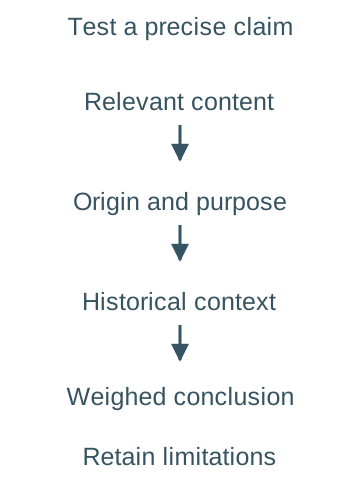
Construct an evidenced overall judgement — Group sources around the disputed issues, evaluate their evidence in context and weigh the limits of the set. Distinguish a source supporting a claim from a source merely mentioning its subject. Conclude how far the view is sustained and why, acknowledging unresolved limitations. No invented quotation or mock archival extract should be presented as an authentic Tudor document.An argument starts with relevant source content, relates provenance and purpose to particular claims, tests the evidence in historical context and weighs a conclusion. These are connected analytical demands, not a formula guaranteeing that every source is equally reliable.
Test yourself
50 questions · Random sets of 10. These quick checks support revision; practise longer explanations and justified judgements too.
 Mr Kidman's Classroom