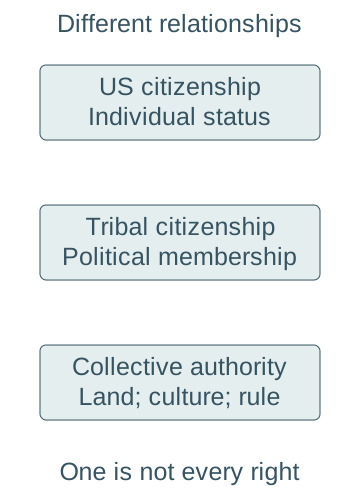
Rights and sovereignty — Native American rights include individual legal protection and participation alongside collective land, treaty, cultural and governing rights. US citizenship and tribal citizenship are different relationships, and equality cannot be measured solely by integration into non-Native institutions. Ask whether a change strengthened self-government and community control or required their surrender as the price of individual opportunity.US citizenship, membership of a Native nation and collective authority are related but distinct. An expansion in one does not alone establish another. These categories are questions for evidence, not an exhaustive account of the institutions or identities of every nation.
Distinct peoples and experiences — Native Americans comprised many nations with different languages, political structures, economies and relationships with the United States. Plains peoples are not a description of every Native community, and even neighbouring nations did not always share interests or strategies. Use specific names where relevant and avoid treating a single leader, battle or federal policy as evidence of an identical experience everywhere.
The position in 1865 — By 1865, earlier dispossession and removal had already transformed many communities, while nations in the West continued to hold land, negotiate and resist. Federal expansion and settler demands threatened sovereignty and livelihoods, and legal status varied. The end of the Civil War did not simply extend African American emancipation measures to every Native person on the same terms.
Land as more than a commodity — Land supported subsistence, movement, social relationships, spiritual life and political authority. Federal or settler descriptions of supposedly unused land could deny existing uses and relationships. Explain why monetary compensation, an individual farm plot and the restoration of a sacred place could represent very different outcomes rather than equivalent solutions to one property dispute.
Treaties and power — Treaties recorded agreements between the United States and particular nations, including territory and obligations. Their meaning, translation, implementation and amendment could be disputed, while unequal coercive power undermined promises. An agreed text is evidence of commitments, not proof of good-faith compliance; later claims could use the text to challenge dispossession.
Reservations and dependence — Reservation policy sought to concentrate communities within defined areas, restricting movement and access to resources. Dependence on officials, rations and external markets could weaken bargaining, while local conditions and agency varied. Reservations were not identical to complete extinction of political identity: communities adapted, retained relationships and continued claims even under severe constraints.
The Plains Wars' wider chronology — The specification's Plains Wars context begins before 1865, conventionally framed from 1854 to 1877. Earlier clashes help explain distrust and later conflict, but the thematic enquiry's main endpoint remains 1992. Do not portray every battle as part of one centrally directed Native army or a simple conflict between two internally unified populations. The 1864 Sand Creek massacre, when Colorado troops attacked Cheyenne and Arapaho people, provides a concrete example of earlier violence deepening mistrust. It predates the main thematic start but helps explain why later assurances could be viewed against experience rather than accepted at face value.
Settler expansion and livelihoods — Railway development, mining, migration and settlement increased pressure on land and routes. Destruction of bison populations undermined the subsistence and independence of many Plains communities, reinforcing military and administrative coercion. Military defeat was therefore connected with economic and environmental pressures, not determined only by weaponry or the personal ability of particular chiefs.
Red Cloud's War — Resistance to the Bozeman Trail and associated forts in 1866–68 helped force US withdrawal from that route and supported the Fort Laramie settlement. This was a meaningful achievement, showing that resistance could influence federal decisions. Its later erosion also demonstrates the difference between winning a concession and securing durable protection against new settler and government pressures.
The Fort Laramie Treaty of 1868 — The treaty recognised a reservation including the Black Hills and set out obligations involving particular nations and the United States. Its provisions became a later basis for claims against dispossession. Do not substitute a generic claim that every treaty promised the same rights or treat the agreed boundaries as evidence that subsequent mining and settlement complied with them.
The Black Hills and renewed conflict — Gold discoveries intensified pressure on the Black Hills despite treaty commitments. Government and military action sought to bring resistant communities under reservation control, while negotiations operated amid unequal pressure. Trace competing claims and the relationship between resource demand, treaty violation and coercion rather than describing conflict as an unexplained outbreak of Native hostility.
Little Bighorn in 1876 — Lakota and Cheyenne forces defeated Custer's detachment in June 1876. The victory demonstrated military capacity and cooperation without permanently reversing US expansion; subsequent campaigns and supply pressures forced further surrenders. Distinguish a battlefield outcome from long-term strategic security, and do not assume every Native nation or every leader participated on the same side.
The limits of military resistance — The United States could mobilise sustained resources, target livelihoods and combine campaigns with administrative pressure. Native divisions, constrained supplies and differing priorities complicated resistance, while some leaders sought negotiation to protect communities. Explain choices under pressure without representing negotiation as simple consent to dispossession or armed resistance as the only form of agency. In the Red River War of 1874–75, campaigns against Southern Plains groups including Comanche, Kiowa and Southern Cheyenne combined attacks on camps and resources with pressure towards reservations. This provides a different regional example from the later Little Bighorn victory, illustrating why one battle cannot represent the impact of the wars on every nation.
1877 and the continuing struggle — The end of major Plains resistance in this framework did not end conflict, survival or collective identity. Federal policies increasingly sought to transform landholding and culture, while communities continued legal, political and cultural action. Avoid an account in which Native Americans disappear after military defeat: later rights struggles depend on those continuing institutions and claims.
Allotment assimilation citizenship and early organised response
Assimilation as a policy aim — Assimilation sought to remake Native people according to dominant non-Native cultural and economic expectations, often treating collective practices as obstacles. Schooling, religion, landholding and citizenship could become linked instruments. Distinguish genuine access to opportunities from coercive conditions requiring cultural or political surrender; officials' claims of benevolence do not establish the experience of those affected.
The Dawes Act in 1887 — The General Allotment Act authorised breaking up covered collectively held reservation lands into individual allotments. It aimed at severalty, individual rather than communal landholding, and assimilation rather than protecting collective government on its existing terms. Initial exemptions and later extensions matter: it did not immediately apply identically to every nation, and the landholding outcomes developed through subsequent law and administration.
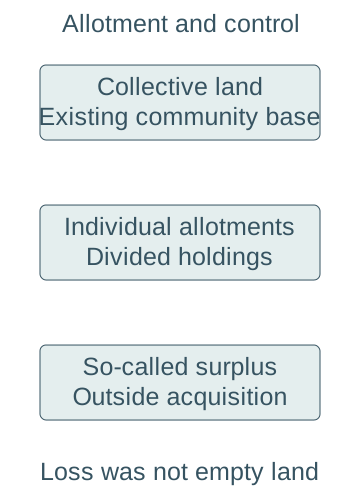
Allotments and so-called surplus land — Officials could treat land beyond individual allocations as surplus and open it to non-Native acquisition under the relevant procedures. The term did not establish that communities had no use or claim to it. Fragmentation, dispossession and loss of collective control followed through policy and implementation; an individual allocation could coexist with a much larger net loss of tribal land.Covered collective lands were divided into individual allotments, while land labelled surplus could be opened to non-Native acquisition. The term did not prove an absence of community use or rights. The boxes identify mechanisms rather than equal areas, universal initial coverage or a complete timeline.
The limits of the individual farm model — Officials' model assumed that allotment would enable self-supporting agriculture, despite varied environments, economies and resources. Poor land, lack of equipment or credit, administrative controls and unfamiliar arrangements could obstruct that aim. Assess suitability and access rather than assuming that failure proved an absence of effort or that every Native society had previously rejected all agriculture.
Trust and property control — Federal trust arrangements were presented as protection but also placed decisions under outside authority. Changes permitting alienation, the sale or transfer of property, inheritance complications and administrative practices could facilitate further loss and fragmentation. Distinguish the claim to protect an individual parcel from the outcome for collective resources, sovereignty and future generations.
Boarding schools and cultural coercion — Schools often separated children from families and sought to suppress Indigenous languages, identities and practices. Some pupils acquired skills and later used them in public life, but this does not cancel coercion, mistreatment or community damage. Interpret individual experiences carefully without treating the existence of any educational benefit as justification for forced cultural transformation.
Religion family and authority — Restrictions on ceremony and outside interference in family and community life affected more than private belief. These policies weakened the institutions through which communities transmitted knowledge and authority. Cultural rights therefore belong within a civil-rights judgement rather than being an optional decorative addition to property and voting.
Wounded Knee in 1890 — The killing of Lakota people by US troops occurred amid fear and repression surrounding the Ghost Dance. It illustrates coercion after the main Plains Wars endpoint, not a second date for Little Bighorn. Distinguish the 1890 massacre from the 1973 occupation at the same location; the historical memory of earlier violence informed later protest.
Lone Wolf v Hitchcock in 1903 — The Supreme Court upheld broad congressional authority to alter treaty arrangements concerning Native land without the consent claimed under the earlier treaty. This strengthened the vulnerability of collective guarantees to federal action. Explain the decision's significance for power and treaty security rather than saying courts had no role or every treaty right ceased to exist after one ruling.
Education and early pressure groups — Native campaigners used education, journalism, petitions, associations and legal argument to contest policy. The Society of American Indians, founded in 1911, illustrated national organisation, while members differed over citizenship and the relationship between assimilation and collective rights. Early activism prevents a misleading jump from military defeat directly to the 1960s.
The First World War — Military service and wartime experience supported arguments for citizenship and recognition, while contributions did not automatically remove discrimination or federal control. Some people were already citizens through earlier measures; others were not. Do not present service as proof of unanimous approval of US policy or citizenship as a single status acquired by everyone for the first time in one year.
The Indian Citizenship Act in 1924 — The Act extended US citizenship to Native people born within US territorial limits who were not already citizens, without requiring surrender of tribal or other property rights. It was a substantial status change but did not automatically remove state voting obstacles or resolve treaty and land claims. Distinguish national citizenship, effective suffrage and continuing tribal membership.
Voting and citizenship — States used restrictions and interpretations that continued to obstruct Native voting after 1924. Challenges and changing state law gradually expanded access, but remote locations, administrative practice and resources could still matter. A citizenship statute is therefore not an adequate standalone measure of political participation; assess the ability to register, vote and influence decisions in particular places.
The Meriam Report in 1928 — The investigation documented severe problems in health, education, poverty and administration, challenging claims that assimilation policy had delivered wellbeing. It helped strengthen arguments for reform without instantly changing conditions. Distinguish an investigation's evidence, its influence on policy debate and the later implementation of reforms rather than giving a report the powers of a statute.
The Indian New Deal war termination and relocation
The context by 1932 — Land loss, poverty, administrative control and cultural interference shaped communities' position, but continuing institutions and activism offered foundations for change. The Depression intensified hardship without creating every problem anew. Compare the position before reform with actual later experience rather than treating a new official philosophy as immediate restoration of lost resources.
Collier and a changed direction — John Collier, Commissioner of Indian Affairs from 1933, supported an approach more favourable to communal life and culture than earlier assimilation programmes. His motives and reforms should be assessed alongside federal authority and Native responses. A sympathetic official still operated within structures that could prescribe the acceptable form of community government.
The Indian Reorganization Act in 1934 — The Act halted further allotment under its framework, encouraged tribal organisation and supported a stronger communal land base. It marked a major change from the earlier individualising programme. It did not return every lost acre, remove all outside authority or secure unanimous community approval; compare its legal possibilities with variation in adoption and implementation.
Consent and constitutional models — Communities differed over accepting the reorganisation framework, and federal constitutional models did not necessarily match existing political traditions. Participation could offer resources and institutional strength while provoking disagreement about representation and control. Avoid assuming either that every nation accepted identical arrangements or that every refusal expressed opposition to all collective self-government.
Relief employment and resources — New Deal programmes offered work, conservation and material assistance in some Native communities. Funding, administrative capacity and local circumstances shaped results, while ongoing poverty limited claims of completed recovery. Economic relief and renewed recognition of communal institutions were related but distinct gains; an improvement in one did not establish equal health, income or land security everywhere.
The limits of the Indian New Deal — The reform direction strengthened possibilities for cultural and political survival, but paternalism, uneven provision and objections from within communities remained. Evaluate against earlier allotment and later termination, not against an invented standard of immediate complete independence. The cross-group New Deal depth study considers whether its effects differed from those experienced by women, workers and African Americans.
The Second World War — Military service and war-industry employment expanded contact, skills and movement, while Native contributions coexisted with discrimination and pressures on communities. Code talkers were a significant contribution, not a description of every Native servicemember. War affected opportunity and identity without automatically determining whether future federal policy would protect or dismantle collective status.
The National Congress of American Indians — Founded in 1944, the NCAI developed intertribal advocacy and lobbying to protect rights and challenge harmful policy. Cooperation across nations did not eliminate their distinct governments or priorities. Its sustained institutional work provides a comparison with later high-profile direct action, and shows that pressure groups were not invented by AIM.
Termination in the 1950s — Termination sought to end the special federal relationship with designated tribes and subject people and resources more fully to ordinary state arrangements. House Concurrent Resolution 108 in 1953 expressed the policy direction; particular termination acts implemented it for different communities. Distinguish a general declaration, specific legal acts and resulting experience rather than assuming every tribe lost recognition at once.
Equality rhetoric and collective loss — Supporters presented termination as ending dependency and treating Native people like other citizens. Critics argued that it removed protections, resources and recognition while disregarding collective rights. Compare the language of individual equality with the loss of a government-to-government relationship: formally similar treatment can impose unequal consequences when it overrides treaty obligations and community circumstances.
Public Law 280 — The 1953 law transferred specified jurisdiction over offences and civil matters in Indian country to named states, with provision for other state assumption under the historical framework. It was related to the era's direction but was not the same legal process as terminating every affected tribe. Distinguish jurisdiction, recognition, ownership and the federal trust relationship instead of treating them as one switch.
Relocation and urban experience — Federal relocation programmes encouraged movement towards urban employment, promising opportunity outside reservations. Some people gained work and networks, while others faced insecure jobs, discrimination, housing problems and separation from support. Urban movement also helped create intertribal connections and new activism; assess varied outcomes rather than assuming either universal prosperity or the disappearance of Native identity.
Resistance before Red Power — Communities and organisations challenged termination through lobbying, campaigns and legal action. The Menominee experience, including the later restoration of recognition in 1973, illustrates that harmful policy could be contested and partly reversed. Restoration did not automatically repair every earlier loss, and one nation's experience must not be generalised to all communities.
Red Power self-determination courts and the position by 1992
Why new activism developed — Land and treaty grievances, termination, urban discrimination, policing and frustration with slow reform helped generate more assertive activism. Wider civil-rights and student movements provided connections and examples, but Native demands drew on their own histories and collective rights. Do not reduce Red Power to an imitation of Black Power or assume every participant favoured the same strategy.
The National Indian Youth Council — Founded in 1961, the NIYC exemplified a younger, more assertive organising generation, including campaigns around treaty fishing rights. Youth activism interacted with older organisations rather than replacing them completely. Compare direct action, legal arguments and lobbying through aims and circumstances instead of using age alone to classify every strategy.
Fish-ins and treaty rights — Activists challenged restrictions on fishing by exercising rights claimed under treaties and attracting publicity to enforcement. These were claims grounded in specific agreements and resources, not simply a general demand to evade every conservation rule. Legal and direct-action strategies could reinforce one another, while the interpretation and practical allocation of fishing rights remained contested.
AIM's foundation and aims — The American Indian Movement formed in Minneapolis in 1968 amid concerns including policing and the treatment of urban Native people. Its work broadened towards sovereignty, treaty rights and community power. Distinguish an organisation's development from a single unchanging founding programme, and do not equate all Native activists or every protest with AIM membership.
Alcatraz in 1969–71 — The occupation by Indians of All Tribes drew attention to dispossession, cultural survival and self-determination. Its symbolic arguments and proposals challenged federal treatment of Native people, but did not establish a court-recognised right to the island merely by occupying it. The action was not simply an AIM operation; participants, organisers and later influence need accurate distinction.
The Trail of Broken Treaties in 1972 — The cross-country mobilisation brought demands concerning treaties, sovereignty and federal policy to Washington and led to occupation of the Bureau of Indian Affairs (BIA) headquarters. Public attention and confrontation raised visibility, while tactics and outcomes were disputed. Assess the proposals and organisation alongside the occupation rather than treating publicity alone as either complete success or total failure.
Wounded Knee in 1973 — The occupation at Pine Ridge involved AIM and local participants amid grievances about tribal leadership, federal authority and treaty obligations. The confrontation generated national attention and serious human costs. Distinguish the 1973 event from the 1890 massacre, and avoid presenting reservation politics as a simple unanimous community confronting one external opponent.The 1890 massacre of Lakota people and the 1973 occupation involving AIM and local participants were distinct events. The memory of earlier coercion contributed to the meaning of the later protest, without making the events identical or the community unanimous.
Assessing direct action — Occupations and demonstrations could publicise grievances, connect activists and increase pressure while provoking repression, division and practical strain. Visibility is one outcome, not the whole measure of land restoration, services or governing authority. Compare short-term concessions, longer-term agenda change and costs with lobbying and litigation rather than assuming that dramatic tactics alone produced every reform.
Nixon's 1970 policy statement — Nixon rejected termination as the basis for policy and endorsed self-determination without ending the federal relationship. This direction qualifies a simple assumption that party label or public reputation alone predicts Native policy. Distinguish a presidential commitment from legislative implementation, resources and the degree of actual control communities subsequently exercised.
The 1975 self-determination Act — The Indian Self-Determination and Education Assistance Act enabled tribes to assume administration of specified programmes through arrangements with federal agencies. It strengthened control over services without establishing unlimited independence or abolishing federal obligations. Assess authority, capacity and resources as well as the existence of contracts; managing a programme and possessing full sovereignty are not identical.
Family and cultural protection — The Indian Child Welfare Act of 1978 addressed the removal and placement of Native children, recognising family and tribal interests through specific procedures. The American Indian Religious Freedom Act of the same year stated a policy of protecting traditional religious practice. Their scope and remedies differed: a declaration of religious freedom did not guarantee success in every sacred-site or ceremonial dispute.
The Boldt decision in 1974 — In United States v Washington, a federal district court decision affirmed treaty fishing rights and an allocation for treaty tribes; subsequent litigation addressed its operation. This was not itself a Supreme Court ruling, although the Court later upheld the core treaty allocation framework in 1979. Distinguish the court level, treaty parties and remedy rather than treating it as a universal national fishing entitlement.
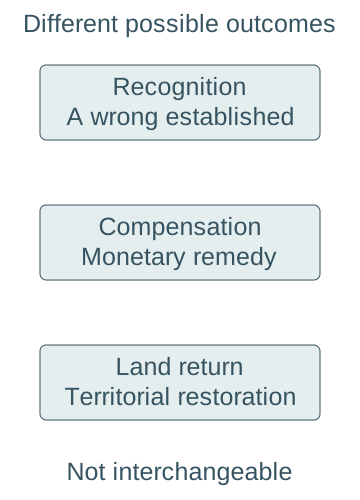
The Black Hills judgement in 1980 — In United States v Sioux Nation, the Supreme Court upheld compensation for the taking of the Black Hills, including interest. The judgement did not return the land; refusal to accept money demonstrated that compensation could fail to meet the political and cultural demand. Evaluate legal recognition and the limits of the remedy separately, without treating a monetary award as consent to the original taking.A judgement recognising a compensable taking and awarding money does not automatically return territory. In the Black Hills dispute, refusal to accept the award expressed demands the monetary remedy did not satisfy. The boxes are analytical distinctions, not a claim that all three outcomes occurred in 1980.
Religious freedom and judicial limits — Employment Division v Smith in 1990 allowed application of a generally applicable criminal prohibition to sacramental peyote use in the case before the Supreme Court. The decision exposed limits to protection through the Free Exercise Clause. Keep the later 1993 federal legislative response outside this enquiry's endpoint and do not claim that a 1978 policy declaration guaranteed every later religious claim.
Repatriation in 1990 — The Native American Graves Protection and Repatriation Act established processes concerning human remains, funerary and sacred objects and cultural patrimony held by relevant institutions. Repatriation means returning covered remains or objects to the appropriate communities or descendants through those processes. It represented a recognition of community relationships and rights over material previously collected or retained by others. Implementation required evidence and procedures; enactment was not instant return of every object or resolution of every claim.
Economic opportunities and sovereignty — By the late twentieth century, some communities pursued enterprises and disputes over regulatory authority as routes to resources and control. The Indian Gaming Regulatory Act of 1988 created a specific federal framework, with state–tribal compact arrangements for relevant gaming. Do not generalise one enterprise's income to all Native people or assume economic development removed conflicts over jurisdiction and dependency.
Comparing the Supreme Court's role — Compare Lone Wolf's broad congressional power, the limits and recognition involved in the Black Hills remedy, fishing litigation and Smith. Courts could sustain federal dominance, recognise treaty claims or restrict particular protections at different times. Explain legal scope and remedies, and distinguish district-court initiatives from Supreme Court decisions rather than counting all litigation as one consistent institutional direction.
Organisations leadership and community agency — NCAI, NIYC, AIM, Indians of All Tribes, tribal governments and local participants used different combinations of negotiation, litigation, services and direct action. Women, families and less-publicised organisers contributed alongside famous male leaders. Compare strategies against aims and conditions; intertribal cooperation did not require the disappearance of distinct nations or unanimous agreement within each community.
Judging change by 1992 — Formal citizenship, revived recognition of collective institutions, greater service control and particular legal protections marked important change from the coercive late-nineteenth-century framework. Land loss, poverty, contested jurisdiction and limited remedies remained. A thematic judgement must weigh individual equality with collective sovereignty and culture, specifying communities and rights rather than assuming either inevitable progress or unchanging victimhood.
Test yourself
50 questions · Random sets of 10. These quick checks support revision; practise longer explanations and justified judgements too.
 Mr Kidman's Classroom