The struggle for leadership and changing alliances
A succession without a settled rule — Lenin's illness and death left no accepted hereditary or electoral procedure identifying one uncontested successor. Leadership depended on party institutions, office, reputation, alliances and policy. Stalin's later dictatorship must be explained through this struggle rather than projected backwards as a position automatically inherited in January 1924.
Stalin's experience and abilities — Stalin possessed experience of party organisation, committees and personnel, and cultivated an image of practical reliability. His ability to understand institutional relationships and exploit rivals' divisions mattered alongside ruthlessness. A quiet or apparently secondary public role did not imply political insignificance. Assess specific methods without assuming that every eventual success came from an infallible plan formed years earlier.
General Secretary from 1922 — The secretaryship gave Stalin opportunities to influence appointments, information and connections within the expanding party apparatus. Positions could create obligations, trust and access to delegates, strengthening a network over time. The office was not formally an automatic dictatorship or sole constitutional leadership of the USSR in 1922; its political value depended on use and the conduct of others.
Appointments and the party apparatus — Control or influence over personnel could affect committee composition, promotion and participation in decision-making. Networks helped a leader mobilise support and isolate opponents. Distinguish the mechanism from a claim that Stalin personally selected every official or controlled every vote from the outset. Institutional advantages could interact with genuine support for particular policies.
Lenin's criticisms — Lenin's late notes criticised several leading figures, and a postscript urged consideration of removing Stalin as General Secretary. They did not simply name Trotsky an uncontested successor. Restricted handling at the party congress and political calculations by other leaders limited their effect. Do not claim that nobody ever heard the criticisms or that the document legally determined the succession.
Trotsky's strengths and vulnerabilities — Trotsky's revolutionary reputation and Red Army role gave him stature, but relations with other leaders, limited organisational alliances and disputes over policy weakened his position. Public prominence was not the same as command of the party apparatus. Explain mistakes and constraints without reducing defeat to personal arrogance alone or assuming that military reputation guaranteed political victory.
The early alliance against Trotsky — Stalin cooperated with Zinoviev and Kamenev in opposing Trotsky during the earlier struggle. Their concerns about his potential dominance helped protect Stalin's position despite Lenin's criticisms. This alliance illustrates how rivals could strengthen someone they later opposed. It was not an unchanging ideological partnership lasting throughout the decade.
Socialism in one country — Stalin promoted the possibility of building socialism within the Soviet Union despite the failure of revolution abroad. The argument could appeal to people exhausted by war and interested in consolidating achievements at home. It did not mean complete diplomatic isolation or abandonment of every international communist activity. Explain its political appeal within the circumstances of the 1920s.
Permanent revolution — Trotsky linked the prospects of the Russian revolution with wider international revolutionary development and the limits facing an isolated economically backward state. This was not simply a proposal to ignore Russia and launch immediate war everywhere. Compare the assumptions about class, development and international support rather than reducing the debate to patriotism versus disloyalty.
Zinoviev, Kamenev and the United Opposition — As alliances shifted, Zinoviev and Kamenev joined Trotsky in opposition to Stalin's direction. Their earlier attacks on Trotsky and their own relations with the apparatus weakened the credibility and reach of cooperation. Explain policy concerns and institutional constraints alongside personal rivalry. Their exclusion demonstrated how party discipline and the faction ban could be used against organised dissent.
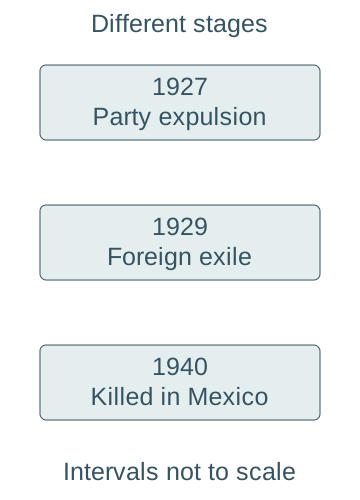
Expulsion and exile — Trotsky and other opposition figures were expelled from the party in 1927, with Trotsky later exiled from the USSR in 1929. Removal from membership, internal displacement, foreign exile and assassination in Mexico in 1940 were distinct stages. Do not collapse them into one event or assume that every rival immediately suffered the same treatment.Trotsky was expelled from the party in 1927, exiled from the USSR in 1929 and assassinated in Mexico in 1940. These are distinct stages, not one immediate execution or the same proceedings as the Moscow show trials. The arrangement is not a scaled time axis.
Stalin and the Right — Stalin then turned against Bukharin, Rykov, Tomsky and others associated with defending the NEP and a less coercive pace of change. The grain-procurement crisis and disagreements over investment and agriculture created a new political struggle. Earlier alliance on one issue did not prevent later exclusion. Policy and power reinforced one another rather than existing as entirely separate explanations.
Bukharin and the NEP alternative — Bukharin argued for development building on peasant incentives and the NEP rather than a sudden coercive offensive against the countryside. His position had ideological and economic reasoning, not merely an objection to Stalin personally. Assess its constraints and political defeat without assuming the unrealised alternative can be described with certainty as either guaranteed success or inevitable disaster.
Why Stalin prevailed — Weigh office and patronage, changing alliances, policy appeal, rivals' errors, party discipline and the limits on organised opposition. Explain how these factors interacted over time. A conclusion should distinguish the defeat of leadership rivals from the later expansion of terror, and recognise that rising dominance did not mean literal control over every local action or the elimination of all private disagreement.
Consolidating dictatorship: image, institutions and terror
Party-state control and personal power — Stalin increasingly dominated a system linking party committees, state offices, economic administration and security bodies. Formal collective institutions continued to exist while practical autonomy narrowed. Analyse appointments, decisions, enforcement and fear rather than treating the word dictatorship as a complete explanation of how control operated.
The cult of personality — Official representation portrayed Stalin as a wise leader, Lenin's rightful heir and the source of national achievement. Celebrations, portraits, texts and naming practices elevated him while obscuring collaborators and rivals. The cult shaped what could be said publicly, but a public expression of praise does not directly measure an individual's sincere belief.
Appropriating Lenin's legacy — Stalin and supporters presented policy as faithful continuation of Lenin, using selected memories, quotations and revolutionary history. A claim of continuity was politically useful even when policies changed. Distinguish historical evidence about Lenin from an official image designed to legitimise Stalin. Suppression or alteration of rivals' roles could make the past a tool of current power.
Education, media and culture — Schools, newspapers, broadcasting, film, literature and visual art could transmit official messages, with censorship limiting alternative accounts. Socialist realism became a prescribed cultural approach in the 1930s, presenting the socialist project through approved narratives. Artists, teachers and audiences were not simply identical passive recipients; participation, accommodation and private response could vary under severe constraints.
Propaganda and material experience — Messages about progress could connect with new education, careers and industrial opportunities for some people, while contradicting others' experience of scarcity, displacement or violence. Propaganda worked alongside patronage, coercion and everyday institutions. Evaluate both the message and evidence of reception instead of assuming either universal belief or universal cynical rejection.
From OGPU to NKVD — The political police developed through changing organisations after the Cheka. The OGPU operated in the 1920s and early 1930s, and its functions were incorporated into the NKVD in 1934. Organisational names and powers changed; do not call every act of repression since 1917 a decision of an already existing 1930s NKVD.
The Kirov murder — Sergei Kirov was killed in December 1934, and Stalin used the event to justify intensified measures against alleged enemies. Whether and how Stalin was involved in planning the murder remains debated; his subsequent exploitation of it is a distinct and much more securely established claim. Avoid presenting an early archival exhibition's confident interpretation of prior responsibility as universally settled scholarship.
Purges and changing targets — Purges could mean expulsion or removal from party positions as well as arrest and execution, with methods and consequences changing over time. Later campaigns reached beyond elite rivals into workplaces, communities and national groups. Define the particular process before assuming every person “purged” suffered the same fate or every campaign was identical.
The show trials — Public trials in 1936–1938 presented former leading Bolsheviks as conspirators, with confessions obtained under coercive circumstances and accusations serving political purposes. Zinoviev and Kamenev were executed in 1936, and Bukharin in 1938. A confession in a staged prosecution is not independent proof that every alleged plot existed. Explain how spectacle and fear helped discredit alternatives and legitimise repression.
Mass operations of 1937–1938 — The Great Terror included large-scale operations targeting people classified as hostile social or national categories, not only famous party leaders. Secret procedures, operational targets and pressures within the apparatus widened victimisation. Stalin and central leaders' responsibility must be weighed alongside how officials implemented and sometimes escalated campaigns. Recognising local agency does not absolve the leadership directing the system.
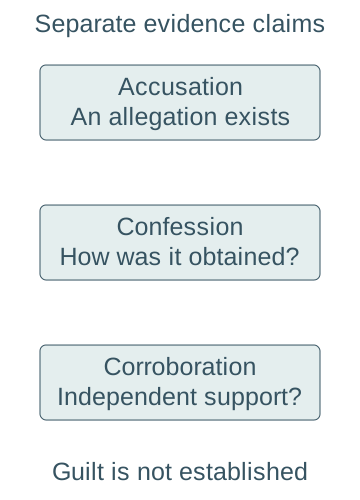
Denunciation and insecurity — People could report others for political motives, fear, personal grievances or opportunities, while officials interpreted reports within categories of suspicion. An accusation did not establish guilt. The system could encourage concealment and mistrust, damaging reliable information and cooperation as well as suppressing opposition. Explain these mechanisms without asserting that every citizen participated in exactly the same way.The existence of an accusation or confession establishes that a claim was made, not that the alleged offence occurred. Assess coercion, purpose and independent corroboration. These are questions for evaluating evidence, not a claim that every accused person had the same experience.
The armed forces and the terror — Repression struck senior officers and others in the armed forces, disrupting experience, trust and command. Its precise effect on preparedness must be assessed alongside equipment, doctrine and later decisions rather than treated as the sole explanation of every military problem. The fact that a leader controlled the army politically does not establish that repression improved its operational competence.
The Gulag — The forced-labour camp system expanded in the 1930s, holding people convicted of political and other offences. Prisoners worked in mining, forestry, construction and other projects under harsh conditions, with hunger, disease, violence and death. Camps served punishment, intimidation and economic purposes. Do not assume all camp labour was efficient or that a completed project removes the human costs of its construction.
Terror and formal constitutional rights — The 1936 constitution proclaimed rights and representative arrangements while political monopoly and repression sharply constrained practical freedom. Formal text and lived experience must be compared rather than simply equated. A constitution's promise is evidence of how the regime presented itself and organised institutions, not direct proof that every right was available to people targeted as enemies.
Control and its costs — Fear and exclusion secured personal dominance, but also destroyed expertise, distorted information and damaged social trust. Some people supported aspects of the system or gained advancement, while others were coerced or victimised. A judgement should specify which kind of control is being measured and retain the consequences for both institutions and individuals.
Agriculture: collectivisation, resistance and famine
The agricultural problem under the NEP — The state wanted food for growing towns, grain for export, resources for investment and tighter control over the countryside. Price relationships and procurement problems exposed tensions between peasant production and state priorities. A crisis in deliveries did not necessarily mean that every household held a large concealed surplus or that coercion was the only imaginable response.
Earlier voluntary cooperation — The 1920s included cooperative and voluntary collective arrangements, with limited and uneven participation. Their existence should be distinguished from the mass coercive transformation that accelerated at the end of the decade. Do not describe every form of peasant cooperation as identical to forced collectivisation or assume all farmers voluntarily chose the later system.
Collective and state farms — A kolkhoz was a collective farm, while a sovkhoz was a state farm employing workers. They differed in formal organisation even though state demands and political control constrained both. Use the terms accurately rather than treating “collective farm” and “state farm” as interchangeable. Actual production, access to resources and household arrangements varied.
Stated aims of collectivisation — Larger units were expected to enable mechanisation, increase output, simplify procurement and release labour for industry. They also extended political control and attacked private economic relationships. Separate intended mechanisms from achieved results: a large farm did not automatically have working tractors, adequate skills or higher yields, and an exported grain shipment did not prove local households had enough food.
Kulaks as a political category — Kulak referred to supposedly wealthier or exploitative peasants, but the category was elastic, expanded or changed to fit political purposes, and used against people with different resources or forms of resistance. It was not a consistently measured class of uniformly rich farmers. Explain official classification and its consequences without adopting every allegation of exploitation or sabotage as established fact.
Dekulakisation — The drive to eliminate kulaks as a class involved confiscation, expulsion, deportation, imprisonment and killing. It removed people and property and helped enforce the transformation of agriculture. Distinguish the regime's stated class war from the varied individuals and families subjected to it. An unsupported exact total can conceal differences between households deported, people imprisoned and those who died.
The acceleration of 1929–1930 — The push for rapid collectivisation brought intense pressure from officials and activists, with targets and campaigns driving participation. Formal claims that joining was voluntary did not remove coercion, threats or the consequences of refusal. Analyse central direction and local practice together rather than treating all abuses as accidental deviations by a few officials.
Resistance and disruption — Peasants could resist through protests, withdrawal, concealment, slaughter of livestock or reduced cooperation. Their actions reflected different fears and priorities, not one identical programme. Disruption reduced productive resources and interacted with poor administration and state demands. Explaining resistance does not justify collective punishment or make every claim of deliberate sabotage credible.
The temporary retreat in 1930 — Stalin's “Dizzy with Success” article blamed excesses on local officials and was followed by some withdrawal from collectives. The retreat helped manage a crisis without ending the broader drive. Distinguish tactical reversal and redistribution of blame from abandonment of collectivisation or proof that coercion had originated only locally.
Mechanisation and machine tractor stations — Machine tractor stations supplied equipment and services while also strengthening state influence over collective agriculture. Mechanisation could raise productive possibilities but depended on availability, maintenance, fuel, skill and organisation. A count of tractors or stations is not itself a measurement of effective work completed, yields or household welfare.
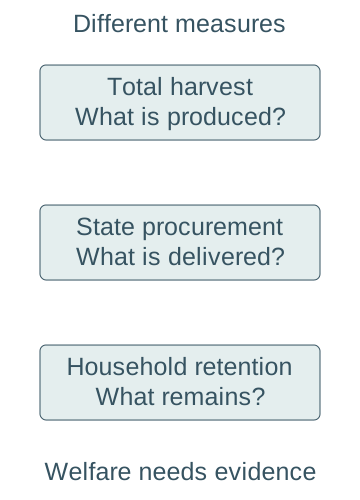
Procurement and distribution — The state extracted grain to meet urban, industrial and export priorities, often under harsh conditions. Deliveries could be maintained while rural consumption suffered, so procurement success is not synonymous with agricultural well-being. Evaluate incentives, local stocks, official knowledge and competing claims instead of assuming that aggregate receipts establish adequate food for producers.Total harvest, state acquisition and what rural households retain are different measures. Higher deliveries to the state do not alone prove improved harvests or nutrition. Seed, feed, storage, losses and other uses also matter, so this schematic is not a complete accounting equation.
Famine and state responsibility — The famines of the early 1930s, particularly 1932–1933 in Ukraine and other regions, involved catastrophic deaths and suffering linked to coercive transformation, procurement, restrictions and disruption. Conditions differed by region, and natural factors alone do not explain the political handling of hunger. Distinguish uncertainty about exact totals from the well-established reality of mass famine and the regime's responsibility for damaging policies and responses.
Ukraine, Kazakhstan and different experiences — Ukraine's Holodomor is central to historical debate about policy, national targeting and intent. Kazakhstan also suffered catastrophic famine associated with forced settlement and disruption of pastoral life, livelihoods based on herding animals. These were not identical regional processes. Explain the mechanisms and evidence without erasing either case or treating a dispute over interpretation and classification as doubt that mass suffering occurred.
Agricultural outcomes and political control — Collectivisation transformed institutions and strengthened the state's access to grain and the countryside, but disruption, livestock losses, coercion and suffering contradict a simple productivity-success narrative. Some output later recovered while structural problems remained. Assess procurement, productive capacity, labour movement, household welfare and control as separate criteria, and distinguish formal incorporation from enthusiastic consent.
Industry, the first two Five-Year Plans and social change
Why accelerate industrialisation? — Leaders linked industrial development with defence, independence, socialist transformation and the need to catch up with stronger economies. Political struggle also shaped the chosen pace and allocation. Explain these motives without treating every ambitious target as a neutral technical necessity or assuming that fear of external threats proves every economic method was unavoidable.
Gosplan and central targets — Gosplan, the state planning commission founded before Stalin's first plan, helped develop targets and coordinate resource priorities. Plans translated political ambitions into output, investment and allocation instructions, but information and bargaining affected the process. Avoid attributing creation of the institution itself to 1928 or assuming planners could know every factory's capacities accurately.
The First Five-Year Plan — The first plan began in 1928 and concentrated heavily on industry, especially coal, steel, machinery, electricity and other producer goods. In January 1933 Stalin claimed fulfilment after four years and three months, but this early-completion claim did not establish that every original or revised target had been met. Distinguish the intended period, political declaration, recorded output and independent assessment.
Heavy industry and consumer goods — Concentrating investment in capital goods, machinery and equipment used to produce further goods, could increase future productive and military capacity while limiting resources for housing, clothing and everyday consumption. This was a distribution and timing choice, not proof that consumer needs disappeared. Assess both what was built and the immediate conditions experienced by workers and families.
New industrial centres — Projects such as Magnitogorsk and the Dnieper hydroelectric development illustrate the scale of change and mobilisation. Construction and output depended on materials, skills, transport and labour, including people moving from the countryside. A new plant or dam is evidence of capacity but cannot alone establish efficient use, good-quality output or adequate living conditions around it.
The Second Five-Year Plan — The second plan, 1933–1937, continued heavy-industrial development and placed importance on consolidation, transport and the effective use of capacity, with defence pressures increasingly significant. Its priorities and outcomes should be compared with the first rather than assumed identical. Improvements in some areas coexisted with consumer shortages and coercive labour conditions.
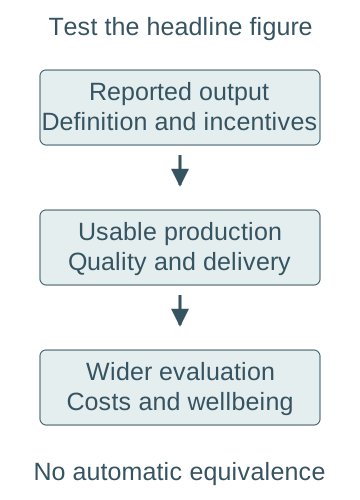
Targets and reported success — Managers under pressure might prioritise measured quantities, conceal problems or alter reporting. A factory judged by weight could have different incentives from one judged by useful quality and delivery. Explain the measure behind an output claim and compare sources. Failure to meet an inflated target does not prove no growth, while meeting a narrow measure does not establish efficient production.Evaluate the definition and incentives behind reported output, then investigate whether products were usable and delivered where needed. Costs, efficiency and living standards require additional evidence. The arrows indicate an analytical sequence, not guaranteed improvement or a measured historical trend.
Bottlenecks, waste and quality — Uneven supplies, unrealistic deadlines, breakdowns, poor coordination and skill shortages could interrupt production. Producing large quantities of one input without matching transport or complementary goods could create waste rather than usable output. Analyse linked production stages instead of treating every additional tonne as an identical addition to welfare or military readiness.
Labour movement and urbanisation — Industrialisation drew large numbers into towns and new settlements, changing occupations and social relationships. Housing, sanitation and services often struggled to keep pace. Some gained education, wages or promotion, while others experienced insecurity, compulsion and hardship. National industrial expansion was therefore compatible with very uneven individual experiences.
Discipline, incentives and Stakhanovism — Wages, bonuses, honours, competition and propaganda encouraged output alongside penalties, labour controls and political pressure. The Stakhanovite movement from 1935 celebrated exceptional production achievements, often dependent on special preparation and collective support. Assess its effect on production targets, morale and relations rather than treating a publicised record as the normal unaided productivity of every worker.
Skills, women and opportunity — Technical education and new jobs created routes of advancement, including for women and people from rural backgrounds. Opportunity coexisted with unequal treatment, domestic burdens and the demand to meet state priorities. Distinguish participation from equality or autonomy. A rise in the number employed does not alone reveal the quality of work, control over choices or distribution of household labour.
Forced labour and industrial achievement — Camp and other coerced labour supported particular construction, extraction and infrastructure projects. Its use must be distinguished from the whole industrial workforce, much of which consisted of other forms of employment. Assess contribution, inefficiency, coercion and human costs without either erasing forced labour or assuming every factory worker was a prisoner.
Assessing the first two plans — Compare growth in productive capacity with targets, quality, costs, distribution, working conditions and state power. The USSR became much more industrial, but this does not settle whether every priority or method was efficient, necessary or beneficial. Explain the chosen criterion and weigh what different kinds of evidence can establish.
The position by 1941 — A third plan began in 1938, but the course's required detailed plan comparison centres on the first two. By 1941 industrial and defence capacity had expanded while agricultural, welfare and administrative difficulties persisted. Germany's invasion in June 1941 marks a major new wartime phase; do not use later victory or Stalin's postwar rule as if they had already occurred within this endpoint.
Test yourself
50 questions · Random sets of 10. These quick checks support revision; practise longer explanations and justified judgements too.
 Mr Kidman's Classroom