Industrial growth immigration and contested organisation 1865–1914
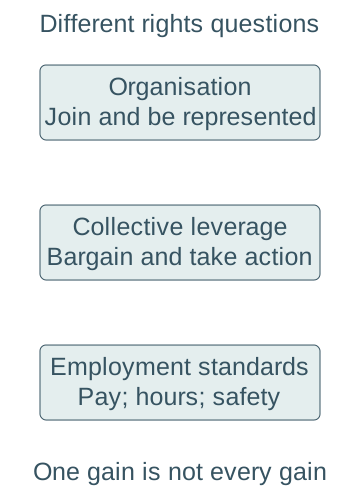
Several meanings of labour rights — Distinguish the ability to organise, recognition of a union, collective bargaining (negotiation between employers and workers’ representatives), freedom to strike and statutory protections for pay, hours and safety. A rise in wages may occur without stronger organising rights, and a recognised union may not represent every worker. Define the criterion before evaluating change across 1865–1992, and connect this strand with race, gender and migration rather than studying a uniform workforce.The ability to organise, collective bargaining and industrial action, and statutory employment standards are related but distinct. Higher pay or a safety rule does not alone establish recognition or unrestricted strike rights. Coverage and practical enforcement require separate evidence.
The position in 1865 — Industrial workers possessed no comprehensive national guarantee requiring employers to recognise unions or bargain collectively. Employment conditions varied by trade, locality and skill, while newly emancipated workers faced particular obstacles to meaningful freedom of contract. Workers did organise, but employers' economic resources, judicial decisions and access to coercive authority often created an unequal contest.
Industrialisation and scale — Railways, steel, mining and mass production expanded a wage-dependent workforce and created incentives for collective organisation. Larger firms could coordinate production, finance and opposition to strikes across sites, making a purely local dispute harder to sustain. Concentration could also connect workers across workplaces: economic growth supplied possibilities for organisation and resources for resistance to it.
Skill and bargaining position — Craft workers with scarce skills could sometimes defend standards and restrict entry more effectively than easily replaced labourers. Mechanisation and the division of work could undermine such leverage or generate new specialist roles. Do not assume every industrial worker experienced the same loss of control; ask how technology, labour supply and the organisation of production affected particular groups.
New Immigration — Immigration from Southern and Eastern Europe increased the industrial labour force in the later nineteenth and early twentieth centuries. Differences of language, religion, occupation and migration experience complicated organisation, while employers could exploit divisions. Immigrants also built unions and mutual support. Treat diversity as an organisational challenge and source of agency, not a claim that migrants inherently prevented collective action.
Race gender and exclusion — Racist exclusion, occupational segregation and unequal treatment of women weakened the claim that a union spoke for all workers. Some organisations sought broader recruitment while others protected narrower memberships. Assess whom a strategy included and excluded; advances for a skilled white male group do not automatically establish equal labour rights for Black workers, women or migrant labourers.
Employer resistance — Employers could use dismissals, blacklists (records used to block future employment), lockouts (employers excluding workers to exert pressure), strikebreakers (replacement workers), private security and company-controlled organisations to resist unionisation. These methods affected income, housing and future employment as well as the immediate dispute. Distinguish private coercion from state intervention while investigating their connections; employer opposition was not simply an opinion without material effects.
Courts and injunctions — Injunctions are court orders requiring or forbidding particular action. They could prohibit specified union action and expose organisers to punishment for disobedience. Courts' protection of property and contract often constrained collective pressure, while legal categories could treat a boycott or strike as an unlawful restraint. Judicial authority mattered alongside armed intervention: the power to define permissible action shaped bargaining even when no troops were deployed.
Yellow-dog contracts — Employers sometimes required workers to agree not to join a union as a condition of employment. Describing this as a freely negotiated individual contract ignored the inequality created by scarce jobs and dependence on wages. Distinguish legal enforceability from practical consent, and trace later restrictions without assuming all anti-union methods disappeared together.
The National Labor Union — Founded in 1866, the National Labor Union sought wider organisation and reforms including shorter working hours. Its ambition illustrates early efforts to move beyond individual trades, but divisions and limited durability constrained it. Early national organisation should not be omitted merely because later federations became more influential; compare aims, membership and sustainability rather than claiming an uninterrupted institutional lineage.
The Knights of Labor — Founded in 1869, the Knights promoted broad labour reform and recruitment beyond a small set of skilled crafts, though exclusions and local inequalities remained. Their ambitions included cooperation and a wider transformation of workers' position. Broad membership could expand reach while complicating coordination and shared strategy; do not equate an inclusive aspiration with equal practical access for everyone.
The railroad strike of 1877 — Wage reductions and wider grievances helped produce a major wave of railway strikes during economic distress. State forces and federal troops helped suppress the unrest, revealing the coercive resources available against collective action. Compare workers' grievances, spread of participation and official claims about order; deployment is evidence of intervention, not proof that every participant had identical aims or used identical methods.
Haymarket and the Knights' decline — The 1886 Chicago Haymarket bombing and its aftermath associated labour radicalism with violence in much public discussion. The Knights were not simply identical with the people accused over the bombing, but reputational damage combined with failed disputes and internal problems to undermine them. Distinguish the event, public reaction and multiple organisational causes rather than making one incident a complete explanation.
The AFL and Gompers — The American Federation of Labor formed in 1886 as a federation of craft unions, associated with Samuel Gompers and practical gains in wages, hours and conditions through bargaining. Its narrower base could strengthen particular negotiations while leaving many workers outside. Evaluate business unionism through both concrete gains and restricted reach, rather than assuming that moderation meant no conflict or that successful bargaining guaranteed universal rights.
Homestead in 1892 — The steel dispute involved an employer lockout, Pinkerton guards, armed confrontation and state militia intervention. Defeat weakened union organisation in an important industry, illustrating how management strategy and coercive resources could overcome worker resistance. A detailed explanation should separate employer decisions, violence and the state's role instead of treating the outcome as an automatic consequence of industrial technology alone.
Pullman in 1894 — Wage reductions amid company-town grievances helped trigger the Pullman dispute, while the American Railway Union's boycott extended its reach. Federal injunctions and troops under Cleveland helped break the action, with mail delivery and interstate commerce used to justify intervention. Do not claim the union represented every railway worker equally: racial exclusion and differences between organisations limited solidarity.
Industrial unionism and the IWW — Industrial unionism sought to organise across skills within an industry, challenging craft divisions. The Industrial Workers of the World, founded in 1905, pursued a more radical approach and organised groups often poorly served by established unions. Its activities demonstrate alternatives, but repression, internal difficulties and limited durable bargaining strength qualify claims about success.
The Progressive era and uneven reform — Growing attention to unsafe factories, child labour and working conditions encouraged state reforms and federal debate. Investigations and disasters could generate pressure, but judicial challenges and uneven coverage limited change. Distinguish minimum standards from union rights: a safety regulation may improve conditions without requiring an employer to recognise a union.
Theodore Roosevelt and the 1902 coal dispute — Roosevelt's intervention in the anthracite coal dispute placed pressure on both sides and helped secure arbitration, settlement through a third party assessing the dispute, rather than simply using national troops to defeat the union. The outcome improved some terms but did not establish general compulsory union recognition. Compare it with Cleveland at Pullman to show variation within federal policy before the New Deal.
World war the 1920s and the New Deal settlement
The First World War and labour demand — War production increased demand for labour and made disruption costly to the national government. Workers could gain bargaining opportunities while officials sought uninterrupted output and managed disputes. Wartime need helps explain concessions, but labour shortages and emergency institutions did not independently create permanent equal rights across all occupations.
The wartime labour bargain — The National War Labor Board established in 1918 promoted settlement and recognised aspects of organising and bargaining in exchange for industrial peace. Its authority was tied to wartime circumstances and did not eliminate employer resistance. Explain the conditional bargain between production, wages and restraint rather than describing either unrestricted strike freedom or the complete abolition of union action.
The 1919 strikes and Red Scare — Post-war inflation, expectations and disputes helped produce major strikes, while fears of radicalism supported repression and hostile portrayals of organised labour. Not every striker was a revolutionary, and a security label did not establish the truth of an allegation. Assess why wartime gains proved vulnerable when government priorities, labour supply and public attitudes changed.
The 1920s open-shop drive — Employers promoted non-union workplaces, company representation and welfare measures while resisting independent bargaining. Prosperity for some workers could coexist with limited organisation and uneven pay. Company benefits might reduce discontent without providing an independent voice; do not infer freely chosen satisfaction from low strike numbers alone.
Depression and bargaining weakness — Mass unemployment after 1929 reduced individual workers' alternatives and could make strike participation especially costly. It also exposed insecurity and increased pressure for government action. Economic crisis could therefore weaken immediate bargaining power while creating conditions for later reform; the direction depended on organisation and policy, not hardship alone.
Norris–LaGuardia in 1932 — The Act restricted federal courts' power to issue labour injunctions and made yellow-dog agreements unenforceable in federal courts. Passed during Hoover's presidency, it qualifies the claim that every significant federal change began after Roosevelt took office. Its scope was important but did not itself establish the full later machinery of union elections and unfair-labour-practice remedies.
NIRA and Section 7(a) — The National Industrial Recovery Act of 1933 included a promise of organising and collective-bargaining rights in Section 7(a). Expectations and mobilisation grew, but enforcement was weak and employer-controlled representation complicated implementation. The Supreme Court invalidated the NIRA framework in 1935; distinguish its stimulus to organising from the more durable Wagner Act settlement.
The Wagner Act in 1935 — The National Labor Relations Act protected covered workers' organising and collective-bargaining rights, defined employer unfair labour practices and created the National Labor Relations Board’s (NLRB) durable enforcement framework. It represented a major change in the national state's position. Coverage excluded important categories, including agricultural and domestic workers, so a national statute must not be confused with universal protection of every worker.
The NLRB's practical role — The Board investigated unfair labour practices and administered representation procedures, supplying mechanisms beyond a statement of principle. Employers could delay, resist or litigate, and enforcement depended on capacity and authority. A union's legal right to seek recognition and its practical strength at a workplace were connected but distinct measures of progress.
Judicial survival and enforcement — The Supreme Court upheld the Wagner Act's constitutional basis in NLRB v Jones & Laughlin Steel in 1937. This strengthened the settlement after earlier judicial hostility to reform, but did not resolve every later dispute over interpretation. Compare courts over time rather than assigning an eternally hostile or eternally protective character to the institution.
The CIO and mass-production workers — The organisation that became the Congress of Industrial Organizations developed industrial unionism in mass-production sectors, moving beyond the AFL's craft emphasis. Broad recruitment could strengthen solidarity across tasks and sometimes across racial divisions, though exclusions and unequal treatment persisted. Organisational strategy helped workers use the changing legal environment; legislation alone did not recruit members.
Sit-down strikes and recognition — In a sit-down strike, workers occupied a workplace rather than merely leaving it, making replacement labour harder to introduce. The Flint action of 1936–37 helped secure recognition at General Motors. Explain the leverage and legal controversy of the method without claiming every occupation was protected or that every employer conceded in the same way.
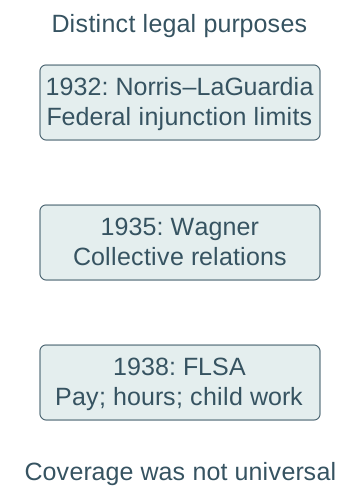
The Fair Labor Standards Act — Enacted in 1938, the FLSA established federal minimum-wage, overtime and child-labour provisions for covered workers, with major exclusions and phased arrangements. It did not immediately apply the same protection to every occupation or establish union recognition. Distinguish its employment standards from the Wagner Act's collective-relations framework, and do not portray an overtime threshold as a universal ban on longer work.The 1932 law restricted federal labour injunctions and yellow-dog enforcement, the 1935 law established a durable collective-relations framework, and the 1938 law addressed employment standards. The labels summarise selected purposes rather than every provision; coverage and implementation differed.
Assessing the New Deal turning point — National law, enforcement machinery and industrial organising together expanded opportunities in the 1930s, but race, gender, occupation and location shaped access. Compare what changed in rights, membership and bargaining results rather than citing one statute as complete proof. The separate depth study evaluates motives, opposition and effects across all four civil-rights strands, not labour alone.
The Second World War bargain — War production, labour demand and government management helped unions gain recognition and membership, while national leaders accepted a no-strike commitment and wage restraint. The wartime National War Labor Board was distinct from the First World War body despite a similar name. Protection, production and limits to independent action developed together rather than forming an uncomplicated expansion of every freedom.
Race and wartime labour rights — Defence employment campaigning, Randolph's pressure and Order 8802 connected workplace rights with the wider African American struggle. Unions could challenge discrimination or reproduce it, depending on organisation and practice. Assess access to jobs, equal treatment and representation separately; the defence programme's fair-employment measures did not automatically bring every worker within the Wagner Act.
Post-war restrictions prosperity and the labour civil-rights connection
The post-war strike wave — After wartime restraint, inflation and competing expectations about wages and management helped produce major disputes in 1945–46. The scale of strikes increased pressure for restrictions as well as demonstrating union mobilisation. Explain why wartime partnership did not guarantee permanent harmony, and distinguish arguments about economic disruption from the legitimacy of workers' grievances.
Taft–Hartley in 1947 — The Labor Management Relations Act amended the Wagner framework, restricted specified union activities and added union unfair labour practices. Truman vetoed it, but Congress overrode him. This was a major limitation rather than the abolition of all organising rights: statutory collective bargaining survived within a more restrictive balance between unions, employers and government.
Closed shops and right-to-work provisions — Taft–Hartley prohibited the closed shop and permitted states to restrict union-security arrangements through Section 14(b). Right-to-work laws concern compulsory membership or payment arrangements, not a guarantee of employment. Distinguish a closed shop, requiring membership before hiring, from other forms of union security rather than calling every organised workplace illegal.
Secondary pressure and emergency powers — Restrictions on specified secondary action, pressure directed at another employer connected to the dispute, limited unions' ability to extend pressure beyond the immediate employer. National-emergency procedures could permit a temporary court-ordered pause in a dispute. Explain the particular mechanism and scope rather than stating that Taft–Hartley prohibited every strike or gave the president an unrestricted permanent power to settle all labour terms.
Anti-communism and internal division — Cold War pressure and requirements directed at union officers intensified disputes over political affiliations. CIO expulsions of left-led unions narrowed organisational unity and damaged some activists and networks. Distinguish allegations, actual political commitments and the consequences of exclusion; do not assume every militant organiser was a communist or every internal conflict originated in government direction.
Post-war bargaining gains — Some organised workers obtained higher wages, pensions and benefits through collective agreements during sustained growth. These gains were substantial but uneven across sectors, regions, race and gender. Workplace benefits could depend on employer and union strength, so they were not identical to a universal national social entitlement or proof that bargaining rights could never be eroded.
The AFL–CIO merger in 1955 — The merger reunited major craft and industrial federations, strengthening coordination and public representation. It did not eliminate every jurisdictional dispute, organising difficulty or internal inequality. Institutional unity should be assessed against its capacity to recruit and bargain, not treated as a membership gain or a guarantee of common strategy in every later dispute.
Landrum–Griffin in 1959 — The Labor-Management Reporting and Disclosure Act responded to concerns about union governance with members' rights and reporting requirements, while also imposing further restrictions on aspects of union activity. Distinguish protection of members within organisations from expansion of unions' bargaining power against employers. Reform can strengthen accountability while constraining collective methods.
The significance of the 1960s — Labour interacted with civil-rights campaigns, expanding public-sector organisation and demands for fair employment and wider opportunity. Not every national union adopted the same position, and tensions over race, leadership and priorities persisted. Evaluate the decade as a change in membership composition, political alliances and rights claims rather than only as a sequence of private-sector wage settlements.
Public-sector organisation — Kennedy's Executive Order 10988 in 1962 recognised organising and representation rights for federal employees within limits. It did not give an unrestricted right to strike or put all public workers under the private-sector Wagner framework. State and local rules varied, so assess federal, state and municipal employees separately when explaining public-sector growth.
Labour and civil rights — Unions and labour organisers contributed resources and participants to civil-rights activity, including the 1963 March on Washington for Jobs and Freedom. Randolph's role exemplifies connections between economic and racial claims. Discrimination within parts of organised labour and disagreements over strategy qualify any claim of universal solidarity; examine particular organisations and coalitions.
Equal employment and women workers — The Equal Pay Act of 1963 and Title VII of the Civil Rights Act of 1964 provided employment protections distinct from union recognition. Enforcing them required complaints, institutions and legal action, while occupational segregation and unequal opportunities persisted. Connect the rights of women and African Americans with labour without assuming all workplace discrimination was resolved by union membership.
Memphis in 1968 — The sanitation workers' strike connected pay, working conditions, recognition and racial dignity in a municipal workplace. King's support showed his concern with labour and economic justice as part of civil rights. The campaign demonstrates that formal national changes coexisted with local conflict; assess workers' organisation and demands rather than making the event solely a backdrop to King's assassination.
Farmworkers structural change and the Reagan era
Agricultural exclusion — Farmworkers' exclusion from the original Wagner Act framework left organising dependent on other strategies and, later, particular state measures. Seasonal employment, mobility, poverty and employer power made sustained organisation difficult. This was not a workforce without agency: mutual support, local organising and pressure outside ordinary industrial bargaining could overcome some obstacles.
Chávez Huerta and wider organisation — César Chávez and Dolores Huerta helped build the National Farm Workers Association from 1962, connecting community organising with labour demands. Leadership operated through workers, families and networks rather than one heroic individual acting alone. Compare material conditions, organisational work and methods; shared ethnicity did not imply identical interests or automatic unity among every farmworker.
Filipino workers and Delano — Filipino farmworkers associated with the Agricultural Workers Organizing Committee initiated the Delano grape strike in 1965, with Larry Itliong among the important organisers. The NFWA joined, and cooperation helped build a wider struggle. Preserve this sequence and contribution rather than saying Chávez alone began the action or that every participant belonged to one organisation from the start.
The UFW and consumer boycott — The United Farm Workers developed through cooperation and organisational change, using strikes, marches, publicity and consumer boycotts to pressure growers. Mobilising people away from the immediate workplace widened leverage where replacing seasonal labour could weaken a strike. Non-violent discipline and alliances mattered, but the movement also encountered internal conflict and difficult choices about migration and recruitment.Farmworker organisers sought support from allies and consumers to influence growers through sales and reputation as well as workplace stoppages. The arrows identify a mechanism of pressure, not a guarantee that every boycott succeeded or that seasonal labour ceased to be vulnerable.
Contracts and limits to success — The 1970 grape agreements demonstrated substantial organising achievement, while continued disputes, rival unions and implementation problems made gains vulnerable. California's 1975 Agricultural Labor Relations Act provided a state framework for farmworker organising. Neither contracts nor one state's law established equal nationwide agricultural protection or permanent victory in every later campaign.
Deindustrialisation and relocation — The decline or relocation of some manufacturing jobs reduced organised labour's established workplace base. Automation, international competition, movement towards less unionised regions and employer strategies interacted with legal and political conditions. Distinguish structural pressures from a single presidential decision, and examine why losses differed between industries and locations.
The changing workforce — Service employment and public-sector organisation became more important as the old industrial core faced pressure. Different workplace sizes, turnover, subcontracting and occupational arrangements affected organising possibilities. A lower union share does not necessarily mean the absolute number fell in exactly the same proportion; use consistent definitions and denominators when comparing membership evidence.
Reagan and PATCO in 1981 — Air traffic controllers belonging to the Professional Air Traffic Controllers Organization (PATCO) struck despite the prohibition on federal employee strikes. Reagan required a return to work and dismissed those who remained on strike. The episode demonstrated a forceful federal stance and influenced perceptions of employer power, but it was not legislation abolishing every union or every private-sector strike.
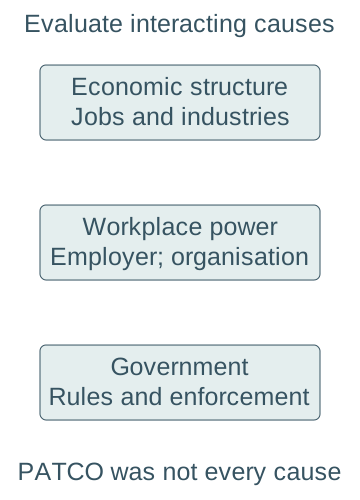
Symbolic impact and wider causes — PATCO mattered as a signal and precedent within a broader era of employer resistance, economic change and reduced organising strength in many private industries. To judge its significance, compare what followed with trends already under way and consider counterexamples. Chronological proximity alone does not prove that one dispute caused every later decline in membership or wages.PATCO was an important event within wider structural, organisational and political pressures. Compare job changes, employer strategies, organising and public institutions before attributing the whole trend to one president or dispute. The boxes are analytical categories rather than measured causal weights.
Reagan-era policy and institutional change — Appointments, enforcement priorities and political attitudes affected how existing labour protections operated. Statutes such as the Wagner framework survived, while their practical value could change through administration and the balance of workplace power. Distinguish a right's legal survival, the effectiveness of remedies and employers' willingness to bargain rather than relying on any one indicator.
Reading membership evidence — Compare like-for-like measures: workers counted, sectors included, geographical coverage and whether a figure is an absolute membership total or a percentage of employment. Rising employment outside organised sectors can reduce density even without the same proportional loss in members. A sound argument links the numerical trend to mechanisms and rights rather than treating a percentage as a complete explanation.
Comparing federal roles across the period — Contrast force at Pullman, Roosevelt's 1902 arbitration, wartime bargains, New Deal protections, Taft–Hartley and PATCO. Presidents, Congress, courts and agencies could disagree, and state rules added variation. Organise comparisons around mechanisms of support or restriction and their scope, rather than assuming a steady national journey from hostility to permanent protection.
Judging labour rights by 1992 — There had been major changes in legal recognition, standards, bargaining institutions and the composition of organised labour since 1865. Important exclusions, weakened industrial leverage and contested enforcement remained. A balanced judgement identifies which workers gained which protections and how securely, connects race and gender with occupation and region, and tests turning points against continuity and reversal across the whole period.
Test yourself
50 questions · Random sets of 10. These quick checks support revision; practise longer explanations and justified judgements too.
 Mr Kidman's Classroom