Civil disputes — Civil law regulates rights and obligations between persons, organisations and sometimes public bodies. A negligence claim seeks a civil remedy for breach of a duty; a criminal prosecution asks whether an offence has been proved. One event can produce both proceedings, so an acquittal does not automatically dispose of a civil claim.
Parties and proof — The claimant brings the claim against the defendant. Ordinarily the claimant must prove the elements of the claim on the balance of probabilities: more likely than not. A defendant relying on a particular defence may bear its burden. This differs from the prosecution's general criminal burden of making the court sure.
Purpose and outcomes — Damages generally compensate established loss rather than punish every morally objectionable act. An injunction may restrain conduct or require action where appropriate. Winning a civil case does not itself send the defendant to prison; breaching a court order can create separate enforcement or contempt issues. Contempt concerns conduct that obstructs justice or disobeys court authority; its consequences are separate from ordinary liability for the original civil claim.
Civil jurisdiction — Jurisdiction is a court's legal authority to deal with a dispute. Subject matter, value, complexity and procedural rules help determine the appropriate forum. Choosing a court is different from choosing the track used to manage a case inside the civil system.
The County Court — The County Court deals with a wide range of civil work, including debt, contract, personal injury and possession claims. It is a single court operating through many hearing centres, not a hierarchy in which every town's court is a separate appellate level. District and circuit judges undertake different work.
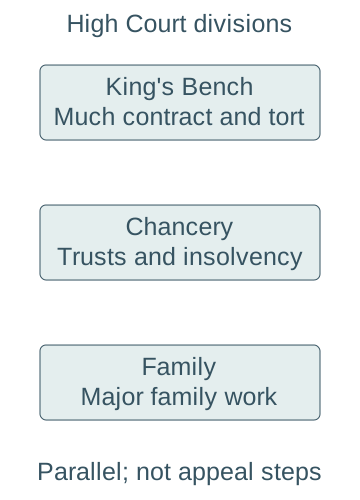
The High Court — The High Court handles substantial or complex civil litigation and also has appellate and supervisory functions. Its three divisions are King's Bench, Chancery and Family. They are divisions of the same High Court, not three separate rungs on an appeal ladder.King's Bench, Chancery and Family are parallel divisions of the High Court. The examples identify selected areas of work rather than exhaustive or exclusive jurisdictions. The separate Family Court is not the Family Division; these boxes are not an appeal ladder.
King's Bench — King's Bench deals with much contract and tort litigation and contains specialist jurisdictions, including the Administrative Court. Older reports and the OCR specification may say Queen's Bench because that was the division's name under Queen Elizabeth II. Use the current name when describing today's structure.
Chancery and Family — Chancery deals with areas such as trusts (arrangements where assets are held for others' benefit), insolvency (inability to meet debts under the relevant legal tests) and company disputes. The High Court Family Division handles important or complex family work. Do not confuse the Family Division of the High Court with the separate Family Court, or imply that every family case starts in the High Court.
First instance and appeal — A first-instance court determines a dispute initially; an appellate court reviews a challenged decision under the applicable appeal rules. The same institutional court can exercise different functions. Describing the High Court simply as an appeal court misses its trial work.
An original forum example — A fictional customer's straightforward claim for an unpaid refund is normally suited to the County Court. Under the ordinary Part 7 starting rules, a damages or specified-sum claim may generally start in the High Court only above £100,000; a personal-injury damages claim uses a threshold of £50,000 or more. These are qualified starting restrictions, not a rule that every larger claim must use the High Court or that the County Court cannot hear substantial claims. Complexity, public importance and specialist provisions also matter. Check applicable rules rather than treating a wealthy party's preference as jurisdiction.
Preparing and managing a civil claim
Before proceedings — A prospective claimant identifies the cause of action (the legal basis for the claim), material facts (facts relevant to establishing it), evidence, defendant and remedy. Applicable pre-action protocols, which set steps before starting specified types of claim, or general pre-action conduct normally require exchange of information and consideration of settlement. A letter before claim gives the other party a fair chance to understand and respond to the dispute.
Proportionate preparation — The cost and extent of evidence gathering should be proportionate to what is at stake. Retain relevant documents and explain how they support an issue; a large folder does not prove a claim by volume alone. Legal advice can identify a limitation period (the legal time limit for bringing a claim) or an unsuitable remedy before costs grow.
Starting and answering — A claim form and particulars state the case being advanced. The defendant may admit, defend or take other permitted procedural steps. Failure to respond can permit default judgment, a decision against a party for failing to take the required response steps, where the rules allow it. A defended allegation is not automatically proved by being confidently stated in a form.
Case management — The court manages progress through directions, timetables and evidence requirements. Directions questionnaires help the court choose suitable management. Case management aims to make proceedings fair, proportionate and efficient, rather than letting parties create unlimited cost or delay.
Track is not court — A track is a procedure for managing a civil claim; it is not a separate court. Both the amount and features such as complexity, likely trial length and expert evidence can matter. An allocation example must therefore state assumptions instead of treating money as the only relevant fact.
Specification and current procedure — OCR's specification retains a three-track description: small claims, fast and multi-track. Current Civil Procedure Rules Part 26 lists four tracks, adding the intermediate track. Learn the required core distinctions while recognising this current procedural development; use the examination's applicable legal cutoff rather than silently presenting an outdated list as today's law.
Small claims — The small claims track generally handles lower-value, relatively straightforward disputes. The ordinary money limit is £10,000, but special rules apply to claims such as personal injury and housing disrepair. The procedure is intended to be more accessible, with restrictions on recoverable legal costs; it does not guarantee zero expense.
Fast track — The fast track normally covers suitable claims up to £25,000 that do not belong on the small claims track, subject to trial-length and expert-evidence requirements. A claim's complexity may make another track more appropriate. Its more structured procedure can improve predictability while still imposing significant cost and preparation.
Intermediate track — Current rules provide an intermediate track for suitable claims normally up to £100,000 that are unsuitable for the smaller tracks and meet further criteria, including trial length and expert evidence. This bridges fast and multi-track management. It is a present-law distinction, not a newly invented OCR fourth court.
Multi-track — Multi-track is the normal track where the other tracks are not suitable. It permits tailored management of high-value or complex cases. Flexibility helps match procedure to the dispute, but bespoke directions, expert evidence and lengthy litigation can increase cost and uncertainty.
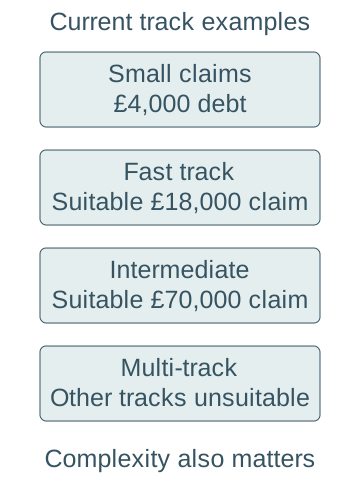
Allocation examples — Assume ordinary defended money claims without special categories: a straightforward £4,000 debt is a plausible small claim; a suitable £18,000 one-day claim may be fast track; a suitable £70,000 two-day claim may be intermediate track. A complex claim may require multi-track management even when its value is lower than expected. These are teaching illustrations, not guaranteed allocation decisions.These are fictional ordinary defended money claims with no special category. A £4,000 straightforward debt, suitable £18,000 short claim and suitable £70,000 claim illustrate different current tracks. Value is not the only criterion: complexity, trial length, experts and special rules also matter. Current CPR Part 26 has four tracks; OCR's legacy three-track wording and the examination's legal cutoff are distinguished in the explanation.
The overriding objective — The civil rules aim to deal with cases justly and at proportionate cost. Fairness includes effective participation and appropriate use of court resources, not merely reaching an outcome quickly. A cheaper process that prevents a party presenting necessary evidence may not provide meaningful justice.
Settlement during a case — Parties can settle after proceedings begin. A settlement can save further expense and preserve control over terms, but the parties should distinguish an agreement from a court's determination of liability. Pressure to settle can reflect litigation risk or lack of funds as well as the underlying merits.
Appeals and the limits of review
Why appeal? — An appeal challenges a decision through a prescribed route, commonly alleging legal error or a serious procedural problem. Disappointment is not itself a ground. Appeal procedure helps correct error and maintain coherent law, but restrictions prevent every dispute being tried indefinitely.
Routes depend on the decision — The destination of a County Court appeal depends on the level of the judge and the nature of the decision. Some go to a more senior judge or the High Court; other routes reach the Court of Appeal Civil Division. Do not memorise a universal County Court-to-High Court-to-Court of Appeal sequence as if every case follows every step.
The Court of Appeal — The Civil Division hears appeals under its jurisdiction from civil courts and certain tribunals. Permission is generally required, and second appeals face tighter conditions. The court reviews the challenged decision; it does not exist simply to let a losing party repeat every argument without showing an appealable issue.
The Supreme Court — The UK Supreme Court is the final domestic appellate court for appropriate civil cases, usually reached from the Court of Appeal with permission. It focuses on arguable points of law of general public importance. Exceptional statutory leapfrog arrangements can permit an appeal directly from the High Court; these do not make leapfrogging the ordinary route.
Review rather than retrial — A civil appeal is normally a review, subject to the rules and exceptions, rather than an automatic full rehearing with unlimited fresh evidence. Explain why the first court's decision was wrong or the process unjust. Separating the legal issue from disagreement with fact-finding produces a stronger argument.
Evaluating appeals — Appellate scrutiny can promote consistency and correct injustice. Permission requirements and limited routes protect finality and public resources. Cost, delay and unequal access to skilled advice can still make an available appeal unrealistic, so formal rights and practical accessibility need separate evaluation.
Employment tribunals and specialist justice
Specialist adjudication — Tribunals decide disputes in defined fields using specialist statutory jurisdiction. An employment tribunal can determine claims such as unfair dismissal and discrimination when the legal requirements are met. It is not a general forum for every workplace disagreement or an alternative criminal jury.
Procedure and participation — Tribunal procedures are intended to make specialist justice workable, but evidence, legal tests and procedural orders still matter. A less formal setting does not mean a claimant wins without proof. Complex discrimination or employment-status questions can require substantial legal analysis.
Employment judges and members — Employment judges determine cases; non-legal members may sit in some circumstances under the applicable rules. Do not claim every case must always use a three-person panel. The relevant composition depends on the type of proceeding and current rules.
Acas early conciliation — For most employment tribunal claims, the prospective claimant must notify the Advisory, Conciliation and Arbitration Service (Acas) first, subject to exceptions. Early conciliation offers a chance to settle with an impartial conciliator's help; it does not require either party to accept a settlement. Time-limit rules and the conciliation process interact, so a revision summary is not a substitute for checking the applicable procedural requirements.
Tribunal appeals — An appeal from an employment tribunal to the Employment Appeal Tribunal normally concerns an error of law, not a general rehearing of disputed facts. Further appeal may reach the Court of Appeal and ultimately the Supreme Court through the permitted route. Specialist justice therefore has an appeal structure rather than operating outside the courts altogether.
Advantages of tribunals — Specialist judges and relevant expertise can improve understanding of recurring disputes. Procedures may be more focused and accessible than ordinary litigation. These advantages are comparative possibilities: a complex claim, representation costs or delay can still make tribunal proceedings demanding.
Limits and fairness — An unrepresented claimant may face an experienced employer and lawyer. Specialist rules do not remove inequalities in knowledge, time or money. Evaluate accessibility through evidence about participation and outcomes rather than assuming the word informal guarantees equality.
Choosing and evaluating alternative dispute resolution
Negotiation — Parties or their representatives communicate directly to seek agreement. No neutral third party is essential. Negotiation allows flexible outcomes, but unequal information, bargaining power or willingness to engage may prevent a fair settlement. A failed negotiation does not itself determine who is legally right.
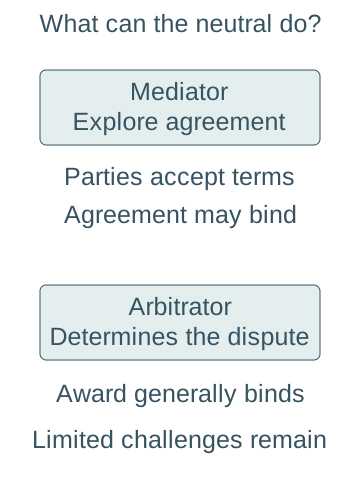
Mediation — An independent mediator facilitates communication and helps parties explore settlement. The mediator ordinarily does not impose a binding decision. A settlement may become binding through the resulting agreement; distinguish the voluntary acceptance of terms from the enforceability of an agreement once made.
Conciliation — A conciliator helps resolve a dispute and may take a more active role in suggesting settlement terms. Acas conciliation is an important employment example. The distinction from mediation can vary by scheme; do not insist every institution uses the labels in exactly the same way.
Arbitration — The parties submit a dispute to an arbitrator for a decision under an arbitration agreement and governing law. The award is generally binding, subject to the applicable limited challenge and enforcement rules. Unlike mediation, arbitration produces an adjudicative decision; it does not depend on both sides liking the award afterwards.A mediator ordinarily facilitates agreement rather than imposing an outcome; legally effective settlement terms may bind once agreed. An arbitrator determines the submitted dispute under the agreement and governing law, ordinarily producing a binding award subject to the applicable limited challenge rules. Neither process is necessarily free or equally suitable for every dispute.
Control and expertise — Alternative dispute resolution (ADR) can let parties choose an appropriate process, timetable or specialist decision-maker. Confidentiality and privacy may protect commercial relationships, though the rules and agreement matter and secrecy is not absolute. Expert arbitration can resolve technical matters, but expert arbitrators and lawyers may be expensive.
Relationship and remedy — A negotiated or mediated settlement can include apologies, future trading arrangements or agreed practical steps beyond the remedy a court would normally order. This may preserve a continuing relationship. If one party needs a public authoritative ruling, enforceable urgent relief or a precedent, ordinary settlement discussions may be insufficient.
Cost and speed — ADR can reduce cost and delay when parties engage productively and the process is proportionate. It is not automatically free or quick. Failed mediation followed by litigation can add expense, while complex arbitration may resemble substantial litigation in its demands.
Power imbalance — A party may accept a poor settlement because it lacks resources to litigate, not because the outcome reflects its legal rights. Independent advice, a skilled neutral and suitable process design can help but do not remove every inequality. Evaluate voluntariness in context rather than treating a signature as proof of equal bargaining strength.
Access and participation — In Churchill v Merthyr Tydfil CBC (2023), the Court of Appeal rejected an absolute bar on courts requiring a non-court dispute resolution process. A proportionate order must preserve the essence of access to a judicial hearing. Requiring participation in a suitable process differs from forcing a party to agree to settlement.
Public law development — Private settlement can meet the parties' needs without producing an authoritative public precedent. Litigation may clarify uncertain law for others but costs time and resources. A strong evaluation distinguishes the individual dispute's interests from the wider legal system's interest in open justice and consistent rules.
Choosing a process — In a fictional supplier dispute, parties who want to keep trading may try negotiation or mediation; a technical dispute governed by an arbitration clause may go to arbitration. An urgent threatened breach may require court relief. Identify the issue, relationship, bindingness, urgency, cost and power balance before recommending a process.
Building an evaluative answer — Develop a reasoned chain: identify a feature, explain its effect, apply it to the type of dispute, then qualify it with a counterargument. For example, mediation's flexibility may preserve a trading relationship, but unequal bargaining power may undermine the fairness of the agreed terms. A list of unsupported advantages does not perform this evaluation.
Test yourself
50 questions · Random sets of 10. These quick checks support revision; practise longer explanations and justified judgements too.
 Mr Kidman's Classroom