Promises and statements — An express term is a contractual undertaking agreed through the parties' words or conduct. A representation may induce agreement without becoming a promised contractual obligation. Identify the particular statement, its context and the alleged commitment rather than classify every persuasive statement as a term or every oral statement as unenforceable.
Importance and reliance — The importance communicated by the recipient, the speaker's expertise, timing and the parties' final record help distinguish a term from a representation. Bannerman v White illustrates expressly communicated importance. No single factor supplies an inflexible test that replaces objective assessment of the agreement.
Knowledge and expertise — Dick Bentley Productions v Harold Smith Motors supports a term where the dealer's statement concerned matters within its expertise. Oscar Chess v Williams illustrates the different position of a private seller relying on a registration document against a knowledgeable dealer. Compare relative knowledge and responsibility rather than assume every vehicle description has identical legal status.
Timing and written records — Routledge v McKay illustrates the relevance of a gap before agreement and omission from the final written record. Those facts are evidence of the parties' contractual intention, not a universal rule that only written words can ever bind. Statutory rules may also treat particular information as included in consumer contracts.
Signature — L'Estrange v Graucob illustrates the ordinary binding effect of signing a contractual document even without reading its terms. The document must be contractual in character and qualifications such as misrepresentation or applicable statutory controls remain relevant. A signature is neither meaningless nor a universal permission to enforce every exclusion.
Misdescribed clauses — Curtis v Chemical Cleaning illustrates how a misrepresentation about an exclusion's scope can prevent reliance on its wider wording. Analyse what was said, the clause and the resulting agreement. Distinguish this qualification from a general claim that not reading a signed document automatically defeats incorporation.
Reasonable notice — For an unsigned contractual document, reasonable steps to bring terms to the other party's attention before or at formation can matter. Parker v South Eastern Railway illustrates notice rather than a universal requirement of actual reading. Assess the document, presentation and opportunity in context; merely printing words somewhere does not establish reasonable notice.
Contractual documents — Chapelton v Barry UDC illustrates a document functioning as a receipt rather than a contractual document incorporating new terms. Ask what a reasonable person would understand the document to do. A ticket can be contractual in one setting and evidential in another, so its label alone does not settle incorporation.
Notice before agreement — Olley v Marlborough Court illustrates a hotel notice supplied after the contract was made. A later notice ordinarily cannot retrospectively add a term without a valid subsequent agreement. Construct a timeline of booking, payment, acceptance and notice rather than infer timing from the place where the notice is displayed.
Machines and formation — Thornton v Shoe Lane Parking illustrates the significance of formation when an automatic parking machine accepts the customer's commitment. Terms provided too late cannot simply be added by a later ticket. The decision does not create one universal timing rule for every website, app or machine regardless of its process.
Unusual burdens — Interfoto v Stiletto illustrates the need for sufficiently prominent notice of an especially onerous or unusual term in its setting. The more surprising the burden, the more the adequacy of notice matters. This common-law incorporation question is separate from whether an incorporated term survives statutory fairness or reasonableness controls.
Previous dealings — A sufficiently regular and consistent course of dealing may incorporate terms in an appropriate case. McCutcheon v David MacBrayne and Hollier v Rambler Motors illustrate limits where previous dealings or signed documents did not establish the required consistent basis. A single earlier purchase does not automatically import every term into all later agreements.
Separate questions — Work through whether a term was incorporated, what it means, how it is classified and whether legislation controls it. A clause can be incorporated yet unenforceable in the relevant respect. Conversely, disliking a clause does not by itself prove that no reasonable notice was provided.Establish whether wording became part of the agreement, interpret its coverage and then apply the relevant statutory control. Inclusion alone does not prove enforceability, and a statutory restriction does not prove notice was never supplied.
Implied terms and consumer standards
Sources of implication — Terms can arise through the particular agreement's necessary implications, established legal incidents of a contractual relationship or legislation. Identify the source and its requirements. A court does not have an unlimited power to insert whatever bargain a judge thinks would be kinder after an unfortunate result.
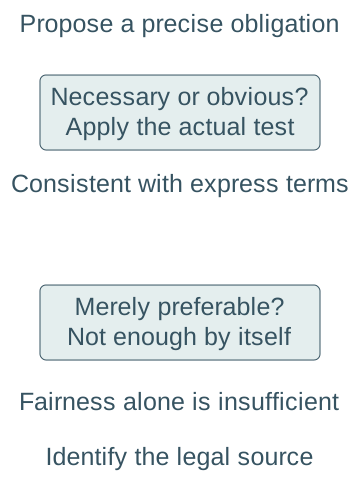
Business efficacy — The Moorcock illustrates implication connected with making the transaction work in the legally relevant sense. The question concerns necessity for the agreement's commercial or practical coherence, not merely whether an extra promise would improve it. The proposed term must be sufficiently clear and consistent with the express bargain.
Officious bystander — Shirlaw v Southern Foundries illustrates an implication so obvious that the parties would have treated it as going without saying. The imagined bystander asks whether a proposed term belongs in the agreement, and both parties would respond that it is obvious. This is a way of testing the parties' presumed shared understanding, not an actual witness requirement. Formulate the precise proposed term and ask whether the relevant hypothetical assent is justified. An obvious practical problem does not prove that both parties would obviously have chosen the claimant's preferred allocation of risk.
Modern qualification — Marks and Spencer v BNP Paribas emphasises necessity and careful distinction between interpreting existing words and adding an unexpressed term. Fairness or reasonableness alone is insufficient. Explain why the bargain lacks the relevant coherence without the proposed term, rather than replace the parties' agreement with a reasonable-looking alternative.For implication in fact, apply the relevant necessity or obviousness requirements to a precise proposed term consistent with the express agreement. Merely improving fairness is insufficient. Implication by law and statute require their own legal bases.
Implication by law — Liverpool City Council v Irwin illustrates implication in a particular contractual relationship concerning necessary common facilities. Such implication is not simply an inference that these individual parties silently discussed every detail. Distinguish the legal incidents of a recognised relationship from implication in fact and from express statutory standards.
Consumer and trader — The Consumer Rights Act 2015 distinguishes a trader acting for purposes relating to trade, business, craft or profession from an individual consumer acting wholly or mainly outside those purposes. Identify the parties and transaction before applying its chapters. A contract between two companies is not automatically a consumer contract because one company is smaller.
Satisfactory quality — Section 9 supplies the consumer goods standard judged by what a reasonable person would consider satisfactory, taking account of description, price and other relevant circumstances. Relevant aspects include fitness for ordinary purposes, appearance, freedom from minor defects, safety and durability. The Act qualifies the standard for matters specifically drawn to attention or which an appropriate examination ought to reveal.
Particular purpose — Section 10 concerns reasonable fitness for a particular purpose made known to the trader, expressly or by implication, subject to the statutory reliance qualifications. A fictional buyer asking for a printer suitable for a specified material raises a different issue from dissatisfaction with a purpose never communicated. Do not assume every personal plan automatically becomes the seller's obligation.
Description — Section 11 requires goods supplied by description to match it. Description is distinct from satisfactory quality and particular-purpose fitness, although the same facts may engage several standards. A sound item can still fail an agreed description; an accurate description does not automatically excuse a separate quality defect.
Samples and models — Sections 13 and 14 address goods supplied by reference to a sample or a model seen or examined, with their respective conditions and qualifications. Identify what the consumer actually relied on and which differences were brought to attention. Do not merge every display, sample and descriptive statement into one identical statutory test.
Digital content — The Act separately addresses digital content of satisfactory quality, fit for a made-known particular purpose and matching description under sections 34 to 36 in the relevant chapter's scope. A paid download raises a different statutory framework from a physical appliance or a service. Do not automatically transfer the goods short-term rejection remedy to every digital-content problem.
Reasonable care and skill — Section 49 requires a trader supplying a service to perform with reasonable care and skill. It does not universally guarantee that every hoped-for outcome occurs. Identify the undertaken service and any additional binding promise, distinguishing careless performance from an outcome that remained uncertain despite proper skill.
Service information and gaps — Section 50 can make relevant information about the trader or service binding where the consumer took it into account as the Act specifies. Sections 51 and 52 address reasonable price and reasonable time where the contract has not fixed them in the legally relevant way. These gap-filling provisions do not ordinarily authorise ignoring an actually agreed price or deadline.
Mandatory protection — The Act restricts contracting out of its specified goods, digital-content and service protections through provisions including sections 31, 47 and 57. Read the applicable provision rather than assume every chapter has identical restrictions. Remedies have their own conditions and are developed separately in the discharge and remedies chapter.
Conditions warranties and innominate terms
Classification and response — Classification concerns the legal importance and consequences of breaching a term. A condition, warranty and innominate term can produce different termination rights. First establish the obligation and breach; a disappointed party cannot obtain a right to terminate merely by calling a minor inconvenience a condition.
Conditions — A condition is a term whose breach ordinarily entitles the innocent party to terminate future performance and claim appropriate damages, subject to applicable qualifications and election. Poussard v Spiers illustrates an obligation fundamental to the engagement in its context. Termination is a legal response requiring analysis, not an automatic statement that no contract ever existed.
Warranties — A warranty is a subsidiary contractual term whose breach ordinarily permits damages without a right to terminate on that breach alone. Bettini v Gye illustrates the distinction from Poussard in the different contractual setting. Both are binding promises; describing a term as a warranty does not mean compliance is voluntary.
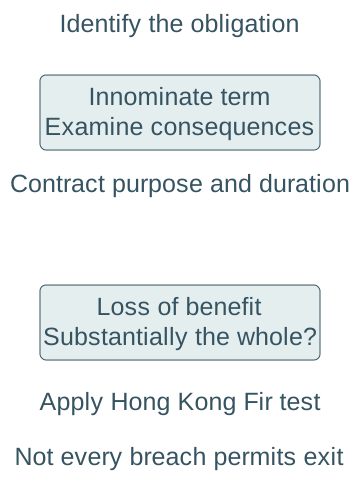
Innominate terms — Hong Kong Fir Shipping illustrates a term whose breach is assessed by its actual consequences for the contractual benefit. The question is whether the breach deprives the innocent party of substantially the whole benefit intended under the contract. Neither every breach nor every serious-sounding description automatically permits termination.Where the relevant term is innominate, determine whether the consequences deprive the innocent party of substantially the whole contractual benefit. A minor breach does not automatically justify termination. First establish classification; conditions and warranties have different consequences.
Consequence analysis — A fictional equipment-maintenance breach causing a brief repair and one causing loss of the essential operating period may have different consequences under an innominate term. Consider the agreement's purpose, duration, delay and remaining benefit. Do not substitute the breaching party's lack of bad intention for the required consequence analysis.
Labels and construction — Schuler v Wickman illustrates that use of the word condition is relevant but must be interpreted within the agreement as a whole. A label does not mechanically establish that any tiny failure permits termination in every context. Conversely, courts do not freely ignore clear contractual choices simply because a later result appears strict.
Certainty in commerce — Bunge v Tradax illustrates the importance of certainty and timely performance in an appropriate commercial setting. Classification can reflect the contract's wording, structure and market context. Compare predictable termination rules with the flexibility and factual uncertainty of the innominate approach rather than assert that one approach is always fairer.
Election and risk — A repudiatory breach is a breach serious enough under the legal rules to justify ending future performance. The innocent party may elect (choose) to accept that breach and terminate, or affirm (keep the agreement in force), subject to the relevant rules. Wrongly ending an agreement can itself have serious consequences. Explain the basis for the claimed termination right and preserve the distinction between accrued liabilities (obligations already arising), future performance and a damages assessment.
Exclusions construction and UCTA
Meaning and coverage — An exclusion seeks to remove liability, while a limitation restricts its amount or scope. After incorporation, interpret whether its wording covers the particular obligation, loss and alleged breach. An exclusion mentioning one kind of event does not necessarily cover an entirely different liability merely because it appears in the same document.
Ambiguity — The contra proferentem approach can resolve relevant ambiguity against the party relying on an exclusion, subject to modern contextual interpretation and statutory rules. Do not invent ambiguity just because a clause is commercially harsh. Distinguish a genuine choice between plausible meanings from rewriting clear words to provide a preferred outcome.
Negligence wording — Canada Steamship supplies influential guidance about construing exclusions of negligence, including express reference and the possible scope of wider wording. Application depends on context and later authority; statutory restrictions may prevent reliance even where the language covers negligence. Do not treat a drafting checklist as an escape from legislation.
Fundamental breach — Photo Production v Securicor rejects an automatic rule that a fundamental breach necessarily destroys every exclusion clause. Construction and applicable statutory controls determine the result. This does not mean every broadly drafted clause is enforceable, particularly where consumer protection or a negligence restriction applies.
UCTA scope — The Unfair Contract Terms Act 1977 controls specified exclusions and restrictions, particularly in relevant nonconsumer business settings, with exclusions and scope provisions of its own. It is not a universal power to review the fairness of every clause in every private arrangement. Establish the statutory gateway before applying a reasonableness test.
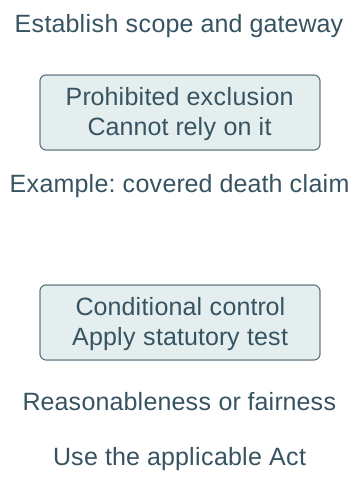
Death and personal injury — Under UCTA section 2, liability for death or personal injury resulting from negligence cannot be excluded or restricted within the provision's scope. For other negligence loss or damage, the restriction must satisfy reasonableness. A reasonable-looking amount cannot validate an exclusion that the statute prohibits outright.
Standard business terms — UCTA section 3 applies where one party deals on the other's written standard terms of business within its scope. Relevant exclusions of breach liability or claims to substantially different performance or no performance are subject to reasonableness. Do not assume section 3 examines every individually negotiated promise simply because both parties are businesses.
Reasonableness — Section 11 asks whether the term was fair and reasonable to include in light of circumstances known or reasonably contemplated when the contract was made. Bargaining strength, knowledge, alternatives, insurance and realistic allocation of risk can be relevant in the proper statutory context. The party claiming the term meets the requirement bears the burden of establishing that it does.
Timing and evidence — Evaluate reasonableness at formation rather than decide solely from sympathy after the loss. A fictional cap negotiated between experienced businesses with available insurance requires different evidence from a hidden cap imposed without alternatives. Neither equal business status nor inequality alone mechanically supplies the complete statutory conclusion.
Consumer fairness transparency and evaluation
Fairness test — Section 62 generally makes an unfair consumer contract term or consumer notice nonbinding on the consumer. A term is unfair if, contrary to good faith, it causes a significant imbalance in the parties' rights and obligations to the consumer's detriment. Consider the subject matter, circumstances at agreement and other relevant terms rather than judge one phrase without context.
Transparency and prominence — Section 68 requires written consumer terms and notices to be transparent, meaning plain intelligible language and, if written, legibility. Prominence draws the average consumer's attention in the relevant statutory context. Being readable does not by itself prove substantive fairness; a clear statement can still impose an unfair imbalance.
Core terms qualification — Section 64 limits fairness assessment concerning the main subject matter or the appropriateness of price against what is supplied, only where the relevant term is transparent and prominent. It does not exempt every charge or all contractual wording from all controls. The Act's listed indicative problematic terms and other statutory requirements must still be considered appropriately.
Consumer negligence bar — Section 65 prevents a trader excluding or restricting liability for death or personal injury resulting from negligence in the relevant consumer contract or notice. Knowledge of a notice does not itself establish voluntary acceptance of negligence risk. Distinguish this statutory prohibition from both the section 62 fairness test and UCTA's nonconsumer context.Within the applicable negligence provision, death or personal-injury exclusions cannot be saved merely by calling them reasonable. Other clauses may require the relevant UCTA reasonableness or Consumer Rights Act fairness assessment. Establish scope and the particular gateway before applying either Act.
Favourable interpretation — Section 69 generally resolves different possible meanings of a consumer term in the way most favourable to the consumer, with the Act's specified enforcement-proceedings qualification. This concerns genuine ambiguity rather than a general right to disregard inconvenient obligations. Interpret the actual words before deciding whether separate fairness controls apply.
Effect and enforcement — An unfair term is not binding on the consumer, but the rest of the contract continues so far as practicable under section 67. Courts have a statutory duty under section 71 to consider fairness where sufficient legal and factual material is available, even if the parties have not raised it. Do not assume one unfair term necessarily invalidates the entire transaction.
Integrated evaluation — Evaluate incorporation, interpretation, classification and statutory control as related but separate protections. Common-law rules support notice and the parties' bargain, while statutory restrictions respond to specified risks and bargaining conditions. Support a reform argument with a concrete problem, an identifiable mechanism and a cost such as uncertainty or compliance expense rather than asserting that every exclusion should be prohibited.
Test yourself
50 questions · Random sets of 10. These quick checks support revision; practise longer explanations and justified judgements too.
 Mr Kidman's Classroom