Starting proceedings — Criminal proceedings ordinarily begin in the magistrates' court, even where the eventual trial must take place in the Crown Court. Starting there does not mean magistrates try every offence. Classification determines the available trial route; guilt must still be established under the substantive criminal law.
Summary offences — Summary offences are normally tried in the magistrates' court. Common assault is a standard example, subject to the applicable procedural exceptions. Summary describes the mode of trial, not an assertion that the harm is unimportant or that the prosecution can dispense with proof.
Either-way offences — An either-way offence can be tried in the magistrates' court or the Crown Court, according to allocation and the defendant's relevant rights. Theft is a common example, with special rules for specified low-value shoplifting. Check the precise offence and exceptions before treating every property offence alike.
Indictable-only offences — The most serious offences, such as murder and robbery, are tried on indictment in the Crown Court. An indictment is the formal document setting out the charges for that trial. Magistrates deal with the initial stage and send the case onward. Do not confuse indictable-only with the broader use of indictable, which can include offences triable either way.
Magistrates and a district judge — A magistrates' court case may be heard by a bench of lay magistrates or a professional district judge in that jurisdiction. Lay benches usually contain three, with two possible; there is no trial jury. The decision-maker hears evidence, applies law and reaches a verdict in a contested trial.
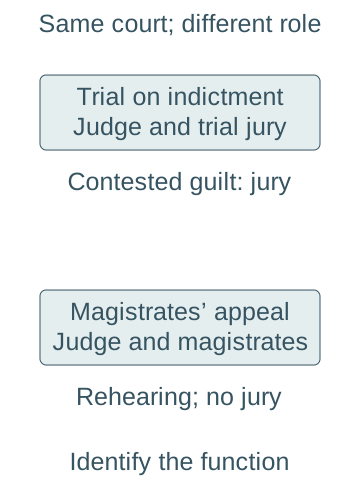
Crown Court trial — In an ordinary contested trial on indictment, the judge handles legal questions, procedure and sentencing, while the jury decides whether the defendant is guilty on the evidence and directions. A guilty plea removes the need for a contested jury verdict. Distinguish this trial function from the Crown Court's sentencing and appellate work.
Allocation for an either-way offence — After an indication of plea, a not-guilty either-way case requires a decision about appropriate venue. Magistrates consider seriousness, complexity and their powers. If they accept summary jurisdiction, the adult defendant ordinarily can elect Crown Court trial; acceptance of jurisdiction does not erase that right, subject to statutory exceptions.
Sending and committal for sentence — Sending a case for Crown Court trial differs from committing a convicted defendant there for sentence because magistrates consider their sentencing powers insufficient. A case can therefore be tried by magistrates but sentenced at the Crown Court. Venue, verdict and sentence are separate decisions.Sending an untried case to the Crown Court is different from a magistrates’ trial followed by conviction and committal for sentence. The boxes distinguish procedural acts; they do not say every case follows all three, and committal requires the relevant legal conditions.
Pre-trial matters — Early hearings address matters such as plea, representation, bail or custody, disclosure and preparation. The prosecution and defence need to know the case they must address. Efficient management supports fairness but must not turn an allegation into an assumed conviction.
Bail and remand — Bail permits release pending a later stage, sometimes with conditions; remand in custody means detention pending that stage. Risks such as failing to attend, further offending or interference with witnesses can matter under the applicable law. Bail is not an acquittal, and remand in custody is not itself a sentence following conviction.
Proof and the presumption of innocence — The prosecution ordinarily must prove the offence so that the court or jury is sure of guilt. A defendant does not have to prove innocence simply because charged. Specific statutory or defence burdens require separate analysis; a general slogan should not obscure an actual reverse-burden rule, which places a specified burden of proof on the defendant rather than the prosecution.
Current powers and examination context — Government guidance checked for this build describes up to six months for a summary offence and up to twelve months for an either-way offence in magistrates' courts, subject to offence-specific powers and applicable dates. Sending a matter for Crown Court sentence remains possible. Proposed reforms or enabling powers are not automatically commenced law; distinguish current guidance and the examination's two-year innovation cutoff.
Criminal appeals and correction of error
Appeal from magistrates — An adult defendant convicted after pleading not guilty may appeal conviction, sentence or both to the Crown Court through the applicable procedure. Following a guilty plea, the ordinary appeal concerns sentence rather than denying the admitted offence. Time limits and the correct route matter; an appeal is not an unlimited opportunity to restart proceedings.
Rehearing in the Crown Court — An appeal against a magistrates' conviction is ordinarily heard afresh by a Crown Court judge with magistrates who were not involved in the original decision. There is no jury for this appeal. This differs from an ordinary Crown Court trial on indictment and from the usual civil appeal model.An ordinary contested trial on indictment uses a judge and trial jury, with guilt decided by the jury under legal directions. An ordinary appeal from a magistrates’ conviction is reheard by a judge with magistrates and no jury. These functions must not be conflated simply because both take place in the Crown Court.
Case stated — A party can seek a case stated for the High Court on a point of law or jurisdiction arising from magistrates' proceedings. The lower court sets out the relevant facts and legal question. The route addresses an alleged legal mistake, rather than giving a jury a fresh opportunity to decide disputed facts.
The Divisional Court — Criminal case-stated appeals are heard by a Divisional Court of King's Bench. This is part of the High Court, not the Court of Appeal Criminal Division. A further appeal to the Supreme Court needs the applicable certification and permission conditions; it does not ordinarily pass through the Court of Appeal from this route.
Appeals following trial on indictment — A person convicted in the Crown Court may seek permission to appeal conviction or sentence to the Court of Appeal Criminal Division. The principal conviction question is whether the conviction is unsafe. The appeal court can act on relevant legal error or fresh evidence under the governing rules; it is not simply another jury trial.
Supreme Court criminal appeals — Further appeal concerns a certified point of law of general public importance and requires permission through the applicable process. The Supreme Court does not ordinarily receive an appeal directly from a magistrates' conviction merely because the defendant wishes to avoid intermediate procedures.
Further safeguards and limits — The Criminal Cases Review Commission can investigate a possible miscarriage of justice and refer an appropriate case back to the appeal court under statutory conditions. It does not itself acquit defendants. Appeal restrictions protect finality and resources, but practical access to evidence and representation can affect whether errors are corrected.
Sentencing purposes and individual decisions
Sentencing after conviction — Sentence is the court's response after conviction, within the offence's powers and applicable legal framework. The seriousness of the offence, statutory provisions, guidelines and relevant individual circumstances matter. A judge cannot choose any punishment simply because it seems popular.
Statutory purposes and the source date — Adult sentencing purposes are now located in Sentencing Act 2020 section 57 rather than simply the historical Criminal Justice Act 2003 section 142 wording retained in some syllabus material. The framework includes punishment, crime reduction including deterrence, reform and rehabilitation, public protection, and reparation. Current amendments and the examination cutoff must be distinguished; the 2026 amendment expressly refers to victims within public protection.
Punishment and desert — Retributive punishment responds to culpable wrongdoing with a proportionate penalty. It looks back to what the offender deserves rather than requiring proof that this sentence will deter someone else. Proportionality limits the argument that any harsh penalty is justified by public anger.
Deterrence — Individual deterrence seeks to discourage this offender from reoffending; general deterrence seeks to discourage others. Its effect depends on factors such as perceived likelihood of detection, understanding and circumstances. Do not assume that increasing severity always produces a matching reduction in crime.
Reform and rehabilitation — Rehabilitation seeks to address factors contributing to offending, for example through education, treatment, skills or support. It is a forward-looking purpose. Its success depends on access, suitability, engagement and conditions after the sentence, not merely the existence of a programme title.
Protection of the public — Incapacitation can reduce an offender's immediate opportunity to harm the public, including victims, through custody or relevant restrictions. Public protection can also involve effective rehabilitation. A policy must consider risk, proportionality and rights rather than assuming indefinite detention is justified for everyone who might offend.
Reparation — Reparation seeks to address harm, for example through compensation or constructive work benefiting those affected or the wider community. It is distinct from making the state richer through a fine. Not every harm can be repaired in money, and the offender's resources affect what is achievable.
Restorative approaches — A restorative process may allow those affected to explain harm and consider accountability and repair where suitable and voluntary participation requirements are met. It is not identical to a community sentence and does not automatically replace criminal proceedings. Consider safety, power imbalance and victims' preferences rather than presuming confrontation is beneficial.
Seriousness — Culpability concerns the offender's blameworthiness; harm concerns the injury, loss or risk created. Sentencing guidelines help identify the relevant category, starting point and range. Two offences with the same label can differ in planning, vulnerability, injury and other legally relevant features.
Aggravation — An aggravating factor can increase seriousness, for example relevant previous convictions, hostility where the legal framework applies, abuse of trust or targeting a vulnerable victim. Explain its relevance to the actual offence. Avoid double counting a feature already used in the offence category.
Mitigation — Mitigating factors can reduce the appropriate sentence, such as relevant personal circumstances, genuine remorse or a lesser role, depending on the case. Mitigation does not mean the offence never occurred. The court must distinguish a supported factor from an unsupported assertion designed to attract sympathy.
Guilty pleas and assistance — A guilty plea can receive a reduction under the applicable guideline, generally greater when entered earlier. The reduction recognises benefits such as avoiding a trial and sparing witnesses, rather than declaring an innocent person guilty. Assistance to the authorities has distinct legal provisions; do not merge every reduction into one rule.
Applying competing purposes — A fictional offender whose addiction contributed to theft may need treatment and supervision alongside proportionate punishment and reparation. Custody may protect others immediately but disrupt housing or employment needed for rehabilitation. Explain the relevant evidence and tradeoffs rather than selecting a sentence from one slogan.
Adult sentence types and their evaluation
Custody — A custodial sentence deprives the offender of liberty within the applicable statutory and guideline framework. The court must consider the relevant custody threshold and legal requirements. Custody can provide punishment and immediate protection, but loss of employment, family disruption and difficult resettlement may undermine later rehabilitation.
Determinate sentences — A determinate sentence has a fixed length. Time physically spent in custody, release provisions and supervision depend on the applicable legal regime; it is not accurate to assume every offender serves exactly the same fraction. A term and its release arrangements are related but distinct legal questions.
Life sentences — A life sentence lasts for life, though some offenders may be released on licence, meaning release subject to continuing legal conditions, after the minimum term and a suitable risk decision, where the legal framework allows. Release does not end the sentence, and recall, a return to custody under the applicable rules, may follow. Murder carries a mandatory life sentence, while the minimum term and whole-life provisions are separate issues.
Suspended custodial sentences — A suspended sentence is a custodial sentence whose operation is suspended under legal conditions. The offender remains in the community subject to the relevant requirements; breach or further offending can lead to activation. It is not an acquittal or a declaration that the custody threshold was never reached.
Community orders — A community order can combine requirements such as unpaid work, rehabilitation activity, treatment or a curfew, where legally available and suitable. Different requirements can serve punishment, rehabilitation and protection together. An effective order depends on resources, compliance and enforcement rather than its label alone.
Fines — A fine is a financial penalty, with the offender's means relevant under the applicable rules. A proportionate financial penalty can punish without immediate custody, but identical nominal sums can burden people differently. Distinguish the fine from compensation, costs and other financial orders.
Discharges — An absolute discharge involves conviction without further punishment; a conditional discharge makes the position conditional on avoiding further offending during the specified period. Neither is an acquittal. They can recognise low seriousness or unusual circumstances without erasing the finding of guilt.
Compensation and ancillary orders — A compensation order addresses loss or injury within the criminal court's powers. Other available orders, such as disqualification, can have protective effects. The offence, legal tests and means matter; a sentencer cannot invent an order or assume every loss is fully repairable through a criminal award.
Consistency and individualisation — Guidelines can promote consistent reasoning between courts while allowing relevant differences between offences and offenders. Uniform sentence lengths do not necessarily mean equal justice if cases differ materially. Conversely, unexplained variation can undermine confidence, so evaluation should consider reasons as well as outcomes.
Lay magistrates and trial juries
Appointment of magistrates — Lay magistrates are appointed volunteers rather than jurors chosen for one trial. Current recruitment permits applications from adults aged 18–74, with retirement at 75; no legal degree is required. Selection assesses suitability, character, judgement, communication and commitment, followed by training and support.
Training and legal advice — A qualified legal adviser assists lay magistrates on law and procedure. The adviser does not replace the bench as the decision-maker on guilt or sentence. Training helps magistrates use their powers responsibly, but evaluation can still ask whether infrequent service and complex law create difficulties.
Roles of lay magistrates — Magistrates undertake work including preliminary criminal hearings, bail decisions, summary trials and sentencing within their powers; suitably trained magistrates also have other jurisdictions. Their regular service builds experience. Do not confuse a magistrate with a jury member or assume that a magistrates' court always uses a lay bench rather than a district judge.
Advantages and limits of magistrates — Community participation, collective decision-making and repeated practical experience can support legitimacy and competent decisions at lower salary cost than an entirely professional bench. Unpaid service does not make the whole process costless. Recruitment, time commitments, representativeness, consistency and reliance on legal advice remain legitimate questions for evaluation.
Jury eligibility — For England and Wales, current general eligibility includes age 18–75, registration on the parliamentary or local-government electoral register, and ordinary residence in the UK, Channel Islands or Isle of Man for a period of at least five years since age 13. The Juries Act's wording concerns ordinary residence, not citizenship alone or necessarily the immediately preceding five years. Disqualification and incapacity rules also apply; meeting one condition alone does not establish eligibility.
Selection and attendance — Potential jurors are randomly selected from the electoral register and summoned. Eligibility, disqualification, excusal, deferral and challenges are dealt with under the applicable rules. Random selection can broaden participation but the final panel is not guaranteed to mirror every feature of the local population.
The jury's trial task — A criminal jury ordinarily starts with twelve members and decides the verdict from admissible evidence, applying the judge's legal directions. Jurors must not conduct private internet research or discuss the case outside authorised deliberation. Independence protects their decision from improper pressure; it is not permission to replace evidence with rumours.
Unanimity and majority verdicts — The court initially seeks a unanimous verdict. A lawful majority verdict may become available after the judge permits it under the applicable time and panel-size rules; for twelve jurors, ten can suffice. A simple seven-to-five vote is not enough. Do not assume a majority is available immediately or that every jury always remains at twelve.
Secrecy and reasons — Deliberation is protected by strict rules, helping jurors discuss evidence freely and reducing outside pressure. Ordinary criminal juries do not provide a reasoned judgment explaining their verdict. This can protect independence while making some allegations of misunderstanding or prejudice difficult to examine; confidentiality is not a blanket licence for juror misconduct.
Evaluating trial by jury — Citizen participation and separation from professional state decision-makers can support legitimacy and independence. Problems can include complexity, prejudice, publicity, intimidation, inconsistent understanding and the cost of trial. Link each claim to a mechanism and consider judicial directions, evidence rules and misconduct safeguards rather than assuming either perfect wisdom or universal incompetence.
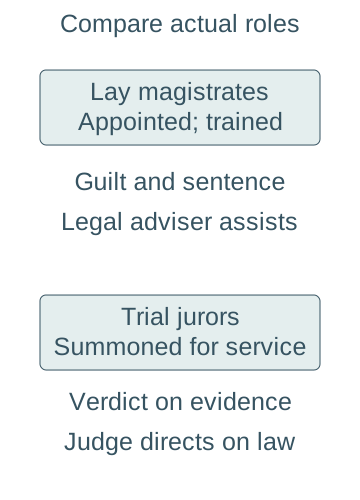
Comparing forms of participation — Lay magistrates repeatedly undertake judicial work with legal advice; a trial jury is summoned for particular service and decides guilt under a judge's directions. Both involve citizens, but roles, selection, training and responsibility differ. A balanced answer compares the actual functions rather than using the word lay as if the systems were identical.Lay magistrates are appointed volunteers with repeated service, training and legal advice; within their powers they decide guilt and sentence. Trial jurors are summoned through the jury process and decide the verdict under the trial judge’s legal directions. Citizen participation does not make the selection, training or sentencing responsibilities identical.
Test yourself
50 questions · Random sets of 10. These quick checks support revision; practise longer explanations and justified judgements too.
 Mr Kidman's Classroom