Building liability — Start with the particular offence's legal definition. Identify its external elements, required state of mind and relevant defences rather than assuming that harm alone establishes guilt. The prosecution ordinarily bears the burden of proving the offence so that the jury or magistrates are sure; specific statutory or defence rules need separate attention.
Actus reus — Actus reus describes the external elements of an offence. It can include conduct, prohibited circumstances and a required consequence, or a legally relevant omission. It is not merely a synonym for a bodily movement: an offence may require proof of property belonging to another, a particular relationship or death caused by the defendant.
Conduct offences — A conduct offence focuses on prohibited behaviour in specified circumstances without requiring the further consequence that a result offence requires. For example, dangerous driving does not require proof of death, whereas causing death by dangerous driving requires the relevant fatal result and causation. Check each statutory definition rather than assuming all offences require injury.
Result offences — A result offence requires a specified consequence and a legally sufficient causal link with the defendant. Murder requires a death caused by the defendant's unlawful conduct as well as its mental element. An intention to kill without the required death does not establish completed murder, although another offence such as attempt may need consideration.
State-of-affairs liability — Some offences focus on being in a prohibited situation. Larsonneur illustrates historically severe state-of-affairs liability where involuntary return to the country did not prevent conviction under the provision. It is a limited example, not a rule that voluntariness is irrelevant to every offence or that the old immigration provision is current law.
Voluntary conduct — Ordinarily the conduct relied on must be voluntary. A movement wholly outside conscious control can raise automatism, but habit, impulse, anger or difficulty resisting an urge does not alone prove complete loss of voluntary control. The cause and degree of loss matter, with insanity and self-induced conditions requiring distinct rules.
No general rescue duty — English criminal law has no universal rule making every bystander guilty whenever they fail to rescue a stranger. A moral reason to help is not automatically a legal duty. Identify a recognised duty, the required failure, causation where relevant and the offence's mental element before asserting criminal omission liability.
Statutory duties — A statute can impose a positive duty whose breach is an offence, such as the applicable road-traffic duties to stop and provide information after a qualifying accident. Read the provision's triggering conditions and required action. Failure is not established simply because a person did not do something socially desirable. Public office can also carry a duty: Dytham illustrates a police officer’s deliberate neglect of duty while witnessing serious violence. It concerned misconduct in public office, not an automatic rule convicting every inactive officer of homicide.
Contractual duty — A contractual responsibility can provide the duty relevant to criminal liability for an omission. Pittwood concerned a crossing keeper's failure to close a gate leading to a fatal accident. A contract does not make every breach a homicide: breach, causation and the elements of the charged offence still need proof.
Relationship duty — Certain relationships can create duties to act, including a parent's responsibilities towards a dependent child. Gibbins and Proctor illustrates fatal failure to feed a child where the relevant duty and murderous intention were established. Do not infer a universal duty between every adult relative simply from the family label.
Assumed responsibility — Taking responsibility for a vulnerable person can generate a duty of care. Stone and Dobinson illustrates an assumed-care situation and inadequate steps to obtain help. Whether a duty arose depends on what was undertaken and the circumstances; casual acquaintance alone is not equivalent to accepting responsibility for ongoing care.
Creation of danger — A person who creates a dangerous situation and becomes aware of it may be under a duty to take reasonable steps within their power to avert the danger. Miller illustrates this after a defendant woke to discover a fire started by his cigarette and moved away without dealing with it. The omission is assessed with the relevant offence's mental element, not as automatic liability for every accident.
Contribution to danger — Evans illustrates a duty where a person contributed to a dangerous situation and knew, or ought reasonably to have known, it had become life-threatening. In the context of gross negligence manslaughter this requires its complete legal test, not merely a moral criticism of inaction. Distinguish the duty's basis from the separate question whether the breach caused death.
Duty and realistic action — Once a duty is identified, specify the reasonable action within the defendant's ability, such as summoning available help. A duty does not demand the impossible, nor does its existence alone prove the required harm or mental fault. Apply the actual timeline and available steps before drawing a conclusion.
Omissions and policy — Arguments for wider rescue duties emphasise protection of vulnerable people and shared responsibility. Arguments against emphasise uncertain boundaries, enforcement and risks to bystanders. Distinguish what the law currently requires from a proposed reform, and explain how a clearly defined duty might address a specific problem without asserting unlimited criminal liability.
Factual legal and intervening causation
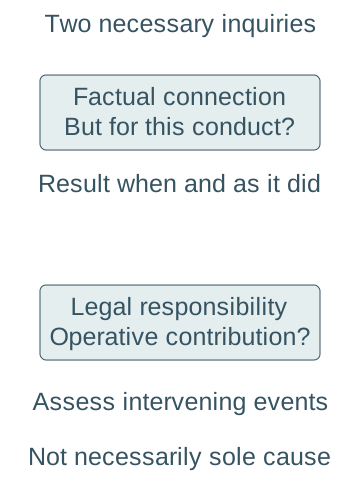
Factual causation — Ask whether the prohibited result would have occurred when and as it did but for the defendant's conduct, applying the facts rather than using the phrase as a conclusion. White illustrates failure to establish causation of death where the victim died from an independent cause before the poison acted. An unsuccessful causal act may still raise attempt liability.
Legal causation — A merely historical contribution is not enough: the defendant's conduct must remain a legally sufficient operating cause of the prohibited result. The language of a significant contribution or a cause more than minimal helps distinguish legal responsibility from remote background conditions. The defendant need not be the only or the dominant cause.First ask whether the result would have occurred when and as it did but for the defendant’s conduct. Then assess whether the contribution remains legally sufficient and operative, including any intervening event. The defendant need not be the sole cause; satisfying the factual inquiry alone does not settle legal causation.
Multiple causes — Two people can each make a legally sufficient contribution to one result. Do not treat a later contribution as automatically erasing an earlier one. Identify what each defendant caused, whether the initial injury remained operative and whether an intervening event was sufficiently independent to break the chain.
Acceleration of death — Conduct can cause death by bringing it forward even if the victim already had a fatal illness. The relevant question is not whether the person would eventually die, since everyone will, but whether the defendant caused or materially accelerated this death under the legal rules. Medical and factual evidence remains important.
Thin-skull principle — Take the victim as found, including relevant vulnerabilities; unusual susceptibility does not itself excuse a defendant whose unlawful conduct caused the result. Blaue applied this reasoning to a victim's refusal of a blood transfusion for religious reasons. The defendant cannot demand that the victim abandon such beliefs to make the injury less serious.
Medical treatment — Later treatment does not automatically break the chain of causation. Cheshire emphasises the exceptional nature of treatment so independent and potent that the defendant's contribution becomes insignificant. An error can contribute to death while the original injury remains a legally sufficient cause; the question is not simply whether the hospital made a mistake.
Exceptional treatment — Jordan illustrates the unusual case in which treatment was held to break the chain on its particular facts. Compare it with the continuing operation of the original injury rather than asserting that any negligent treatment absolves an attacker. Distinguish ordinary medical complication, independent cause and the actual evidence of significance.
Third-party intervention — A third party's reasonable response to the defendant's danger need not break causation. Pagett illustrates police returning fire while the defendant used a person as a shield. The intervention was connected with the created danger; do not turn the example into a rule that every police action is necessarily reasonable or legally attributable to the defendant.
Victim escape — An escape response can leave the chain intact where it is within the range that might reasonably be expected in the circumstances. Roberts illustrates this issue. Assess the perceived threat and reaction rather than treating either every escape or only the safest possible response as automatically attributable to the defendant.
Free informed voluntary acts — A fully informed and voluntary independent act may break the causal chain, depending on the offence and context. Kennedy (No 2) distinguishes supplying a drug from causing the death of an informed adult who freely self-administers it. It does not eliminate every possible separate duty to seek help or liability under another offence.
Causation application — For a fictional stabbing followed by treatment complications, identify factual causation, the continuing effect of the wound and the nature of the treatment before discussing a possible break. Apply both sides to the evidence and avoid assuming that the chronologically last act is the sole legal cause. Separate the causal question from what injury the defendant intended.
Intention recklessness and negligence
Mens rea — Mens rea means the mental or fault element required by the particular offence, not a general requirement that the person feels wicked. Different offences require different states of mind concerning different elements. A good motive does not necessarily negate intention, and an accidental result is not necessarily outside liability if the offence permits recklessness or negligence.
Direct intention — A result is directly intended when bringing it about is the defendant's aim or purpose. Success need not be certain: firing at a distant target with the purpose of killing can involve intention despite a low chance of success. Distinguish intending a result from merely recognising that it might happen.
Motive and intention — Motive is the reason for acting, whereas intention concerns the result aimed at or inferred under the relevant rule. A person who deliberately kills to obtain an inheritance still intends death; a person claiming compassionate reasons can also intend it. Motive may help explain evidence or sentencing without replacing the offence's mental test.
Oblique intention — Where the prohibited result is not the defendant's purpose, the exceptional oblique-intention direction may become relevant. Under Woollin, a jury may find the necessary intention where death or serious injury was virtually certain, barring unforeseen intervention, and the defendant appreciated that fact. It is not enough that the consequence was merely likely or foreseeable.
Objective and subjective limbs — The Woollin approach separates whether the consequence was virtually certain from whether this defendant appreciated that virtual certainty. Evidence may support one limb without the other. Do not replace appreciation with what a reasonable person ought to have foreseen, or turn the direction into an automatic mandatory finding of intention.Where the exceptional oblique-intention direction is appropriate, distinguish whether death or serious injury was virtually certain, barring unforeseen intervention, from whether the defendant appreciated that fact. The jury may find the necessary intention; neither mere probability nor a reasonable person’s foresight is a substitute.
Evidence of intention — Criminal Justice Act 1967 section 8 requires the tribunal to determine intention or foresight from all the evidence rather than being bound to infer it solely because a consequence was natural and probable. Words, conduct, planning and surrounding circumstances can support an inference. An assertion that the defendant did not mean it is relevant evidence, not automatically decisive.
Subjective recklessness — Under the R v G approach, the defendant is aware of a relevant risk and, in the circumstances known to them, it is unreasonable to take it. Awareness is subjective; the evaluation of taking the risk uses the applicable reasonableness assessment. Identify the particular consequence or circumstance for which recklessness is required.
Unseen risks — A risk obvious to a reasonable adult does not by itself establish this defendant's subjective awareness. Age and understanding can be relevant evidence, as R v G illustrates. A tribunal may reject an implausible denial on the evidence, but it must not silently replace the subjective test with the former Caldwell approach of liability for an unconsidered obvious risk.
Awareness and justification — Knowing there is some risk is not automatically culpable recklessness: evaluate whether taking it was unreasonable in the circumstances known to the defendant. Legitimate emergency action can illustrate why context matters. This does not mean a defendant may simply declare every personally useful risk reasonable.
Negligence — Negligence concerns falling below the required standard of care, rather than necessarily consciously appreciating the risk. Criminal liability on that basis depends on the offence. Distinguish failure to meet an objective standard from R v G awareness, and do not assume every civil breach of care is a criminal offence.
Gross negligence — Gross negligence manslaughter requires more than ordinary careless conduct: a duty, breach, causation, a serious and obvious risk of death at the time of breach and grossness justifying criminal punishment under the complete test. The risk concerns death rather than merely some injury. The dedicated homicide chapter applies the authorities and elements in detail.
Matching fault to offence — For murder, intention to kill or cause grievous bodily harm (really serious injury) is required; foresight of a possible injury alone is insufficient. Other offences can have different mental requirements and sometimes require no foresight of the full eventual harm. Always label the charged offence and element before evaluating the defendant's state of mind.
Transferred malice and coincidence
Transferred malice — Where the defendant has the relevant mens rea towards one person but the act causes the corresponding prohibited harm to another, that fault can transfer. Latimer illustrates a blow aimed at one person striking another. The doctrine addresses a mismatch of victim, not the complete absence of the required mental element.
Limits of transfer — The required fault cannot simply transfer between legally different kinds of harm. Pembliton illustrates intent directed at people not supplying the mental element for damage to property merely because a window was broken. Consider whether the defendant separately possessed the mens rea for property damage rather than assuming transfer answers every accidental consequence.
Coincidence principle — The external elements and required fault ordinarily need to coincide. Earlier bad thoughts followed by wholly unrelated innocent conduct do not automatically establish an offence, nor does later regret or later intention retrospectively alter a completed accidental event. Courts examine whether conduct is continuing or part of a legally relevant transaction.
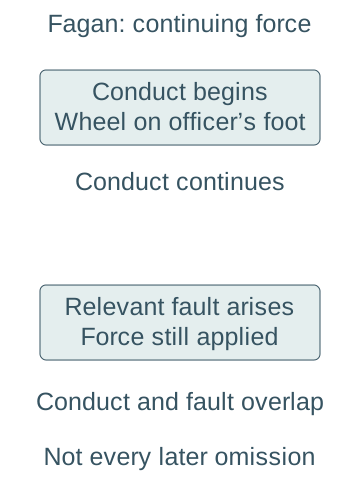
Continuing act — Fagan illustrates a continuing act: a car wheel remained on an officer's foot, and the relevant fault arose while the application of force continued. The analysis does not make every later failure to undo an accident a continuing act. Identify the continuing prohibited conduct and when the defendant acquired the necessary state of mind.The schematic Fagan sequence shows the wheel remaining on the officer’s foot while the relevant fault arose. The continuing application of force allowed conduct and fault to coincide. It does not turn every later omission after a completed accident into a continuing act or retrospectively create earlier intention.
Single transaction — Thabo Meli illustrates a planned sequence treated as one transaction where defendants mistakenly believed the victim had already died before a later act completed the killing. The court did not require artificial separation defeating the original murderous plan. Apply the connection between acts and purpose rather than combining any unrelated events.
Timing application — In a fictional assault followed by moving an apparently dead victim, construct the timeline of conduct, belief and the actual cause of death. Discuss coincidence and transaction reasoning where justified, distinguishing an initial accident followed by a new independent event. A time chart assists analysis but does not itself prove the legal connection.
Strict liability and evaluative reasoning
Meaning of strict liability — Strict liability dispenses with proof of mens rea for at least one element of an offence. It does not necessarily remove every mental requirement, the need for the actus reus, causation where required or all defences. Absolute liability is a distinct stronger idea; do not use the terms as universal synonyms.Strict liability means no mens rea need be proved for at least one specified element. The external element still requires proof, and the remaining elements, causation and available defences must be analysed under the particular offence. This is not a universal abolition of fault or a statement that every defence is unavailable.
Presumption of mens rea — There is a presumption that criminal offences require mens rea, particularly where conviction carries serious stigma. Statutory wording, context, purpose and the relevant authorities can rebut it. Silence about fault is a starting problem of interpretation, not automatic proof that Parliament imposed strict liability.
Gammon principles — Gammon identifies considerations including the presumption of mens rea, stronger weight for truly criminal offences, the possibility of displacement by clear implication, social concern or public safety and whether strict liability would promote the statutory purpose by encouraging greater vigilance. Apply the factors to the actual offence rather than reciting a checklist as if every regulatory offence is automatically strict.
Sweet v Parsley — Sweet v Parsley illustrates the importance of the mens rea presumption where a landlady lacked knowledge of tenants' drug use. It cautions against converting statutory silence into liability without fault in a genuinely criminal context. Identify the required element and interpretation rather than assuming every owner knows all activity on their property.
Public-protection argument — Supporters argue that strict liability can encourage vigilance, compliance systems and effective enforcement where proving a particular mental state would be difficult. A regulated business may be better placed to monitor risks. Explain how removing the proof requirement for a defined element actually advances safety, rather than relying on the label regulatory alone.
Fairness and effectiveness — Critics argue that punishment without relevant fault can stigmatise a careful person, fail to distinguish blameworthiness and impose burdens that reasonable precautions cannot avoid. Deterrence is questionable where an actor could do no more. Evaluate proportionate penalties and statutory due-diligence defences, which can protect someone who took the precautions required by that particular provision, where actually provided; do not invent such a defence for every strict-liability offence.
Structured criminal answer — State the offence and each relevant element, use concise authority for the precise proposition, apply competing inferences to the facts and reach a qualified conclusion. Analyse duty before omission, factual before legal causation and the correct type of fault before defences. General moral condemnation or a list of case names cannot replace reasoning about the actual defendant.
Test yourself
50 questions · Random sets of 10. These quick checks support revision; practise longer explanations and justified judgements too.
 Mr Kidman's Classroom