Discharging obligations — Discharge concerns release from contractual obligations through a legally recognised route. Performance, frustration, agreement and the consequences of breach require separate analysis. Identify the obligation, sequence and legal basis rather than assume any difficulty or complaint automatically ends every duty and accrued right.
Entire performance — An entire obligation can make payment dependent on complete performance, illustrated by Cutter v Powell in its historical setting. Identify whether the promise really is entire and what the contract or relevant statute requires. The strict starting point is qualified by recognised doctrines; it is not a universal rule that every minor defect eliminates all payment in every transaction.
Severable obligations — A contract may divide performance and payment into distinct parts rather than require one indivisible completed result. Ritchie v Atkinson illustrates the relevance of construing the agreement's divisible obligations. Merely performing part of the work does not itself prove that the parties agreed to a proportionate entitlement.
Substantial performance — Hoenig v Isaacs illustrates recovery of the contract price less an appropriate deduction where substantial performance occurred. Bolton v Mahadeva illustrates defects sufficiently serious to prevent that conclusion. Assess the promised result and actual defects rather than adopt a fixed percentage test for every building or service agreement.
Partial performance accepted — A freely accepted partial benefit can support remuneration under the relevant rules, but acceptance must be assessed realistically. Sumpter v Hedges distinguishes having no practical choice about incomplete work left on one's land from freely agreeing to pay for it. A landowner's unavoidable retention does not automatically prove a fresh promise.
Tender and prevention — A valid tender of performance (a legally sufficient offer to perform the obligation) or the other party's wrongful prevention can affect the performing party's position under the relevant rules. Identify whether the offered performance actually satisfied the obligation and whether the recipient was entitled to reject it. Refusing defective work is not necessarily wrongful prevention.
Exact obligations and statutes — Whether a promise requires a precise result, reasonable care or substantial compliance depends on the term, classification and applicable legislation. Consumer goods and services have distinct statutory standards and remedies. Do not use substantial performance as a universal excuse for supplying a different description or denying mandatory consumer protection.
Agreement to release — Parties may agree to vary or release obligations subject to the relevant formation, consideration, deed and statutory rules. Accord is the agreement to settle or release obligations; satisfaction is the legally sufficient supporting performance or consideration. The distinction separates the settlement from the basis making it enforceable. A unilateral wish to escape is not mutual discharge, and pressured or misleading settlements need their own analysis.
Frustration events limits and statutory adjustment
Radically different obligation — Frustration can discharge an agreement where a supervening event, without the relevant party's fault and beyond the agreement's allocated risk, makes performance impossible or radically different under the doctrine. Difficulty, expense or reduced profitability alone ordinarily does not suffice. Apply the actual obligation and event rather than a general feeling that continuation is unfair.
Destruction — Taylor v Caldwell illustrates destruction of the essential music hall before the relevant performance. Identify whether the destroyed thing was essential to the promised performance and whether the contract allocated that risk. Damage to a convenient but replaceable resource does not automatically frustrate every agreement involving it.
Personal incapacity — Condor v Barron Knights illustrates incapacity affecting a personal-performance obligation. The nature, duration and contractual importance of the inability matter. Temporary inconvenience to one employee does not necessarily frustrate a company's obligation which can properly be performed through others.
Common purpose — Krell v Henry illustrates frustration of a shared foundation of the arrangement, contrasted with Herne Bay Steamboat v Hutton where meaningful contractual purposes remained. A party's undisclosed private motive is not automatically the agreement's shared foundation. Identify precisely what benefit and purpose the contract contemplated.
Expense and delay — Davis Contractors v Fareham illustrates that serious expense and delay did not themselves make the obligation radically different. Compare the scope, duration, risk allocation and changed circumstances rather than assume any increased cost or missed commercial expectation satisfies frustration. The doctrine is exceptional, not routine price revision.
Alternative performance — Tsakiroglou illustrates an available alternative shipping route despite increased difficulty after the expected route closed. Ask what was actually promised and whether a lawful available alternative remains within the obligation. A different method is not automatically radically different performance, though the degree and contractual context can matter.
Self-induced events — Maritime National Fish and The Super Servant Two illustrate limits where the relevant party's choices or allocation contributed to the inability. Frustration does not ordinarily excuse a party-created shortage merely by describing it as an external disaster. Identify available resources, commitments and actual causes rather than assume either all choice or all external involvement is conclusive.
Foreseeability and clauses — A contract can allocate supervening risks through express terms, including a relevant force-majeure clause, specifying what happens when identified exceptional events disrupt performance. Such a clause operates through its wording and conditions rather than a universal common-law excuse with one fixed meaning. Foreseeability is relevant to risk allocation but must not be treated as an inflexible rule that any imaginable event can never frustrate.
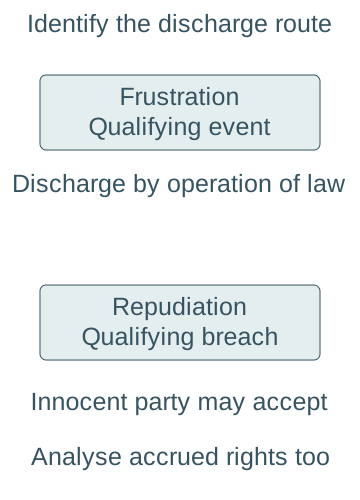
Automatic prospective discharge — Where frustration is established, the doctrine discharges future obligations by operation of law rather than by one party choosing to accept a repudiatory breach. It differs from breach and from rescission for a vitiating factor. Financial adjustment then requires the applicable contract, statutory and restitutionary rules.Established frustration operates through the doctrine after a qualifying supervening event; accepted repudiatory breach involves the innocent party’s election. Both require separate attention to accrued rights and financial consequences rather than treating every earlier transaction as nonexistent.
Money paid and payable — Within its scope, the Law Reform (Frustrated Contracts) Act 1943 generally makes money paid before discharge recoverable and sums previously payable cease to be payable. The court may allow a just amount for relevant expenses, subject to statutory limits. Do not assume the whole deposit is always retained or always refunded without any expense analysis.
Valuable benefits — Section 1(3) can permit a just sum for a valuable nonmoney benefit obtained before discharge, with the statutory ceiling and relevant factors. Distinguish the recipient's benefit from simply reimbursing every cost the supplier incurred. BP v Hunt illustrates the importance of the statutory benefit assessment rather than a universal completed-work invoice rule.
Scope and fairness — The Act has scope limitations and respects relevant contractual provision under its terms. Evaluate how automatic discharge and discretionary adjustment distribute unexpected losses, while noting uncertainty and the parties' opportunity to allocate risk. A fair-looking result must still be reached through the applicable gateway and legal mechanism.
Actual anticipatory and repudiatory breach
Actual breach — Actual breach occurs when a contractual obligation is not performed as required when due or during performance. Identify the exact promise and failure rather than infer breach solely from the claimant's dissatisfaction. Whether termination is available depends on classification and the relevant seriousness rules, while damages raise further questions.
Anticipatory repudiation — A sufficiently clear refusal or disabling conduct before performance is due can amount to anticipatory repudiation. Hochster v De La Tour illustrates the innocent party's ability to accept repudiation and sue before the original performance date. A request to discuss an amendment is not necessarily an unequivocal refusal to perform.
Acceptance of repudiation — The innocent party may accept a qualifying repudiation and terminate future performance, while accrued rights and appropriate damages remain relevant. Termination differs from treating the agreement as never formed. Identify the communicated election and the legal basis rather than automatically remove every obligation the moment a threatening message is received.
Affirming the agreement — An innocent party may instead keep the agreement alive where the relevant rules permit, with consequences and limits. Avery v Bowden illustrates the significance of a supervening event before repudiation was accepted. Affirmation is not always a risk-free method of freezing the best available damages position indefinitely.
Classification and seriousness — Breach of a condition ordinarily supports termination, breach of a warranty ordinarily damages alone, and an innominate term requires the appropriate consequence test. Apply the actual agreement and Hong Kong Fir approach rather than assume every late delivery or minor defect justifies ending the transaction. Wrongful termination can itself be repudiatory.
Performance cooperation — White and Carter v McGregor illustrates a qualified situation where affirmation and performance could support a debt claim without the other party's cooperation. The approach has limits, including the need for cooperation and legitimate-interest considerations in relevant cases. Do not assume every supplier can deliberately run up avoidable expenditure and recover it as a debt.
Damages interests causation remoteness and mitigation
Compensatory aim — Robinson v Harman states the ordinary contractual aim of putting the claimant, so far as money can, in the position proper performance would have produced. Damages ordinarily compensate recognised loss rather than punish mere breach. Establish what would have happened under performance instead of automatically awarding the contract's entire price.
Expectation calculation — In a fictional replacement purchase, agreed supply at £120 is replaced reasonably at £150 after breach, giving a £30 basic difference before other legally relevant adjustments. The claimant does not automatically receive £150 plus the unpaid £120. Check saved costs, actual payment, further losses and duplicate recovery against the protected position.For the stated fictional unperformed supply and reasonable substitute, the basic difference is £150 minus £120, or £30. Actual payments, saved costs, other recoverable losses and the protected performance position require separate analysis; this is not a universal formula for every breach.
Reliance loss — Anglia Television v Reed illustrates wasted expenditure as a possible measure in the relevant circumstances. Reliance and expectation cannot simply be added to recover the same loss twice or escape a proven losing bargain. Identify expenditure, causal connection, foreseeability and the relevant limits rather than assume every preparatory cost is always recoverable.
Proof and causation — The claimant must establish the relevant loss and causal connection, with appropriate evidence and rules about uncertainty. A contractual breach does not automatically explain every later business failure. Distinguish the promised benefit, independent causes, costs saved and the scope of the obligation before calculating a figure.
Remoteness starting point — Hadley v Baxendale distinguishes losses arising naturally in the usual course from special losses within the parties' relevant contemplation through communicated circumstances. The assessment concerns the knowledge and legal test at contracting, not hindsight that any loss was physically possible. Identify the actual kind of loss and available information.
Ordinary and special profits — Victoria Laundry v Newman illustrates ordinary business profits contrasted with unusual lucrative opportunities not sufficiently communicated. A defendant does not necessarily assume liability for every undisclosed exceptional deal merely by promising timely delivery. Explain the contract, knowledge and particular loss rather than classify all profits as always recoverable or always remote.
Contractual likelihood — The Heron II develops the relevant contractual remoteness threshold, distinct from simply importing the negligence foreseeability test unchanged. The Achilleas illustrates a context-sensitive issue concerning assumed responsibility in an unusual commercial setting. The ordinary starting point remains important; do not replace it with an unrestricted intuition that any foreseeable loss must be paid.
Mitigation — British Westinghouse illustrates reasonable steps to limit loss and accounting for relevant resulting benefits. The claimant is not legally required to achieve a perfect result, but cannot recover avoidable loss caused by unreasonable failure to respond. Assess options available at the time rather than demand a hindsight-optimal purchase.
Reasonable response costs — Reasonable mitigation expenditure can be recoverable even if the chosen response does not succeed, subject to causation and the relevant rules. A fictional urgent substitute arrangement should be judged against actual available alternatives. The defendant cannot simply demand the cheapest imaginable response, and the claimant cannot automatically pass on extravagant unrelated spending.
Cost of cure and amenity — Ruxley v Forsyth illustrates limits on disproportionate rebuilding cost and recognition of lost amenity in its setting. The correct measure is not invariably the most expensive way to achieve literal performance or only the fall in market value. Explain proportionality and the actual contractual interest rather than promise unrestricted damages for disappointment.
Distress and pleasure — Jarvis v Swans Tours illustrates a qualifying contract whose purpose includes pleasure or enjoyment. Damages for distress are not a universal consequence of every frustrating commercial breach. Identify the contract's purpose, relevant authority and actual recognised loss instead of treating all upset as automatically compensable.
Nominal damages — Where breach is established but compensable loss is not proved, nominal damages may recognise the infringement. This differs from assuming substantial compensation simply because the defendant behaved badly. Separate proving breach from proving the amount and type of recoverable loss.
Agreed sums equitable remedies and consumer rights
Agreed damages — Parties may specify consequences of breach through an agreed-sum clause. Identify incorporation, construction, the nature of the obligation and any statutory consumer control. A clause is not automatically valid because the parties call it liquidated damages or automatically penal merely because the sum exceeds a later exact loss.
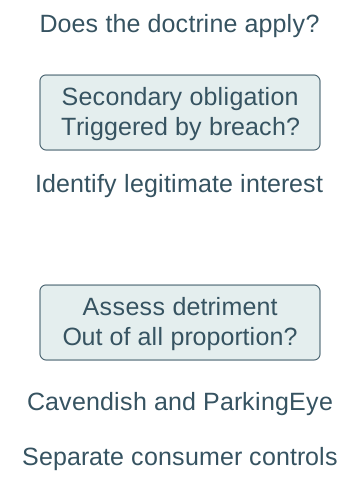
Penalty doctrine — Cavendish and ParkingEye focus on a secondary obligation imposing a detriment out of all proportion to the innocent party's legitimate interest in enforcing the primary obligation. Genuine pre-estimation remains relevant in appropriate compensation settings but is not the sole universal modern test. First identify whether the penalty doctrine is engaged rather than review every price term as a penalty.First establish whether the clause falls within the penalty doctrine as a secondary obligation arising on breach. The modern test concerns detriment out of all proportion to the innocent party’s legitimate enforcement interest. Clause labels and an exact comparison with later direct loss do not alone settle enforceability; statutory controls remain separate.
Legitimate interests and fairness — ParkingEye recognised interests beyond a simple calculation of the operator's direct parking loss in its particular arrangement. Its result does not validate every parking charge or every breach sum in every setting. Apply the actual interest, proportionality, wording, notice and separate consumer legislation rather than assume a case name provides universal immunity.
Specific performance — Specific performance is a discretionary equitable order requiring contractual performance where its requirements are satisfied and damages are inadequate. Unique property can present a stronger basis than readily available substitutes. Clean hands (the claimant's relevant conduct being free from improper behaviour), delay, hardship and practical enforceability matter; an established breach does not create an automatic entitlement to this order.
Personal services — Courts generally avoid compelling personal service through specific performance because of liberty, relationship and supervision concerns. An injunction enforcing a valid negative obligation raises distinct limits. Distinguish preventing a forbidden act from using an order so coercively that it effectively forces unwanted personal employment.
Injunctions — Lumley v Wagner illustrates enforcement of a negative contractual undertaking in its setting, while Warner Bros v Nelson illustrates relevant limits in a personal-performance context. An injunction is discretionary and must rest on an enforceable obligation and appropriate circumstances. It is not merely a second label for damages or an unrestricted power to control a person's future work.
Short-term consumer rejection — For qualifying nonconforming goods the Consumer Rights Act generally provides a 30-day short-term rejection period, with the statutory clock, delivery/ownership/installation conditions and perishable-goods qualification. A repair or replacement request can pause the clock with the Act's further protection after return. This is not a universal right to reject every item simply because the buyer changes their mind.
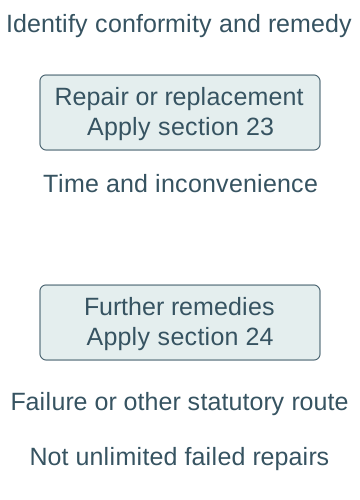
Repair or replacement — Under section 23, qualifying repair or replacement must be provided within a reasonable time, without significant inconvenience and at the trader's necessary cost. The chosen route is subject to impossibility and disproportionate-cost qualifications. A trader cannot automatically charge the consumer for a remedy the section requires it to provide.
Price reduction or final rejection — Section 24 gives the relevant further remedies under conditions including failed repair/replacement, impossibility or failure to provide the remedy within reasonable time without significant inconvenience. The consumer is not generally required to tolerate unlimited failed repairs. Final refunds can raise statutory use-deduction rules and exceptions, so do not promise a full-price refund forever for every used item.For qualifying goods, repair or replacement is subject to section 23’s conditions including reasonable time, no significant inconvenience and relevant impossibility or cost limits. Section 24 provides price reduction or final rejection through its gateways. The separate short-term right and refund deductions require their own statutory analysis.
Partial rejection — Section 21 addresses rejecting some goods while retaining others, with qualifications including commercial units. The consumer cannot necessarily split a set whose character would be materially impaired by division. Identify which goods fail to conform and the statutory conditions rather than assume one defect always requires return of every unrelated purchase.
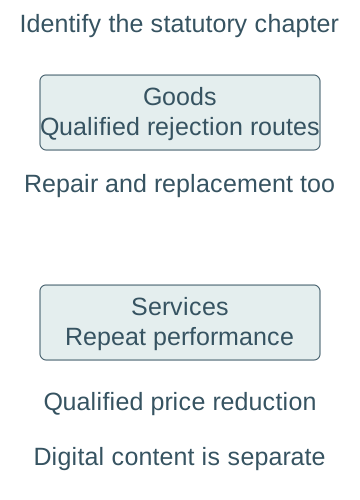
Service and digital remedies — For qualifying service failures the Act provides repeat performance and price reduction under their conditions, rather than simply importing every goods rejection rule. Digital content has its own repair/replacement and price-reduction framework with relevant exceptions. Identify the chapter, standard and remedy gateway before advising which response follows a fictional problem.Goods, services and digital content have distinct standards and remedy gateways. Service repeat performance and price reduction are not simply universal goods rejection rights. Mixed transactions may engage more than one chapter under the Act’s conditions.
Integrated remedy evaluation — Compare damages, agreed sums, equitable relief and statutory repair or rejection by identifying the interest protected, availability, cost, delay and enforceability. Evaluate certainty against flexible compensation and effective consumer protection using concrete examples. End a problem analysis with a justified remedy and calculation, avoiding double recovery and distinguishing discharge from liability for accrued loss.
Delayed performance — Late performance may breach the agreement without automatically defeating every payment entitlement or permitting termination. Decide whether time is of the essence through the actual wording, applicable statute, commercial context or a valid notice making a reasonable deadline essential in the relevant circumstances. Compare an essential event-date delivery with a minor delay where useful performance remains; the term classification and seriousness rules control the response.
Exercising consumer rejection — Under section 20 the consumer exercises rejection by indicating the decision to reject and treat the contract as at an end; the indication can be through words or conduct sufficiently clear to the trader. The consumer generally makes goods available for collection or returns them as agreed, with the trader bearing reasonable return costs subject to the Act. A refund must be given without undue delay and within 14 days from the trader agreeing entitlement under the provision, ordinarily using the same payment means without a fee unless the consumer expressly agrees otherwise. Distinguish this refund clock from the separate period for exercising short-term rejection.
Test yourself
50 questions · Random sets of 10. These quick checks support revision; practise longer explanations and justified judgements too.
 Mr Kidman's Classroom