Homicide categories — Homicide concerns causing another human being's death. Murder, voluntary manslaughter and involuntary manslaughter have different elements; the occurrence of a death does not itself choose the offence. Begin with the external and mental elements, causation and any complete or partial defence, then explain the justified outcome.
Murder's external elements — Murder is the unlawful killing of a human being in being under the King's Peace. The historical definition's language does not make murder depend on a reasonable personality or require the victim to be a British citizen. Lawful self-defence can mean a killing is not unlawful; wartime qualifications do not give private persons a general licence to kill enemies.
A human being in being — The victim must be a living human being under the relevant legal rules. A fetus is not itself a murder victim before live birth, but a prenatal injury can present a different question if a child is subsequently born alive and dies from it. Do not replace the legal distinction with a claim that violence before birth can never have homicide consequences.
Causation and death — Prove factual and legal causation, drawing on the previous chapter's rules about multiple contributions, vulnerability and intervening events. Intending to kill is insufficient for completed murder if the defendant did not cause death. The old year-and-a-day rule was abolished; do not reject causation solely because death occurred more than a year after injury.
Murder's mens rea — The required fault is intention to kill or cause grievous bodily harm. Vickers and Cunningham illustrate the serious-injury alternative; malice aforethought does not require personal hatred or advance planning. Recklessness as to possible death alone does not supply murder's mental element, even though another homicide offence may be relevant.
Direct and oblique intention — An aim to kill or cause really serious injury is direct intention. Where appropriate, apply Woollin's exceptional approach to a virtually certain consequence appreciated by the defendant, with a permitted inference rather than an automatic equation. Motive, foresight and intention remain distinct; a compassionate explanation does not automatically remove intent.
Intention and attempt — Attempted murder requires intention to kill, whereas completed murder can be based on intention to cause grievous bodily harm where death results. A nonfatal attack intended only to cause serious injury is not automatically attempted murder. The attempt chapter examines the required acts and mental element separately.
Partial and complete defences — A complete defence can lead to acquittal of homicide; a successful partial defence reduces murder to manslaughter where murder's elements are otherwise present. Loss of control and diminished responsibility are the prescribed partial defences developed here. Suicide pact is another legal category, but not an additional school-selected optional unit or a substitute for the specified content.
Murder and sentencing — An adult murder conviction carries a mandatory life sentence, with the minimum term and release framework determined under the relevant rules. Life does not universally mean the same fixed number of years in custody. Manslaughter gives greater sentencing discretion, but a successful partial defence does not guarantee immediate release or a nominal punishment.
Analytical order — For a fictional fatal stabbing, establish the death, unlawful conduct, causal connection and relevant intent before analysing a raised defence. Discuss each partial defence on its own evidence and proof rules. Do not infer murderous intent solely from the eventual death or assume that every psychiatric diagnosis proves a defence.
Loss of control
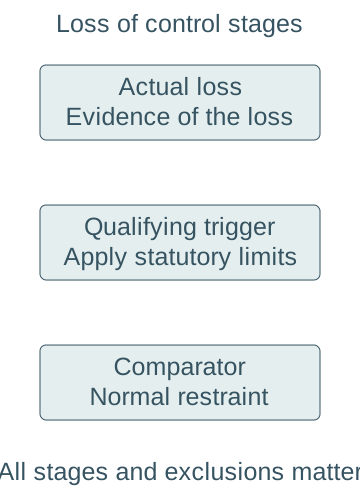
Statutory structure — Coroners and Justice Act 2009 sections 54 and 55 replaced the old provocation defence with loss of control. Analyse actual loss of self-control, an attributable qualifying trigger and the statutory comparator. The stages are cumulative; merely naming a trigger does not establish that the defendant lost control or met the comparator.The loss-of-control defence requires actual loss, an attributable qualifying trigger and the statutory comparator. The schematic is an overview: the statutory exclusions, relevant circumstances and proof rules must also be applied, and a trigger alone does not establish the defence.
Actual loss of control — There must be evidence of a real loss of self-control contributing to the killing. Anger, panic, a brutal attack or the phrase I lost it does not automatically establish it. Examine behaviour and surrounding circumstances rather than using the severity of violence as proof that the legal test was met.
Not necessarily sudden — The loss need not be sudden. A response to accumulated abuse may therefore require consideration even where an immediate explosive reaction is absent. Delay still matters as evidence of what actually occurred, especially where planning may support a considered decision rather than loss; time alone neither proves nor disproves the defence.
Fear trigger — One qualifying trigger is fear of serious violence from the victim against the defendant or another identified person. Assess the evidence of fear and its connection with the loss of control. This partial defence differs from complete self-defence: a feared threat does not by itself establish that the force used was lawful or reasonable.
Things done or said — Another trigger concerns things done or said, or both, amounting to circumstances of an extremely grave character and causing a justifiable sense of being seriously wronged. Both gravity and justification matter. A defendant feeling insulted does not automatically satisfy the statutory limits, and ordinary jealousy is not a general entitlement to kill.
Combined triggers — The fear and things-done-or-said triggers can operate together. Identify the contribution of each and the statutory requirements rather than forcing a complex abusive situation into only one label. Qualifying circumstances still need to explain the actual loss and satisfy the comparator stage.
Manufactured excuses — The statutory exclusions address fear or a sense of being seriously wronged where the defendant incited the relevant thing to be done or said for the purpose of providing an excuse to use violence. Merely being involved in an argument is not identical to deliberately manufacturing a trigger. Apply the purpose and context rather than a blanket rule excluding every defendant who started a disagreement.
Sexual infidelity — Sexual infidelity is excluded as a qualifying trigger in its own right. Clinton explains why its presence does not require stripping it from the context of other potentially qualifying matters. The qualification does not reinstate a general infidelity defence: identify an independently sufficient statutory trigger and the remaining requirements.
Statutory comparator — Ask whether a person of the defendant's sex and age, with a normal degree of tolerance and self-restraint and in the defendant's circumstances, might have reacted in the same or a similar way. The test does not simply ask whether another unusually volatile person could do the same. Identify which circumstances are legitimately included.
Capacity for restraint — Circumstances whose only relevance is to reduce general tolerance or self-restraint are excluded from the comparator under the statutory rule. A disorder may affect the seriousness of a particular taunt without lowering the normal baseline of restraint. Diminished responsibility can present a separate route where its medical and functional conditions are proved.
Revenge and proof — The defence is unavailable where the killing resulted from a considered desire for revenge. Once sufficient evidence is raised for a properly directed jury reasonably to find the defence might apply, the prosecution must disprove it to the criminal standard. Do not import diminished responsibility's defendant-bears-proof rule into loss of control.
Evaluation of loss of control — The fear trigger and absence of a suddenness requirement can improve recognition of abusive contexts, while gravity, justification and normal restraint limit excuses for violence. Evaluate uncertainties in interpreting loss, context and the comparator. Explain whether a proposed reform would improve fairness without simply legitimising revenge or importing the obsolete provocation rules.
Diminished responsibility
Modern statutory test — Homicide Act 1957 section 2, as amended by Coroners and Justice Act 2009 section 52, requires an abnormality of mental functioning arising from a recognised medical condition. It must substantially impair at least one specified ability and provide an explanation for the conduct in the killing. These linked conditions replace using the original enacted 1957 wording as the current complete test.
Recognised medical condition — The condition must be medically recognised; unsupported assertions of an unusual personality or anger are insufficient. Clinical evidence helps identify the condition and its effects. A diagnosis is relevant but does not automatically prove substantial impairment or the connection with the killing.
Specified abilities — The relevant abilities are understanding the nature of the conduct, forming a rational judgment and exercising self-control. Substantial impairment of at least one can suffice; the defendant need not establish all three. Explain the specific functional effect instead of assuming the label mental illness answers every statutory question.The amended diminished-responsibility test specifies understanding the nature of the conduct, forming a rational judgment and exercising self-control. At least one must be substantially impaired by the qualifying abnormality; a recognised condition and explanation for the killing remain necessary. This is not a diagram equating any diagnosis with the defence.
Meaning of substantial — Golds confirms that substantial does not mean merely anything beyond trivial, nor does it require total impairment. Where explanation is necessary, a significant or weighty impairment captures the ordinary meaning better than a minimal threshold. The jury evaluates the evidence under the proper test rather than treating a medical expert's conclusion as a binding verdict.
Explanatory connection — The abnormality provides an explanation where it causes, or is a significant contributory factor in causing, the defendant's conduct in the killing. Coexistence of a condition and a homicide is not enough without the required connection. The condition need not be the sole cause, but it cannot be wholly unrelated to the fatal conduct.
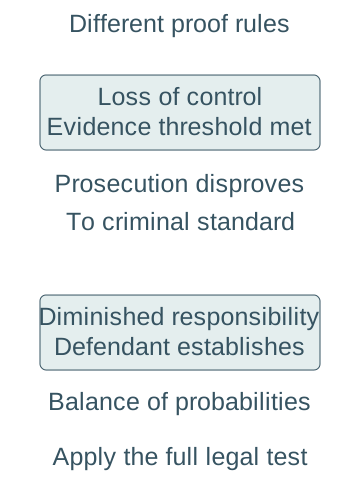
Burden and medical evidence — The defendant must establish diminished responsibility on the balance of probabilities. Expert evidence is usually important but the tribunal determines whether the statutory elements are met on all the evidence. Distinguish this proof allocation from the prosecution's ordinary burden and from the loss-of-control rules.Once sufficient evidence properly raises loss of control, the prosecution must disprove it to the criminal standard. Diminished responsibility must instead be established by the defendant on the balance of probabilities. These proof rules concern distinct defences and must not be exchanged.
Acute voluntary intoxication — Dowds establishes that acute voluntary intoxication alone does not supply the required recognised medical condition for diminished responsibility. Describing drunkenness as abnormal does not circumvent the statutory test. A separate recognised condition, including an applicable dependency condition, requires evidence and the full functional and explanatory analysis.
Condition plus drink — Dietschmann illustrates assessing whether the relevant abnormality substantially impaired responsibility despite additional voluntary intoxication, rather than treating intoxication as automatically excluding the defence. Separate the effects of the recognised condition from being merely drunk. The condition must still satisfy the amended statute's requirements and explain the killing.
Comparing partial defences — Loss of control focuses on actual loss, qualifying circumstances and a normal-restraint comparator; diminished responsibility focuses on medically grounded abnormality, functional impairment and explanation. A person may raise both if evidence supports them, but neither automatically follows from the other. A failure to meet one test is not permission to lower the other's requirements.
Evaluation and application — For a fictional defendant with an established disorder, connect medical findings to each statutory ability and the fatal conduct, consider competing explanations and state the burden correctly. Evaluate the benefits of medical grounding and flexible sentencing against disputed thresholds, expert access and the reverse burden. Avoid stereotypes that diagnosis means violence or lack of all responsibility.
Unlawful act manslaughter
Distinct basis — Unlawful act manslaughter requires an unlawful criminal act that is objectively dangerous and causes death, with the fault required for the underlying offence. Murderous intent is not required. Calling conduct merely wrong, careless or a civil tort does not establish the necessary criminal base offence.
Prove the base offence — Identify the act and all elements of its underlying crime, including its mens rea and any relevant defence. Lamb illustrates why a fatal incident does not establish this homicide where the supposed assault's requirements were absent. Franklin distinguishes a civil wrong from the required unlawful criminal act.
An act rather than mere omission — The unlawful-act route requires a positive act; Lowe illustrates the limitation where liability rested on omission. A fatal failure to perform a duty may instead require analysis under gross negligence manslaughter. Do not assume the inability to use one homicide category proves no other can apply.
Objective dangerousness — Church asks whether sober and reasonable people would recognise a risk of at least some physical harm from the act. The foreseeable harm need not be death or grievous bodily harm. Identify the actual act and relevant circumstances; do not substitute a requirement that this defendant personally foresaw death.
Observer's knowledge — The reasonable observer is assessed with relevant knowledge available in the circumstances, not every hidden fact discovered after death. Dawson illustrates limits concerning an unsuspected heart condition; Watson illustrates that circumstances becoming apparent during an incident can affect the assessment. Explain what could be known at the relevant point rather than assuming omniscience.
Fault for the act — Newbury and Jones confirms the importance of intention to do the unlawful act with its necessary fault rather than an additional requirement to foresee harm for this manslaughter route. The objective dangerousness question remains separate. This does not make an entirely innocent act criminal simply because it unexpectedly causes death.
Death caused by the act — The unlawful dangerous act must factually and legally cause death. Apply intervening-event reasoning rather than assuming danger proves causation. Kennedy No 2 shows the significance of an informed adult's free self-administration; supplying a drug alone is not automatically the fatal act for this route.
Evaluation of constructive liability — Constructive liability means that responsibility for the more serious consequence is built on the proved underlying offence without requiring the same fault as murder. Supporters argue that choosing a dangerous crime justifies responsibility when it kills and protects people against unlawful violence. Critics question liability for a death the defendant neither intended nor foresaw, and differences caused by chance. Connect fairness criticisms to the modest some-harm threshold and explain why proving the base offence remains a meaningful restriction.
Gross negligence manslaughter and comparison
Complete framework — Gross negligence manslaughter involves a duty of care, breach, causation of death, a serious and obvious risk of death at the time of breach and negligence so gross as to justify criminal punishment. Adomako is the central authority, with later cases refining the risk assessment. A tragic outcome or ordinary civil negligence alone is insufficient.
Duty and breach — Identify the source and scope of the duty, such as a treating professional, an assumed responsibility or contribution to a dangerous situation. Then specify how the required standard was breached. Adomako concerned failure by an anaesthetist, a doctor responsible for anaesthesia during treatment, to notice and respond to a disconnected oxygen tube; the profession's existence did not itself establish the fatal breach.
Serious and obvious fatal risk — The risk must be one of death, serious and obvious at the time of breach under the applicable circumstances. Rose rejects turning a possibility that further examination might reveal danger into an already obvious fatal risk. Avoid reasoning backwards from death or treating the risk of any minor harm as enough.
Causation despite duty — Even where a duty and grave breach exist, establish that the breach caused death. For an omission, explain the steps that should have been taken and the evidence about whether they would have prevented the fatal result. A bad professional mistake with no proved causal connection cannot be converted into this homicide merely because the person later died.
Grossness and jury — The jury must decide whether the conduct was exceptionally bad and deserving criminal punishment in all the relevant circumstances. Professional standards, the danger and the explanation for failure can matter. Civil negligence and moral criticism are not automatic substitutes for the criminal threshold, and an expert does not determine the verdict.
Awareness and omissions — Actual awareness of the risk is not a universal separate requirement for gross negligence manslaughter, unlike subjective recklessness. An omission can support this route where a recognised duty and all other elements are proved. Evans illustrates contribution to a life-threatening situation and failure to summon help without turning every bystander into a guarantor of survival.
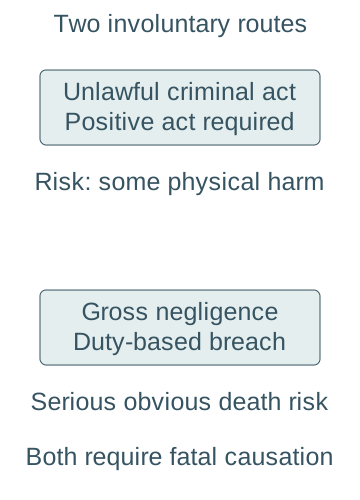
Comparing involuntary routes — Unlawful-act manslaughter requires a positive criminal act dangerous as to some physical harm and its underlying fault. Gross-negligence manslaughter instead requires duty-based breach, a serious and obvious risk of death and grossness; an omission can qualify. Both require causation of death and proof of their distinct requirements, so neither is a shortcut around a missing element of the other.Unlawful-act manslaughter requires a positive criminal act, its required fault, objective danger of some physical harm and fatal causation. Gross negligence manslaughter requires a duty and breach, a serious and obvious risk of death at breach, causation and criminal grossness; an omission can qualify. The diagram compares selected distinctions and does not replace either full test.
Evaluation of gross negligence — A grossness threshold can reserve criminal punishment for exceptionally serious failings while permitting accountability without intent to kill. Critics question predictability and the boundary with professional error. Evaluate clarity, hindsight risks, jury assessment and support for safe practice; do not assume every error deserves punishment or every professional role deserves immunity.
Integrated homicide problem — For a fictional death following deliberate violence, an untreated condition and a delayed call for help, separate each person's conduct and duty. Apply murder and any supported partial defence before testing appropriate involuntary routes. Use causation, the correct risk threshold, mens rea and proof rules explicitly, and explain which uncertainties prevent a categorical verdict.
Test yourself
50 questions · Random sets of 10. These quick checks support revision; practise longer explanations and justified judgements too.
 Mr Kidman's Classroom