Meaning literal golden mischief and purposive approaches
Why interpretation is needed — Legislative language can be ambiguous, broad, technically defined or applied to new circumstances. A dispute can concern the meaning of one word, its relationship with other provisions or the statute's purpose. Courts interpret the enacted text within legal principles rather than merely choose any result they consider fair.
Literal approach — The literal approach emphasises the ordinary grammatical meaning of the enacted words in their relevant context, including any technical definition. In Whiteley v Chappell, the defendant impersonated someone who had died before the election. The prohibition concerned impersonating a person entitled to vote; a dead person was not entitled to vote, so the conviction could not stand under that wording. Do not assume literal interpretation means every word is read in isolation or that dictionaries alone determine all legal meaning.
Limits of literalism — Fisher v Bell illustrates how an established contractual meaning of offer affected a statutory prohibition. A shop display normally invites customers to make an offer rather than itself making one; that technical distinction can therefore change what conduct falls within wording about offering goods for sale. The approach can support predictability and respect for enacted wording but produce gaps or apparently unintended outcomes. Explain the disputed language and result before evaluating whether certainty outweighs the identified problem.
Golden approach — The golden approach allows departure from a literal reading to avoid an absurd result within its legal limits. In its narrow form, a word with more than one possible meaning is read to avoid the absurd option; R v Allen illustrates this in the bigamy context. It is not a general power to replace any policy the judge dislikes.
Wider golden reasoning — Re Sigsworth illustrates preventing a murderer from benefiting under the relevant inheritance provision. The reasoning is broader than choosing between two dictionary senses, but remains a legal response to an unacceptable consequence in context. Distinguish the authority's actual proposition from an unlimited judicial power to rewrite succession law whenever sympathetic facts arise.
Mischief approach — Heydon's Case directs attention to the previous legal position, the defect the legislation addressed and the remedy intended. Smith v Hughes illustrates interpretation focused on the statutory nuisance rather than only the physical position of the person soliciting. Identify the old problem and textual connection, not simply a desired new policy unrelated to the Act.
Purposive approach — A purposive approach interprets language in light of the legislation's objective within the legal context. Royal College of Nursing v DHSS illustrates considering the purpose of a statutory scheme in changed medical practice. This can accommodate developments but can also raise disputes about how confidently the purpose is identified and how far interpretation may go.
Comparing approaches — Literal, golden, mischief and purposive reasoning overlap in practice and are useful analytical descriptions rather than a mandatory four-step ladder used identically in every judgment. Apply each where relevant to the disputed wording and facts. Modern interpretation often considers text, context and purpose together without implying the words no longer matter.
Fictional application — Suppose a fictional park rule prohibits vehicles, and a dispute concerns a powered mobility aid. Identify definitions, surrounding provisions, the rule's safety purpose and consequences of competing readings. Do not assert a real precedent or a predetermined legal outcome for this invented wording; the exercise develops reasoned application under qualified assumptions.
Evaluation — Textual emphasis can protect legal certainty and Parliament's chosen words; purpose-sensitive reasoning can avoid evasion and adapt general language to practical problems. Both can involve choices and produce uncertainty. A supported judgement connects the chosen approach with the actual ambiguity, democratic legitimacy, accessibility and consequences rather than claiming one method always produces justice.
Interpretative aids human rights and historical EU influence
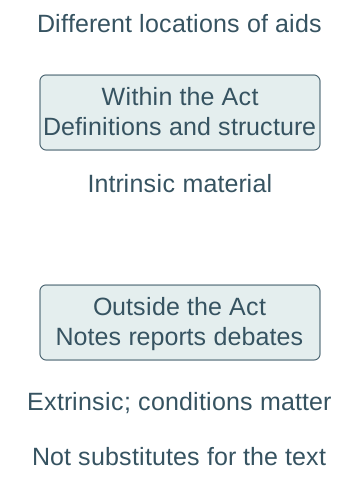
Intrinsic aids — Aids within the Act include definitions, long title, headings, schedules and the relationship between provisions. Their legal significance and weight depend on the actual material. Read the provision in the structure of the Act rather than assume a short title, marginal label or isolated word always overrides operative text.
Extrinsic aids — External material can include dictionaries, relevant earlier law, explanatory notes, Law Commission reports and permitted parliamentary material. Such materials can illuminate language, background or the problem addressed. They are not interchangeable with the enacted rule, and an explanation's usefulness does not make its author the final legislative authority.
Hansard and Pepper v Hart — Hansard is the official report of parliamentary debates. Pepper v Hart permits reference to clear statements by a minister or other Bill promoter in the relevant circumstances of ambiguous or obscure legislation or an absurd literal result. The conditions restrict using debates as an interpretative aid. A remark by any backbencher on any policy issue is not automatically conclusive evidence of the provision's meaning.Intrinsic aids include relevant definitions and the Act’s internal structure. Extrinsic aids include relevant notes, reports and permitted parliamentary material, with the Pepper v Hart conditions for the relevant use of promoter statements. The categories do not make all materials equally authoritative or replace the enacted rule.
Explanatory material and purpose — Explanatory notes and reform reports can help identify context and the mischief, but must be assessed against the actual enacted text. A draft proposal may differ from the final Act. Distinguish using material to understand the background from asserting every abandoned proposal became law.
Human Rights Act interpretation — Human Rights Act 1998 section 3 requires legislation to be read and given effect compatibly with Convention rights so far as it is possible to do so. Ghaidan v Godin-Mendoza illustrates the strength of the interpretative obligation in its context. It is not an unrestricted power to enact whatever rights policy a court prefers.
Limits and declarations — Where a compatible reading cannot properly be achieved, the relevant higher court may have the section 4 declaration route if its conditions are met. A declaration of incompatibility does not itself invalidate the Act or automatically rewrite its text. Distinguish this constitutional response from interpreting subordinate legislation beyond its enabling authority.
Historical EU interpretation — During UK membership, domestic courts interpreted relevant law consistently with EU obligations under applicable principles, including the directive-consistent approach associated with Marleasing. That historical influence helps explain purposive and conforming reasoning. It is not a claim that the UK's present relationship is unchanged or that every directive now automatically governs every domestic dispute.
Evaluating interpretative aids — Context and evidence can improve understanding but increase research costs and conflicting arguments. Parliamentary statements can illuminate a clear assurance while raising concerns about selective quotation and apparent ministerial control of meaning. Evaluate the specific aid and legal conditions instead of asserting all external material is forbidden or every source has equal authority.
Ratio obiter authority and the court hierarchy
Stare decisis — The doctrine of precedent supports following binding legal principles from earlier decisions in materially relevant circumstances. It promotes consistency, predictability and equal treatment, but requires identifying what was actually decided. A previous result is not a binding rule for every later case sharing only a superficial factual similarity.
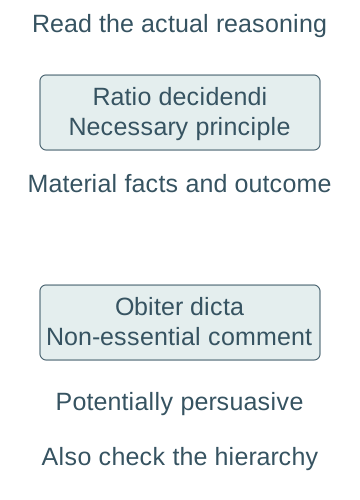
Ratio decidendi — The ratio is the legal principle necessary to the decision on the material facts. It is identified by analysing issues, reasoning and outcome rather than simply selecting the judge's most memorable sentence. Multiple judgments and alternative grounds can make its scope disputed, so explaining the reasoning matters.
Obiter dicta — Observations not necessary to decide the case can be persuasive without constituting its binding ratio. A hypothetical discussion or broader comment may influence later reasoning because of its quality and source. Nonbinding does not mean irrelevant, but a striking remark cannot be treated as binding solely because a senior judge said it.Identify the legal principle necessary to the decision on its material facts, distinguished from observations beyond what was needed. The ratio’s binding force also depends on the applicable court hierarchy and issue; obiter can be persuasive. A memorable sentence alone does not establish either category.
Material facts — Facts matter where changing them would affect the legal reasoning or rule's application. For a fictional duty case, the relationship, risk and nature of loss may matter more than the parties' names or clothing. Explain why a factual difference is legally significant rather than listing any difference as a reason to avoid authority.
Binding authority — A binding precedent must come from a court with the required hierarchical authority and contain the relevant legal principle applicable to the issue. Its age or publicity alone does not decide binding status. The hierarchy is not a simple map of physical buildings or a claim that every statement by every judge in a higher court binds universally.
Court hierarchy — Within the relevant England and Wales hierarchy, Supreme Court decisions bind lower courts on applicable legal principles, followed by the relevant appellate and High Court authority under the rules. Distinguish civil and criminal divisions and their roles. Scotland's separate legal system and the Supreme Court's particular jurisdictions mean that an undifferentiated all-UK criminal ladder would mislead.
Persuasive sources — Persuasive authority can include obiter reasoning, dissenting judgments, relevant decisions from other jurisdictions and the Privy Council in the ordinary position. Its weight depends on quality, context and source. Do not turn persuasive into binding merely because the reasoning seems attractive or assume persuasive sources can freely displace a directly binding case.
Privy Council qualification — The ordinary persuasive position has a limited procedural qualification explained in Willers v Joyce No 2, where an appropriately constituted Privy Council panel can indicate the relevant domestic approach under the specified arrangements. This is an exception, not a rule that all Privy Council decisions automatically outrank domestic appellate authority. State the ordinary rule clearly and avoid overstating the qualification.
Original precedent — A court deciding a new legal issue can establish an original principle through reasoning from existing law and analogy. The rule's future authority then depends on the court and its ratio. Original does not mean a judge can ignore legislation, binding authority or the actual dispute before the court.
Reporting and research — Reliable law reports and judgments allow lawyers and courts to identify the principle, material facts and later treatment. A case summary is a learning aid rather than a replacement for a difficult judgment's reasoning. Check whether a decision has been distinguished, overruled or affected by legislation rather than treating every old statement as permanently decisive.
Following distinguishing overruling and appellate flexibility
Following a precedent — A court follows authority where its binding principle governs the materially relevant facts. Explain the shared legal issue and rule's application, not merely that both disputes concern the same broad subject. Similar names or outcomes alone do not identify a ratio.
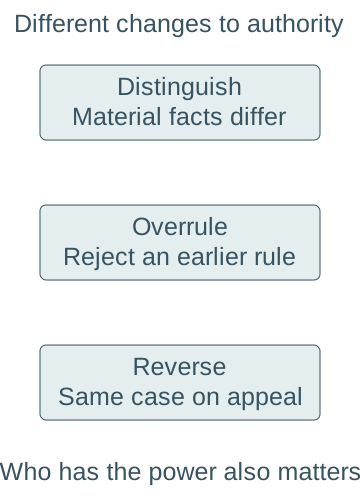
Distinguishing — A court distinguishes a case where a legally material factual difference means its ratio does not govern the present issue. Merritt and Balfour illustrate the importance of context in domestic contractual intention. The lower court does not thereby overrule the earlier authority or declare every factually different case nonbinding.
Overruling — A court with power over an earlier precedent can reject its legal rule in a later different case. The earlier legal principle loses the relevant authority, subject to the later decision's scope. Distinguish this from an appeal changing the result between the same parties or an Act changing the governing law.
Reversing — An appellate court reverses a lower decision in the same case through its appeal powers. This concerns the procedural history and outcome, even where the reasoning also affects legal principles. A later unrelated case disapproving an old rule is ordinarily discussed as overruling, not reversing that old case on appeal.Distinguishing explains why an earlier ratio does not govern materially different facts. Overruling rejects an earlier rule in a later different case by a court with the required power. Reversing changes the lower decision in the same litigation through an appeal. These are different mechanisms, not three compulsory successive steps.
Supreme Court flexibility — The 1966 Practice Statement allowed the House of Lords to depart from its own earlier decisions when appropriate while treating them as normally binding. The Supreme Court inherited the approach, reflected in its Practice Directions. The power is exercised cautiously; a panel merely preferring another answer does not mean precedent is freely optional.
Certainty and correction — Departing can correct serious error or adapt law but can disturb reliance in contracts, property arrangements or criminal law. Herrington and Shivpuri illustrate departures in their contexts; Knauer explains continued caution. Evaluate the reason for correction and effect on certainty rather than assuming either never changing or constantly changing is automatically best.
Court of Appeal civil division — The civil division ordinarily follows its own previous decisions, subject to the Young v Bristol Aeroplane exceptions: conflicting earlier decisions, inconsistency with a superior binding decision and a decision made per incuriam. The exceptions are limited legal categories, not a general power to depart whenever a later panel thinks the old reasoning weak.
Per incuriam — Per incuriam concerns a decision made in ignorance of a relevant binding statutory provision or authority within the doctrine's limits. It does not mean a judge can label any allegedly mistaken result careless and disregard it. Identify what binding material was missed and how it affects the legal rule.
Criminal appellate flexibility — The criminal division has relevant additional flexibility to avoid injustice where liberty is at stake, illustrated by Taylor's criminal-precedent reasoning. This does not abolish the hierarchy or authorise routine disregard of Supreme Court authority. Compare the need for consistency with correction of serious injustice through the actual appellate rules.
Evaluation of precedent — Binding principles promote consistency, efficient legal reasoning and predictable planning, while distinguishing and limited departure allow adaptation. Complexity, cost of appellate correction, retrospective effects and difficult ratios can limit these benefits. Develop a connected argument using the mechanisms rather than an unqualified list claiming the system is simultaneously completely rigid and entirely flexible.
Historical EU sources institutions primacy and direct effect
Historical scope — OCR specifies studying EU law for its historical impact on England and Wales following UK withdrawal. The following principles explain the membership framework; they are not a claim that the UK remains a member or that all present domestic disputes follow identical rules. Keep the EU, Council of Europe and European Convention on Human Rights institutionally distinct.
Treaties and competence — EU treaties established institutions, competences (areas in which the EU had legal power to act) and foundational obligations and are primary EU law. Institutional powers were conferred through the treaty framework rather than an unrestricted ability to legislate on anything. Identify the source and historical context before discussing how a provision affected domestic law.
Commission — The European Commission generally proposes EU legislation, undertakes executive functions and promotes compliance with treaty obligations within its powers. It is not the same as the European Council or a domestic national cabinet. Its legislative role commonly interacts with the Parliament and Council rather than replacing them.
Parliament and Council — The European Parliament represents citizens through elections, while the Council of the European Union involves member-state ministers in its legislative and other roles. They participate in the relevant lawmaking procedures with different bases of representation. Distinguish the Council of the EU from the European Council of national leaders and from the separate Council of Europe.The Council of the European Union involves member-state ministers, while the European Council involves national leaders. The Council of Europe is a separate organisation associated with the Convention system. The distinction supports the specification’s historical EU-law coverage and does not imply that the UK is currently an EU member.
Court of Justice — The Court of Justice of the European Union interprets EU law and supports uniform application through its jurisdiction, including the preliminary-reference system. It is not the European Court of Human Rights in Strasbourg. A preliminary ruling addresses the EU legal question while the national court resolves the domestic dispute through the applicable process.
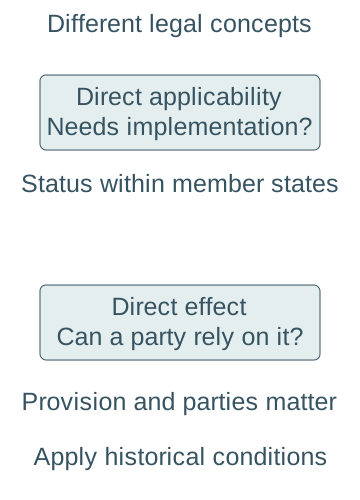
Regulations — Under the treaty framework a regulation is binding in its entirety and directly applicable in member states, without each state needing to enact a separate domestic implementing statute simply to give it that status. Direct applicability and whether a particular provision can be relied on directly in litigation are distinct questions. Historical membership qualifications must remain explicit.
Directives — A directive binds member states as to the result while leaving national authorities choice of form and methods under the treaty framework. It ordinarily requires national implementation. A regulation and directive are not interchangeable simply because both can influence domestic rights.
Direct effect — Direct effect concerns an individual's ability to rely on a qualifying provision in legal proceedings. Van Gend en Loos established the principle; requirements such as sufficient clarity, precision and unconditionality matter. Direct effect is not the same concept as direct applicability and does not mean every EU text automatically supplies every private claim.Direct applicability concerns status without a separate domestic implementing measure merely to give the rule that status. Direct effect concerns relying on a qualifying provision in proceedings, with conditions and distinctions concerning state and private defendants. Apply the relevant historical membership framework rather than assuming every EU instrument has identical effects in every present dispute.
Vertical and horizontal distinctions — Vertical effect concerns a claim against the state or qualifying state body, while horizontal effect concerns private parties. Marshall illustrates the limit on treating a directive itself as imposing obligations horizontally; a directive's qualifying vertical effect also depends on requirements such as expiry of its implementation deadline. Avoid claiming directives always have the same direct effect as regulations or that all indirect domestic consequences are excluded.
Primacy and historical domestic effect — Costa v ENEL established primacy within EU law; Factortame illustrates the historical domestic effect of EU obligations through the UK's then statutory arrangements. In the relevant membership context, conflicting national provisions could be disapplied where the rules required. Disapplication is not identical to Parliament formally repealing the Act, and the historical account does not assert unchanged present general supremacy after withdrawal.
EU evaluation and application — For a fictional historical membership problem, identify whether the source is a treaty rule, regulation or directive, the claimant and defendant and the required conditions. Distinguish direct applicability, direct effect, interpretative obligations and primacy rather than treating all EU influence as one doctrine. Evaluate uniform rights, practical enforcement and national decision-making through the relevant time and legal framework.
Test yourself
50 questions · Random sets of 10. These quick checks support revision; practise longer explanations and justified judgements too.
 Mr Kidman's Classroom