Different professional roles — Barristers, solicitors and chartered legal executives undertake legal work through different training and regulatory routes. Their work overlaps, so a rigid claim that only one profession ever advises, drafts or appears in court is misleading. Particular reserved activities depend on authorisation and rights, not the job title alone.
Solicitors' client work — Solicitors commonly provide continuing client advice, investigate facts, prepare documents, negotiate and manage litigation where authorised. They may work in firms, organisations or public service. A solicitor's task is not limited to sending instructions to a barrister, and many disputes settle without a court hearing.
Solicitor advocacy — Solicitors can undertake advocacy within their rights of audience. Higher-court advocacy normally requires the relevant higher-rights qualification. This has reduced the traditional division between solicitors' case preparation and barristers' advocacy, but competence, authorisation and the particular court still matter.
Barristers' specialist work — Barristers often specialise in advocacy, legal opinions and drafting. Some are self-employed in chambers; others are employed. A chamber is not automatically a partnership in which every barrister shares responsibility for every colleague's case. Specialist expertise can assist difficult litigation without guaranteeing success.
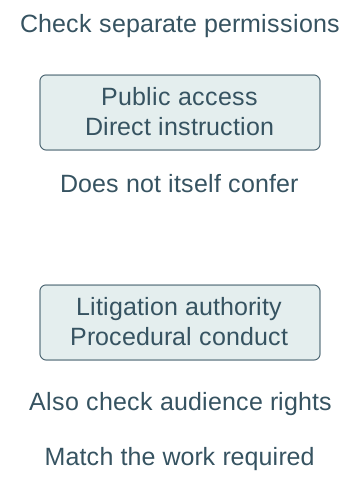
Instructions and public access — Traditionally a solicitor instructs a barrister, providing organised case materials and questions. Public-access arrangements permit appropriately authorised or trained barristers to accept suitable instructions directly from members of the public. Direct access does not mean every barrister must accept every client or that every client can manage the remaining procedural work unaided.
Litigation and advocacy rights — Conducting litigation involves formal management of proceedings, such as issuing proceedings and taking procedural steps; a right of audience permits appearing and speaking for someone before a court. They are distinct reserved activities, meaning work restricted to appropriately authorised people or applicable exemptions. Public-access status alone does not authorise a barrister to conduct litigation; the appropriate separate authorisation is needed. A client may otherwise need to handle procedural tasks or instruct a person who is authorised to do them.A client may instruct a suitably authorised public-access barrister directly, but public-access status alone does not authorise conducting litigation. Advocacy rights and litigation authority must be checked separately against the work required.
Chartered legal executives — Chartered legal executives commonly develop specialist practice in areas such as conveyancing (legal work transferring property ownership), family work or litigation. Qualification and experience can provide an alternative professional route. Specific independent practice, litigation or advocacy rights require the relevant authorisation; membership alone does not confer unrestricted rights to every reserved activity.
Choosing an appropriate professional — In a fictional contractual dispute, a client may need ongoing factual investigation, advice and authorised litigation conduct, with specialist advocacy for a contested hearing. Compare expertise, continuity, permitted work, fees and the client's ability to manage tasks. Neither a traditional two-lawyer model nor direct access is automatically best for every dispute.
Professional duties — Lawyers owe duties including acting competently, maintaining confidentiality, avoiding relevant conflicts and behaving honestly within their regulatory framework. Duties to the court can limit what a client may demand: representation is not permission to mislead a judge or present known falsehoods. Acting for an unpopular client does not itself endorse the client's conduct.
Regulation complaints and public confidence
Regulators and representation — A regulator supervises professional standards in the public interest; a representative body promotes a profession's interests. The functions should not be conflated. The Solicitors Regulation Authority and Bar Standards Board have regulatory roles, while the Law Society and Bar Council have representative roles within the relevant institutional arrangements.
Solicitors' regulation — The SRA authorises and regulates solicitors and relevant firms, setting standards and taking regulatory action within its powers. A client can check a practitioner's status and permitted work. A firm advertising legal services is not by that fact alone authorised for every reserved activity.
Barristers' regulation — The BSB regulates barristers and relevant authorised entities through its rules and powers. It addresses matters such as professional conduct and authorisation. The Bar Council is not interchangeable with the BSB, and an institution's regulatory function differs from supplying a personal remedy for every poor-service complaint.
Legal executive regulation — CILEx Regulation is the independent regulator of relevant CILEX members and authorised practice under its arrangements checked for this build. Proposals for changes in regulatory arrangements must not be taught as already implemented merely because consultation material exists. Match a person's actual status and authorisation to the relevant regulator.
Service complaints — A client should ordinarily use the provider's complaints procedure first. The Legal Ombudsman can consider eligible service complaints within its scheme, such as unreasonable delay or poor communication, after the relevant requirements are met. Scheme jurisdiction, time limits and eligibility matter; it is not a universal appeal court against every lawyer's legal advice.
Misconduct and negligence — Regulatory misconduct, poor service and professional negligence are different issues that can overlap. A disciplinary process protects standards; a negligence claim requires its civil elements and concerns recoverable loss. A dissatisfied client has not automatically proved professional negligence simply because the case was lost.
Evaluating regulation — Independent standards and remedies can protect consumers and improve confidence, while delay, procedural complexity and difficulty identifying the correct body can discourage complaints. Independence from professional self-interest must be balanced with informed expertise and fair treatment of practitioners. Explain the mechanism rather than assuming a regulator's existence guarantees compliance.
Judges appointments and constitutional roles
Judicial hierarchy and functions — Different judges undertake work in different courts: district and circuit judges, High Court judges, Court of Appeal judges and Supreme Court justices have distinct jurisdictions. Professional judicial office differs from being a lawyer representing a party. A senior title does not authorise its holder to disregard the law or determine a case outside the court's powers.
The trial judge — A judge manages proceedings, decides legal questions, rules on admissibility and directs a jury where one sits. In a judge-alone civil or magistrates' trial, the judge can also decide disputed facts. After a criminal conviction the judge sentences within the legal framework; the precise task depends on the jurisdiction.
Appellate judges — Appeal judges determine challenges through the applicable routes and grounds. Their judgments may explain legal principles with precedential significance. An appellate court must identify a relevant issue and power rather than simply substitute a personal preference for the trial outcome.
Appointment on merit — Judicial selection uses prescribed processes, qualifications and assessment of suitability, with the Judicial Appointments Commission having an important role for many offices in England and Wales. Supreme Court appointments use a distinct statutory selection process. Avoid claiming one commission personally appoints every judge at every level.
Diversity and experience — A wider range of professional and social experiences may improve understanding and confidence without changing the duty to apply law impartially. Merit and diversity should not be treated as logically incompatible. Evaluate the barriers to reaching eligibility and obtaining experience, not only the formal wording of a selection rule.
Judicial independence and accountability
Independence — Judges must decide cases according to law and evidence without improper pressure from government, parties, media or personal interests. Institutional independence concerns the judiciary's position; decisional independence concerns the particular case. Independence is a safeguard for litigants, not a private privilege exempting judges from standards.
Separation of powers — The legislature makes law, the executive governs and the judiciary interprets and applies law while reviewing legality within its powers. UK arrangements involve interaction rather than complete institutional isolation. Ministers' membership of Parliament illustrates overlap, while constitutional reforms have separated some previously combined offices and functions.
Constitutional Reform Act — The Constitutional Reform Act 2005 strengthened institutional arrangements including the statutory duty to uphold judicial independence, reforms to the Lord Chancellor's position and creation of the Supreme Court. The Supreme Court opened in 2009, separating the final appellate court from the House of Lords. Enactment and the date the new court began operating are different events.
Security of tenure — Protection against arbitrary removal helps judges decide against powerful interests without fear for their job. Senior judges hold office on protected conditions; removal of senior judicial officeholders involves special constitutional procedures rather than a minister simply dismissing an unpopular judge. The exact office and statutory rules matter, so do not describe every judicial post as identical.
Financial and institutional safeguards — Statutory arrangements concerning remuneration, appointment and court administration help limit improper influence. Predictable pay can reduce vulnerability to pressure, but budgets and administration can still affect how effectively courts work. Independence of decisions does not mean the justice system operates without public funding or parliamentary scrutiny.
Judicial immunity — Protection from personal civil suit for judicial acts within the relevant rules helps judges decide without fear of retaliatory litigation. It is not a general licence to commit crimes or act corruptly. A dissatisfied litigant should distinguish an appropriate appeal or complaint from suing a judge personally simply because the decision was adverse.
Impartiality and bias — An independent judge must also be impartial. A relevant financial interest, prejudgment or an appearance of bias can undermine fair decision-making; recusal, where the judge steps aside from hearing the case, may be necessary under the applicable test. Institutional separation alone does not establish that every individual judge is free from a disqualifying conflict.
Reasons and open justice — Reasoned judgments and open proceedings permit scrutiny of legal reasoning and support appeals and public understanding, subject to lawful exceptions. These safeguards differ from directing a judge to reach a politically preferred verdict. Criticism can be legitimate, but threats or pressure to secure a particular outcome threaten independence.
Discipline and complaints — Judicial conduct can be examined through the appropriate complaints and disciplinary system. A conduct complaint is not ordinarily a substitute for appealing a legal ruling. Accountability can address misconduct while preserving freedom to decide cases; the distinction prevents both unreviewable behaviour and punishment for lawful unpopular decisions.An alleged error of law is challenged through the applicable appeal rules and powers. A complaint about judicial misconduct follows the relevant conduct procedure; it is not ordinarily an alternative appeal against the judgment. Both forms of accountability can coexist with freedom from improper pressure.
Evaluating independence — Security of tenure, impartial selection and institutional separation help protect the rule of law. Continuing concerns include social representativeness, appointment processes, resources and external pressure. A strong argument identifies which safeguard addresses which risk and evaluates its limits, rather than equating independence with complete absence of accountability.
Funding advice representation and access
Formal and practical access — A legal right has limited practical value if a person cannot identify the issue, obtain advice, gather evidence or use the procedure. Access to justice therefore concerns money, information, language, disability, time and available providers. The existence of a court form does not prove that both parties can participate effectively.
Private payment — Clients may pay hourly rates, fixed fees or other lawful arrangements. Predictability, scope, tax, disbursements (separate expenses paid as part of the case, such as court fees or expert fees) and potential liability for the opponent's costs matter. A fixed price for one hearing does not necessarily cover every stage of a case or remove adverse-cost risk.
Insurance and membership support — Before-the-event legal expenses insurance or a trade union may fund eligible legal assistance under the policy or membership terms. Coverage, exclusions, provider choice and limits must be checked. Having insurance does not automatically authorise expenditure on any chosen lawyer or guarantee payment of every liability.
Conditional fee agreements — A conditional fee agreement can link the lawyer's fee to success under the agreement. A success fee is an additional amount payable to the lawyer if the agreed success condition is met. Its amount and recoverability are governed by law and terms. No win, no fee is not a promise that the client can never face any expense: disbursements, insurance, deductions and adverse costs need separate consideration.
Limits of conditional funding — A lawyer considering a conditional arrangement may assess prospects, damages and recoverable fees. This can improve access for some claims while leaving low-value, uncertain or non-monetary cases unattractive. Conditional funding therefore does not fill every gap created by restricted public assistance.
Legal Aid Agency — The LAA administers legal aid within the statutory scheme. Availability depends on the kind of matter and applicable eligibility tests, rather than every low-income person receiving unlimited free representation. Scope, financial eligibility and merits or interests-of-justice tests are distinct questions.
Civil scope — Civil legal aid is restricted to matters within the statutory scheme, particularly Schedule 1 to the Legal Aid, Sentencing and Punishment of Offenders Act 2012 (LASPO), subject to exceptions and later provisions. Areas such as specified housing, family protection and other protected matters may qualify when conditions are met. Do not assume all family disputes, all debts or all compensation claims are covered.
Means and merits — A financial means assessment examines the relevant resources under current rules; a merits assessment considers whether the claim meets the scheme's legal criteria. Passing one does not automatically satisfy the other, and some categories have special or non-means-tested rules. Avoid invented universal income thresholds or describing every recipient as paying nothing.
Exceptional case funding — Exceptional case funding may make assistance available outside ordinary civil scope where the applicable legal test requires it, particularly to avoid relevant rights breaches. Exceptional does not simply mean a case feels important or sympathetic. The statutory criteria and other eligibility requirements must be addressed.
Police-station advice — A person questioned at a police station is entitled to free independent legal advice under the applicable criminal scheme. This is distinct from the later tests for publicly funded court representation. Do not advise someone that being employed automatically removes the police-station advice entitlement.
Criminal representation — Court representation through criminal legal aid involves the applicable means and interests-of-justice rules, with different treatment depending on court, age and circumstances. Relevant interests-of-justice factors include risk to liberty, complexity and ability to present the case. The police-station entitlement does not prove every later service is automatically free without conditions.
Contributions and providers — Public funding can involve financial contributions under the relevant scheme, and a qualified person may struggle to find a provider with capacity. Financial eligibility on paper is therefore different from actually securing timely representation. Evaluate the supply of skilled advisers as well as the eligibility rules.Eligibility requires the rules relevant to the particular funding scheme, including scope and applicable financial and legal tests. Actual timely assistance also depends on a suitable provider, capacity and urgency. These are distinct questions; the diagram is not a universal sequence or eligibility decision.
Advice agencies and pro bono work — Citizens Advice, law centres, university clinics, charities and pro bono lawyers (lawyers providing their work without charging the client for it) can offer assistance within their expertise, resources and service limits. Initial advice, specialist casework and full representation are different levels of help. Voluntary work can widen access without guaranteeing a complete replacement for a funded legal service.
Litigants in person — A person conducting a case without a lawyer may save representation fees but face difficulty identifying law, preparing evidence or meeting procedural duties. Judicial case management and clear information can help while preserving impartiality. The judge cannot simply become one party's lawyer, and lack of representation does not remove all court rules.
Budget and system effects — Restricting funding can reduce direct public expenditure while increasing unmet need, self-representation or pressure elsewhere in the justice system. Those are mechanisms to investigate, not invented proof of a particular numerical saving or cost. Compare early advice, case complexity, settlement and downstream consequences when assessing value.
Building an access argument — For a fictional low-income tenant facing a legally complex possession claim, assess scope, means, merits, urgency and provider availability, then consider advice agencies and other funding without assuming eligibility. Contrast a business able to buy specialist representation. Explain how procedural fairness, expertise and resource differences affect effective access and which reform would address the identified barrier.
Test yourself
50 questions · Random sets of 10. These quick checks support revision; practise longer explanations and justified judgements too.
 Mr Kidman's Classroom