Legal rules sources civil criminal and the rule of law
Law and other norms — Legal rules and principles are recognised and enforceable through the relevant legal institutions. Moral expectations, etiquette, school rules and sporting rules can influence behaviour without all being state law. Some conduct engages several systems at once, so a breach of one rule does not automatically establish a criminal offence or civil cause of action.
Functions of law — Law can coordinate conduct, protect rights, resolve disputes, authorise institutions and attach consequences to prohibited behaviour. These functions can conflict: a fast procedure might reduce cost while limiting participation. Explain the actual purpose and mechanism rather than define all law only as punishment or assume every rule achieves its stated objective.
Custom and common law — Custom informed the historical development of English law, while common-law principles developed through decisions and precedent. Not every repeated social practice is thereby an enforceable custom. Identify recognition, legal reasoning and institutional authority rather than imagine that popularity alone automatically turns a habit into law.
Statute and development — Statutes are enacted through the legislative process and can create, reform or replace rules within the constitutional framework. Courts interpret their meaning and apply relevant precedent. Judge-made principles, legislation and social change interact rather than form a history in which one source entirely disappeared when another emerged.
Civil law — Civil proceedings address rights and wrongs between relevant parties, often seeking compensation, declarations or orders. The claimant ordinarily proves the claim on the balance of probabilities, subject to particular rules. Civil does not mean unimportant, always private in every sense or incapable of affecting public bodies.
Criminal law — Criminal law defines offences and generally involves prosecution of an accused person, with the offence proved to the criminal standard and punishment after conviction. A complainant is not automatically the prosecuting party or the person deciding sentence. One incident can produce both civil and criminal proceedings under their distinct requirements.
Rule of law and arbitrary power — The rule of law requires public power to operate through law rather than unrestricted personal discretion. A law-governed system needs genuine limits, accessible standards and institutions able to determine whether power was lawfully exercised. The phrase rule by law can describe use of legal forms without equivalent protection against arbitrary domination.
Core safeguards — Clarity, reasonable stability, publicity, prospective guidance (rules available to guide conduct before it occurs), equality before law, fair process and independent courts support legal accountability. Different accounts disagree on whether substantive rights and justice belong within the definition or are separate ideals. Identify the chosen account instead of presenting one contested list as the only possible philosophical definition.
Access and enforcement — Legal rights need practical means of enforcement, not just words on paper. UNISON illustrates the constitutional importance of effective access to courts and tribunals in its historical fee context. It is not a rule that every legal service must always be cost-free; assess whether a barrier prevents meaningful use of the rights and institutions involved.
Rule-of-law evaluation — General rules can restrain power and support planning, but complexity, unequal resources, selective enforcement and emergency discretion can undermine practical protection. Formal equality can coexist with unequal effects. Evaluate a concrete process such as funding or court access against identified safeguards, without treating either an enacted rule or a rights label as proof that justice is achieved.
Law morality positivism natural law and pluralism
Morality — Morality concerns standards about right and wrong which may arise from conscience, religion, ethical argument or social commitments. Views differ between people and within communities. A moral conviction can motivate support for law or criticism of it, but its existence does not automatically establish a legally enforceable rule.
Overlap and divergence — Many prohibited acts, such as deliberate violence, also attract moral condemnation, while some immoral behaviour is not unlawful and some legal obligations are justified mainly by coordination. A parking rule's chosen hours can serve orderly use without a unique moral truth about that exact time. Distinguish overlap from the claim that legality and morality always coincide.
Pluralist society — Pluralism recognises diverse moral and religious outlooks within one society. Law must address shared interests while respecting disagreement and protecting people from harm. A majority view can matter democratically without automatically establishing that a minority's private conduct should be criminalised.
Legal positivism — Positivist approaches distinguish whether a rule is legally valid through recognised social sources from whether it is morally good. Hart's argument does not mean every valid law is just or must never be criticised. The separation can make moral criticism clearer by acknowledging an unjust rule's legal existence rather than confusing identification with endorsement.
Natural-law approaches — Natural-law theories connect legal authority or genuine obligation with reason, moral standards or human goods in ways varying between thinkers. They support questioning radically unjust rules rather than treating institutional enactment as the entire answer to authority. Do not reduce every version to a single religious command or assume all natural-law thinkers make identical claims about an unjust statute's legal status.
Validity and obedience — Whether a rule counts as law, whether it is just and whether someone morally ought to obey it are distinct questions. A person can identify a rule as legally valid while arguing for reform or principled disobedience. A claimed moral justification does not automatically give a legal defence to the offence or civil wrong involved.A rule’s recognised legal status, its moral defensibility and the moral reasons for obedience are distinct questions. They can interact, but identifying a law is not automatically endorsing it and moral criticism does not itself create a legal defence. Different theories explain their relationship in different ways.
Changing moral expectations — Debates and social experience can influence legislation and interpretation, while law can also influence accepted conduct. Change is not necessarily linear, universal or morally uncontested. Explain the evidence and institutional mechanism rather than claiming society has one view that the law always follows immediately.
Illustrative legal conflicts — Brown and the consent cases raise tensions between autonomy, protection and the criminal enforcement of harm limits; Dudley and Stephens raises emergency necessity and the value of life. Use their actual holdings as examples, not proof that all moral disagreements have the same legal answer. Distinguish a court's legal reasoning from the student's preferred ethical conclusion.
Enforcement of morality Hart Devlin and harm
Devlin's concern — Devlin argued that shared morality supports the bonds of society and that the law can legitimately protect society against conduct threatening that common moral framework. Explain the social-cohesion argument rather than caricature it as a preference for any punishment. Its central assumptions about shared morality and social disintegration require critical assessment.
Hart's challenge — Hart challenged the claim that deviation from conventional morality itself demonstrates social harm warranting criminalisation. Individual liberty, diversity and the difference between positive social morality (the moral views actually accepted in a society) and critical moral reasoning (assessing whether those views are defensible) matter. This position does not require denying that law can prohibit harmful conduct or protect vulnerable people.
Mill's harm principle — Mill's argument supports restricting a competent adult's liberty to prevent harm to others rather than merely enforce society's dislike of self-regarding conduct. Questions remain about what counts as harm, indirect effects, vulnerability and genuine consent. The principle is a philosophical argument, not itself a universal enacted complete defence to any offence.
Moralism paternalism and offence — Legal moralism concerns enforcing morality as such; paternalism concerns restricting a person's choice for that person's own protection; preventing offence concerns others' distress or disgust. These rationales differ and can overlap. Identify which is being used rather than assuming every protective rule is simply moral disapproval.
Consent and vulnerability — Genuine adult agreement strengthens autonomy arguments, while coercion, unequal power, impaired capacity and serious harm can support protection. The factual quality of agreement matters before any philosophical conclusion. Do not infer valid consent or harmlessness from a group's identity, a relationship or the absence of an immediate complaint.
Applying the debate — For a fictional proposal to criminalise a private consensual activity, identify alleged harm, evidence, capacity, coercion, the enforcement cost and the moral views involved. Explain both cohesion and liberty arguments, then test proportionality and less restrictive alternatives. Do not treat majority disapproval alone as either proof of social collapse or automatically irrelevant to every democratic consideration.
Evaluation of morality enforcement — Protecting others and maintaining workable social relations can justify legal intervention, but pluralism and minority liberty make unchecked moral enforcement dangerous. A strong judgement states which conduct and rationale it concerns, weighs the evidence and explains limits. Merely naming Hart and Devlin or declaring all law moral does not answer whether this particular prohibition is justified.
Justice fairness rights and outcomes
Contested meaning — Justice can concern fair procedures, fair outcomes, appropriate distribution and respect for rights. People can agree that justice matters while disagreeing about its criteria. Define the sense used in an argument rather than assume a favourable outcome for one litigant proves the whole system just.
Procedural justice — An impartial hearing, opportunity to participate, reliable evidence, reasons and an appropriate review route can support procedural fairness. Fair-looking procedures may still be inaccessible through cost or complexity. Distinguish genuinely usable safeguards from merely listing formal institutions.
Substantive justice — Substantive justice asks whether the legal rules and outcomes themselves are defensible, not only whether the procedure was properly followed. A clear rule can distribute burdens unfairly; an apparently compassionate exception can undermine equal treatment. Explain the substantive criterion rather than treating sympathy as a complete theory.Procedural justice concerns fair and usable participation, evidence and decision-making. Substantive justice examines the defensibility of the rule and outcome using a justified criterion. A proper procedure does not automatically establish a just rule, and a preferred outcome does not excuse an unfair process.
Distributive and corrective justice — Distributive justice concerns allocation of benefits and burdens, while corrective justice concerns rectifying relevant wrongs between parties. Tort compensation can illustrate correction, while legal-aid priorities raise distribution. The categories can interact and do not themselves settle whose loss should be compensated or how limited resources should be allocated.
Equality and equity — Treating like cases alike supports consistency, but relevant differences may justify different treatment to achieve fairness. Substantive equality asks about practical disadvantage beyond identical formal wording. Equity and equitable remedies also have specific legal meanings; do not assume a judge has unlimited power to disregard rules whenever a result seems unequal.
Utilitarian reasoning — A utilitarian approach evaluates consequences for overall welfare rather than only one person's preference. It can support prevention and efficient resource use, but raises concerns where aggregate gains burden vulnerable individuals or rights. Specify whose interests and consequences are counted and acknowledge uncertainty rather than assert that any popular benefit justifies any sacrifice.
Rawlsian perspective — Rawls's original-position and veil-of-ignorance ideas ask people to consider fair institutional principles without knowing their own social position. Equal basic liberties and fair equality of opportunity matter; the difference principle permits relevant inequalities only where they work to the greatest benefit of the least advantaged under the framework's priorities. This is not simply equal money for everyone or maximising average income regardless of distribution.
Rights and entitlement perspectives — Rights-based approaches protect specified interests against some aggregate trade-offs; entitlement reasoning can emphasise just acquisition and transfer rather than redistribution solely to match a pattern. Explain the actual principle and its consequences. These perspectives can expose tensions with purely consequential reasoning without every rights claim automatically determining the legal result.
Testing justice in this course — Compare proof standards, partial homicide defences, compensatory damages and contractual protection using the theories that genuinely illuminate the issue. The specification does not require every theory or case in detail. Select a useful framework, apply accurate examples and explain both the protection achieved and the practical limits rather than insert unrelated theorists into every answer.
Law society social control consensus and conflict
Two-way influence — Law can shape behaviour and institutions while social practice, technology, power and campaigns shape legal development. A new rule can change incentives without immediately changing everyone's beliefs. Explain a mechanism and evidence rather than assuming society determines law in one direction or law completely controls society.
Formal social control — Courts, police, legal sanctions and official regulatory processes provide formal mechanisms of control under relevant powers. Their legitimacy depends on authority, fairness and limits as well as compliance. A high number of sanctions does not alone show either effectiveness or justice without examining the conduct and process.
Informal social control — Family expectations, education, community reactions, workplace culture and reputational consequences can guide behaviour without direct legal enforcement. They can reinforce lawful conduct but also discourage reporting or exclude minorities. Distinguish an informal norm from the state's legal power and evaluate both positive and harmful effects.Formal mechanisms include official institutions and legal sanctions under their powers. Informal mechanisms include expectations and social reactions without direct legal enforcement. Either can influence behaviour with beneficial or harmful effects; their existence alone does not prove legitimacy, fairness or effectiveness.
Consensus theory — Consensus perspectives emphasise shared values and law's role in supporting order and cooperation. They can explain widespread support for rules against violence and for reliable agreements. Criticism asks whose agreement is measured and whether apparent compliance masks unequal power or lack of alternatives.
Conflict theory — Conflict perspectives examine how competing interests and unequal power shape legal rules, enforcement and access. Economic resources or institutional influence can affect whose harms receive attention. The perspective is an analytical theory, not proof that every rule serves one class or that all cooperation is illusory.
Labelling theory — Labelling approaches examine how official and social reactions can affect identity, opportunity and subsequent behaviour. Selective enforcement or stigma may help reproduce disadvantage. This does not mean the underlying harm is imaginary or every labelled person inevitably reoffends; investigate mechanisms and evidence rather than turn a theory into a universal prediction.
Moral panic and media — A moral panic involves a heightened social reaction presenting a group or conduct as a major threat, potentially disproportionate to evidence and amplified by media or official responses. It can encourage rapid legal or enforcement change. Not every serious public concern is a panic, and neither publicity nor timing alone proves distortion or causation.
Participation and change — Campaigns, legal challenges, evidence and public debate can expose neglected problems or contest an existing label. Unequal resources can shape which claims are heard and how reform develops. Use the lawmaking chapter's distinction between attention, actual legislative change and implementation rather than equate a headline with an enacted rule.
Realist approaches evaluation and extended argument
Realist focus — A realist approach asks how law operates in practice rather than relying only on formal statements. It can examine actual enforcement, institutional behaviour, victims' experience and social conditions. Different realist traditions are not identical: empirical concern with legal decision-making and the specification's left/right approaches to crime control require contextual distinction.
Right realism — Right-realist approaches commonly emphasise personal responsibility, deterrence, opportunity reduction and effective control of offending. They can support practical preventive and enforcement measures. Evaluation should ask whether a proposed intervention reduces harm fairly and effectively rather than assert that every strict measure necessarily works or all social causes are denied.
Left realism — Left-realist approaches take victims' experiences seriously while examining inequalities, relative deprivation, exclusion and relations between communities and authorities. Prevention can include improved accountability, support and addressing conditions contributing to harm. This does not mean denying responsibility or excusing all offending as inevitable poverty.
Comparing realistic policies — For a fictional theft problem, compare improved guardianship and proportionate enforcement with community trust, victim support and reducing exclusion. Measures may be combined rather than assigned to mutually exclusive slogans. Identify evidence, rights, costs and who experiences the results instead of assuming one political label guarantees effectiveness.
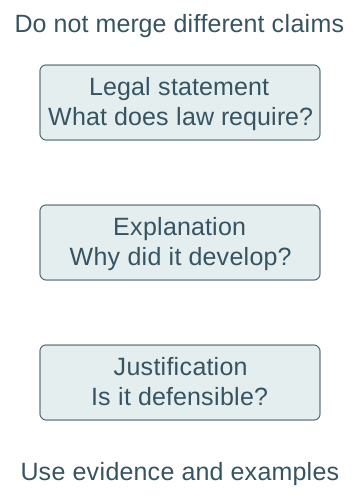
Connecting legal examples — Apply social-control and justice perspectives to sentencing purposes, legal aid, vicarious liability or consumer protection using the accurate substantive rules. A theory may explain an aspect without fully explaining every institution. Distinguish explanation of why a rule exists from an argument that the rule is justified or a claim about what current law requires.Stating the current legal requirements, explaining how or why a rule developed and evaluating its justification are different tasks. A social theory can illuminate a mechanism without changing the legal elements, and a policy preference does not itself establish either historical causation or current law. Synoptic arguments should connect accurate examples, reasons and counterarguments.
Extended-answer method — Define the exact issue, state a defensible argument, explain a relevant theory and apply accurate legal examples, then test a serious counterargument and reach a supported conclusion. Paragraphs should develop reasons rather than list names. The legal system's achievements and limitations need evidence and mechanisms, not an unsupported statement that all law is just or all enforcement is oppressive.
Qualified judgement — A conclusion should identify which conditions make the rule or reform more defensible, such as effective access, reliable evidence, proportionate protection or safeguards for disagreement. Acknowledge a remaining trade-off without refusing to take a reasoned position. A recall quiz can check concepts but cannot certify the quality of the required synoptic extended argument.
Test yourself
50 questions · Random sets of 10. These quick checks support revision; practise longer explanations and justified judgements too.
 Mr Kidman's Classroom