Separate legal meanings — Assault in its narrow common-law sense concerns causing apprehension of immediate unlawful violence; battery concerns application of unlawful force. Everyday language and charging terminology sometimes use assault more broadly. Keep the analytical elements distinct rather than assuming contact is necessary for every assault or that all harmful conduct is a battery.
Apprehension — The victim must anticipate immediate unlawful force, not necessarily feel frightened. A confident person can apprehend an attack; an unconscious person or someone entirely unaware of a threat cannot apprehend that threat at that moment. Their lack of apprehension does not itself exclude an independently established battery.
Words and conduct — Threatening movements or words can constitute assault if the elements are met. Logdon illustrates an apparently credible firearm threat despite the gun's actual nature. Actual capability is different from what the victim apprehends, so a concealed impossibility does not automatically prevent the offence.
Silence and context — Ireland shows that repeated silent telephone calls can amount to assault where their context causes the required apprehension. Silence is not invariably harmless or invariably criminal. Explain what the victim understands and whether the threatened violence is sufficiently immediate rather than using the communication medium as a complete answer.
Immediate violence — Immediate is not limited to a blow landing in the next fraction of a second. Constanza illustrates contextual fear of violence at a time not excluding the immediate future. A threat of remote future harm may fail this assault element while still raising another offence; do not treat every alarming message as an assault regardless of timing.
Words negating a threat — Words can remove the apparent immediacy or unlawfulness of accompanying conduct. Tuberville v Savage illustrates how the whole communication can negate an apparent threat. Assess words and actions together rather than mechanically counting an aggressive gesture without its context.
Conditional threats — A condition does not automatically prevent assault. A demand backed by an immediate threat of unlawful force can create the required apprehension, while a condition ruling out any present threat can alter the analysis. The question is what immediate unlawful violence the victim anticipates in the actual circumstances.
Assault mens rea — The defendant must intend to cause apprehension of immediate unlawful violence or be subjectively reckless as to causing that apprehension. The fault concerns apprehension, not necessarily an intention to carry out the threatened attack. Apply the relevant awareness to the victim and circumstances; bad temper alone is not proof of every element.
Assault without injury — No physical injury or contact is required for narrow assault. For a fictional raised fist, ask whether the victim perceived it, apprehended sufficiently immediate unlawful violence and whether the defendant had the relevant fault. A threatening act behind the victim's back does not establish apprehension merely because it looks intimidating to an observer.
Battery force unlawfulness and fault
Application of force — Battery requires unlawful application of force to another, including contact too slight to produce injury. The body does not need to be bruised or cut. The legal issue is the contact and its unlawfulness alongside the mental element, not a minimum measurable level of pain.
Everyday contact — Ordinary social contact can be lawful through the relevant consent and contextual principles. Collins v Wilcock distinguishes generally accepted contact from an unjustified physical restraint. Hostility is not a universal additional requirement, but neither does every accidental jostle in a crowded place establish a criminal battery.
Clothing and indirect force — Contact with clothing being worn can suffice, and force can be applied indirectly rather than only by the defendant's bare hand. Throwing a substance or setting a mechanism in motion requires analysis of application and causation. Do not assume that distance or the absence of skin-to-skin contact necessarily defeats battery.
Indirect causation — DPP v K illustrates how placing acid in a hand dryer could result in force being applied when another person used it. The authority concerns indirect application through the mechanism, not a rule making every hidden hazard an automatic battery. Relevant fault, causation and any defence still need proof.
Continuing conduct — Fagan illustrates a wheel remaining on a police officer's foot while the necessary fault arose. The continuing application of force could coincide with mens rea. Explain the continuing act rather than asserting that all later failures to reverse a completed accident necessarily amount to battery.
Battery mens rea — Intention or subjective recklessness as to applying unlawful force is sufficient. Venna supports this mental requirement. An intention to inflict serious injury is unnecessary for battery, but a genuinely accidental contact without the required fault cannot be converted into it simply because someone was touched.
Unlawfulness and defences — Consent where legally effective, lawful self-defence and other relevant powers can make force lawful. Identify the particular justification and limits; a role such as police officer does not confer unrestricted permission to use force. The dedicated defences chapter develops consent and self-defence rather than treating the word consent as universally decisive.
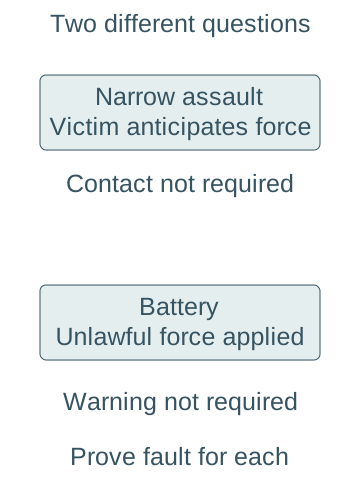
Assault and battery comparison — A victim may apprehend a punch that never lands, be struck without warning, or anticipate and receive it. Those patterns illustrate assault without battery, battery without narrow assault, or both. Apply the elements independently instead of treating them as an unavoidable sequence or requiring every charge to prove an injury.Narrow assault requires apprehension of immediate unlawful violence with the relevant fault, without necessarily any contact. Battery requires unlawful application of force with the relevant fault, without necessarily warning the victim. The offences can coexist or occur separately; the boxes do not represent a compulsory sequence.
Assault occasioning actual bodily harm
Section 47 structure — Under section 47 of the Offences Against the Person Act 1861, assault occasioning actual bodily harm requires an assault or battery causing actual bodily harm. Establish the base conduct, the required harm and causation. A court does not choose section 47 merely because any bodily change occurred, and section 47 does not require all the more serious elements of section 18.
Actual bodily harm — ABH means harm more than transient or trifling in the relevant legal sense. It need not be permanent or life-threatening. The assessment considers the nature of the injury and its context rather than a rigid rule that one named injury always establishes exactly the same offence in every case.
Examples and evidence — Bruising, cuts, temporary loss of consciousness or other injuries may support ABH depending on seriousness and evidence. T v DPP illustrates temporary unconsciousness; DPP v Smith illustrates that cutting a substantial amount of hair without consent can constitute bodily harm. These authorities do not make every trivial touch or minor hair disturbance an ABH offence.
Psychiatric harm — Chan-Fook and Ireland recognise that a medically identifiable psychiatric injury can constitute bodily harm. Mere emotions such as fear, distress or panic are not by themselves the necessary psychiatric injury. Evidence must support the condition and its causal link to the assault rather than relying only on the victim saying they were upset.
Occasioning and causation — Occasioning means causing the harm through the relevant assault or battery. A victim's escape injury can require the causal reasoning illustrated by Roberts, including the range of responses reasonably expected in the circumstances. An injury occurring later is not automatically caused by the earlier threat simply because the events are close in time.
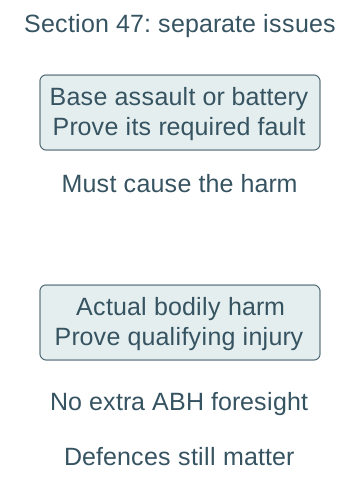
Mental element for section 47 — Savage and Parmenter establish that the mens rea of the underlying assault or battery suffices; no additional intention or recklessness as to ABH itself is required. The harm must still be caused. Do not confuse lack of foresight of the full injury with absence of every mental element or treat section 47 as strict about the base assault.Section 47 requires a proved assault or battery causing qualifying actual bodily harm. The mental element of that base offence is required, but no additional intention or recklessness as to ABH itself. The absence of that additional fault requirement does not remove the need for base fault, injury, causation or relevant defence analysis.
Applying section 47 — For a fictional deliberate shove causing a fall and significant injury, establish intentional or reckless unlawful force, the injury's ABH character and causation. Consider the actual circumstances and defences. Explain why not intending the injury does not necessarily exclude section 47, while a missing causal connection or wholly accidental lawful contact changes the analysis.
Wounding grievous bodily harm and section 20
Section 20 external elements — Section 20 concerns unlawful wounding or inflicting grievous bodily harm (GBH). Wounding and GBH are alternatives: a serious injury need not break the skin, while a qualifying wound need not independently be really serious. The statutory alternatives and actual facts matter more than using all injury labels interchangeably.
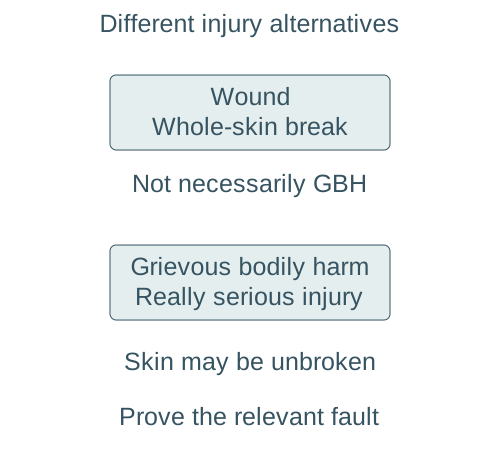
Meaning of a wound — A wound requires a break in the continuity of the whole skin under the relevant legal definition. JCC v Eisenhower illustrates that internal bleeding without that skin break is not by itself a wound. Conversely a relatively small qualifying cut can be a wound; do not assume wound means only a large or near-fatal injury.A wound requires the legally relevant break in the continuity of the whole skin; it need not independently amount to really serious harm. GBH requires really serious harm but need not involve a skin break. These are alternatives in the relevant sections, not successive steps on a universal injury ladder; each offence’s fault and other elements remain necessary.
Meaning of GBH — Grievous bodily harm means really serious bodily harm. DPP v Smith is an authority for that meaning; distinguish it from the later same-name hair-cutting case. The whole injury and victim's circumstances matter, and serious harm can exist without broken skin or a weapon.
Victim's circumstances — Bollom illustrates assessing injury in the context of the particular victim, including vulnerability. The same physical injuries may have different seriousness for a young child and a healthy adult. Do not replace evidence with a rule that every mark on a vulnerable person is automatically GBH.
Serious psychiatric injury — Burstow confirms that sufficiently serious psychiatric injury can amount to GBH and that inflicting it does not require a direct physical blow. Distinguish a recognised serious condition from ordinary distress and establish causation. The act need not itself be a technical assault where the section's external elements are otherwise proved.
Maliciously — In section 20, maliciously concerns intention or subjective recklessness as to some physical harm, not personal spite or foresight of really serious injury. Mowatt, read with Savage and Parmenter, supports this distinction. A friendly motive does not automatically negate fault, while wholly unforeseen injury does not itself establish the required risk awareness.
Harm fault and result — Section 20's actual result must meet the wounding or GBH alternative, but its fault need extend only to some physical harm. This mismatch is important in application and evaluation. Do not lower the required result because the fault threshold is lower, or raise the mental threshold to GBH just because the injury was very serious.
Applying section 20 — For a fictional intentional punch causing a serious fracture, analyse the force, causal injury and whether some physical harm was intended or foreseen. Compare section 18 only if evidence supports its additional intent. The final charge cannot be selected from injury seriousness alone without the appropriate mental and defence analysis.
Section 18 comparison and reform
Section 18 external elements — Section 18 covers unlawful wounding or causing grievous bodily harm with its required further intent. The wound and GBH alternatives are not confined to injuries caused by weapons. Identify the actual injury, causal connection, mental route and relevant defences rather than treating a severe outcome as automatic proof of specific intent.
Intent to cause GBH — The principal section 18 route requires intention to cause grievous bodily harm. Intending only a wound or foreseeing only some harm is insufficient for this route. Belfon illustrates the distinction from recklessness, while Taylor illustrates why intention to wound alone does not necessarily establish the required GBH intent.
Resisting lawful apprehension — Section 18 also includes the statutory intent to resist or prevent lawful apprehension or detention. Here apprehension means arrest or capture, unlike the anticipation of violence meant by apprehension in narrow assault. This distinct route requires its own intent and the relevant malicious causing of the wounding or GBH; do not simply state that the principal GBH-intent route is the only possible section 18 basis. Lawfulness and what the defendant intended need attention.
Evidence of serious intent — Weapon choice, targeting, threats, force, repeated actions and surrounding circumstances may support an inference of intention to cause really serious harm. No single fact mechanically proves it, and the defendant's words are not automatically conclusive either. Apply the relevant direct or exceptional oblique-intention reasoning where appropriate.
Comparative fault — Battery requires intended or reckless unlawful force; section 47 needs the base assault or battery fault without additional ABH foresight; section 20 needs intention or recklessness as to some physical harm; the principal section 18 route needs GBH intent. Keep this comparison distinct from the actual harm each offence requires and from section 18's apprehension route.
Hierarchy and overlap — Non-fatal offences have overlapping external elements and unequal fault thresholds. A wound can qualify under a serious statutory category despite relatively limited damage, and a very serious injury may fall under section 20 rather than the principal section 18 route if GBH intent is not proved. A single severity ladder therefore cannot answer every charging or problem question.
Language and correspondence — Criticisms include the 1861 Act's archaic language, overlapping alternatives, the complexity of inflict versus cause and imperfect correspondence between fault and the harm punished. Explain a concrete contrast, such as unforeseen ABH after a proved battery, rather than asserting that the law has no fault requirement at all.
Reform proposals — The Law Commission's 2015 report proposed a modernised structure and clearer terminology. Distinguish recommendations from enacted current law: a proposal does not repeal sections 18, 20 or 47 by being published. Evaluate intelligibility, coherence, fair labelling, protection and proof difficulties using the actual proposed change before reaching a supported conclusion.
Integrated non-fatal answer — For fictional threats followed by a shove and a serious injury, separate each alleged act, victim awareness, injury, causation and fault. Apply the closest relevant authorities and any supported defence, then compare plausible offences. Identify missing evidence and avoid presenting charging guidance examples, maximum penalties or a remembered case label as a substitute for proving legal elements.
Test yourself
50 questions · Random sets of 10. These quick checks support revision; practise longer explanations and justified judgements too.
 Mr Kidman's Classroom