Secondary responsibility — Vicarious liability can make one person legally responsible for another's tort where the required relationship and connection are established. It does not necessarily depend on the employer personally breaching a duty, and it does not remove the wrongdoer's own liability. Prove the underlying actionable tort rather than infer one from the existence of employment alone.
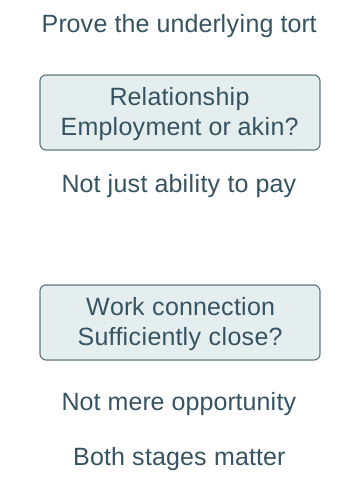
Two distinct stages — Ask first whether the relationship is employment or sufficiently akin to it and second whether the tort is sufficiently connected with that relationship's work. A positive answer at one stage does not establish the other. Keep relationship, connection and the underlying tort as separate issues instead of treating any workplace link as conclusive.First prove the underlying tort. Vicarious liability then requires a qualifying employment or akin relationship and sufficiently close connection between entrusted activities and the wrongdoing. Ability to pay, a role label or work-created opportunity alone does not automatically establish either stage.
Employment in substance — The real relationship matters more than a contractual label. Control, integration, personal service, payment, tools, financial risk and consistency of the arrangements can inform the relevant common-law assessment. No single label such as self-employed or paid worker automatically decides every context.
Ready Mixed Concrete — Ready Mixed Concrete illustrates looking at the service and control arrangements and whether the contractual provisions are consistent with employment in the relevant analysis. Use its reasoning for the actual issue rather than assume a person's tax description or uniform alone proves status. The vicarious-liability inquiry must not be mechanically equated with every statutory employment-rights category.
Akin-to-employment relationships — A formal employment contract is not always necessary. Catholic Child Welfare Society and Cox illustrate relationships integrated into the defendant's activities where the relevant risk and responsibility justify the legal category. Explain the actual task and organisational relationship rather than treat every volunteer, religious member or prisoner as automatically within the rule.
Independent business — Barclays confirms the continuing distinction where the tortfeasor (the person who committed the tort) is genuinely carrying on an independent business. Merely commissioning work does not automatically impose vicarious liability for everything the provider does. Analyse the relationship in substance and distinguish this issue from a separate direct duty or statutory contractor provision.
Insurance and resources — An employer or organisation may have resources and insurance that improve the claimant's chance of compensation, but ability to pay alone is not a free-standing legal test. Enterprise activity, integration and creation of risk inform the rationale within the actual doctrine. Do not assume a wealthy organisation is liable for every associated person's act.
Relationship application — For a fictional shop employee, an integrated unpaid worker and an outside specialist serving many clients, compare actual duties, control, service and business arrangements. State what evidence would clarify the relationship. A careful conclusion explains both analogies and limits rather than deciding solely from a payslip, a title or sympathetic loss.
Course of employment and close connection
Salmond formulation — The traditional formulation concerns an authorised wrongful act or an unauthorised mode of doing an authorised act. It helps explain ordinary employment cases but must be read with modern close-connection authorities, especially intentional wrongdoing. Prohibition and work connection require analysis rather than a rule that every forbidden act is outside employment.
Negligent performance — Century Insurance illustrates a worker's careless act during an assigned delivery task being connected with the employment, despite the employer not authorising the precise carelessness. Ask what work was being performed and how the tort arose. The employer need not instruct the employee to commit the very breach for secondary liability to be possible.
Prohibitions and methods — Limpus and Rose v Plenty illustrate that an express prohibition can concern the method of performing work rather than take every breach outside it. Contrast a restriction defining what work the person was engaged to do with one merely regulating how the work should be done. The wording of a rule is relevant evidence, not automatic immunity.
Independent ventures — An employee on an independent venture unconnected with assigned work may be outside the course of employment. Storey v Ashton illustrates departure for a personal purpose. Time, location and use of an employer's vehicle are relevant but not individually decisive; identify the actual activity and purpose rather than label every detour a complete frolic.
Close-connection test — Lister and later authorities ask whether the tort is so closely connected with the acts entrusted to the employee that it can fairly and properly be regarded as committed in the course of the employment. This is a legally structured connection inquiry, not an unrestricted invitation to impose liability whenever the result feels fair.
Field of activities — Identify the employee's entrusted functions or field of activities broadly but accurately, then assess the connection with the wrongdoing. Mere opportunity, workplace access or introduction to the victim is not necessarily enough. Explain what the employee was authorised to do and whether the wrongdoing was a misuse of that entrusted position in the legally relevant sense.
Mohamud and clarification — Mohamud illustrates the connection between an employee's customer-facing functions and wrongful conduct in its particular setting. Morrison 2020 clarifies that it did not create a universal rule covering everything in an unbroken temporal sequence after a work encounter. Avoid treating any customer interaction or data access as automatically enough.
Personal vendetta — Morrison 2020 distinguishes work-related opportunity from conduct pursuing a personal vendetta outside the ordinary course. The employee's motivation can matter to whether they were furthering the employer's business or pursuing a separate personal objective. Do not simplify this into either motive always decides everything or motive can never be relevant.
Modern boundary — BXB confirms the separate relationship and close-connection stages and rejects treating but-for connection with a role as sufficient for every intentional wrong. Apply its relevant proposition without equating membership, trust or mere opportunity with automatic organisational responsibility. The legal requirement protects against unlimited association-based liability.Analyse the employee’s entrusted field of activities and whether the wrong is sufficiently connected to it, rather than infer liability from access, trust or timing alone. Morrison 2020 and BXB qualify overbroad readings of earlier authorities. A personal aim can inform the connection inquiry but is not a mechanical answer to every case.
Connection application — For a fictional delivery worker causing injury while delivering goods, then separately using access for personal retaliation, analyse the different conduct and purpose. Establish each underlying tort, relationship and close connection using the appropriate authorities. Failure of vicarious liability does not itself decide a separately alleged direct organisational negligence claim.
Tort defences consent and contributory responsibility
Different effects — A defence's requirements and effect matter: contributory negligence ordinarily reduces damages while volenti can defeat the relevant claim. A missing duty, absent causation and an enforceable exclusion are separate legal reasons rather than interchangeable defences. Identify which issue the facts actually support before applying a familiar label.
Claimant fault — Under the 1945 Act assess whether the claimant failed to take reasonable care relevant to their own safety and whether that fault contributed to the damage. Mere moral criticism or conduct unrelated to the injury is insufficient. The standard and circumstances must be appropriate to the claimant rather than an automatic demand for perfection.
Allocation — The reduction must be just and equitable in light of responsibility, with causal contribution and blameworthiness relevant. A court does not simply count how many careless acts each side committed. Explain the actual effect on the injury and the respective responsibilities instead of inventing a percentage from a vague impression of fairness.
Accident and injury — Froom illustrates that claimant conduct can contribute to the seriousness of injury without causing the initial accident. A negligent driver may remain responsible for the collision while the claimant's failure to take a relevant precaution affects damages. Distinguish those causal questions and use actual evidence, not an automatic reduction regardless of whether the precaution would have changed the injury.
Free informed acceptance — Volenti concerns legally sufficient free and informed acceptance of the relevant risk. Knowledge is necessary to analyse acceptance but is not equivalent to it. Identify the actual agreement, understanding and choice rather than infer that every spectator, passenger or employee has surrendered all rights by participating.
Work and rescue — Smith v Baker illustrates the weakness of equating workplace danger knowledge with free acceptance. Rescue cases also require attention to the pressures and circumstances rather than treating assistance as an automatic agreement to absolve the wrongdoer. Explain the real opportunity to choose and the particular risk, preserving the relevant legal limits.
Dangerous choices — Morris v Murray illustrates a particularly extreme voluntary-risk setting involving a dangerous flight. The authority does not make every drink-related passenger case identical, and statutory controls can restrict relying on acceptance in particular contexts. Identify the actual transport and applicable rules instead of transferring one case as a universal bar.
Defence application — For a fictional worker injured partly through their own careless handling, distinguish an evidenced partial reduction from a claim that accepting the job implied unrestricted consent. Consider whether a warning informed the choice or enabled safety, without treating awareness as decisive. State what evidence would support contribution, acceptance or neither.
Damages injunctions and making good loss
Compensatory objective — Ordinary tort damages seek to place the claimant, so far as money can, in the position they would have occupied without the legally actionable wrong. This differs from a guaranteed punishment of the defendant or a payment for every moral grievance. The causal and legal limits of the relevant tort determine recoverable loss.
Financial and nonfinancial consequences — Proved earnings loss, reasonable care costs and property repair can be pecuniary losses; pain, suffering and loss of amenity can be nonpecuniary personal-injury heads where recoverable. The categories and scope differ between torts. A nuisance claimant cannot simply import every bodily-injury head into a land-based claim without the relevant entitlement.
Consequential financial loss — Income lost because of an actionable physical injury differs from a claim for pure economic loss without that injury or property damage. The distinction prevents the mistaken conclusion that excluding specialist pure-economic-loss coverage excludes all financial consequences. Prove amount, causation and remoteness rather than assume every later financial difficulty is recoverable.
Past and future loss — Special damages commonly concern quantifiable losses up to trial, while general damages include losses requiring assessment such as future earnings and nonfinancial injury. Terminology does not make every past loss automatically easy to prove or every future loss unlimited. Future assessments depend on evidence and appropriate legal assumptions, not invented universal figures or discount rates.
Mitigation and proof — A claimant must act reasonably to limit avoidable loss, with recoverable expenses and the defendant's allegation assessed under the rules. Reasonable treatment, replacement arrangements or efforts to resume appropriate work can be relevant, but unsafe or unreasonable measures are not automatically required. Keep mitigation separate from claimant fault causing the original injury.
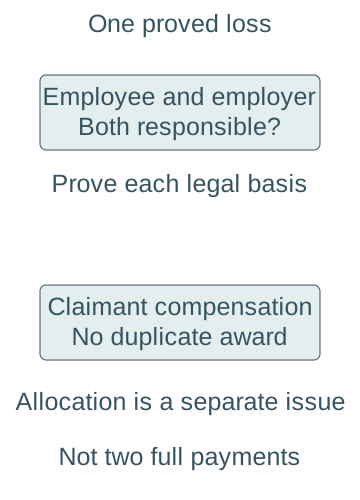
No double recovery — The same loss cannot simply be compensated twice under different labels or against multiple responsible defendants. Contribution and recovery arrangements must be distinguished from the claimant's underlying entitlement. Identifying both an employee and employer does not mean the claimant automatically receives two full awards for the same damage.An employee’s tort and an employer’s secondary responsibility can coexist where the tests are satisfied, but the claimant cannot simply recover two full compensatory awards for the same loss. Contribution or allocation between responsible persons is a distinct issue from multiplying the claimant’s entitlement.
Illustrative calculation — If a fictional proved assessment is £50,000 and a given justified claimant-fault reduction is 20 percent, the remaining award is £40,000. The arithmetic assumes the assessment and percentage have already been legally established. It does not predict a real judge's assessment, ignore mitigation or establish liability from a number alone.
Prohibitory and mandatory orders — A prohibitory injunction restrains conduct, while a mandatory injunction requires specified action. Both depend on legal entitlement and discretion rather than a claimant merely preferring an order. A continuing nuisance may need carefully framed restrictions, with practical consequences and competing interests considered under the relevant principles.
Discretion and alternatives — Damages in place of an injunction can be appropriate where the legal discretion supports them; Coventry v Lawrence supplies relevant nuisance guidance. Public benefit, effectiveness, the nature of harm and the burden of an order can matter without automatic immunity. Distinguish the liability decision from selecting a workable and lawful remedy.
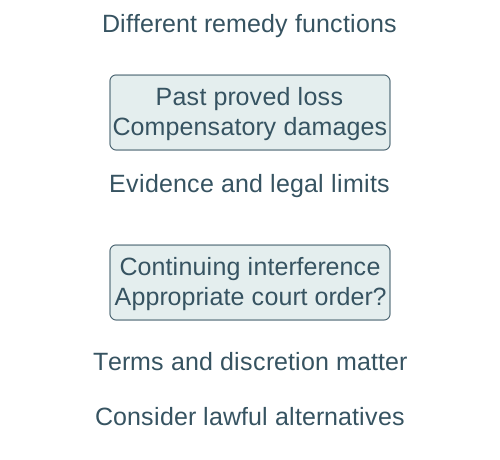
Remedy application — For a fictional continuing emission causing proved property damage, separate compensation for past harm from measures limiting future interference. Identify recoverable heads, evidence, mitigation and the proposed order's terms, then consider justified alternatives. Avoid either automatically shutting down all activity or treating compensation as permission to continue any interference indefinitely.Compensatory damages address proved legally recoverable loss, with causation, mitigation and no-double-recovery limits. An appropriately framed injunction can restrain or require conduct concerning continuing interference under the relevant discretion. Liability does not automatically choose closure, unrestricted continuation or an identical monetary alternative in every case.
Evaluation enterprise risk and practical justice
Compensation and risk allocation — Vicarious liability can improve access to compensation and place the cost of work-created risks on the organisation benefiting from the activity. Insurance and prices can distribute some costs more broadly. This rationale helps explain the doctrine without itself proving that every insured organisation is legally responsible for every associated wrong.
Prevention and supervision — Liability may encourage suitable selection, training, supervision and safe systems. Its practical incentives depend on the organisation's ability to influence the activity and manage risk. Do not assume liability always prevents intentional misconduct or that reasonable employer precautions necessarily defeat secondary liability once the legal tests are otherwise met.
Fairness to organisations — Strict secondary responsibility can burden an organisation that did not authorise or personally commit the wrong, including charities and public bodies with limited resources. The relationship and close-connection limits protect against liability for a person's wholly separate conduct. Evaluate a specific boundary rather than treat every employer as either a blameless bystander or an unlimited insurer.
Predictability and development — Extending beyond formal contracts can prevent artificial labels defeating valid claims, while flexible concepts such as akin to employment and close connection create borderline uncertainty. Barclays, Morrison and BXB clarify limits alongside earlier expansion. Explain what those distinctions actually require before judging the law as either wholly unpredictable or mechanically certain.
Defence and remedy balance — Contributory responsibility can reflect a claimant's role without eliminating justified compensation; a complete acceptance defence requires more demanding proof. Remedy discretion can address ongoing harm while preserving legitimate activity. Evaluate each mechanism's fit with fairness, evidence and practical access rather than assuming every defence is an improper denial of rights.
Access and individual justice — Cost, delay, evidence, insurance, insolvency and legal assistance influence whether a claimant can turn entitlement into a remedy. A defendant's ability to pay can affect practical recovery without being the sole liability test. Relate evaluation to actual litigation and resources instead of inventing unsupported success rates or compensation guarantees.
Integrated tort reasoning — For a fictional organisational incident, establish the actual tort, relationship and close connection, then any direct duty alleged separately. Assess claimant conduct, free acceptance, causal and remoteness limits, provable losses and a suitable remedy without double recovery. Reach reasoned individual conclusions and evaluate the allocation of work-created risk through the relevant legal mechanisms.
Test yourself
50 questions · Random sets of 10. These quick checks support revision; practise longer explanations and justified judgements too.
 Mr Kidman's Classroom