Gradient as a ratio — For distinct points (x₁,y₁) and (x₂,y₂) with x₂ ≠ x₁, the gradient is m = (y₂ − y₁)/(x₂ − x₁). Keep the subtraction order the same in numerator and denominator. Through (−1,2) and (3,10), the gradient is 8/4 = 2; a vertical line instead has undefined finite gradient.
Point-gradient equation — A line with gradient m through (a,b) has equation y − b = m(x − a). Through (2,−3) with gradient 4, obtain y + 3 = 4(x − 2), so y = 4x − 11. Substituting the known point checks the intercept and the signs inside the brackets.
Two-point equation — Find the gradient from two points and substitute either into the point-gradient form. Through (−2,5) and (4,−1), m = −1 and y = −x + 3. If the two points share the same x-coordinate, use the vertical equation x = constant rather than divide by zero.
General line form — The form ax + by + c = 0 includes vertical lines when b = 0 and a ≠ 0. If b ≠ 0, rearrange y = −(a/b)x − c/b, so the gradient is −a/b. Multiplying all coefficients by the same nonzero constant gives the same geometric line.
Horizontal and vertical — A horizontal line has equation y = k and gradient zero. A vertical line has equation x = h and no finite gradient. They are perpendicular. The rule involving a negative reciprocal must be supplemented by these cases rather than interpreted as a legal division by zero.
Parallel lines — Two distinct nonvertical lines are parallel when their gradients are equal. The line parallel to y = 3x − 7 through (2,1) is y − 1 = 3(x − 2), giving y = 3x − 5. Equal gradient alone also allows coincident lines, two equations describing the same line, so compare intercepts or coefficients if distinctness matters.
Perpendicular lines — For two nonvertical lines with nonzero gradients, perpendicularity requires m₁m₂ = −1. A perpendicular to gradient 2 has gradient −1/2, not −2. Through (4,1), its equation is y − 1 = −(x − 4)/2. Handle horizontal/vertical perpendicular lines separately.
Line intersections — Solve the two line equations simultaneously to locate an intersection. For y = 2x + 1 and y = −x + 7, obtain x = 2 and y = 5. Different gradients give one intersection; equal gradients give either no intersection for distinct parallels or infinitely many points for the same line.
Distance and midpoint — The distance between (a,b) and (c,d) is √((c − a)² + (d − b)²), derived from Pythagoras. Their midpoint is ((a + c)/2,(b + d)/2). For (−1,2) and (5,10), the distance is 10 and midpoint is (2,6), retaining both coordinate signs.
Perpendicular bisector — A perpendicular bisector passes through a segment's midpoint at right angles to the segment. For endpoints (0,0) and (4,2), the midpoint is (2,1), the segment gradient is 1/2 and the bisector gradient is −2. Its equation y − 1 = −2(x − 2) simplifies to y = −2x + 5.
Circle equations centres radii and intersections
Circle definition — A circle is the set of points at a fixed positive distance r from a centre (a,b). Pythagoras gives (x − a)² + (y − b)² = r². The centre is not read as the signs written inside the brackets: (x + 2)² + (y − 3)² = 25 has centre (−2,3) and radius 5.
Expanded circle form — Expanding gives x² + y² + 2fx + 2gy + c = 0, whose centre is (−f,−g) and squared radius f² + g² − c. These conclusions follow by completing both squares. The equal x²/y² coefficients and absence of an xy term distinguish this standard circle form from other conics.
Completing two squares — For x² + y² − 6x + 4y − 12 = 0, write (x − 3)² − 9 + (y + 2)² − 4 − 12 = 0. Hence (x − 3)² + (y + 2)² = 25, so centre (3,−2), radius 5. Account for both constant corrections rather than change the expression's value.
Real circle conditions — The completed squared radius must be positive for a nondegenerate real circle, one with positive radius rather than a single point. Zero gives a single point and a negative value gives no real points. For x² + y² − 2x + 4y + c = 0, r² = 5 − c, so a genuine circle requires c < 5.
Constructing an equation — Given centre (2,−1) and a point (5,3) on the circle, r² = 3² + 4² = 25. Therefore (x − 2)² + (y + 1)² = 25. Calculate the squared distance directly; taking a square root then squaring again is unnecessary and can introduce rounding.
Inside on or outside — Compare a point's squared distance from the centre with r²: smaller means inside, equal means on and larger means outside. For x² + y² = 25, (3,4) lies on the circle and (1,2) lies inside. This test is not itself a tangent calculation.
Diameter endpoints — A circle with diameter endpoints A and B has centre at their midpoint and radius half their distance. If A = (−2,1) and B = (4,9), the centre is (1,5), diameter 10 and radius 5. Thus (x − 1)² + (y − 5)² = 25.
Line-circle intersections — Substitute the line equation into the circle to obtain a quadratic in one coordinate. With y = x + 1 and x² + y² = 25, get 2x² + 2x − 24 = 0, so x = 3 or −4. The paired points are (3,4) and (−4,−3), not every possible combination of the separate coordinate values.
Discriminant and contact — After a valid nonvertical substitution, the quadratic discriminant distinguishes two intersections, a repeated tangent intersection or no real intersection. For y = x + k with x² + y² = 25, the quadratic is 2x² + 2kx + k² − 25 = 0 and Δ = 200 − 4k². Tangency therefore requires k = ±5√2.
Intersections and admissibility — An algebraic intersection must satisfy every original equation and any restricted curve segment. A line may meet an entire circle twice but a specified arc only once or neither time. Verify exact coordinates before deciding how many geometrically permitted solutions remain.
Tangents chords and circumcircles
Radius and tangent — At a point P on a circle, the tangent is perpendicular to the radius from the centre to P. First verify P lies on the circle, find the radius direction, then form a perpendicular line through P. A line through an arbitrary nearby point is not a tangent merely because its gradient has been chosen as a negative reciprocal.
Tangent worked example — For centre (1,2), radius 5 and point P = (4,6), the radius gradient is 4/3. The tangent gradient is −3/4, so y − 6 = −3(x − 4)/4, or 3x + 4y − 36 = 0. Substituting P checks the line, and the radius and tangent gradients multiply to −1.The radius-five circle has centre C=(1,2) and contact point P=(4,6). The radius displacement (3,4) has gradient 4/3; its tangent displacement can be (4,−3), giving gradient −3/4 and line 3x+4y=36. The geometric construction uses equal axis scales of 20 pixels per unit, with a right-angle marker at P.
Vertical-radius exception — For the circle x² + y² = 9 at (0,3), the radius is vertical and the tangent is horizontal y = 3. At (3,0), the radius is horizontal and the tangent is vertical x = 3. These cases cannot both be represented by an ordinary finite-gradient negative-reciprocal calculation.
Translated tangent identity — For a point (p,q) on (x − a)² + (y − b)² = r², the tangent satisfies (p − a)(x − a) + (q − b)(y − b) = r². This follows because the radius vector is perpendicular to the tangent's direction. The point-on-circle condition is necessary; do not apply the formula to an external point as though it were a contact point.
External point tangents — An external point generally has two tangents to a circle. For x² + y² = 25 and external point (13,0), write a line y = m(x − 13), substitute into the circle and set the discriminant to zero. This gives 25 − 144m² = 0, so m = ±5/12. Keeping only one sign would miss a tangent.
Chord midpoint property — The perpendicular from a circle's centre to a chord bisects it. If the centre-to-chord distance is d and radius is r, half the chord length is √(r² − d²) for 0 ≤ d ≤ r. For radius 5 and distance 3, the full chord length is 8, not 4.The perpendicular centre-to-chord distance is 3 and radius is 5. The right triangle therefore has half-chord length 4, so the full chord is 8. The circle and triangle use a common scale of 25 pixels per unit. The lower horizontal segment is the chord, not a diameter; doubling the centre distance would not give its length.
Chord bisector method — The perpendicular bisector of a chord passes through the circle's centre. Given two nonparallel chords, intersect their perpendicular bisectors to find the centre, then calculate the radius from any known circle point. A diameter's midpoint is already the centre and its perpendicular bisector still passes through it.
Angle in a semicircle — An angle subtended by a diameter at a third point on the circle is a right angle. Conversely, a right triangle's circumcircle, the circle passing through all three vertices, has the hypotenuse as a diameter. For vertices (0,0), (6,0) and (0,8), the centre is the midpoint of (6,0) and (0,8), namely (3,4), and radius 5.
General circumcircle — For three noncollinear points, points not all on one straight line, find the intersection of two perpendicular bisectors or substitute all three into x² + y² + 2fx + 2gy + c = 0 and solve for f,g,c. With (0,0), (4,0), (0,2), the equation is x² + y² − 4x − 2y = 0, centre (2,1), radius √5. Collinear distinct points do not determine a finite circumcircle.
Geometric proof and checks — Use the chord-bisector and semicircle properties to justify a construction rather than merely locate an apparent centre in a sketch. Check all original points against the final circle equation and all tangent directions against their radii. A not-to-scale diagram supports reasoning but cannot establish equal lengths or right angles without a property or calculation.
Parametric equations elimination and restricted curves
Parameter meaning — Parametric equations express coordinates separately using a shared parameter t: x = f(t), y = g(t). They describe paired outputs at the same t, not independent choices of x and y. The parameter may be time in a model or simply a mathematical variable describing a curve.
Eliminating a linear parameter — If x = 2t + 1 and y = 3t − 4, then t = (x − 1)/2 and y = 3(x − 1)/2 − 4, giving 2y = 3x − 11. Recover the parameter domain separately; elimination alone gives the supporting line, not necessarily the exact segment traversed.
Restricted line segment — For the preceding equations with 0 ≤ t ≤ 4, endpoints are (1,−4) and (9,8). The Cartesian relation applies only for 1 ≤ x ≤ 9. As t increases the point moves toward (9,8); a bare straight-line equation omits this direction and restriction.The same parameter value produces each coordinate pair. The supporting Cartesian line is 2y=3x−11, but the stated interval selects only the segment from (1,−4) to (9,8), traversed in that order as t increases. The displayed relations are a coordinate summary, not a plotted graph.
Quadratic parameterisation — For x = 5t and y = 3t², eliminate t = x/5 to get 25y = 3x². If t ≥ 0, then x ≥ 0 and only the right-hand branch is described. The unrestricted parabola would include extra points absent from that parameter domain.
Reciprocal parameterisation — For x = 5t and y = 5/t with t ≠ 0, multiplying gives xy = 25. Positive t gives the first-quadrant branch; negative t gives the third-quadrant branch. The exclusion t = 0 and any extra sign restrictions remain necessary after elimination.
Circle parameterisation — For x = a + r cos t and y = b + r sin t, subtract the centre coordinates and use cos²t + sin²t = 1 to obtain (x − a)² + (y − b)² = r². With r > 0 and 0 ≤ t < 2π, the parameter describes the full circle once anticlockwise from (a + r,b).
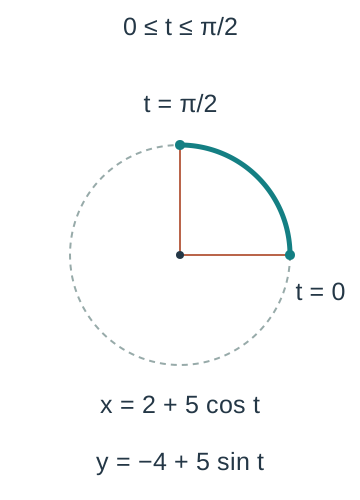
Circle centre and radius — The equations x = 2 + 5 cos t, y = −4 + 5 sin t describe a circle centred at (2,−4), radius 5. At t = 0 the point is (7,−4), at t = π/2 it is (2,1), and at t = π it is (−3,−4). The same parameter value must be used in both coordinates.
Arc restrictions — For that circle with 0 ≤ t ≤ π/2, only the upper-right quarter relative to its centre is described, including the endpoints. The full Cartesian circle equation includes three extra quarters. Use the trigonometric sign and endpoint conditions to state the required arc, not merely the equation.Only the green upper-right quarter, including its dark endpoints, is traced by 0≤t≤π/2. The dashed remainder shows portions of the supporting circle excluded by that interval. The horizontal/vertical radii have equal displayed lengths, and increasing t moves from the right endpoint (7,−4) to the top endpoint (2,1). The labelled t values are angles in radians, not Cartesian coordinates.
Repeated traversal — Extending a circular parameter domain from 0 ≤ t < 2π to 0 ≤ t < 4π repeats every position twice without changing the geometric locus, the set of positions on the curve. Replacing t by −t reverses direction for the standard circle. A Cartesian equation records the locus, while parametric equations and their domain also record traversal information.
Constructing a parameterisation — A line through position (a,b) with direction components (u,v) can be parameterised by x = a + ut, y = b + vt. For a segment from A to B, using t between 0 and 1 with direction B − A includes each endpoint. Check endpoint values rather than assume every parameter interval gives the required length.
Coordinate models units and interpretation
Affine conversion model — Converting Celsius C to Fahrenheit F uses F = (9/5)C + 32. It is a straight-line relationship with gradient 9/5 and intercept 32, not direct proportion between C and F. Two known conversion pairs determine this line, but a valid physical interpretation still requires the correctly named temperature scales.
Distance-time line — A distance-from-origin model d = vt + d₀ has gradient v in distance units per time and intercept d₀. If d is position along a signed line, v can be negative. If the vertical quantity is total accumulated distance travelled, it cannot decrease; read the quantity before assigning a motion interpretation.
Motion between positions — An object moves at constant velocity from (1,8) at t = 0 to (6,20) at t = 5. Its component rates are (6 − 1)/5 = 1 and (20 − 8)/5 = 12/5, so x = 1 + t and y = 8 + (12/5)t. For just the stated journey use 0 ≤ t ≤ 5 and the given coordinate/time units.
Speed and direction — For that motion with coordinates in metres and t in seconds, speed is √(1² + (12/5)²) = 13/5 m/s. Its direction can be described by the vector (1,12/5), while the path gradient is (12/5)/1 = 12/5. A component velocity is not by itself the total speed, and a path gradient has different units from speed.
Testing a straight-line assumption — A line fitted through two observations necessarily reproduces them but may fail at intermediate or later values. Compare additional measurements and contextual constraints such as changing speed, calibration limits or measurement uncertainty. Do not interpret two-point interpolation as proof that the real process has a constant rate everywhere.
Geometric modelling limits — A circular model assumes equal radius from a centre, while an object that only looks round in perspective may not satisfy that planar model. A straight path ignores curvature and a constant-velocity parameterisation ignores acceleration. Explain which simplification is being used and how a measured discrepancy might motivate a different model.
Time and distance restrictions — Negative time may describe a mathematical extension but be outside a journey starting at t = 0. A line's position coordinates can be negative even while its elapsed time and travelled distance are nonnegative. State restrictions by quantity rather than reject every negative answer or accept every real parameter indiscriminately.
Complete model communication — State axes, units, parameter meaning, allowed interval and assumptions before interpreting a graph or equation. Derive results using consistent units and explain whether an intersection is a meeting at the same time or only a shared place at different parameter values. Equal path coordinates alone do not establish that two moving objects collide.
Test yourself
50 questions · Random sets of 10. These quick checks support revision; practise longer explanations and justified judgements too.
 Mr Kidman's Classroom