Fundamental identities and domain-aware simplification
Identity versus equation — An identity holds for every input in its stated common domain, while an equation asks for inputs making two expressions equal. Sin²x + cos²x = 1 is an identity for all real x; sin x = 1/2 has particular solutions. Establishing an identity requires a general argument rather than a few matching calculator values.
Fundamental square identity — The unit circle gives sin²x + cos²x = 1. It allows substitution of 1 − sin²x for cos²x or vice versa. Choose the version reducing the number of different functions in an equation; replacing both at random can make a simpler problem more complicated.
Tangent quotient — Tan x = sin x/cos x requires cos x ≠ 0. It can turn a mixed sine/cosine expression into one quotient, but dividing an equation by cosine is a new step requiring its zero cases to be considered. The original expression's domain is the starting point for all later restrictions.
Secant identity — Divide sin²x + cos²x = 1 by cos²x where cos x ≠ 0 to obtain tan²x + 1 = sec²x. Thus sec²x − tan²x = 1 on that domain. The identity does not define secant or tangent at their excluded angles.
Cosecant identity — Dividing the same identity by sin²x where sine is nonzero gives 1 + cot²x = cosec²x. This identity is valid at x = π/2 because sine is one and cotangent is zero. Do not import tangent's excluded points into a differently defined quotient.
Factoring first — An expression such as sin x − sin x cos x factors as sin x(1 − cos x). Factoring exposes separate zero possibilities without dividing by a potentially zero expression. It is often safer than cancelling a common-looking function across an equation.
Rationalising a trig expression — For (1 − cos x)/sin x, multiply numerator and denominator by 1 + cos x where that multiplier is nonzero to obtain sin x/(1 + cos x). The equality holds where the original expression and the manipulation are defined. At an angle where either side was originally undefined, simplification does not assign it a new value.
Common-denominator method — To simplify 1/(1 − sin x) + 1/(1 + sin x), use denominator 1 − sin²x = cos²x. The numerator becomes 2, giving 2 sec²x for cos x ≠ 0. Record the original denominator exclusions, rather than only comparing values at convenient sample inputs.
Choosing one side — To prove an identity, usually transform one side into the other using established identities, factorisation or common denominators. Starting from the desired equality and manipulating both sides can conceal an unjustified reversible step. If using equivalences, explain that each is valid under the stated restrictions and the final established statement implies the original.
Checking a proposed identity — A counterexample in the stated domain disproves a proposed identity immediately. For instance sin x + cos x = 1 fails at x = π/4 because its left side is √2. A graph or sample values can help find a failure, but repeated numerical agreement is not a complete proof of a true identity.
Compound-angle formulae and geometric justification
Addition formulae — The sine addition identity is sin(A + B) = sin A cos B + cos A sin B, and cosine addition is cos(A + B) = cos A cos B − sin A sin B. They apply to directed angles in degrees or radians used consistently. Sin(A + B) is not generally sin A + sin B.
Geometric starting point — A unit-radius right-triangle projection at angle B has components (cos B,sin B). Rotate the whole geometric construction through angle A. Its two perpendicular component directions now have unit directions (cos A,sin A) and (−sin A,cos A), the second obtained by a quarter-turn, not by assuming the compound-angle formula being proved.
Rotated horizontal component — The original horizontal component has length cos B with a directed sign where needed. After rotation its horizontal projection is cos B cos A and vertical projection cos B sin A. Directed components allow the construction to describe quadrants beyond the initial acute-angle picture.
Rotated perpendicular component — The perpendicular component contributes −sin B sin A horizontally and sin B cos A vertically after rotation. Add it to the first component: the endpoint is (cos A cos B − sin A sin B,sin A cos B + cos A sin B). Since this is the unit point at angle A + B, its coordinates establish both addition identities.The schematic shows a unit triangle initially at B=30° rotated by A=30°, using equal coordinate scales of 180 pixels per unit. OQ has directed length cos B along the A direction; QP has directed length sin B along its positive perpendicular, with a right-angle marker at Q. OP is the resulting unit direction at A+B. General directed projections give horizontal component cos A cos B−sin A sin B and vertical component sin A cos B+cos A sin B. The numeric drawing illustrates the geometry; the accompanying component argument proves the general identities.
Scope of the geometric proof — An acute-angle diagram makes the right-triangle projections easy to see; directed coordinate projections and the sine/cosine symmetries extend the result to other angle positions. State what the components represent and why the second direction is perpendicular. Quoting the addition formula to rotate a point and then claiming that rotation proves it would be circular reasoning: using the result you are trying to prove as a reason why it is true.
Subtraction identities — Replace B by −B and use sine's odd and cosine's even symmetry to obtain sin(A − B) = sin A cos B − cos A sin B and cos(A − B) = cos A cos B + sin A sin B. The sign change in cosine's middle operation differs from the sine pattern, so derive or check it rather than swap signs indiscriminately.
Tangent addition — Divide the sine addition formula by the cosine addition formula where the quotient and divisions are defined. After division by cos A cos B, tan(A + B) = (tan A + tan B)/(1 − tan A tan B). This written form additionally requires tan A and tan B to exist and its denominator to be nonzero; the sine/cosine forms can remain meaningful at other inputs.
Tangent subtraction — Similarly tan(A − B) = (tan A − tan B)/(1 + tan A tan B) on its common domain. A zero denominator signals an excluded tangent output or an invalid intermediate expression and needs checking. Do not cancel an apparent factor if doing so would conceal where the original tangent expression was undefined.
Exact compound angle — Write 75° = 45° + 30° and use exact triangle values: sin 75° = (√2/2)(√3/2) + (√2/2)(1/2) = (√6 + √2)/4. Cos 15° has the same value by its subtraction formula. Retaining radicals demonstrates an exact result rather than an approximate decimal coincidence.
Exact tangent difference — For tan 15°, use 45° − 30°: (1 − 1/√3)/(1 + 1/√3) = (√3 − 1)/(√3 + 1) = 2 − √3. Rationalise by a conjugate and check the angle is acute, so the final value should be positive and smaller than one.
Double angles half angles and equivalent forms
Double sine — Set B = A in the addition formula to get sin 2x = 2 sin x cos x. The factor two multiplies the whole product. This identity holds for all real x and is useful for both simplifying products and solving equations with doubled arguments.
Double cosine forms — Cos 2x = cos²x − sin²x = 2 cos²x − 1 = 1 − 2 sin²x. Substitute the fundamental square identity to move between the three forms. Choose the version matching the function already present so an equation can become a quadratic in sine or cosine.
Double tangent — Where the relevant expressions are defined, tan 2x = 2 tan x/(1 − tan²x). The denominator is zero when tan x = ±1, corresponding to an undefined doubled-angle tangent. The quotient form also requires tan x to exist, so it is not an unrestricted substitute at every angle where tan 2x happens to exist.
Square reduction — Rearranging the double-cosine identities gives sin²x = (1 − cos 2x)/2 and cos²x = (1 + cos 2x)/2. These are exact identities, later useful for integration as well as graph and equation work. The doubled argument is 2x, not x squared.
Half-angle magnitudes — Replacing 2x by θ gives sin²(θ/2) = (1 − cos θ)/2 and cos²(θ/2) = (1 + cos θ)/2. Taking square roots determines magnitudes; choose the sign using the quadrant of θ/2. Writing a positive root automatically can be wrong outside a restricted angle interval.The full angle 3π/2 has cosine zero, giving squared half-angle cosine one half. Its half-angle is 3π/4 in quadrant two, so the actual cosine is −√2/2. The positive square root supplies only the magnitude; a sign conclusion requires the half-angle interval.
Exact half-angle example — Since 15° is acute, sin 15° is the positive square root of (1 − cos 30°)/2, giving √(2 − √3)/2. It also equals (√6 − √2)/4 from a compound formula. Verify equivalence by squaring the positive expressions or simplifying exactly, not merely comparing rounded decimals.
Quadrant-sensitive double angle — If sin θ = 3/5 and θ is in quadrant two, then cos θ = −4/5. Hence sin 2θ = −24/25 and cos 2θ = 7/25; where defined tan 2θ = −24/7. Choosing the positive root for cos θ would reverse the doubled sine's sign.
Product recognition — The expression 4 sin x cos x equals 2 sin 2x, while cos²x − sin²x equals cos 2x. Reversing these identities can also help: a target written as sin 2x may need expansion into a product. Preserve coefficients and use the identity in the direction that advances the required proof.
Identity with quotient restrictions — The quotient (1 − cos 2x)/sin 2x simplifies to tan x where sin 2x ≠ 0. Substituting double-angle identities gives 2 sin²x/(2 sin x cos x). Cancelling requires sin x and cos x nonzero, and the simplified tangent does not restore the original quotient at excluded multiples of π/2.
Unrequired substitution boundary — Half-angle sine/cosine identities follow directly from double angles and are in this course's scope. The general tan(θ/2) substitution formulae are not required by the 9MA0 guidance. Concentrate on justified identities, signs and domains rather than assume a new optional technique is compulsory.
Harmonic forms extrema and shifted equations
Single shifted cosine — A harmonic expression combines sine and cosine of the same angle. A cos θ + B sin θ can be written R cos(θ − α), where R = √(A² + B²) ≥ 0, R cos α = A and R sin α = B. This follows by expanding the compound cosine. If A = B = 0 the expression is zero and α need not be determined; otherwise choose α in a quadrant matching both coefficients.
Quadrant for phase — The ratio tan α = B/A alone does not distinguish opposite quadrants. Use the signs of cos α = A/R and sin α = B/R, or a correctly interpreted two-argument arctangent. If A = 0, determine α from the coordinate signs rather than divide by zero.
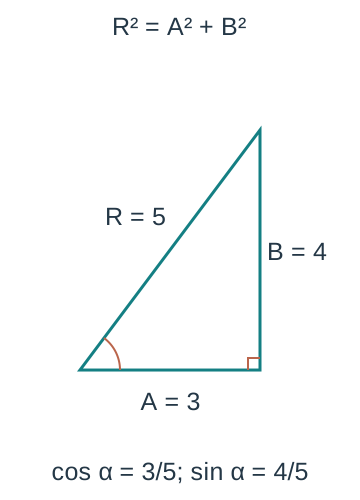
Harmonic worked form — For 3 cos θ + 4 sin θ, R = 5 and α is in quadrant one with cos α = 3/5 and sin α = 4/5, approximately 53.13°. Thus the expression is 5 cos(θ − α). Expanding back checks that both original coefficients have the correct signs and order.The coefficient triangle for A=3 and B=4 has hypotenuse R=5, with matching ratios cos α=3/5 and sin α=4/5. It uses equal scales of 60 pixels per coefficient unit. These positive coordinates select a first-quadrant phase. Other coefficient signs require a quadrant-aware phase choice rather than blindly taking an acute arctangent.
Alternative sine form — The same expression can be R sin(θ + β), where R cos β = B and R sin β = A. For 3 cos θ + 4 sin θ, β is approximately 36.87°. Different-looking phase forms can be equivalent; compare their expanded coefficients rather than declare one wrong because its angle differs.
Extrema and attainment — Since cosine ranges from −1 to 1, the nonzero harmonic expression ranges from −R to R over a full cycle. For 3 cos θ + 4 sin θ, the maximum 5 occurs at θ = α + 360°k for an integer k and the minimum −5 at θ = α + 180°. On a restricted interval a full-cycle extremum may be unavailable, so inspect endpoints and permitted angles.
Equation feasibility — The equation 3 cos θ + 4 sin θ = 6 has no real solutions because the left side's magnitude is at most 5. Establish the range before applying an inverse function to an impossible ratio such as 6/5. The same check helps diagnose inconsistent contextual data.
Shifted harmonic equation — To solve 3 cos θ + 4 sin θ = 4 for 0 ≤ θ < 360°, write cos(θ − α) = 4/5. With β = arccos(4/5) ≈ 36.87°, θ = α ± β + 360°k for an integer k, giving approximately 16.26° and 90°. Carry adequate precision in α and β and check both in the original equation.
Solving for a minimum shift — For k + 3 cos θ + 4 sin θ to be nonnegative for every real θ, its minimum k − 5 must be at least zero, so k ≥ 5. If the problem gives only part of a cycle the required k can differ because the global minimum may not be attained. State the angle domain before interpreting the condition.
Squared harmonic expressions — An equation involving (A cos θ + B sin θ)² can produce both positive and negative square-root branches. If the squared expression equals c with c ≥ 0, solve the unsquared expression equal to √c and −√c, subject to its amplitude range. Keeping only the positive branch can lose valid angles.
Trigonometric equations intervals proof and checking
General solution structure — For sin u = s with −1 ≤ s ≤ 1, use u = arcsin s + 2kπ or u = π − arcsin s + 2kπ, then retain angles in the required interval. Boundary values can make the two families coincide, so do not double-count. Cosine and tangent have corresponding symmetry and period families.
Cosine and tangent families — For cos u = c, use u = ±arccos c + 2kπ. For tan u = t, use u = arctan t + kπ. Use degrees consistently if the problem states degrees, replacing full and half turns appropriately. The integer k describes repetitions and is constrained by the actual interval, not guessed from one calculator output.
Doubled-angle interval — For sin 2x = 1/2 with 0 ≤ x < 2π, the argument 2x spans [0,4π). Its four admissible values are π/6,5π/6,13π/6,17π/6, giving x = π/12,5π/12,13π/12,17π/12. Solving only over one argument cycle would miss half the solutions.The argument u=2x covers two full sine cycles even though x covers one full cycle. Find all four u solutions in [0,4π), divide every one by two, and retain the original x interval. The listed u-values correspond to x=π/12,5π/12,13π/12,17π/12.
Shifted degree interval — For sin(x + 70°) = 1/2 and 0° < x < 360°, the inner angle lies strictly between 70° and 430°. Its allowed sine solutions are 150° and 390°, giving x = 80° and 320°. Translate the interval before selecting branches, then translate back and check the open endpoints.
Quadratic trigonometric form — For 6 cos²x + sin x − 5 = 0, replace cos²x by 1 − sin²x. Rearrangement gives 6 sin²x − sin x − 1 = 0, so (3 sin x + 1)(2 sin x − 1) = 0. Solve both sine values −1/3 and 1/2 before finding their angle families.
Quadratic angle solutions — On 0° ≤ x < 360°, sine 1/2 gives 30° and 150°. Sine −1/3 gives approximately 199.47° and 340.53°. All four satisfy the original equation; an algebraic auxiliary root outside [−1,1] would instead be rejected before inversion.
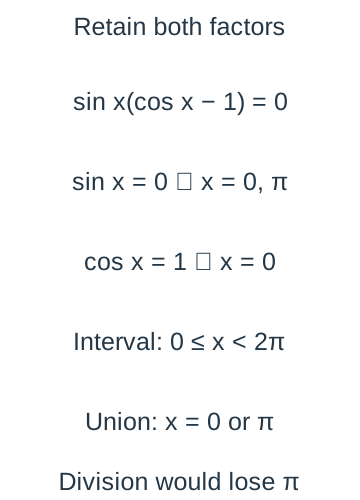
Avoiding lost solutions — For sin x cos x = sin x, factor to sin x(cos x − 1) = 0. On 0 ≤ x < 2π, solutions are 0 and π; the cosine-one branch adds no new angle beyond zero. Dividing by sin x at the start would lose the legitimate solution π and is not justified without handling sine-zero cases.On [0,2π), the sine-zero branch supplies 0 and π; the cosine-one branch supplies only 0, already counted. Their union is {0,π}. Unconditional division by sine removes a branch and misses π. The diagram lists solution branches rather than treating both conditions as simultaneous requirements.
Avoiding introduced solutions — Squaring cos x = 1/2 yields cos²x = 1/4, which also allows cosine −1/2. On a full degree cycle the original solutions are 60° and 300°, while 120° and 240° belong only to the squared equation. Check in the original after a potentially non-equivalent transformation.
Compound identity proof — To prove cos x cos 2x + sin x sin 2x = cos x, recognise the left side as cos(x − 2x) = cos(−x) = cos x. The subtraction formula and even cosine symmetry justify every step for all real x. A few substituted angles would not establish the identity over that full domain.
Context and complete answers — In a motion, force or periodic model, state the angle or time units, transform the interval through any multiplier or phase, retain every permitted solution and interpret each physically. Check denominator exclusions and the original equation, remove duplicate endpoints and give exact values or justified rounding as requested. A principal inverse value alone is not a complete interval solution.
Test yourself
50 questions · Random sets of 10. These quick checks support revision; practise longer explanations and justified judgements too.
 Mr Kidman's Classroom