Momentum-change law — For a constant-mass body, F = ma = mΔv/Δt for a constant or interval-average resultant. Rearranging gives impulse FavgΔt = Δp. Impulse is a vector in N s, equivalent to kg m s⁻¹. For variable forces use the signed area under the resultant force-time graph, not an arbitrarily selected peak force multiplied by the whole duration.
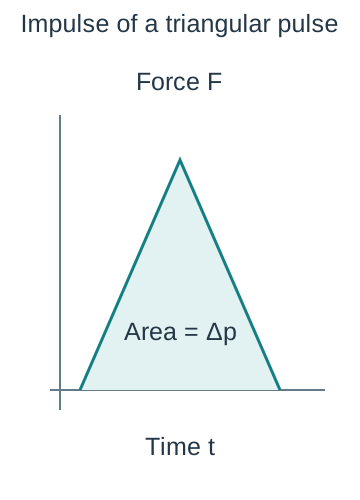
Force-time area — A triangular force pulse with base duration 0.020 s and peak 60 N has impulse ½ × 0.020 × 60 = 0.60 N s. A rectangular approximation using the peak throughout would give twice this value. Integrating or estimating strips from a sampled trace represents the actual time-varying interaction more faithfully.The triangular force pulse has impulse equal to its shaded area, half the base duration times peak force for this shape. It is a schematic trace, not a claim that every collision pulse is triangular.
Reversal and signs — A 0.15 kg ball changes velocity from +8.0 to −6.0 m s⁻¹. Its change in momentum is 0.15(−6.0 − 8.0) = −2.1 kg m s⁻¹. If contact lasts 0.010 s, average resultant is −210 N. Subtract velocities as signed vectors; subtracting speed magnitudes gives the wrong impulse for a rebound.
Reducing peak forces — For a specified momentum change, a longer stopping interval lowers the magnitude of average force. Padding and controlled deformation can extend this interval, but the actual peak depends on the pulse shape. Conservation of momentum alone cannot determine that peak or prove every cushioning design safe.
CP9 measurements — Use a force sensor or suitable force-time measurement for an interaction and light gates or calibrated video to measure velocities before and after. Record mass, synchronize the timing and define the positive direction. Calculate Δp independently of the force trace so the comparison genuinely tests their relation.
CP9 processing and evaluation — Zero the force sensor, choose sampling fast enough to resolve a short impact and subtract a justified baseline before estimating signed area. Compare force-time impulse with mass times velocity change using uncertainties. A sensor measuring only the contact force needs other relevant impulses included or justified negligible; do not confuse one force with the resultant.
Two-dimensional collisions and kinetic energy
Vector conservation in a plane — For negligible external impulse, conserve momentum independently along two fixed perpendicular axes. Resolve all incoming and outgoing velocities with their correct angles and signs. Conserving total scalar speed or adding momentum magnitudes ignores direction and does not determine a two-dimensional collision correctly.
Planar collision example — Two equal masses have initial velocities (3,0) m s⁻¹ and (0,0). If one leaves at (1,1) m s⁻¹, the other must have (2,−1) m s⁻¹ by component conservation. Their final speed squares are 2 and 5, compared with initial 9; kinetic energy falls to 7/9 of its original value, so this isolated example is inelastic.For equal masses, common-scale velocity arrows illustrate the component conservation example. The outgoing vectors one-one and two-minus-one add to three-zero. The construction displays vector sum rather than a spatial trace through the collision.
Elastic and inelastic — An elastic collision conserves total kinetic energy as well as total momentum for an isolated system. In an inelastic collision kinetic energy changes into other energy forms, while total energy remains conserved. Perfectly inelastic means bodies stick with a common velocity; some inelastic collisions still leave them separate.
Energy comparison — Calculate total ½mv² separately before and after using actual velocity magnitudes. Compare with measurement uncertainty before classifying a near-elastic result. A momentum-consistent set of vectors can require an increase in kinetic energy; that would need a source such as stored internal energy and cannot be called a passive elastic collision.
Momentum-energy relation — For nonrelativistic motion, p = mv and Ek = ½mv² give Ek = p²/(2m), where p is momentum magnitude. This scalar energy depends on the square of a vector's magnitude and cannot be calculated by merely squaring one component unless all other components are zero. The expression is not valid at relativistic speeds.
Fixed-energy comparisons — At fixed Ek, p = √(2mEk), so a larger mass has greater momentum but lower speed. At fixed momentum, Ek = p²/(2m) is smaller for a larger mass. State what remains fixed before deciding which quantity increases; these comparisons have different premises.
CP10 recording tracks — Record small-sphere collisions with a camera viewing as nearly perpendicular to the plane as possible. Include a length scale in that plane and establish frame rate. Determine centres over several frames well before and after contact; short finite differences estimate average velocities over those selected windows.
CP10 planar processing — Map displacement vectors into a common x-y coordinate system, divide by the frame intervals and multiply by measured masses. Compare total momentum components and total kinetic energies before and after. Calibrate perspective or restrict the field so a single scale is valid; a ruler in a different plane can distort speed estimates.
CP10 limitations and safety — Keep spheres contained so they do not fall or become floor hazards, and use the approved slow tabletop arrangement. Rolling spheres also store rotational kinetic energy; a translational-only analysis can appear inelastic when rotation changes. Friction, camera parallax, uncertain centre positions and selecting frames during contact are separate limitations to evaluate.
Angular motion and centripetal acceleration
Radian measure — An angle θ in radians equals arc length s divided by radius r, so θ = s/r. One complete turn is 2π radians or 360°. Use radians in s = rθ and angular-speed equations; a dimensionless angle still needs its stated convention.
Angular velocity and period — Angular speed ω is angular displacement per unit time for uniform circular motion. In one period T it changes by 2π, giving ω = 2π/T = 2πf. A point at radius r travels circumference 2πr in the same time, so tangential speed v = rω.
Constant speed changing velocity — In uniform circular motion the speed is constant but the velocity direction changes continuously. The acceleration is perpendicular to velocity and directed towards the centre. It is not evidence of a growing speed; after release, without other forces, the body travels along the tangent rather than continuing around the circle.
Velocity-vector derivation — Over a short turn Δθ, two equal velocity vectors form an isosceles triangle. Its change magnitude approaches vΔθ as Δθ becomes small, directed towards the centre at the interval midpoint. Dividing by Δt gives a = vω = v²/r = rω². This explains the inward direction rather than treating it as an extra unexplained force.At the top of a circle, velocity is tangent to the right while acceleration points down towards the centre. The arrows are kinematic vectors, not an additional force diagram, and their lengths are not comparable physical units.
Circular calculation — For r = 0.80 m and period T = 2.0 s, ω = π rad s⁻¹, v = 0.80π = 2.51 m s⁻¹ and a = 0.80π² = 7.90 m s⁻². Units and numerical factors matter: using f in place of ω misses a factor 2π in speed and 4π² in acceleration.
Resultant forces in circular motion
Centripetal resultant — Centripetal force names the inward resultant required for circular motion: Fnet,radial = mv²/r = mrω². It is provided by real forces such as tension, friction or gravity; do not draw it as an additional interaction alongside those forces. Resolve actual forces along the inward radial direction before equating their sum to ma.
Horizontal circle examples — For a particle on a smooth horizontal table attached to a taut horizontal string, tension provides the inward resultant and weight balances normal reaction vertically. For a car on a level circular path, static tyre friction can supply the radial force. The required friction rises with speed squared; availability depends on the road and tyres.
Vertical circle at top — For a body on a light string at the top of a vertical circle, inward is downward, so tension + mg = mv²/r. Since a string cannot push, tension must be nonnegative; the limiting taut condition gives v² = gr. Below that limiting top speed the assumed complete taut circle cannot continue as modelled.
Vertical circle at bottom — At the bottom, inward is upward, so tension − mg = mv²/r. Tension is therefore larger than the required radial resultant. If speed changes with height, use energy conservation with any losses to connect speeds; uniform speed cannot simply be assumed when gravity does work and no drive maintains it.
Force and work — A purely radial force does no instantaneous work on tangential motion because force and velocity are perpendicular. It changes momentum direction without changing kinetic energy. Gravity in a vertical circle generally also has a tangential component away from top and bottom, so it can change speed there.
Scaling and model choices — At fixed radius, doubling speed quadruples required radial resultant. At fixed angular speed, increasing radius increases that resultant; at fixed tangential speed it decreases it. Distinguish the controlled quantity and verify that the actual force can supply the proposed path before trusting the circular equation.
Circular investigation — A rotating mass experiment can test force against speed squared at fixed radius and mass, with appropriate guarding and a secure rotating system. Measure the period over many turns and use v = 2πr/T. Tension measurement, radius definition and changing speed affect the result; practical safety requires the supervised apparatus, not improvised high-speed rotation.
Test yourself
50 questions · Random sets of 10. These quick checks support revision; practise longer explanations and justified judgements too.
 Mr Kidman's Classroom