Gravitational field — A gravitational field is a region where a mass experiences gravitational force. Field strength g = F/m is force per unit test mass, with units N kg⁻¹ equal to m s⁻². It is a vector directed towards an attracting source. The test mass probes the field; its presence is not required for the source's field to exist.
Universal gravitation — For point masses or suitable spherical mass distributions outside their surfaces, F = GMm/r², attractive along their joining line. Here r is centre-to-centre separation, not height above the surface. G is a universal constant in this model, unlike local g which varies with location and source mass.
Field derivation — Dividing GMm/r² by test mass m gives g = GM/r². The test object's mass cancels, explaining equal free-fall acceleration at the same location when nongravitational effects are negligible. A heavier body still experiences a larger gravitational force; equal acceleration does not imply equal weights.
Radial geometry — Field lines point inward and get less dense farther out, representing declining magnitude. Outside an isolated spherical source the magnitude follows an inverse square. This formula cannot be extrapolated to r = 0 inside an extended planet: the enclosed mass and distribution become relevant there.
Surface and altitude — For a spherical planet of radius R, gsurface = GM/R² and g at height h is GM/(R + h)². At h = R, the distance to the centre doubles and field is one quarter of its surface value. Using h as the denominator would give an unphysical divergence at the surface.
Field calculation — Take illustrative planet mass 6.0 × 10²⁴ kg, radius 6.4 × 10⁶ m and G = 6.67 × 10⁻¹¹ N m² kg⁻². Surface g = 9.77 N kg⁻¹ and a 70 kg body's weight is about 684 N. State the chosen approximate values rather than imply all planetary surface locations have precisely this field.
Several sources — Add gravitational field contributions as vectors. Between two positive masses, fields point towards their respective sources and may cancel at a point nearer the smaller mass. Outside both along the same line they reinforce. A zero resultant field can coexist with nonzero gravitational potential.
Gravitational potential and energy
Potential definition — Gravitational potential Vgrav is potential energy per unit mass, in J kg⁻¹. Choose zero at infinity for an isolated point or spherical source; then Vgrav = −GM/r. It is a scalar and is negative at finite distance because positive work is needed to remove a mass to infinity quasistatically, meaning slowly enough that changes in kinetic energy can be neglected.
Potential energy — An object of test mass m has U = mVgrav = −GMm/r. Changing m scales energy but not the source potential itself. Moving from r₁ to a larger r₂ increases potential energy by GMm(1/r₁ − 1/r₂), a positive value. Potential and field strength have different units and different radial dependence.
Field and gradient — The radial field component is the negative potential gradient. With radius increasing outward and V = −GM/r, dV/dr is positive, so gr = −GM/r² is inward. A field-strength magnitude plot is positive and falls as 1/r²; a signed outward-component plot is negative. Label which one is shown.The schematic potential is negative relative to zero at infinite distance and rises towards zero as radius increases. A separate horizontal zero reference lies above the curve. Its negative radial gradient corresponds to an inward field component.
Potential calculation — With GM = 4.0 × 10¹⁴ m³ s⁻², potential at r = 8.0 × 10⁶ m is −5.0 × 10⁷ J kg⁻¹. At r = 1.6 × 10⁷ m it is −2.5 × 10⁷ J kg⁻¹. A 100 kg object raised between these radii gains 2.5 × 10⁹ J of gravitational potential energy, ignoring other transfers.
Near-surface approximation — For a height change small compared with planet radius, ΔU ≈ mgΔh using nearly constant g. For large radial changes use the difference in −GMm/r instead. The approximation is about an energy difference, not a claim that global potential with zero at infinity equals gh at all heights.
Equipotentials and work — An isolated spherical source has concentric spherical equipotentials, perpendicular to radial field lines. Moving along one changes no gravitational potential energy. Moving outward crosses to less negative potential and requires positive external work if speed is unchanged. Equal radial spacing does not mean equal potential changes.
Escape reasoning — For ideal escape with zero final speed at infinity, total mechanical energy starts at zero, so ½mvesc² − GMm/r = 0 and vesc = √(2GM/r). This derivation assumes no propulsion after launch, no drag and an isolated source. A real launch can use propulsion and interactions, so the simple speed is a model condition, not a universal flight instruction.
Electric comparison — Both isolated point-source fields obey inverse-square magnitude laws and potentials proportional to 1/r. Gravity acts on mass and is attractive in this model; electric forces act on signed charge and can attract or repel. Gravitational potential with zero at infinity is negative for a positive source mass; electric potential can have either sign. Field vectors and scalar potentials must be combined differently in both cases.
Orbital dynamics and energy
Circular orbit derivation — For a small satellite in a circular orbit around a much more massive spherical source, gravity provides the centripetal resultant: GMm/r² = mv²/r. Therefore v = √(GM/r). Orbit radius is centre-to-centre distance. Do not add a second force called centripetal to the actual gravitational force.A satellite at the top of a circular path has rightward tangential velocity and downward gravitational force towards the centre. Gravity itself supplies the required centripetal resultant; there is no extra radial interaction.
Period-radius law — Using v = 2πr/T gives T² = 4π²r³/(GM). Thus T² plotted against r³ is linear through the ideal origin for satellites of the same dominant source. The satellite mass cancels under the small-satellite approximation; changing central mass changes the relation.
Orbit example — For GM = 4.0 × 10¹⁴ m³ s⁻² and radius 1.0 × 10⁷ m, v = √(4.0 × 10⁷) = 6.32 × 10³ m s⁻¹. Period is 2πr/v = 9.93 × 10³ s. The altitude requires subtracting planet radius; the given r is not automatically height above ground.
Weightlessness in orbit — A freely orbiting astronaut and spacecraft accelerate together under gravity. Their mutual support force can be near zero, producing apparent weightlessness, even though gravitational force remains substantial. Orbit is continuous free fall with transverse motion, not a region where gravity is absent.
Geostationary requirements — A geostationary orbit must be circular, in the equatorial plane and travel in the same rotational sense as Earth with period equal to its sidereal rotation, the time for one rotation relative to distant stars, approximately 23 h 56 min. Matching a roughly daily period alone is insufficient for appearing fixed above one surface longitude. Such an orbit exists at a particular centre radius for Earth's GM.
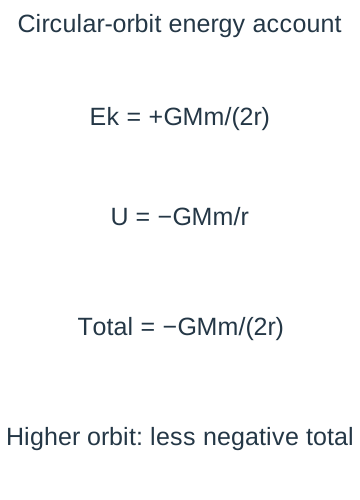
Orbit energies — For a circular orbit, Ek = GMm/(2r) and U = −GMm/r, so total mechanical energy Etotal = −GMm/(2r). The orbit is bound because total energy is negative relative to separated rest at infinity. A higher circular orbit has less kinetic energy but greater total energy because its potential energy rises by more.The circular-orbit kinetic energy is positive and half the magnitude of negative gravitational potential energy. Their sum is negative for this bound circular orbit, becoming less negative as radius increases for fixed source and satellite masses.
Changing circular orbits — To move from one circular orbit to a larger one requires an overall energy input despite the lower final orbital speed. A real transfer involves intermediate motion and burns or other interactions; comparing the endpoint energies does not specify the trajectory or total propellant. Do not infer that slowing an orbiting body alone instantly places it on a higher circular path.
Elliptical motion and model limits — In an unpowered noncircular orbit, speed varies as energy shifts between kinetic and gravitational potential forms, usually faster near the source. The circular v = √(GM/r) is not the instantaneous speed formula for every ellipse. Significant other bodies, atmospheric drag or a nonspherical field require additional modelling and can alter orbital energy or direction.
Test yourself
50 questions · Random sets of 10. These quick checks support revision; practise longer explanations and justified judgements too.
 Mr Kidman's Classroom