Source and received power — Luminosity L is total radiated power in watts; received intensity I is power per unit receiving area in W m⁻². A faint-looking source may be intrinsically dim or simply distant. Comparing apparent brightness alone cannot distinguish those possibilities without distance information or a justified luminosity model.
Inverse-square derivation — For an isotropic source with negligible absorption, total luminosity crosses a sphere of radius d and area 4πd², so I = L/(4πd²). The same total energy per second is spread over a larger area. Distance is from the source, and the receiving area is normal to propagation; obscuration or directional emission changes the assumptions.
Intensity calculation — An illustrative source of L = 4.0 × 10²⁶ W at d = 2.0 × 10¹¹ m gives I = 4.0 × 10²⁶/[4π(2.0 × 10¹¹)²] = 796 W m⁻². Doubling distance reduces I by four while leaving the source's L unchanged. Use metres if substituting luminosity in watts for SI intensity.
Parallax geometry — Observe a nearby star against distant background stars from opposite points in Earth's orbit. The total apparent shift is 2p, where parallax angle p is the half-angle corresponding to a baseline of one astronomical unit (AU), approximately the mean Earth–Sun distance. For small p in radians, d ≈ 1 AU/p. Confusing p with the full shift gives a factor-two distance error.Opposite Earth-orbit viewpoints give total angular shift twice the conventional parallax p. The half-baseline is one astronomical unit. The triangle is grossly enlarged for visibility and is not a scale drawing of stellar distance.
Angular units and parsec — There are 3600 arcseconds in a degree and π/180 radians in a degree. A parsec is the distance with parallax p = 1 arcsecond for a one-AU baseline, about 3.09 × 10¹⁶ m. Thus d in parsecs is 1/p when p is in arcseconds. This convention differs from using an arbitrary observer separation with the same number.
Parallax uncertainty — At p = 0.050 arcseconds, d = 20 pc. If the small-angle p estimate has 10% relative uncertainty, d has approximately 10% by the reciprocal rule. More distant stars have smaller angular shifts and larger relative effect from a fixed angular error; proper motion, the star's own apparent movement across the sky rather than the annual viewing shift, and observation geometry also need separating from annual parallax.
Standard candles — A standard candle is a source whose luminosity is known or inferred from a calibrated relation. Combining with measured intensity gives d = √[L/(4πI)]. It is not enough for two sources merely to look similar. Calibration, variability, absorption and whether the source actually belongs to the chosen class limit the distance estimate.
Distance comparison and bias — Two equal-luminosity candles with intensities in ratio 9:1 are at distances in ratio 1:3 under inverse-square assumptions. Uncorrected intervening absorption makes a candle appear fainter and can make its inferred distance too large. Quote an approximate distance with calibration and intensity uncertainty rather than imply perfect cosmic rulers.
Hertzsprung-Russell diagram and stellar evolution
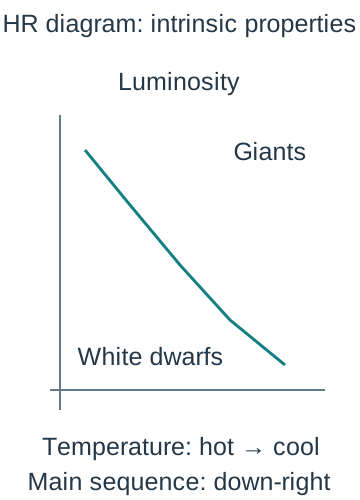
HR axes — A simple Hertzsprung-Russell diagram plots luminosity vertically and surface temperature horizontally, usually with temperature decreasing to the right. Both scales often span many powers of ten. Locate a star using its intrinsic luminosity and inferred temperature, not apparent brightness alone; temperature ordering is deliberately opposite many ordinary increasing horizontal axes.The HR schematic has luminosity upward and temperature decreasing rightward. Main sequence slopes from hot luminous upper left to cool dim lower right; giant and white-dwarf regions contrast large versus small radiating area. These are property coordinates rather than a galaxy map.
Main sequence — Main-sequence stars form a diagonal band from cool lower-luminosity stars at the lower right to hot high-luminosity stars at the upper left. Their stable energy source is core hydrogen fusion. A star's position is linked to its properties and stage, not a literal spatial location within the galaxy.
Giants and white dwarfs — Red giants are cool yet luminous because of large radiating surface area; white dwarfs are hot yet relatively faint because they are small. Use L = 4πR²σT⁴ to justify radius comparisons. Colour alone does not determine luminosity; a cool giant can outshine a hotter small star.
Star formation and balance — A cloud can contract under gravity, warming as gravitational energy changes form. A protostar becomes a main-sequence star when core conditions sustain hydrogen fusion and the star approaches a supported energy balance. Gravity's inward tendency is balanced by pressure gradients; fusion supplies energy that maintains the hot interior rather than a simple outward beam force replacing pressure.
Lower-mass evolution — After core hydrogen exhaustion, a Sun-like star can develop shell burning, expand to a red giant and later eject its outer layers, leaving a white dwarf. The white dwarf has no sustained core fusion source and cools over time. Avoid assigning one exact path or lifetime to every star without specifying mass and composition.Broad illustrative lower-mass and higher-mass evolution routes diverge after main-sequence fusion. The collapsed massive-star remnant depends on the event and core; the schematic does not assign a single universal endpoint or detailed timescale.
High-mass evolution — A sufficiently massive star can pass through supergiant stages, form heavier nuclei and undergo core collapse and a supernova. The remnant can be a neutron star or black hole depending on the core and event. The HR path is an evolution of luminosity and temperature, not the star physically travelling along a drawn diagonal through space.
Evolution evidence — Stellar populations and spectra, nuclear models and the distribution of stars on HR diagrams support the broad sequence. Individual long evolutionary histories are inferred from evidence and models rather than observed end to end over a human lifetime. Compare predictions with independently measured temperatures, luminosities and cluster properties and retain the model's limitations.
Doppler effect redshift and expansion
Doppler reasoning — Motion of a wave source relative to an observer changes the rate at which wavefronts arrive. An approaching source gives higher observed frequency and shorter wavelength; a receding source gives lower frequency and longer wavelength. The emitted source frequency need not change. For light in vacuum, the propagation speed remains c rather than adding the source's speed classically.
Spectral redshift — Identify a pattern of known spectral lines and compare observed wavelength λobs with rest wavelength λrest. Redshift z = (λobs − λrest)/λrest. A line shifted from 500 nm to 510 nm gives z = 0.020. Use the rest value as denominator, not the observed one; multiple lines help confirm the identification.
Frequency sign — For redshift, observed frequency is lower, so a positive fractional frequency reduction can be defined (frest − fobs)/frest. At small z this is approximately z, but the exact wavelength definition gives frest/fobs = 1 + z. Do not write a positive Δf/f without identifying which difference and denominator are meant.
Low-speed inference — For radial recession much slower than light, z ≈ v/c, so z = 0.020 gives v ≈ 6.0 × 10⁶ m s⁻¹ using c = 3.0 × 10⁸ m s⁻¹. This approximation is unsuitable for arbitrarily large z. Cosmological redshift reflects expansion of space in the model; nearby peculiar motions, motions relative to the general cosmic expansion, can also shift lines and complicate a pure Hubble-flow interpretation.
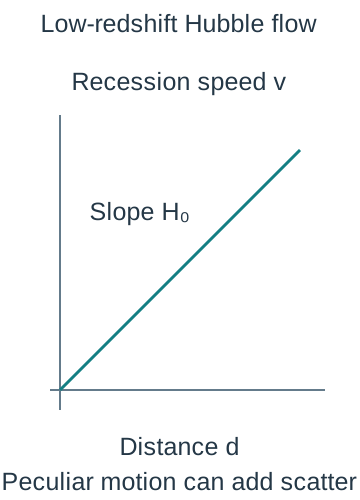
Hubble relation — For suitable cosmological distances in the low-redshift regime, recession speed is approximately v = H₀d. A straight v-d graph has gradient H₀. This empirical relation supports an expanding universe model; it does not locate our galaxy at a unique centre of expansion. Every observer moving with an ideal homogeneous expansion sees the same pattern of distant recession.The schematic recession-speed versus distance line has gradient Hubble constant in the applicable flow regime. Real data need distance calibration, redshift interpretation and peculiar-motion uncertainties; no measured present value is asserted here.
Hubble units — A quoted illustrative H₀ = 70 km s⁻¹ Mpc⁻¹ means 70000 m s⁻¹ per 3.086 × 10²² m, or 2.27 × 10⁻¹⁸ s⁻¹. For d = 100 Mpc it predicts 7000 km s⁻¹ in that model. This is a worked assumed value, not a claim that a particular disputed measurement has been settled.
Age fate and unseen matter
Expansion age estimate — If expansion speed had stayed constant in a simple model, an age scale is t ≈ d/v = 1/H₀. For the illustrative H₀ above this is 4.41 × 10¹⁷ s, about 14.0 billion years using 3.156 × 10⁷ s per year. Actual expansion history can accelerate or decelerate, so the reciprocal alone is not an exact universal age formula.
Hubble uncertainty and evidence — Distance-ladder calibration, source identification, absorption and peculiar velocities affect inferred H₀. Different methods probe expansion with different assumptions and uncertainties. A larger assumed H₀ gives a smaller reciprocal age scale, but disagreement must be evaluated through evidence rather than selecting whichever estimate suits a preferred outcome.
Dark matter evidence — Some gravitational observations, including galaxy rotation and gravitational lensing, imply more gravitating matter than ordinary luminous material accounts for within the model. Dark matter names this inferred nonluminous matter component; it is not simply a label for every faint star or the same thing as dark energy. Its detailed nature is not established by a rotation graph alone.
Density and fate models — In simple matter-dominated expansion models, gravity slows expansion and sufficient density can lead to recollapse, while lower density can allow continued expansion. This comparison depends on the assumed contents and dynamics. It is misleading to claim that a single dark-matter measurement by itself settles the fate of every possible universe model.
Accelerated expansion and judgement — Evidence for accelerated cosmic expansion motivates a dark-energy term or related model development, distinct from the gravitating dark matter used in galaxy models. Age and ultimate fate depend on the full expansion history and assumptions about these components. Distinguish observed evidence from extrapolation far into the future and avoid presenting an uncertain physical identity as directly observed fact.
Test yourself
50 questions · Random sets of 10. These quick checks support revision; practise longer explanations and justified judgements too.
 Mr Kidman's Classroom