Anarchism and order — Anarchism challenges the claim that a government has a rightful standing power to command everyone within a territory. Its positive problem is how people can organise a society through voluntary relationships rather than permanent rulers. Anarchy in this political sense does not mean that cooperation, rules, responsibility or disagreement disappear; the dispute concerns how arrangements are justified and whether anyone may impose them.
Autonomy of the individual — Autonomy means directing one's own life through judgment and choice rather than simply obeying another will. Anarchists ask whether an institution permits meaningful consent, dissent and departure. A workplace may formally allow resignation yet offer very poor alternatives; whether that is genuine freedom is a major disagreement between individualist and collectivist approaches, not a question settled by the word voluntary.
Coercive relationships — Coercion restricts choice through force or threats. Anarchist critiques extend from state punishment to economic dependence, patriarchal authority and social discipline, although thinkers emphasise these differently. Persuasion and freely accepted cooperation differ from an imposed command, but informal group pressure can also become coercive. Removing government alone therefore need not remove every dominating relationship.
The state as a special problem — The state claims the right to make binding rules and enforce them even against dissenters. Anarchists question why residence, inherited nationality or a majority vote establishes everyone's consent. A democratic state can be more accountable than a dictatorship yet still compel the minority. This challenges the justification of political authority rather than claiming that all regimes impose identical harms.
Authority and expertise — Accepting a doctor's advice for a particular problem need not give the doctor a permanent right to rule one's life. Anarchists can distinguish knowledge that people freely consult from hierarchical authority backed by compulsory obedience. Critics ask whether genuinely voluntary expertise remains possible where information, education and bargaining power are unequal.
Human nature and conditions — Collectivist arguments emphasise sociability and capacities developed through cooperation; Stirner begins from the particular individual and rejects a fixed ideal of humanity as a higher master. Neither position is adequately represented by saying that everyone will automatically become kind once government ends. Evaluate whether the proposed institutions can manage persistent disagreement, self-interest and unequal power.
Society without government — Social life comprises relationships and shared activity; it is not identical to a state bureaucracy. Voluntary associations might organise production, learning and care, while federations coordinate matters crossing local boundaries. These proposals need mechanisms for resolving disputes and meeting needs, so a serious assessment asks who decides, whose voice counts and what happens when an agreement fails.
Evaluating the anti-state argument — Supporters argue that government reproduces dependence and protects powerful interests; critics argue that common enforceable rules can protect vulnerable people against private domination. Compare the actual alternative with the actual state rather than an ideal voluntary society with only the worst government. The central test is whether abolishing political hierarchy reduces coercion overall or allows new rulers to emerge.
Stirner and individualist anarchism
The unique individual — Max Stirner refuses to subordinate the living individual to supposedly sacred abstractions such as the nation, humanity or the state. His egoism concerns the individual's own purposes and relationships rather than service to an impersonal ideal. It should not be confused with a scientific claim that every action is secretly selfish or with Rand's theory of objectively correct rational interests.
Ownness and freedom — A person may obtain a legal permission yet continue to organise life around duties treated as unquestionable. Stirner's ownness emphasises making one's capacities and commitments one's own rather than waiting for freedom to be granted by an external authority. This challenges inner submission as well as police power; the absence of a particular ban does not settle the wider issue of self-direction.
The state and obedience — For Stirner, even a people's state demands that individuals serve an authority standing above them. Replacing a monarch with an abstract collective does not remove that demand. His criticism therefore reaches democratic and socialist states as well as hereditary government, raising a difficult question about whether collective decisions can ever bind a continuing dissenter.
Property without sacred title — Stirner rejects the idea that property is a sacred natural or state-given right which everyone must revere. What is one's own is connected with one's actual capacity to appropriate, use and maintain it. This is a radical challenge to legal title, not a conventional defence of a minimal state enforcing absolute property rights; critics ask how vulnerable individuals would resist the power of stronger possessors.
Union of egoists — Stirner's association is sustained by participants finding it useful to their own lives rather than by an unconditional duty to a corporate body. Cooperation, affection and shared projects remain possible. The key distinction is that the association must remain the participants' activity, instead of hardening into a superior institution demanding sacrifice regardless of their continuing purposes.
Individualism and its limits — An individualist can argue that a community which commands self-sacrifice recreates the problem it claims to abolish. A collectivist replies that effective agency depends on shared resources and protection from economic domination. Evaluate both the freedom to leave and the practical ability to live outside an association; formal exit without viable alternatives may offer little protection.
Bakunin, collectivism and syndicalism
Social freedom — Mikhail Bakunin treats freedom as something realised among other free people, through social cooperation and equality. If access to land, work and education depends on subordination to owners or officials, legal liberty can be hollow. This joins opposition to the state with opposition to capitalist class domination instead of treating those issues as unrelated.
Collective ownership and distribution — Bakunin's collectivist tradition advocates common control of the means of production by organised workers rather than a central state owning everything. It is commonly distinguished from anarchist communism by remuneration, or payment, linked to labour contributed. Collective ownership, labour-based reward and distribution according to need are different questions; a shared rejection of capitalism does not establish agreement on every allocation rule.
Revolution and the new ruling class — Bakunin rejects capturing the state as a secure route to emancipation. A revolutionary minority administering society could acquire interests and privileges of its own, even while claiming to represent workers. This is an argument about institutions and incentives: changing the rulers' class language does not ensure that the ruled retain control.
Organisation from below — Workers' associations and local communes can link through federation, with decisions rooted in their members rather than an independent ruling centre. Delegation can coordinate large projects, but delegates must remain answerable instead of accumulating permanent authority. The practical challenge is to combine dependable cooperation with meaningful local control and the right to disagree.
Syndicalism and workplace power — Syndicalism centres workers' industrial organisation and direct collective action. Unions can defend conditions and develop workers' capacity to manage production; a general strike is conceived as challenging the existing economic order. Bakunin's emphasis on workers' associations helped influence later anarcho-syndicalism. Do not treat every trade union or ordinary wage strike as an anarchist revolutionary project.
Direct action and assessment — Direct action seeks change through participants' own activity rather than relying solely on representatives taking office. It can include collective refusal, organising and peaceful workplace action; it is not a synonym for violence. Evaluate who can participate, whether excluded groups are heard and whether collective action builds durable democratic control or concentrates power in an activist minority.
Kropotkin, mutual aid and anarchist communism
Mutual aid — Peter Kropotkin argues that mutually beneficial cooperation is an important factor in survival and social development. His claim challenges a picture of nature and society as nothing but isolated competition. It does not mean that conflict never occurs or that every cooperative act is disinterested charity; repeated support can benefit participants and strengthen their common capacities.
Social institutions and human potential — Customs and institutions can cultivate cooperation or undermine it through imposed hierarchy and economic insecurity. Kropotkin uses historical and natural examples to support the possibility of cooperation without a commanding state. Such examples establish capacities and counterexamples to universal selfishness; they do not by themselves prove that every complex modern service can be organised successfully in the same way.
Anarchist communism — Kropotkin advocates common access to productive resources and distribution according to need, without a central coercive state. Accumulated wealth depends on generations of interconnected work, making a precise individual entitlement to every product difficult to establish. Communism here describes common provision and need, not the rule of a single party or a government ministry directing every decision.
Why reject wages for each contribution? — If production relies on inherited knowledge, shared infrastructure, care and interconnected labour, identifying one person's isolated share can be arbitrary. A labour-based wage may also disadvantage people unable to perform the same work. Kropotkin's alternative prioritises meeting needs; critics ask how contributions, demanding work and scarce goods will be organised without recreating coercion.
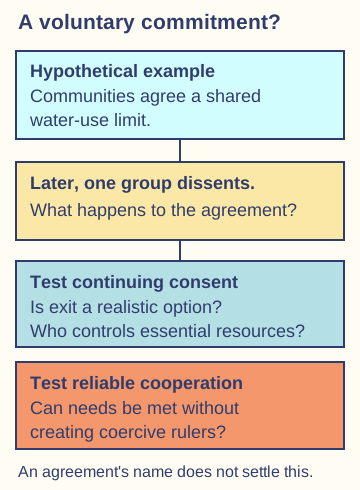
Voluntary coordination — Free agreement and decentralised associations are intended to coordinate production and provision. Imagine several communities jointly organising water supply: they would still need reliable commitments, information and ways to handle shortages. The hypothetical illustrates the institutional problem rather than proving that an agreement either must fail or automatically succeeds because its participants reject government.
Evaluating mutual aid — Supporters argue that competition-centred institutions hide existing cooperative capacities and that economic security can enable participation. Critics point to free riding, receiving shared benefits while avoiding a fair contribution, disagreement over needs and large projects requiring commitments over time. A developed judgment tests mechanisms such as reciprocity and transparent decisions against both state and private alternatives rather than merely asserting that people are good or bad.
Proudhon, property and workers' associations
Order without rulers — Pierre-Joseph Proudhon's anarchism rejects the identification of social order with a commanding political power. Agreements among self-managing producers can coordinate activity without a sovereign standing above them. Order therefore means an intelligible pattern of reciprocal relationships, not compulsory obedience to one centre or the disappearance of all organisation.
Property and possession — Proudhon attacks ownership that permits an owner to extract income or control others' labour merely through title. Distinguish that critique of exploitative property from a blanket claim that nobody may use a home or work with tools. Possession and use can support independence; the important question is which ownership relation permits domination and how an alternative distributes control.
Mutualism — Mutualism proposes reciprocal exchange, in which parties provide something to one another, and cooperation among independent producers and associations, with arrangements for credit that do not subordinate them to privileged owners. It differs from both capitalist accumulation through ownership and Kropotkin's communist distribution according to need. Describing all non-state economics as one free market hides these disagreements about property, exchange and entitlement.
Workers' associations and cooperatives — Where production requires combined labour, workers can organise an association and govern their common enterprise. A cooperative changes who exercises control; it is not simply a private firm donating part of its profit. Coordination among associations can preserve shared production without creating a state employer, although difficult questions remain about internal minorities and relations with outsiders.
Federalism and economic plurality — Proudhon's federal approach distributes authority through agreements rather than concentrating it permanently at the centre. Productive associations and smaller producers may cooperate while retaining a measure of independence. Assess how unequal resources affect genuinely reciprocal bargaining and whether commitments remain voluntary when one party controls an essential resource.
Judging Proudhon's alternative — Mutualism offers a route between isolated possessors and central state ownership, but critics ask whether exchange reproduces inequality and dependence. Communist anarchists question continued individual accounting; individualists question collective claims over participants. Accurate comparison identifies the particular property relationship and decision rule instead of treating Proudhon as identical to either Stirner or Kropotkin.
Goldman, emancipation and revolutionary means
Freedom and self-expression — Emma Goldman links emancipation with developing individuality, creativity and freely chosen relationships. Political change which leaves people governed by oppressive moral expectations, economic dependence or patriarchal control is inadequate. Her account therefore joins social transformation with personal self-expression rather than reducing liberation to a new constitution or income arrangement.
Religion, patriarchy and intimate life — Goldman criticises institutions and conventions that demand obedience and constrain women's independence. A formal legal right may coexist with dependence within work or personal relationships. Her argument extends anarchist opposition to coercion into everyday life; it does not assume that replacing one law instantly changes social expectations or makes every relationship equal.
Economic and personal emancipation — Economic independence can widen choices, but paid work alone need not remove exploitation or conventional expectations. Equally, private self-expression without changing material domination can leave many people unable to exercise it. This gives a basis for comparing Goldman's simultaneous attention to collective conditions and individual development with more exclusively economic accounts.
The revolutionary violence debate — In The Psychology of Political Violence, Goldman sympathetically presents Alexander Berkman's 1892 attempt on industrialist Henry Clay Frick's life as a response to violence against workers during the Homestead strike. This is her political interpretation of the act, not neutral proof that it was justified or effective. She argues that repression and social suffering can provoke rebellion rather than treating anarchist theory alone as its cause. Her defence illustrates why she cannot simply be classified as rejecting every violent tactic; equally, it does not make violence a sufficient programme for a free society. Distinguish explaining an act, judging its justification and assessing whether it achieved emancipation; criticism can address harm, public reaction and the danger of reproducing coercion.
Means and ends — Violent or authoritarian methods can undermine an emancipatory objective by legitimising coercion, harming others or empowering a new elite. Peaceful methods may also be criticised as ineffective under repression. Analyse necessity, proportionality, consequences and consistency with autonomy rather than assuming that every anarchist accepts the same tactic. This is historical and ethical evaluation, not practical guidance for harm.
Comparing traditions and evaluating a stateless society
Shared opposition, different foundations — All five specified thinkers challenge imposed authority, but their reasons and preferred arrangements differ. Stirner resists a higher collective ideal; Bakunin links freedom to social equality; Kropotkin develops mutual aid and need; Proudhon emphasises reciprocal associations; Goldman connects personal and social emancipation. A shared enemy does not make them interchangeable or eliminate conflicts between the individual and the group.
Economy as a dividing line — Compare whose resources are controlled, how decisions are made and how output is distributed. Stirner's ownness, Proudhon's mutualist exchange, Bakunin's collectivist labour reward and Kropotkin's need-based provision answer different questions. Goldman shares a critique of economic domination but also challenges arrangements which suppress individuality. Avoid reducing the debate to state ownership versus private ownership alone.Shared anti-statism does not imply agreement about property or distribution.
Can rules remain voluntary? — A federation might agree a shared water-use limit, yet a member could later reject it. If the federation enforces the rule, critics see coercive government returning; if it cannot enforce commitments, critics question security and fair provision. Anarchists can reply that voluntary coordination and social dependence need not become a permanent sovereign. Explain what the proposed safeguard actually does and whether meaningful exit exists.A joint commitment raises separate questions about consent, dissent and reliable provision.
Evaluating hierarchy beyond the state — A stateless society might still contain powerful employers, patriarchal families or influential informal leaders. Conversely, a state may restrain some private power while imposing its own commands. Assess political, economic and social coercion together. The fact that an institution calls itself a cooperative or voluntary union is insufficient evidence that its members possess equal practical freedom.
Building a substantiated judgment — For an essay on whether anarchists agree about freedom, organise direct comparisons around autonomy, material conditions and collective obligation, using named thinkers accurately on both sides. For feasibility, test dispute resolution, essential provision, scale and new hierarchies. A conclusion should weigh these criteria and explain the most significant qualification; short quiz success cannot substitute for this extended analysis.
Test yourself
50 questions · Random sets of 10. These quick checks support revision; practise longer explanations and justified judgements too.
 Mr Kidman's Classroom