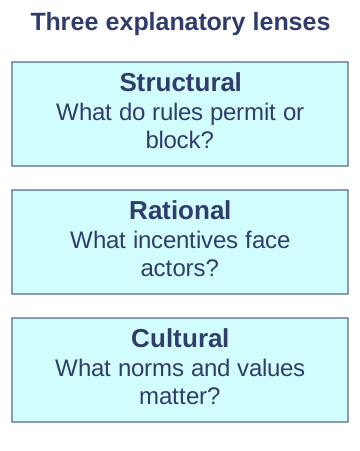
Comparison needs explanation — A comparison identifies a shared issue, explains both systems using matched evidence and accounts for the similarity or difference. Two separate national descriptions do not automatically become comparative analysis. Define the outcome being compared, such as legislative restraint, rights access or the ability to implement a programme, before selecting examples.
Structural approach — A structural explanation asks how institutional rules distribute opportunities, authority and vetoes. Separate executive election, bicameral agreement and federalism can explain some US bargaining constraints; fusion and Commons confidence can explain UK executive advantages. Structure shapes incentives but does not establish that actors always use every available power.
Rational approach — A rational explanation analyses actors pursuing objectives under costs, benefits and strategic expectations. A legislator may resist a party leader because district voters or a primary challenger matter more to re-election. The approach requires plausible goals and information; a claim that actors maximise self-interest is not proof that an observer knows their motives.
Cultural approach — A cultural explanation examines political values, identities, expectations and historical experience. Constitutional reverence, trust, ideas about liberty and attitudes to government can affect acceptance of institutions. Avoid treating national cultures as uniform or permanent: groups disagree, and institutions can shape culture as well as respond to it.
Combining approaches — To explain a restrained executive, identify formal vetoes, actors' incentives to use them and norms governing cooperation. A hostile legislature under separated powers can be a structural setting; electoral incentives explain particular resistance; expectations about oversight affect perceived legitimacy. These are complementary lenses, not labels to attach without causal reasoning.The three approaches ask distinct but complementary causal questions. National stereotypes and labels alone do not explain outcomes.
Evidence and limits — Compare the same policy or function across a defined period, check denominators and distinguish formal authority from actual outcomes. A contrast between one unusually weak Prime Minister and one unusually strong President cannot by itself establish a permanent national rule. Consider alternative explanations, case selection and whether the evidence is representative.
Constitutions, territorial power and legislatures
Different foundations — The UK draws on dispersed constitutional sources and orthodox parliamentary sovereignty; the US uses an entrenched constitutional text as higher law. Both systems contain written rules, court interpretation and political practices. The contrast is therefore uncodified versus codified, not a literate system versus one without written laws.
Amendment and flexibility — Many UK constitutional reforms proceed through ordinary legislation, while US Article V demands supermajorities and state ratification. Flexibility can improve responsiveness but ease executive-led rule changes; entrenchment can protect stability and minorities but preserve an outdated bargain. Evaluate amendment against both the pace and legitimacy of change.
Devolution and federalism — UK devolved powers derive from statutes under Westminster sovereignty, while US states have constitutionally protected positions within a federal system. Political consent and territorial legitimacy constrain UK central action even without a general legal devolved veto. US federal supremacy also means states are not independent sovereign countries free from all national constraints.
Territorial equality — US Senate equality protects states regardless of population; UK devolution recognises differing territorial settlements. Both raise questions about equal citizenship and territorial voice. State or national recognition can be defended against central dominance while criticised for unequal individual influence; explicitly state which kind of equality the argument uses.
Chambers and legitimacy — Both countries have bicameral legislatures, but the US has two elected chambers with largely coequal law-making roles, while the UK has an elected Commons and unelected revising Lords. Commons confidence and financial primacy reinforce its position; Senate appointment and treaty powers give it distinctive strengths without making the House irrelevant.
Legislative initiative — UK governments normally rely on a Commons majority and timetable resources to advance major legislation. US presidents need congressional allies and agreement across separately elected institutions. However, UK rebellions and Lords revision can matter, while unified US party control and bargaining can enable substantial legislation; institutional tendencies are not guaranteed outcomes.
Committee comparison — Congressional committees combine legislation, oversight and information powers in a strongly separated system. UK select committees specialise in departmental scrutiny, while public bill committees examine legislation. Elected UK committee chairs complicate an outdated picture of total whip control; congressional party polarisation also qualifies claims that every US committee acts independently of parties.
Money and representation — Both legislatures can scrutinise spending and represent constituents, but Congress's separate appropriations authority can confront an executive not dependent on confidence. UK governing-party loyalty may reduce the risk of financial defeat. Compare actual oversight and concessions rather than assuming a formal power is always exercised to its maximum.
Executives and accountability
Selection and tenure — A Prime Minister emerges from party leadership and Commons confidence, while a President has a separate Electoral College selection and fixed term. UK party pressure can remove a leader without a national general election; a US midterm defeat does not automatically remove a President. Separate tenure can protect autonomy while reducing immediate legislative removal mechanisms.
Cabinet relationships — UK collective responsibility and ministerial membership of Parliament link cabinet to legislative survival. US cabinet secretaries are appointed executive heads outside Congress, while White House staff and EOP coordinate presidential priorities. Both leaders face resource dependence and may prefer smaller adviser circles, so formal cabinet rules alone do not show actual influence.
Formal powers and usable power — A President possesses a veto and commander-in-chief role, while a Prime Minister often has stronger routine legislative resources through party and timetable control. Greater formal separation may produce more difficulty delivering a domestic programme. Assess initiation, enactment and implementation separately instead of awarding a single permanent power score.
Removal and responsibility — Commons confidence, party leadership pressure and ministerial resignation differ from US House impeachment and Senate conviction. UK collective and individual responsibility are political conventions with variable sanctions; US impeachment is an exceptional constitutional process. Neither should be confused with a court finding criminal guilt.
An analytical comparison — A disciplined Commons majority can allow a UK Prime Minister to enact a domestic programme more readily than a President facing a hostile congressional chamber. The structural difference is fusion versus separation; rational incentives explain why MPs may preserve their government while US legislators cultivate separate bases. Rebellion, factionalism and the policy's popularity qualify the generalisation.
Courts, rights and civil-rights campaigns
Judicial authority — US courts can invalidate unconstitutional statutes under higher constitutional law; UK courts generally cannot invalidate a valid Westminster Act simply for incompatibility with Convention rights. UK courts still exert important influence through interpretation, review of executive action and devolution decisions. Comparing statute remedies must not become the false claim that UK judges have no constitutional power.
Appointments and independence — Both systems seek independent adjudication, but US presidential nomination and Senate confirmation are more overtly partisan than the UK's commission-based processes. US good-behaviour tenure and protected salary support independence; UK security and institutional separation do too. Political selection and independence in later judging are different dimensions rather than mutually exclusive categories.
Rights architecture — US constitutional amendments supply entrenched rights interpreted by courts; UK protection combines statute, common law, parliamentary action and Convention mechanisms. Entrenchment may resist an ordinary hostile legislature but leaves interpretation highly consequential. UK flexibility may allow rights expansion or reduction through legislation, with electoral and international pressures affecting the political cost.
Protection and implementation — Brown and UK equality or rights legislation show that formal protections require administration, resources, litigation and political support. Court access, enforcement and social inequality can limit protection in both systems. A constitutional text and a parliamentary statute are different legal instruments, but neither automatically changes every lived condition.
Campaign comparison — Civil-rights groups in both countries use litigation, lobbying, evidence and mobilisation. US federalism and judicial invalidation create particular venues, while UK parliamentary and executive channels differ. Compare a stated objective, resources, institution, remedy and implementation rather than placing two famous protest photographs side by side and inferring equal effects.
Elections, parties and finance
Election of national leaders — UK electors choose MPs whose Commons balance supports government formation; US presidential selection aggregates electors through states and DC. Both can produce a governing executive without a majority of national popular votes, but through different mechanisms. A Prime Minister's party seat majority is not the same procedure as an Electoral College majority.
Legislative electoral systems — Westminster FPTP and many US congressional plurality contests reward local winners, while UK devolved systems introduce proportional or ranked alternatives. US state variations also qualify a blanket claim of identical rules. Compare constituency scale, districting and electoral geography as well as the broad system label.
Two parties and multiple arenas — US barriers help sustain two-party dominance, while UK smaller parties can have concentrated territorial bases, devolved representation and occasional governing leverage. Both main US parties contain broad factions; UK major parties also contain ideological divisions. Explain the institutional and social incentives rather than claiming the UK is fully proportional or US parties internally homogeneous.
Party unity and incentives — UK MPs may avoid defeating their government, but leadership contests and rebellions show limits to discipline. US legislators have separate electoral incentives, yet ideological sorting and partisan identities can produce cohesive voting. Formal decentralisation and actual parliamentary voting cohesion are not identical measures.
Policy and ideology — Do not equate US Democrats with UK Labour or Republicans with Conservatives simply by placing them on a left-right line. Compare the same issue and date, considering health provision, welfare, markets, rights and national histories. A party may favour intervention in one field and decentralisation in another, making a single label inadequate.
Money rules and debates — Both systems regulate contributions, spending and disclosure, but US independent-expenditure categories and Super PACs differ from UK party finance. Separate candidate donations from independent spending and legal limits from reporting requirements. Compare expression, access and wealth inequality without asserting that all funding is either unlimited or state-provided in either country.
Group influence and comparative judgment
Access and method — US federalism, Congress, agencies and courts provide multiple targets; UK central executive access can be especially valuable where a government controls legislation. Devolution and UK courts also provide alternative routes, and US party polarisation may close some doors. Access-point counts alone do not determine how much influence a particular group exercises.
Insiders, outsiders and resources — BMA negotiation and Greenpeace litigation illustrate mixed UK strategies; US groups also combine expertise, money, legal action and mobilisation. In both countries membership, economic leverage, information and favourable opportunity matter. Insider status can change, and outsider pressure can have major effects without routine ministerial consultation.
Iron triangles and pluralism — Stable reciprocal US committee-agency-interest relationships can create durable insider access; UK policy communities can also privilege established interests. Wider networks, investigative journalism and campaign mobilisation challenge a wholly closed model. Compare openness and outcomes instead of assuming that many organisations guarantee equal influence.
Writing a comparative judgment — Organise each paragraph around one common criterion: explain a similarity or contrast, give matched evidence, use an appropriate theoretical mechanism and qualify it. For an essay, sustain a line of reasoning and weigh the criteria in the conclusion. Named theories, counts and quiz recall do not substitute for explicit paired analysis and a substantiated judgment.
Test yourself
50 questions · Random sets of 10. These quick checks support revision; practise longer explanations and justified judgements too.
 Mr Kidman's Classroom