Conserving and adapting — Conservatism gives weight to inherited institutions, continuity and the limits of deliberate redesign. It is not simply opposition to every change: reform may be needed to preserve a workable order. A judgment should identify what is being conserved, why it is valuable and whether change protects or undermines it.
Human imperfection — Traditional conservatives often stress limited knowledge, fallibility and the potential for disorder or self-interest. This supports caution about utopian schemes and reliance on authority, habit and institutions. It does not logically require believing that every individual is wholly malicious or that learning and improvement are impossible.
Organic society — An organic account treats society as historically developed relationships and obligations rather than just an association of isolated contractors. Families, local communities and institutions can transmit knowledge and belonging. Critics ask whether inherited structures preserve unjust power; defenders argue that abstract replacement may destroy valuable relationships whose full purpose is not immediately visible.
Tradition and practical knowledge — Long-standing arrangements may embody accumulated experience not reducible to a blueprint. That offers a reason for caution rather than proof that age guarantees justice. Evaluate a practice's functioning, harms and possibilities for gradual repair; an appeal to tradition still needs an account of why continuation is warranted.
Authority and order — Authority can coordinate conduct, protect security and provide stable expectations where individuals disagree. Traditional accounts may accept hierarchy and obligation, while still debating the lawful limits of rulers. Authority's justification and accountability matter: support for order is not automatically support for every arbitrary command.
Property and responsibility — Private property can support independence, security and attachment to social order. Traditional paternalist accounts may connect ownership to duties toward others, while market-liberal accounts place stronger emphasis on individual entitlement. Property can therefore be a shared concern justified through different accounts of society and obligation.
Hierarchy and inequality — Traditional conservatives may see differentiated roles and unequal outcomes as unavoidable or functional, with duties attached to status. Critics question whether inherited advantage is being disguised as natural necessity. Distinguish accepting some inequalities from defending every existing inequality regardless of origin, effect or obligation.
Pragmatism — A pragmatic disposition assesses consequences and circumstances instead of treating one abstract formula as decisive. It supports adaptation and compromise where needed for stability. However, critics may see inconsistency or unprincipled defence of power; evaluate whether a change follows a stated concern with continuity and practical learning rather than assuming any compromise is conservative.
Traditional conservatism and the New Right
Paternalism and One Nation — Paternalist conservatism regards socially powerful groups as owing duties that can support welfare and reform to maintain cohesion. One Nation arguments warn that extreme division can threaten the shared order. This differs from an unconditional demand for economic equality: assistance is often justified through obligation, stability and membership of a society.
Market liberalism — The New Right's market-liberal strand emphasises private property, enterprise, competition and limits on state economic intervention. It challenges paternalist support for extensive management or redistribution. A smaller economic state does not necessarily mean no legal framework: property and contracts still need enforcement.
Social authority — Another New Right strand stresses order, responsibility, national identity and traditional institutions. It can favour strong police or state authority while opposing a large welfare bureaucracy. The tension with market individualism is substantive: choices encouraged by markets may weaken traditions or relationships that social conservatives want to preserve.
A coalition with tensions — Market freedom and social authority can align against some forms of state provision, yet diverge over migration, community disruption, consumer culture or moral regulation. Avoid claiming that every New Right thinker holds an identical package. Evaluate whether an apparent contradiction concerns the state's size, its function or the values being prioritised.
Hobbes and Burke
Hobbes and insecurity — Hobbes's state of nature lacks a common power able to enforce agreement. Broad equality in vulnerability, competition, distrust and pursuit of reputation can create insecurity even if people would prefer peace. The explanation is structural as well as psychological: fear of others' possible actions can make defensive conflict rational.
Reason, natural laws and covenant — Reason points people toward peace and covenants, agreements creating obligations, but agreements without reliable enforcement may fail. Individuals authorise a sovereign to secure order; the sovereign need not be a single monarch rather than an assembly. A strong power is justified by protection, not by claiming that every ruler inherited a divine personal superiority.
Sovereign and self-preservation — Hobbes gives the sovereign extensive authority to prevent return to insecurity, but an individual's concern for self-preservation does not disappear. Obedience has a relationship to protection, and resistance to an immediate threat to one's life raises a distinct issue. This is not Locke's broad rights-and-trust account or a general entitlement to reject any disliked policy.
Hobbes in the tradition — His pessimistic assessment of insecurity and emphasis on authority are important to conservative arguments, while his contract reasoning differs from later organic traditionalism. Use him to explain a particular view of people, order and the state rather than pretending that all specified thinkers share one historical method or view of government.
Burke and inheritance — Burke regards institutions and obligations as products of accumulated history rather than raw materials for complete rational reconstruction. Inherited practices can support liberty and social connection even when their full rationale is not captured in an abstract theory. Preservation includes prudent reform, because an institution unable to adapt may become less secure.
Whig principles and America — Burke's Whig outlook supported constitutional restraint on Crown power rather than simple royal absolutism. His arguments for conciliation with the American colonists treated their claims through inherited liberties and political circumstances. Support for their cause should be compared with his assessment of France rather than interpreted as approval of every revolution or rejection of all.
The French Revolution — Burke criticised the attempt to reconstruct society through abstract rights and the destruction of inherited authority and institutions. His anti-Jacobinism, opposition to the radical revolutionary politics associated with the Jacobins, opposed revolutionary rationalism and the dangers he associated with it. Evaluate whether caution protects valuable complexity or shelters unjust privilege; the argument cannot be reduced to dislike of all freedom.
Property and obligation — Burke links property, continuity and responsibility across generations, giving weight to duties beyond immediate preference. Critics question inherited inequalities and whose voice counts in the historical settlement. This differs from an exclusively individual entitlement account because social continuity and obligations help justify the institution.
Oakeshott, Rand and Nozick
Oakeshott's conservative disposition — Oakeshott values the familiar and usable over speculative perfection, treating politics as an ongoing practice rather than a project with one final ideal destination. This is a disposition toward change and uncertainty rather than automatic endorsement of every policy of a Conservative party. Practical adjustment can be appropriate without a comprehensive redesign.
Critique of rationalism — He distinguishes technical knowledge that can be stated as rules from practical knowledge learned through participation. Rationalism overestimates the ability of a general blueprint to replace embedded judgment. The criticism is not an instruction to abandon all reasoning or expertise; it challenges claims that political life can be fully mastered by technique alone.
Faith and scepticism — Politics of faith places expansive confidence in government as a route to human perfection, while politics of scepticism restrains that ambition and attends to the risks of power. These are ideal-type political attitudes, not simply religious belief versus atheism. The contrast concerns what government can know and legitimately accomplish.
Rand and rational self-interest — Ayn Rand defends individuals' pursuit of their own rational interests and happiness, rejecting the idea that a person's life must be sacrificed to a collective purpose. Ethical egoism in her account is not impulsive whim or permission to violate others' rights. Reason and long-term values distinguish the position from a caricature of doing anything immediately profitable.
Rights and capitalism — Rand links individual rights to laissez-faire capitalism and opposition to coercion, collectivism and statism, giving the state extensive authority over individuals and social life. A protective legal order should secure persons and property rather than redistribute people as means to others' goals. Voluntary cooperation or benevolence can be consistent with chosen values; rejection of obligatory self-sacrifice is not a ban on every act of kindness.
Rand's position and tensions — AQA places Rand in this study of conservatism, especially for the market-individualist contrast; she should not be described as endorsing every traditional conservative belief. Her challenge to inherited authority and emphasis on reason can conflict with organic hierarchy and scepticism about rational design. Compare the reasoning rather than assigning a party label as an explanation.
Nozick's minimal state — Nozick argues for a state limited to protective functions such as security, enforcement of contracts and protection against force, theft and fraud. People have rights that constrain using them for others' purposes. A minimal state differs from no state and from paternalist government managing broad social outcomes.
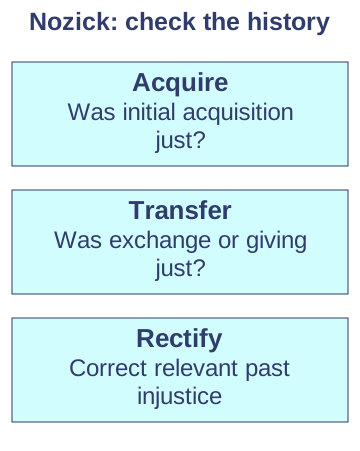
Entitlement theory — A distribution is assessed through justice in acquisition, transfer and rectification of past injustice rather than conformity to a fixed pattern of shares. Voluntary transactions can generate unequal outcomes without injustice if the relevant prior holdings and processes are just. A large fortune is therefore not justified merely because it exists; its history matters.Existing wealth is not justified just because it exists. Entitlement requires the appropriate history and correction of injustice.
Voluntary exchange example — Imagine everyone begins with just holdings and many freely pay a performer a small sum, making the performer much richer. Nozick's challenge is that restoring a prescribed pattern would repeatedly interfere with voluntary transfers. The example assumes justified initial holdings and genuine freedom, so it does not prove that every real market distribution meets the theory.
Rectification and disagreement — Past coercion, theft or unjust acquisition can undermine entitlement and require rectification; ignoring this makes the theory too permissive toward any existing inequality. Critics also ask how voluntary choice works under severe deprivation and how historical wrongs can be identified. Contrast Nozick with Rawls's institutional principles rather than calling both simply supporters of any market outcome.
Comparing people, state, society and economy
Human-nature contrasts — Hobbes's insecurity, Burke's accumulated wisdom, Oakeshott's knowledge limits and Rand's rational agency supply different arguments about government. Traditional concern with imperfection does not make every market liberal pessimistic in the same way. Explain what a thinker believes about people and how that premise supports the institutional conclusion.
Economy and community — Traditional paternalism may accept intervention to preserve cohesion; Rand and Nozick resist redistribution grounded in collective claims. Markets can generate innovation and independence but also disruption and inequality that traditional accounts find destabilising. Shared defence of property does not settle how to respond to these consequences.
Authority and liberty — A strong protective state can be compatible with a limited economic role, but coercive moral regulation can conflict with individual-rights arguments. Distinguish governmental function from total size. A balanced evaluation asks whose choices are restrained, which order or right is protected and what legal limits apply.
Change and continuity — Burkean reform to preserve, Oakeshottian practical adjustment and market-liberal challenges to established economic arrangements are not identical attitudes to change. A radical market reform can seek to restore property and choice while disrupting inherited practices. Whether this is coherent depends on which conservative value is taken as primary.
Sustaining an argument — For an essay on whether conservatives agree about the state, compare at least three specified thinkers using authority, rights, scope and economic function. Identify real overlap as well as principled disagreement, and weigh which differences are central. Biographies or slogans about a strong state do not substitute for direct comparison and a reasoned conclusion.
Test yourself
50 questions · Random sets of 10. These quick checks support revision; practise longer explanations and justified judgements too.
 Mr Kidman's Classroom