Devolution and sovereignty — Devolution transfers defined powers from central institutions to territorial legislatures and governments through statute. It does not, in orthodox UK constitutional law, create a separate sovereign state. Nevertheless, elected devolved institutions develop political legitimacy that makes unilateral interference costly; a legal power to change the settlement is not the same as an easy political choice.
Asymmetry — Scotland, Wales and Northern Ireland have different powers, institutions, histories and electoral arrangements. England has no single devolved national legislature equivalent to theirs. Calling the settlement asymmetric explains these differences, but does not by itself establish whether they are fair: compare need, identity, accountability and consent.The comparison shows institutional asymmetry, not four identical national legislatures or separate sovereign states.
Reserved and devolved matters — A reserved matter remains with UK institutions; devolved institutions legislate within their statutory competence, the subjects and actions the law permits them to deal with. Defence, foreign affairs and much macroeconomic policy remain central, while health and education are major devolved fields. Boundaries and exceptions differ, so do not assume a policy label gives every territory identical power over every detail.
Scotland — The Scottish Parliament legislates and scrutinises within devolved competence, while the Scottish Government implements policy and is accountable to it. Scotland has substantial powers over health, education and aspects of taxation, alongside its distinct legal system. Reserved UK powers and budget constraints limit autonomy without making the Parliament a mere advisory body.
Wales — The former National Assembly is now Senedd Cymru, the Welsh Parliament, with the Welsh Government as executive. Wales developed from a more limited initial settlement to primary legislative powers and a reserved-powers model. Health, education and local government illustrate real policy responsibility. The 2026 Senedd has 96 members elected in sixteen six-member constituencies through closed-list proportional representation.
Northern Ireland — The Northern Ireland Assembly legislates in transferred fields, with a power-sharing Executive shaped by the Belfast/Good Friday Agreement. Unionist, nationalist and other identities complicate simple majority-rule models. Cross-community safeguards can support consent but make formation and stability dependent on cooperation; institutional suspension interrupts devolved accountability and delivery.
Power-sharing and policy — Northern Ireland's arrangements seek inclusion after conflict rather than reproducing a normal single-party-majority executive. Allocation of offices, cross-community procedures and legal equality protections matter alongside election results. Evaluate inclusiveness against the risks of mutual veto and blockage, without treating every difference as evidence that devolution has failed.
Legislative consent — Under the Sewel convention, Westminster will not normally legislate in devolved areas without devolved consent. The convention's political significance is distinct from a legally enforceable devolved veto over Westminster. Disputes over what counts as normal and over the boundary of competence illustrate the difference between legal sovereignty and cooperative governing practice.
Finance and capacity — Devolved choices depend on spending allocations, devolved revenues and applicable borrowing rules as well as legislative powers. The Barnett formula adjusts parts of block-grant funding using changes in comparable English spending and population proportions; it is not a simple calculation of equal spending per person. Fiscal dependence can limit policy freedom, while different priorities can still produce meaningful variation.
Policy divergence — Devolution permits different approaches to education, health or public services, giving voters a closer level at which to judge policy. Divergence can support innovation and territorial choice but also generate unequal entitlements or cross-border complications. Establish which body controls a disputed decision before assigning responsibility for its outcome.
The union and nationalism — Devolution can accommodate national identity by providing self-government within the UK, but also offer nationalist parties a platform and institutions for pursuing independence. The 2014 Scottish independence referendum rejected independence while demonstrating the strength of the constitutional debate. Neither continued union nor continued nationalism alone proves what would have happened without devolution.
England and intergovernmental relations
English territorial imbalance — UK ministers and Westminster also decide many England-only matters, while MPs from devolved territories participate in the UK Parliament. The West Lothian question asks why MPs from devolved territories can vote on England-only matters at Westminster when English MPs cannot vote on equivalent devolved matters in those territories. Possible responses include an English Parliament, stronger regional devolution or revised parliamentary procedures; each changes accountability and the balance of the union differently.
Regional and local models — English devolution includes the London Mayor and Assembly and differing mayoral or combined-authority arrangements elsewhere. Transport, skills, planning and economic development feature in many settlements, but powers depend on the relevant legislation and agreement. An elected mayor is not automatically equivalent to a Scottish First Minister with a national legislature.
Benefits and objections — Moving decisions closer to residents can improve local knowledge, visibility and policy coordination. Critics point to uneven coverage, voter confusion, weak fiscal autonomy and the possibility that a large directly elected mayor concentrates local power. Evaluate an actual power and accountability route rather than using geographic closeness as sufficient proof of democratic control.
Relations between governments — UK and devolved ministers negotiate on shared issues, funding and cross-border effects. Formal authority coexists with bargaining, party differences and information dependence. Cooperation can make a settlement work despite constitutional disagreement, while a common party label does not guarantee identical territorial priorities.
Brexit and territorial tensions — EU withdrawal affected fields such as agriculture and regulation that intersect with devolved responsibility. Disagreement over repatriated powers, responsibilities returning from EU institutions, and the UK internal market brought legal competence, consent and economic integration into conflict. Explain the policy mechanism rather than reducing every dispute to a choice between total central control and full territorial sovereignty.
Assessing devolution — Use criteria including meaningful self-government, clear accountability, service outcomes, inclusion and stability of the union. Benefits on one criterion may conflict with another. A strong answer considers asymmetric institutions and political conditions rather than concluding that all territories experienced an identical reform.
EU institutions, aims and UK influence
Why the EU remains on the course — The UK left the EU on 31 January 2020 and the transition period ended on 31 December 2020. EU institutions, the legacy of membership and the continuing relationship still shape UK debate and policy choices. Study the effects of membership and withdrawal in their proper periods rather than describing the UK as a current member.
Integration and its aims — European integration seeks peace, cooperation, prosperity and a shared framework for cross-border activity. A single market aims to reduce barriers to goods, services, capital and people; it is more than a tariff agreement, which reduces taxes charged on traded goods. Economic integration can expand opportunity while requiring common standards and limiting unilateral policy choices in participating fields.
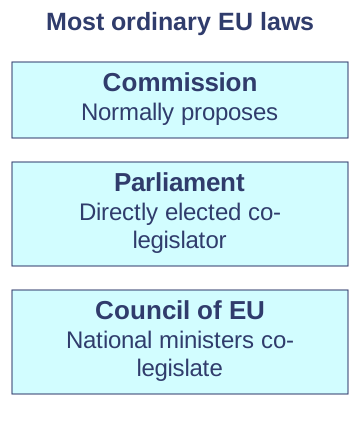
The European Commission — The Commission normally proposes EU legislation, administers programmes and works to enforce EU law. Its role supports common rules and continuity, but critics question its distance from direct electoral control. It does not alone enact all EU legislation, and commissioners are not a chamber of directly elected national MPs.
Parliament and Council — The directly elected European Parliament and the Council of the European Union, composed of national ministers, jointly adopt most EU legislation under the ordinary legislative procedure. This combines citizen and state representation. The Council's decision rules vary by field; do not assume every measure requires either unanimity or a simple majority of countries.Parliament and the ministerial Council jointly adopt most ordinary EU legislation on Commission proposals. The European Council and Council of Europe are different bodies.
Three different councils — The European Council brings heads of state or government together to set broad political direction and does not ordinarily legislate. The Council of the EU brings ministers together for legislative and coordinating work. The Council of Europe is a separate international organisation associated with the European Convention on Human Rights, not an EU institution.
Court and central bank — The Court of Justice of the EU interprets EU law and supports uniform application within its jurisdiction. The European Central Bank manages monetary policy for the euro area, which is not identical to the whole EU. During UK membership, the UK retained sterling; do not attribute the UK's interest-rate decisions to the ECB.
Sovereignty during membership — The European Communities Act 1972 provided the domestic legal basis for giving effect to EU obligations. Factortame illustrated courts disapplying conflicting national provisions within that framework. Political debate therefore concerned both the practical constraints of membership and the claim that Parliament retained the ability to change the statutory basis of participation.
Economic and policy effects — Membership influenced competition, trade, labour and environmental policy and gave UK representatives a role in making common rules. Supporters emphasised scale, access and collective influence; critics emphasised regulatory constraints, budget contributions and reduced national discretion. Evaluate a specific mechanism and evidence rather than treating every economic change as caused solely by the EU.
Aims and achievement — Integration helped bind former adversaries into common institutions and enlarge cross-border trade, but peace has multiple causes and economic gains are uneven. Euro-area crises, migration disputes and different national priorities expose limits to unity. Distinguish an aim, an observed outcome and a causal explanation when judging success.
Referendum and withdrawal — The 2016 referendum produced a Leave majority. Implementing withdrawal then required legislation, negotiations and decisions about trade and rights, revealing that a binary mandate did not settle every policy detail. Electoral and parliamentary conflict over Brexit linked sovereignty, representation, party unity and territorial identity.
Continuity and divergence — Leaving the EU did not instantly remove all EU-derived rules from domestic law. Withdrawal legislation preserved substantial continuity, and later legislation changed the status and treatment of retained rules, including the assimilated-law framework from 2024. A government can seek divergence, but costs, trade commitments and administrative capacity constrain what is practical.
Northern Ireland and the Windsor Framework — Avoiding a hard border on the island of Ireland while managing UK and EU market rules created distinctive arrangements. The 2023 Windsor Framework adjusted these, with some EU goods rules continuing to apply in Northern Ireland. The Stormont Brake is a conditional process involving qualifying Assembly members and UK government action for certain changed rules; it is not an unrestricted veto over all EU law.
Influence without membership — EU standards can affect UK exporters because selling into a market requires meeting its rules. The UK can negotiate agreements and choose domestic policies, but lacks the ordinary member-state vote in EU institutions. Legal autonomy and practical influence are different criteria: evaluating sovereignty requires considering both.
An integrated evaluation — To assess whether withdrawal increased control, compare formal legislative freedom with economic interdependence, Northern Ireland arrangements and territorial consent. To assess devolution, ask who now makes and funds the relevant decision. A linked argument explains how territorial government and international commitments interact without claiming that one removes every power from the other.
Test yourself
50 questions · Random sets of 10. These quick checks support revision; practise longer explanations and justified judgements too.
 Mr Kidman's Classroom