Parliament is not government — Parliament comprises the Crown, Commons and Lords; government consists of ministers and the executive machinery they direct. Ministers depend on parliamentary confidence and normally sit in one House, but opposition and backbench MPs are not government members. A government victory in a Commons division, a formal recorded vote, is not proof that the institutions are identical.
The Commons — The Commons has 650 constituencies, each returning one MP under first past the post. Its elected status, control of confidence and central financial role give it primacy over the Lords. A large governing majority may strengthen executive control, while rebels, marginal seats (constituencies won by a small margin) and constituency interests can complicate party management.
The Lords and reform — The Lords is a revising chamber principally composed of life peers, alongside Church of England bishops. The 1999 reform removed most hereditary members but retained an exception; the House of Lords (Hereditary Peers) Act 2026 removed the remaining hereditary basis for membership. Do not present the old 92-hereditary exception as the current settlement. Expertise and independence can improve scrutiny, while appointment and lack of election raise legitimacy concerns.
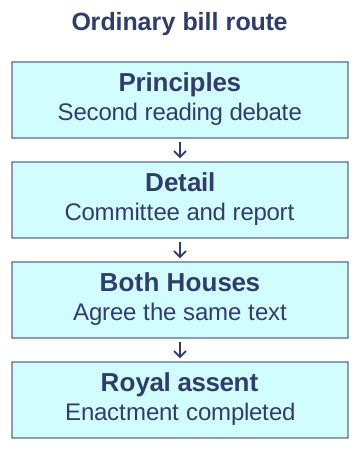
Stages of a bill — A typical public bill proceeds through introduction, debate on principles, detailed committee scrutiny, report and third reading in each House, with agreement on amendments before royal assent, the monarch’s formal approval that makes the bill an Act. Financial and Parliament Act rules qualify the relationship. The distinction between amending detail and rejecting a principle matters when explaining where scrutiny can change a proposal.A simplified ordinary route highlights distinct scrutiny tasks. Each House has stages, and financial/Parliament Act exceptions need the accompanying explanation.
Government control of time — Government normally controls much of the Commons timetable and introduces most major legislation. Programme motions, delegated legislation and a disciplined majority can compress scrutiny. However, control is not unlimited: committees, the Lords, opposition time, backbench business, media pressure and possible rebellion can alter the political price of proceeding.
Delegated legislation — An Act can authorise ministers to make detailed rules through statutory instruments. This allows technical or urgent changes without a new full Act, but the scope of delegated power and often limited amendment opportunities create accountability concerns. Evaluate the enabling statute and scrutiny procedure rather than assuming every instrument is either unchecked or fully debated like a bill.
Trustee representation — In the Burkean account, representatives exercise independent judgment about the national interest rather than obeying every local instruction. Expertise and deliberation may improve policy, but constituents can regard independence as detachment. A trustee still owes explanations and faces election; the theory does not grant permanent immunity from accountability.
Delegate and mandate — A delegate follows expressed constituent preferences; a mandate claim authorises a party to implement its electoral programme. Both face ambiguities: constituents disagree, manifesto commitments compete and voters choose a package for many reasons. A seat majority does not establish that a majority of voters endorsed each individual policy.
MPs and peers — MPs legislate, scrutinise ministers, represent constituents and seek redress of grievances. Peers revise bills, debate and bring expertise without the same constituency mandate. MPs divide their time among overlapping roles, and neither a high speaking count nor an impressive profession alone demonstrates policy influence.
Privilege and opposition — Parliamentary privilege supports free parliamentary speech and the Houses' ability to conduct their work without improper outside interference. It is not a general personal exemption from law. The official opposition challenges ministers, proposes alternatives and publicises failures; its impact depends on information, opportunities and governing-party cohesion as well as seats.
Scrutiny and executive accountability
Questions and debates — Prime Minister's Questions and departmental questions force ministers to answer in public and can expose contradictions. Short exchanges may reward performance, evasive answers and partisan messaging. Detailed debates offer more space, but publicity or a persuasive speech does not automatically change a government majority's voting behaviour.
Select committees — Cross-party departmental committees examine policy, expenditure and administration, hear witnesses and publish reports. Since 2010, many Commons committee chairs have been elected by the whole House, while party groups elect many members subject to proportional allocation and House appointment. Avoid the outdated claim that whips simply appoint every chair and member. Party balance and party influence still matter.
Committee constraints — Committees can develop expertise and secure public or ministerial responses, but recommendations are not generally binding. Access to documents and civil-service evidence can be contested; ministers control departmental cooperation within the applicable accountability framework. Assess whether evidence changed a bill, administration or public debate rather than equating a critical report with policy reversal.
Public bill committees — These scrutinise legislation line by line, unlike departmental select committees' broader inquiries. Their party balance normally reflects the Commons, so a government majority can defeat amendments. Even unsuccessful amendments can clarify ministerial intent or reveal defects later addressed elsewhere; legislative influence is broader than the number of opposition amendments formally accepted.
Party discipline — Whips coordinate attendance and communicate the importance of votes; career incentives, ideology and loyalty also encourage cohesion. MPs are not legally owned by party leaders and can rebel, resign or lose the whip. A large majority reduces the threat from small rebellions, but a divided majority party can still constrain its leader.
The Lords as a check — Because governments do not normally have an automatic Lords majority and peers may face fewer electoral or career pressures, the chamber can press for revisions. Its unelected status, conventions and Parliament Act limits constrain resistance. A balanced judgment distinguishes capacity to delay or persuade from final control of confidence and ordinary financial business.
Redress and agenda setting — Constituency casework, petitions, campaigns and parliamentary questions can place neglected issues on the agenda and secure responses for individuals. Influence may occur without defeating government. Conversely, gaining a debate does not prove the proposed solution was adopted; follow the mechanism from representation to action.
Prime Minister, cabinet and policy
Appointment and confidence — The monarch appoints a Prime Minister able to command Commons confidence; the public does not directly elect a separate prime-ministerial office. Party leadership and general-election success are important routes, but a change of party leader can change Prime Minister between elections. A parliamentary mandate and a personal media mandate are analytically different.
Prime-ministerial resources — Patronage, the ability to appoint people to posts and offer career opportunities, control of cabinet organisation, the ability to coordinate policy, media visibility and access to officials strengthen the Prime Minister. These are resources rather than guarantees: a weak parliamentary position, internal rivals, unpopular policy or an economic crisis may reduce their usefulness. Link the resource to a decision and show the constraint.
Cabinet government — Cabinet brings senior ministers together to coordinate policy and resolve disputes across departments. In a collegiate account, the Prime Minister is first among equals, or primus inter pares. In practice, the balance changes with leadership style, ministerial expertise and political support; constitutional descriptions alone cannot reveal who prevailed in a specific decision.
Core executive — Power is distributed among the Prime Minister, cabinet, Treasury, departments, advisers and coordinating institutions. A Prime Minister may set priorities yet depend on others for finance, expertise and delivery. Resource dependence explains why neither an all-powerful leader nor a uniformly sovereign cabinet is an adequate model for every issue.
Cabinet committees and informal groups — Smaller committees handle cross-departmental questions and can prepare or make decisions under cabinet authority. An inner cabinet or informal adviser network may improve speed and coordination but marginalise some ministers. Ask who received information, who could challenge and whether a formal cabinet discussion meaningfully tested alternatives.
Policy making — A policy may pass through agenda setting, consultation, appraisal, decision, legislation, implementation and review, but real decisions often revisit earlier stages. Civil servants advise and implement; ministers carry political responsibility. Treasury constraints, departmental incentives and evidence of implementation problems can reshape what began as a leader's promise.
Collective responsibility — Ministers are normally expected to support agreed government policy publicly or resign, allowing government to speak coherently and Parliament to hold it accountable. Cabinet confidentiality supports frank discussion but can weaken public visibility. Explicitly agreed suspensions, such as during some referendum campaigns, are exceptions rather than abolition of the convention.
Individual responsibility — A minister answers to Parliament for departmental conduct and personal behaviour, but accountability does not mean automatic resignation for every official error. Whether resignation follows depends on knowledge, fault, seriousness, parliamentary confidence and political support. Distinguish giving an explanation, correcting failure and taking a personal sanction.
1954 and 2016 responsibility examples — Sir Thomas Dugdale resigned over the Crichel Down affair in 1954, a classic reference point in responsibility debates whose interpretation requires attention to the facts. Iain Duncan Smith resigned as Work and Pensions Secretary in 2016 over welfare-policy disagreement. These illustrate that departmental answerability and collective policy disagreement are different routes to resignation.
Pre-1997 executive case: the poll tax — The community charge, introduced in Scotland in 1989 and England and Wales in 1990, illustrates the Thatcher government's ability to drive through a major policy. Flat-rate individual liability, perceived unfairness, administrative problems and opposition created political costs. Replacement and the wider crisis in Thatcher's leadership show that initial enactment is not the same as durable executive success.
Post-1997 executive case: Iraq — The Blair government's decision to join the 2003 invasion illustrates prime-ministerial agenda setting, international commitments and concentrated decision-making. The Commons approved the government's motion despite a substantial Labour rebellion. Later Chilcot findings criticised the process and the conditions under which the UK chose military action; do not confuse a Commons vote with proof that all evidence and alternatives were adequately tested.
Imperial, presidential or constrained? — A leader's personalised media strategy and use of advisers may suggest presidentialisation, but a UK Prime Minister remains dependent on party, Commons confidence and cabinet resources. Compare formal powers with changing political conditions. A strong leader in one policy area can be constrained in another, so the analysis needs a time, decision and criterion of power.
Constructing a balanced judgment — To evaluate whether Parliament controls the executive, distinguish legislative amendment, information disclosure, agenda change and removal from office. Use evidence for both executive dominance and meaningful scrutiny, explain the causal mechanism and qualify for majority size and party cohesion. Counting defeats alone misses anticipated reactions and quiet concessions.
Test yourself
50 questions · Random sets of 10. These quick checks support revision; practise longer explanations and justified judgements too.
 Mr Kidman's Classroom