Socialist concerns — Socialism criticises social arrangements that subordinate people's lives to unequal economic power and seeks greater equality, cooperation and human development. Socialists disagree over ownership, markets, the state and the route to change. A definition confined to public ownership alone misses important disputes about ends and means within the tradition.
Human nature and environment — Many socialists regard human behaviour as shaped by social conditions rather than fixed selfishness. Cooperation and solidarity can develop where institutions encourage them, while competition can generate antagonism. This does not require claiming that every person is naturally selfless or that changing ownership instantly removes every conflict.
Equality and liberty — Socialists may defend equal worth, reduced class hierarchy, material equality, opportunity or access to flourishing, but give these different weights. Freedom can mean protection from domination and poverty as well as absence of legal interference. Assess whether a proposed institution expands people's agency or creates a new coercive hierarchy rather than assuming collective ownership guarantees freedom.
Community and cooperation — People depend on shared production, care and public institutions, so outcomes cannot be attributed solely to isolated individual effort. Collective arrangements can express solidarity and provide services beyond market purchasing power. Critics ask about incentives, pluralism and central control; socialists themselves disagree about how democratic cooperation should be organised.
Ownership and distribution — Private ownership of productive resources can give owners power over employment, investment and the distribution of output. Public ownership, cooperatives, regulation and redistribution are different possible responses. Distinguish changing who owns an enterprise from changing taxes or service access, and explain which socialist objective each mechanism serves.
Marx, Engels and revolutionary change
Class and production — Marx and Engels analyse classes through their relationship to the means of production, resources such as land, factories and equipment used to produce goods, rather than income alone. In capitalism, the bourgeoisie owns capital while the proletariat sells labour power. A well-paid employee and a small owner complicate simple rich-versus-poor labels; the analysis concerns social relations and power as well as earnings.
Historical materialism — The material organisation of production and its class relationships help explain institutions, ideas and historical change. This is not a claim that beliefs never matter or that every event has one immediate economic cause. The argument asks how productive forces and social relations create possibilities, interests and conflicts across time.
Dialectical change — Contradictions within a social order can generate struggle and transformation; in capitalist production, expanding social cooperation coexists with private control and appropriation. Class conflict is therefore part of an account of historical development, not merely disagreement about the size of one tax. The term dialectical materialism is associated with this tradition and later formulations; explain the mechanism instead of using the label as a substitute.
Exploitation — Workers sell labour power while owners receive surplus generated in production, the value workers create beyond the value of their labour power in Marx’s account under capitalist relations. In Marx's account, exploitation is structural and can occur even where a contract is legally valid and the employer obeys existing law. It is not limited to unusually cruel managers or wages below a legal minimum.
Alienation — Workers can become separated from control over their work, its products, their human capacities and one another. The idea concerns the organisation of life and production, not merely temporary boredom or a dislike of one task. Higher wages may improve conditions without removing the underlying loss of control identified by the theory.
State and ideology — Marxist analysis asks how state institutions and dominant ideas can support prevailing class relations. This can involve law, property and assumptions that existing arrangements are natural or meritocratic. Do not reduce the argument to every official taking personal orders from an individual owner; structural power and direct conspiracy are different explanations.
Revolution and emancipation — Revolutionary socialism seeks transformation of capitalist class relations rather than only improved terms within them. Working-class organisation and consciousness matter to the proposed transition. Communist society is conceived as overcoming class domination, not simply preserving an endlessly expanding coercive bureaucracy under a different label.
Prediction and interpretation — Marx and Engels identified tendencies and contradictions expected to generate capitalist crisis and struggle; later history has prompted major disagreements about timing, inevitability and routes to change. Compare their claims with reformist critiques without treating the persistence of capitalism as proof that no class relation or inequality exists. Historical evaluation requires specifying which prediction or mechanism is being tested.
Luxemburg: reform, revolution and mass action
Reform is not the final goal — Rosa Luxemburg argued that parliamentary and trade-union reforms could improve lives and develop struggle but could not substitute for transforming capitalist relations. She opposed making gradual reform the ultimate socialist objective. This is not a rejection of every wage campaign or vote; it distinguishes means of struggle from the final aim.
Spontaneity and learning — Mass action can develop through conflicts and opportunities not scripted by party officials. Participation can educate and organise workers as well as express already completed consciousness. Spontaneity therefore concerns creative mass agency, not a belief that preparation, analysis and organisation have no role.
Party and masses — A revolutionary organisation should help clarify, connect and advance struggles rather than replace the working class with a commanding minority. Luxemburg criticised bureaucratic caution and over-centralisation that suppresses initiative. Her approach links leadership to mass self-activity instead of choosing between no organisation and total top-down direction.
The mass strike — Economic and political struggles can interact: a dispute over wages may become a wider challenge to authority, while political action can reshape workplace organisation. A mass strike is not simply a technical order that a party can issue whenever convenient. Analyse historical conditions and developing participation rather than treating it as a guaranteed switch to revolution.
Inevitability and agency — The specification's focus on confidence in revolutionary triumph should be read alongside Luxemburg's stress on active mass struggle and the dangers of defeat. A belief that capitalism's contradictions create revolutionary possibilities is not a practical instruction to wait passively for an automatic event. Evaluate organisation, consciousness and historical contingency in the argument: events can turn out differently depending on actions and conditions.
Webb and cooperative organisation
Webb's reformist approach — Beatrice Webb emphasised investigation, collective organisation and institutional reform rather than a sudden unplanned overthrow. Fabian gradualism sought evidence-based changes capable of reorganising social provision. This differs from simply leaving market outcomes untouched, while raising questions about expert administration and democratic participation.
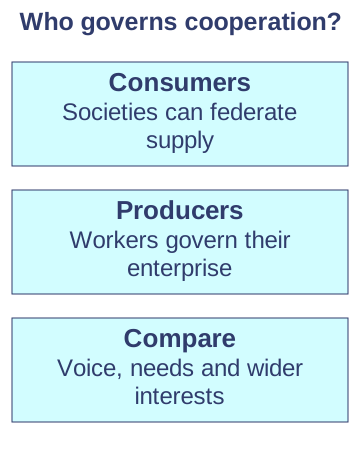
The cooperative principle — A cooperative is owned and governed for its members under cooperative arrangements rather than solely for outside investors. Consumers and workers can be different membership bases with different interests. The existence of cooperative ownership does not answer every question about price, pay, accountability or relations with the wider public.
Cooperative federalism — In Webb's account, consumer societies can federate into wholesale organisations and develop production to meet members' needs. The units are cooperatives joining together, not US state governments. This consumer-centred federation aims to avoid isolated enterprises reproducing narrow private interests and to organise supply on a wider basis.Webb contrasts consumer-centred federation with producer-centred cooperative individualism. This is not US federalism or Randian egoism.
Cooperative individualism — The contrasting producer-centred approach gives workers or producers control of their particular enterprise. Webb questioned whether isolated producer interests and market competition could secure the broader consumer interest. Do not mistake the term for Rand's ethical individualism: it concerns organisation within the cooperative movement, not a rejection of all cooperation.
Democracy and expertise — Webb's institutional emphasis can support coordinated provision and informed reform, while critics worry about managerial control and insufficient local initiative. Compare consumer democracy, producer autonomy and expert coordination using a concrete service. Different forms of collective ownership can distribute voice very differently.
Crosland, Giddens and revisionism
Crosland's revision — Anthony Crosland argued that post-war capitalism had changed and that nationalisation was not the defining socialist end. Welfare, democracy and public policy could reduce inequality within a mixed economy. The argument revises orthodox Marxist expectations rather than denying every need for collective action or social reform.
Ends and means — Personal liberty, social welfare and equality are central values in Crosland's account; public ownership is one possible instrument rather than a test that every industry must be nationalised. A state-owned monopoly with little freedom or equality is not automatically a socialist success by his criteria. Evaluate the realised values rather than only the ownership label.
Equality and public policy — Progressive taxation, where the tax rate rises with income or the relevant tax base, education, services and social provision can reduce disadvantage and widen opportunity. Crosland's concern extends beyond a minimalist formal opportunity rule toward social equality and quality of life. Critics question reliance on growth, the durability of reforms and continued private investment power; these are substantive objections rather than a definition alone.
Giddens's Third Way — Anthony Giddens argues that globalisation, changing class structures and social risks require renewal beyond traditional state socialism and unqualified market liberalism. The Third Way combines market dynamism with social inclusion and public investment. It is a contested reformulation, not merely a mathematically exact midpoint between every left and right policy.
Social investment — Education, skills, infrastructure and support for participation aim to equip people to manage change rather than only compensate them after harm. Positive welfare connects support with agency and responsibility. Critics ask whether employability replaces equality, whether work is available and whether conditions impose unfair burdens on vulnerable people.
Rights and responsibilities — The Third Way stresses reciprocal duties, community and participation alongside support. A market economy is treated as compatible with social goals when institutions manage risks and exclusion. Evaluate the actual balance between opportunity and obligation rather than describing every condition as either liberation or punishment by definition.
Socialist renewal or retreat? — Defenders see Giddens adapting egalitarian aims to changed economic conditions; critics see acceptance of private power and weakened redistribution. Compare with Crosland's social equality and Marx's class transformation using state role, markets, ownership and outcomes. The dispute concerns what counts as the continuing socialist end as well as the most effective means.
Revolutionary socialism and social democracy
Routes to change — Revolutionary accounts question whether capitalist institutions can be transformed through cumulative reform alone; social democrats seek democratic improvements through legislation, taxation and services. The divide concerns state power, class relations and the durability of reforms, not only how impatient a thinker feels. Different strategies can share some immediate demands while disagreeing over the final goal.
State and democracy — The state can be analysed as sustaining class domination, an instrument for reform or a coordinator of social investment. Public ownership and planning can expand collective control but risk bureaucracy and concentrated power unless accountable. Socialists disagree over centralisation, worker participation, electoral institutions and how to protect liberty.
Markets and equality — A mixed economy may fund services and social protection, while revolutionary critics argue private investment retains structural power and reforms remain reversible. Supporters of reform ask whether abolishing markets or concentrating administration would improve freedom and performance. A fair comparison considers feasible institutions, incentives, democratic voice and distribution rather than assuming an ownership label settles outcomes.
A worked ownership comparison — An illustrative enterprise could be privately owned with strong labour law, worker-owned, consumer-owned through a federation or publicly owned with elected oversight. Compare who decides investment, who receives surplus, whose interests are represented and how conflicts are resolved. This shows why Webb's cooperative distinctions, Marxist control questions and Crosland's ends-versus-means test are related but not identical.Different ownership forms distribute decision-making and benefits differently. Test socialist values through institutions and outcomes rather than labels alone.
Direct evaluative comparison — For an essay on whether socialists agree about equality, distinguish equal moral worth, class abolition, reduced material inequality, fair opportunity and social inclusion. Compare named thinkers directly and explain how their accounts of people, production and the state justify different institutions. A conclusion should weigh the significance of disagreement, not merely count shared words.
Test yourself
50 questions · Random sets of 10. These quick checks support revision; practise longer explanations and justified judgements too.
 Mr Kidman's Classroom