Constitutional authority — The Constitution written in 1787 and subsequently ratified establishes a federal republic whose institutions operate under a higher constitutional law. Its authority is different from an ordinary congressional statute. Original exclusions and compromises over slavery and political membership matter when judging the gap between the language of liberty and the rights actually enjoyed at the founding.
Articles and amendments — Article I concerns Congress, Article II the presidency and Article III the federal judiciary; later articles address states, amendment, supremacy and ratification. Amendments form part of the Constitution and can supersede earlier provisions. Reading the original text without checking later amendments can therefore produce serious errors, such as claiming senators are still normally chosen by state legislatures.
Separation and interdependence — The branches have separate functions and distinct personnel, and executive office-holders cannot simultaneously sit in Congress. However, they share important tasks: presidents nominate judges, senators confirm them and Congress funds executive activity. Separation means checks and bargaining, not three institutions that never interact.
Checks and balances — A president can veto legislation, Congress can override a veto by the required supermajorities and courts can test constitutional validity. Senate confirmation of appointments, appropriations (legal approval of spending), impeachment charges against officials and oversight supply further restraints. These checks can protect liberty and require justification, while also creating multiple veto points that obstruct decisions even when a large public majority wants action.
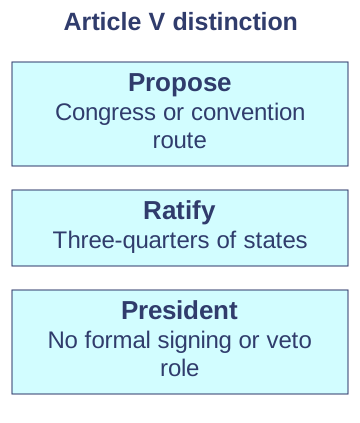
Article V routes — Amendments may be proposed by two-thirds of both congressional chambers or by a convention called after applications from two-thirds of state legislatures. Ratification requires three-quarters of states through legislatures or conventions, as Congress specifies. The President has no formal signing or veto role in this amendment process; proposing and ratifying are different stages.Proposal and ratification are separate constitutional stages. The accompanying notes specify each route and its threshold.
Thresholds and rigidity — With fifty states, the convention-application threshold is 34 and ratification requires 38. Twenty-seven amendments have been ratified. High thresholds protect against temporary majorities but permit a relatively small share of the population, concentrated in enough states, to block change; state equality and population equality are not the same criterion.
Change without formal amendment — Judicial interpretation, congressional legislation, executive practice and social change alter the Constitution's practical operation without rewriting its text. Debates over original meaning and evolving application concern how legitimate that change is. Rigidity in formal amendment does not mean that every institution behaves exactly as it did in 1787.
Supremacy and enumerated powers — The Constitution and valid federal law prevail over conflicting state law within their constitutional scope. Congress has enumerated powers, meaning powers specifically listed in the Constitution, including taxation and interstate commerce, plus powers needed to carry them into effect. Federal supremacy is not a blank permission for any federal actor to act outside constitutional authority.
The Bill of Rights — The first ten amendments protect liberties and regulate governmental power, including expression, religion and criminal-process safeguards. They were initially framed primarily as limits on federal government. Later judicial incorporation through the Fourteenth Amendment extended many protections against states; protection is therefore a combination of text, interpretation and enforcement.
Evaluating the framework — Codification makes fundamental rules accessible and supports enforceable constitutional limits. Critics emphasise amendment difficulty, unequal state representation and the authority of unelected interpreters. An evaluation should ask how effectively the framework combines rights, democratic responsiveness, stability and accountability rather than treating age or brevity alone as proof of success.
Federalism and federal-state relations
Federal and state authority — Federalism constitutionally distributes authority between national and state governments. States have their own constitutions and elected institutions and retain substantial responsibilities, including many education, policing and election-administration functions. Unlike ordinary statutory devolution, their basic position is part of the constitutional order rather than a discretionary grant from a sovereign national legislature.
Tenth Amendment and shared fields — The Tenth Amendment reserves powers not delegated to the federal government nor prohibited to states to the states or the people. Many real policy areas still involve overlapping authority. Environmental regulation, health provision and education can combine federal law, grants, state legislation and judicial decisions, so a neat two-column list cannot describe every contemporary relationship.
Grants and conditions — Federal grants can fund state programmes while attaching conditions, influencing policy without direct federal administration. Conditions may promote national standards but raise concerns about coercion and accountability. A state may formally have a choice yet face strong fiscal incentives; examine the legal framework and practical dependence separately.
Cooperation and conflict — Cooperative federalism stresses shared programmes and bargaining, while state autonomy arguments emphasise limits on national direction. Political positions can change with the policy and the party holding each institution. An actor defending states on one issue may seek federal intervention on another, so policy incentives help explain apparently inconsistent preferences.
Rights and territorial variation — Federalism can permit policy experiments and local responsiveness but also preserve unequal protection or entitlements. Civil-rights struggles show that state autonomy can conflict with equal treatment, while national action may protect minorities. Neither level is inherently always the stronger defender of liberty; examine the policy, period and enforcement.
Fiscal and legal limits — State budgets, federal conditions, constitutional review and cross-border economic effects constrain autonomous choices. Federal courts can settle competence disputes, but judgments require institutional response and implementation. To judge which level is dominant, trace the actual rule, funding and delivery rather than only reading the label on a programme.
Congress, representation and law-making
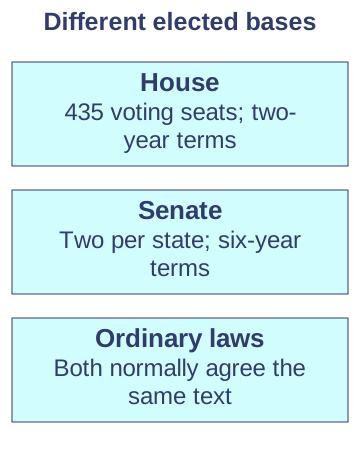
Two elected chambers — Congress consists of a House of Representatives with 435 voting seats apportioned among states by population and a Senate with two senators per state, currently 100. House members serve two-year terms; senators six-year terms, with approximately one-third of seats elected every two years. The House's fixed size is statutory, while equal state Senate representation has constitutional protection.Population apportionment and equal state representation create different constituencies. Special powers differ despite shared ordinary legislation.
Different constituencies — Representatives serve districts and senators serve whole states. Equal Senate representation gives residents of smaller states more senators per person, while House districts are population-based within the allocation system. Longer terms and statewide constituencies may encourage different priorities, but electoral competition, party pressure and ambition affect both chambers.
Party allegiance and leadership — Parties organise agendas, committees and leadership positions, but US legislators have their own electoral bases. Primary voters, donors, constituents and ideological caucuses, groups of legislators organised around shared outlooks, can pull against party leaders. Contemporary polarisation can produce strong party voting without making members' dependence identical to that of MPs sustaining a UK government's confidence.
House and Senate powers — Both chambers must normally agree the same legislative text. Revenue-raising bills originate in the House, which can impeach; the Senate confirms relevant appointments, consents to treaties by two-thirds of senators present and tries impeachments. The Senate does not possess every House power, nor is the House merely an advisory chamber.
Bills and committees — A proposal is introduced, referred to relevant committees, examined and potentially amended before floor consideration. Committees supply expertise, hold hearings and can prevent proposals advancing. Different versions must be reconciled and passed in identical form before presentation to the President; a committee's support alone does not enact a law.
Agenda control and procedure — House leadership and the Rules Committee strongly shape floor debate and amendments. Senate procedures give individual senators and minorities different opportunities to delay or bargain. Standing rules and precedents matter alongside constitutional clauses; do not attribute every procedural obstacle directly to the text of 1787.
Filibuster and cloture — For most ordinary Senate legislation, ending debate through cloture normally needs three-fifths of the full Senate, usually 60. Confirmation nominations and some special procedures operate under different precedents or rules. A filibuster need not involve continuous dramatic speaking, and the 60-vote cloture threshold is not a universal constitutional requirement to pass every measure.
Reconciliation — Budget reconciliation allows qualifying budgetary measures to follow a special Senate route with limited debate and majority voting. The Byrd Rule and other conditions restrict its scope; it is not a device that automatically makes any policy eligible. Distinguish passing a permitted budget provision from removing all legislative checks.
Presidential response — The President can sign an ordinary bill or return it with objections. Congress can override a veto by two-thirds in each House; the constitutional calculation concerns votes in properly constituted chambers, not a nationwide public vote. Inaction can also produce a law after the specified period, with a pocket-veto exception where adjournment prevents return.
Oversight, money and effectiveness
Power of the purse — Congress taxes, authorises programmes and appropriates funds; executive departments cannot treat a presidential preference as unlimited legal spending authority. Appropriations are distinct from authorisation and the separate debt-limit question. Funding disputes can shut down affected operations when appropriations lapse, rather than automatically cancelling every function of government.
Oversight tools — Committees investigate implementation, hold hearings, demand evidence under applicable powers and publicise failure. Appropriations conditions and confirmation can reinforce scrutiny. Subpoenas, formal demands for testimony or evidence, may be contested and witnesses may resist; an impressive hearing does not guarantee compliance, remedial legislation or punishment.
Impeachment and removal — The House brings charges through impeachment; the Senate tries them, with conviction requiring two-thirds of senators present. Impeachment alone is not removal or criminal conviction. Party allegiance, evidence and public reaction affect willingness to use these exceptional constitutional tools.
Representation and casework — Members respond to constituent problems, seek district or state benefits and explain national choices. Local responsiveness can support trust, while pursuit of particular benefits can conflict with collective fiscal priorities. Delegate, trustee and partisan motivations may coexist within the same member rather than functioning as exclusive personal types.
Divided and unified government — Divided government places the presidency and at least one chamber under different party control, increasing some bargaining and investigation incentives. Unified control can ease action but does not eliminate bicameral constraints (both chambers must agree), internal party divisions, procedural or judicial constraints. The number of veto players and their preferences matter more than the label alone.
Gridlock and bargaining — Multiple veto points, polarisation, narrow margins and competing electoral incentives can block legislation. Supporters see restraint on hasty majorities; critics see an inability to address urgent problems. Evidence should consider what was enacted, what was prevented and concessions made before a final vote, rather than assuming inactivity has only one cause.
Congress and courts — Congress creates lower federal courts, determines much judicial organisation and confirms appointments through the Senate; courts can invalidate unconstitutional legislation. Congress may revise a statutory rule after an interpretation, but an ordinary statute cannot simply overrule the Constitution. Constitutional amendment or a later judicial change is a different route.
Judging congressional power — Compare legislation, finance, oversight, representation and executive constraints across a defined period. A Congress can obstruct a President effectively yet struggle to enact an alternative programme. Strength as a veto institution and effectiveness as a policy-maker are different questions that a balanced conclusion should address.
Test yourself
50 questions · Random sets of 10. These quick checks support revision; practise longer explanations and justified judgements too.
 Mr Kidman's Classroom