Constitutional position — Article III establishes the Supreme Court and federal judicial power, with lower federal courts created by Congress. Constitutional supremacy enables courts to test public action against higher law. The Court normally decides actual legal disputes within jurisdiction, not every political question that commentators would like it to settle.
Nomination and confirmation — The President nominates a justice and the Senate considers confirmation, including committee scrutiny and a floor vote under applicable procedures. This connects appointments to political institutions and creates opportunities for ideological selection. Once appointed, a justice is not legally obliged to follow the nominating President or repay a party through judgments.
Tenure and salary — Federal judges hold office during good behaviour, commonly described as life tenure, with protection against salary reduction while in office. These rules reduce fear of executive dismissal or electoral retaliation. Independence is not the absence of every political influence: appointment selection, personal outlook and public legitimacy can still shape debates about the Court.
Current composition at review — The official roster checked in October 2026 lists Chief Justice John Roberts and Associate Justices Clarence Thomas, Samuel Alito, Sonia Sotomayor, Elena Kagan, Neil Gorsuch, Brett Kavanaugh, Amy Coney Barrett and Ketanji Brown Jackson. Appointment histories and judicial outlooks matter, but names and vacancies should be rechecked as the course is revised.
Ideology and variation — Six current justices were nominated by Republican presidents and three by Democratic presidents; the six are commonly associated with a conservative majority. This is an analytical pattern, not a rule that all cases divide six–three or that appointer party legally determines every vote. Different doctrines and case facts produce different coalitions and separate opinions.
Legitimacy and representation — Life tenure can protect unpopular minorities against temporary majorities, but unelected judges deciding major policy questions raise a counter-majoritarian concern: unelected judges may overturn decisions supported by elected majorities. Professional and social backgrounds affect legitimacy debates without turning justices into demographic delegates. Evaluate independence, legal reasons, rights outcomes and accountability as distinct criteria.
Interpretation, judicial review and power
Judicial review — Marbury v Madison in 1803 is a central reference point for judicial review of federal action. The Court can hold statutes or executive action unconstitutional, giving its interpretation consequences unavailable to the UK Supreme Court with an ordinary Westminster Act. This power operates within cases, doctrine and implementation constraints, not as an unrestricted political veto on demand.
Constitutional interpretation — Broad phrases such as due process (fair legal procedures and related constitutional safeguards) and equal protection (protection against unjustified unequal treatment by government) require application to disputes not anticipated in detail at the founding. Text, history, structure, precedent and consequences can inform different judicial approaches. A conclusion may be politically consequential while still turning on a genuine disagreement about constitutional meaning.
Strict and loose construction — Strict construction is often used to describe narrow readings of governmental authority or constitutional language; loose construction allows broader application. These labels are imprecise unless linked to a clause and reasoning. They are not automatic synonyms for conservative versus liberal outcomes, originalism versus living constitutionalism or restraint versus activism.
Originalism and textualism — Originalism emphasises constitutional meaning at adoption; textualism emphasises the enacted language, particularly in statutory interpretation. Neither means simply following the present personal preferences of eighteenth-century individuals. Critics question historical evidence and modern application, while supporters argue these approaches constrain judicial discretion.
Living constitutional approaches — An evolving interpretation may apply constitutional principles to changing social conditions rather than confining applications to adoption-era expectations. Supporters see continuity of principle and meaningful rights; critics fear judges substituting values for democratic decisions. Analyse the method and legal argument rather than assuming that change alone proves illegitimacy.
Activism and restraint — Activism can mean willingness to overturn laws or precedent, while restraint can mean deference or narrow decisions; define the usage. A conservative Court striking down legislation can be activist in this institutional sense. A decision's policy direction and its willingness to displace other institutions are separate dimensions.
Precedent and disagreement — Stare decisis supports consistency and reliance on earlier decisions, but precedent can be distinguished or overturned. A majority opinion supplies the controlling judgment, while concurrences (opinions agreeing with the result but adding or changing reasons) and dissents (opinions disagreeing with the result) explain different reasoning and may shape future arguments. Judicial change can therefore be gradual or dramatic without any formal constitutional amendment.
Access and implementation — Litigation needs appropriate parties, standing, resources and a case reaching the Court; the Court selects only a small proportion of applications for review. A ruling also depends on compliance and institutional implementation. Legal authority can be strong while remedies are delayed, uneven or contested.
Checks on judicial power — Appointments, statutory jurisdictional arrangements, resources, later legislation within constitutional bounds and amendment can affect the judiciary. The high amendment threshold and long tenure make some checks difficult. Congress can respond to a statutory interpretation differently from a constitutional holding; an ordinary Act cannot simply repeal a constitutional right declared by the Court.
Landmark decisions and rights controversies
Brown v Board of Education — In 1954 the Court held state-imposed racial segregation in public schools incompatible with equal protection, rejecting separate-but-equal in that setting. The decision challenged a deeply embedded discriminatory system. It did not by itself remove all segregation, inequality or resistance; enforcement, legislation and campaigning remained essential.
Obergefell v Hodges — In 2015 the Court required states to license and recognise marriages between same-sex couples under Fourteenth Amendment reasoning. Supporters emphasised equal dignity and liberty, while critics disputed the Court's interpretation and its role relative to democratic institutions. Identify the right and legal basis instead of reducing the case to a popularity contest.
Roe, Casey and Dobbs — Roe v Wade in 1973 recognised a constitutional abortion protection later modified by Casey. Dobbs in 2022 overruled those precedents and held that the Constitution did not confer that abortion right. The decision allowed major policy divergence and political contest over regulation; it did not itself impose one identical nationwide abortion policy.
Changing protection — Brown, Obergefell and Dobbs show that judicial interpretation can expand or withdraw constitutional protection. Supporters and critics may disagree about whether the Court is enforcing the Constitution or making policy. A balanced analysis needs the majority's reasoning, objections, institutional effects and distinction between constitutional protection and what legislatures may choose to regulate.
United States v Nixon — The 1974 tapes case constrained a President's claim to absolute executive confidentiality against a particular judicial evidence demand. It illustrates the Court's ability to affect executive accountability, not that every national-security or confidentiality claim is invalid. It can be compared with political pressure and congressional investigation as complementary checks.
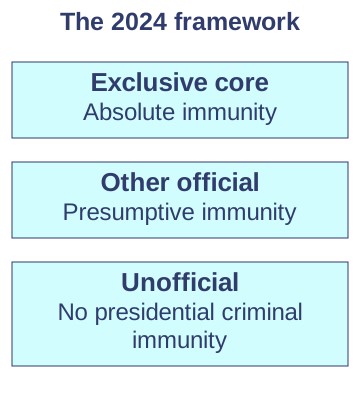
Trump v United States, 2024 — The Court distinguished absolute immunity for conduct within exclusive constitutional authority, presumptive immunity for other official acts and no immunity for unofficial acts. The decision concerned former-presidential criminal prosecution and required further classification of conduct; it was not blanket immunity for everything a President might do. Critics and defenders debate the consequences for executive independence and accountability.These categories summarise Trump v United States (2024) for former-presidential criminal prosecution. They are not a general immunity for every action.
Using cases evaluatively — For each ruling, state issue, constitutional principle, decision, controversy and consequence. Compare at least two using a consistent criterion such as minority protection or democratic responsiveness. A case name without reasoning is not evidence of judicial power, and subsequent policy conflict does not mean the ruling had no effect.
Civil liberties, amendments and the civil-rights movement
Civil liberties and civil rights — Civil liberties restrain interference with freedoms, while civil rights concern equal status and treatment; the concepts overlap. Freedom to speak can enable an equality campaign, while unequal access can make a formal liberty hard to exercise. Analyse both legal protection and the social conditions of its use.
Constitutional protections — The First Amendment protects expression, religion, assembly and petition within developed legal doctrines. Fourth, Fifth and Sixth Amendment safeguards concern searches, due process and criminal proceedings. These are not unlimited permissions for any conduct: the relevant legal test, state action and jurisdiction matter.
Reconstruction amendments — The Thirteenth Amendment abolished slavery with its punishment exception, the Fourteenth addressed citizenship and equal protection and the Fifteenth prohibited specified racial restrictions on voting rights. Their adoption did not prevent later discrimination, intimidation and exclusion. A constitutional promise requires enforcement and can be undermined by institutions and practices.
Further participation amendments — The Nineteenth Amendment prohibits denial of voting rights on grounds of sex; the Twenty-Fourth addresses poll taxes in federal elections; the Twenty-Sixth protects voting rights from age denial for citizens eighteen and over. These provisions tackled different barriers and should not be compressed into a claim that one amendment established all equal voting access.
Civil-rights movement strategies — Organisations such as the National Association for the Advancement of Colored People (NAACP) pursued litigation, while boycotts, marches, voter registration and direct action mobilised broader pressure. Martin Luther King Jr and other organisers linked moral claims, organisation and media visibility. The movement was diverse and cannot be reduced to one leader, one court case or one uniformly agreed strategy.
Courts, Congress and executive — Brown altered constitutional law, the Civil Rights Act 1964 addressed major discrimination and the Voting Rights Act 1965 supplied voting protections and enforcement mechanisms. Federal executive action mattered to implementation. The interaction demonstrates institutional complementarity: courts alone did not enact every protection or guarantee social equality.
Enforcement and social change — Rights campaigns confronted intimidation, local resistance and unequal resources. A legal victory can enable later action while leaving economic inequality and residential segregation unresolved. Distinguish desegregation rules, access to voting and broader substantive equality when evaluating progress.
Race, voting and institutional evaluation
Race as an illustrative policy study — Race is used here as the developed civil-rights policy example, not as a claim that it is the school's only taught choice. The study connects equal protection, education, voting legislation, pressure groups and public policy. Avoid treating all members of an ethnic group as having identical interests or experiences.
Voting Rights Act and Shelby County — In 2013 Shelby County v Holder invalidated the Section 4(b) coverage formula used for Section 5 preclearance, which required covered jurisdictions to obtain approval before changing voting rules. It did not repeal the entire Voting Rights Act. This altered the operation of an important protection and intensified debate over state autonomy, contemporary evidence of discrimination and the role of national safeguards.
Contemporary equality debates — Disputes over registration, identification requirements, districting and access concern both election administration and unequal burdens. A fair analysis tests evidence of discrimination, integrity claims, proportionality of rules and availability of remedies rather than assuming either motive or effect from a party label. Dated cases require checking against later legislation and judgments.
Pressure-group resources — Civil-rights organisations use test cases, legal expertise, campaigns, coalition-building and voter mobilisation. Access to lawyers and sympathetic institutions can strengthen influence, while funding and agenda competition constrain it. A campaign's legal victory should be assessed alongside implementation and the voices it does or does not represent.
Rights and federalism — National constitutional protection can constrain discriminatory state policy, while states can also provide protections beyond a federal minimum in some fields. After a constitutional restriction is removed, state variation may widen. The level of government is not a permanent predictor of whose rights will be better protected.
Evaluating protection overall — Compare clarity of constitutional text, independent adjudication, accessible remedies, democratic legislation and effective enforcement. Entrenchment can resist hostile majorities, but contested interpretation and reversal make protection politically consequential. A justified conclusion identifies which rights, institutions and period are being assessed rather than claiming the system always protects or always fails minorities.
Test yourself
50 questions · Random sets of 10. These quick checks support revision; practise longer explanations and justified judgements too.
 Mr Kidman's Classroom