The experimental question — An experiment investigates whether changing an independent variable affects a dependent variable while relevant alternatives are controlled. The causal claim concerns the manipulated contrast, not every difference between people. Start by specifying the behaviour and a plausible alternative explanation.
Independent and dependent variables — The independent variable is the factor varied between conditions; the dependent variable is the measured outcome. In a hypothetical test of quiet versus background speech on word recall, sound condition is the independent variable and number of target words correctly recalled is the dependent variable. Participant age is not automatically the independent variable merely because it is measured.
Operationalisation — Operationalising a variable states exactly how it is manipulated or measured. Better memory is too vague; number of specified words recalled after a fixed delay is testable. Precision improves replicability but can narrow the construct, so evaluate whether the operational measure represents the intended ability.
Laboratory experiment — A laboratory experiment provides controlled conditions and can isolate a manipulated difference. The setting may be a classroom or another organised environment rather than a particular building. Artificial tasks, participant expectations and experimenter influence can limit the claim's everyday relevance.
Field experiment — A field experiment manipulates a variable in an everyday setting. It can improve realism while reducing control over unrelated influences and complicating consent. A study is not a field experiment simply because it happens outdoors: manipulation and the setting both matter.
Natural experiment — A natural experiment uses an independent-variable difference produced by circumstances rather than deliberately created by the researcher. It can investigate exposures that would be unethical or impractical to assign. Group equivalence and other differences require special scrutiny before a causal conclusion.
Quasi-experiment — A quasi-experiment compares an existing participant characteristic, such as a defined clinical group, rather than randomly assigning that characteristic. Standardised tasks can still be used. Differences may reflect several features associated with the group rather than the named characteristic alone.
Random allocation — Random allocation assigns participants to conditions through chance, helping distribute participant differences without guaranteeing perfect balance in a small sample. It concerns conditions within a study. Random sampling concerns selection from a population and answers a different question.
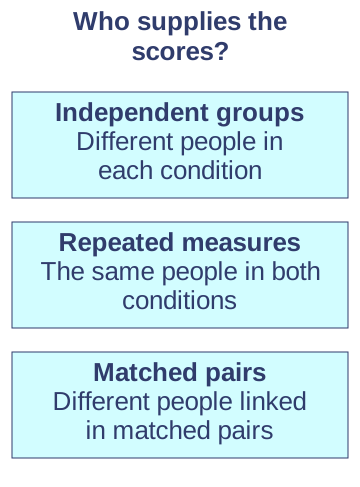
Independent groups — An independent-groups design uses different participants in the conditions. It avoids repeating the same test for a person, but participant differences can contribute to an observed contrast. Random allocation and suitable sample sizes help manage rather than magically remove that risk.
Repeated measures — A repeated-measures design tests the same participants in more than one condition. It controls stable participant differences but introduces order effects, practice, fatigue and possible awareness of the comparison. Counterbalancing addresses some order effects without removing every carryover influence.Dependence comes from the design, not simply equal sample sizes. Repeated observations and matched pairs require analysis that recognises their relationship.
Matched pairs — A matched-pairs design uses different people matched on relevant characteristics, with one from each pair in each condition. Matching must concern characteristics related to the outcome, and perfect matching is rarely possible. The design avoids some repetition effects while requiring additional recruitment and measurement.
Counterbalancing and randomisation — Counterbalancing varies condition order systematically, for example AB and BA. Randomising item order reduces a fixed ordering influence. These procedures address different sources of bias; neither should be named without explaining which feature it changes.
Extraneous and confounding influences — An extraneous variable is a relevant influence other than the intended independent variable. If it changes systematically with condition and could explain the outcome, it creates a confound. A recall study with a longer study period only in the quiet condition cannot isolate sound as the cause.
Control groups and standardisation — A control group or comparison condition helps identify what happens without the relevant intervention or under a specified alternative. Standardised instructions and procedures improve comparability. A comparison should preserve relevant contact and expectations where possible, not merely be called a control without explanation.
Observing behaviour
Observational choices — Observation records behaviour under a specified scheme. Naturalistic observation occurs in an everyday setting; controlled observation structures relevant circumstances. Observation is not inherently causal: without an appropriate manipulation or design, associations and descriptions remain the main conclusions.
Overt and covert observation — In overt observation people know they are being observed; in covert observation they do not. Awareness can change behaviour, while concealment raises consent and privacy issues. Being in a public place does not automatically remove all ethical responsibilities.
Participant and non-participant roles — A participant observer joins the activity or group; a non-participant observer remains outside it. Joining can improve contextual understanding but affect behaviour, independence or recording. These role choices are distinct from whether observation is overt or covert.
Behavioural categories — Categories turn a research question into observable, clearly defined actions. They should be relevant, sufficiently inclusive and avoid ambiguous overlap where each event needs one code. Friendly is difficult to code reliably; offers an object to another child without a request is more operational.
Event sampling — Event sampling records each occurrence of a specified behaviour within the observation period. It is useful for discrete acts but can overwhelm an observer if events are frequent or simultaneous. Define the event boundary and how repeated acts are counted.
Time sampling — Time sampling records behaviour at predetermined intervals or within specified time segments. It can make a long observation manageable, but brief events between sample points may be missed. Report the interval and whether a point sample or interval rule was used.
Observer agreement — Two observers independently applying the same scheme can reveal ambiguous definitions. Training and clearer categories may improve inter-observer reliability. Agreement does not by itself show that the category measures the intended psychological construct or that people behave naturally.
Self-reports and relationships
Questionnaires — A questionnaire presents questions or statements in a planned form and can collect information efficiently. Its apparent uniformity does not guarantee shared interpretation. Literacy, recall, social desirability and response options can affect the meaning of answers.
Open and closed questions — Open questions allow responses in participants' own words and can reveal unanticipated meanings. Closed questions provide specified choices that simplify comparison but may force an unsuitable answer. Choose a format for the research aim rather than assuming quantitative is always superior.
Wording and order — Avoid leading, loaded and double-barrelled questions. How satisfied are you with the friendly and effective support? assumes friendliness and combines two judgements. Question order can prime later answers, so piloting and justified ordering matter.
Rating scales — A rating scale maps an answer onto ordered options. Labels and direction should be clear and balanced, with an appropriate not-applicable choice where needed. Equal spacing of printed numbers does not automatically mean equal psychological intervals between them.
Structured interviews — A structured interview follows a standard schedule, supporting comparison and potentially reducing interviewer variation. It can limit clarification and miss unexpected issues. The presence of an interviewer can improve understanding while also affecting disclosure.
Unstructured interviews — An unstructured interview allows flexible questions and follow-up to explore meaning. It can provide rich contextual data but makes consistent comparison, coding and replication more difficult. Flexibility should remain connected to the aim and participant welfare.
Correlational investigations — A correlation measures the association between co-variables rather than manipulating one as an independent variable. A positive association means higher values tend to go with higher values; a negative association means higher values tend to go with lower values. Either can be strong or weak.
Third variables and direction — Study time and recall may correlate because studying improves recall, stronger prior knowledge makes studying more effective, or motivation affects both. A coefficient alone cannot choose among causal directions or common causes. A scattergram and design context are needed for interpretation.
Content analysis and case studies
Content analysis — Content analysis systematically examines communication or other recorded material through a justified coding scheme. It may quantify defined categories or examine contextual meaning. The sample of material, unit of analysis and coding decisions must be explicit before a conclusion about a wider population.
Developing a coding scheme — Define whether the unit is a word, image, sentence, article or other meaningful unit. Code examples and difficult cases, then check independent agreement. Counting aggressive words without context may confuse condemnation, quotation and endorsement.
Content-analysis limitations — Accessible media may not represent what people actually encounter, and frequency does not directly measure psychological effect. A pattern in portrayals is not evidence that an audience copied it. Distinguish the communication's content from its reception and consequences.
Case studies — A case study investigates a person, group, institution or event in depth, potentially using several methods. It can expose processes missed by group averages and generate hypotheses. The selection and detailed context limit claims that every other case will be the same.
Triangulation — Using complementary observations, interviews, documents or other measures can test whether interpretations converge. Methods may share biases or investigate slightly different constructs, so convergence is not guaranteed. Explain what each adds and how disagreement would be handled.
Design synthesis — Select a method by the question, the feasibility of manipulation, measurement quality, ethics and desired claim. An association, a rich account and a causal estimate are different outputs. The strongest design is the one that supports the stated conclusion with transparent limits, not the one with the most impressive label.
Test yourself
50 questions · Random sets of 10. These quick checks support revision; practise longer explanations and justified judgements too.
 Mr Kidman's Classroom