Defining and describing mental health difficulties
Definitions and judgement — Different definitions highlight statistical rarity, social expectations, functioning or an ideal standard of well-being. Each identifies a different comparison. None should be used alone to label a person or infer that difference is illness; apply criteria with cultural, contextual and ethical qualifications.
Statistical infrequency — A characteristic can be unusual relative to a reference population. Rarity is descriptive rather than automatically undesirable: an exceptional ability can be rare without being a disorder. The reference population, measurement and chosen cut-off affect who is classified as unusual.
Deviation from social or cultural norms — A behaviour may conflict with what a community expects, but norms differ across groups and historical periods. Social disapproval can reflect prejudice or power rather than impairment. Distinguish a contextual norm from a justified clinical judgement.
Failure to function adequately — This approach considers difficulty managing everyday demands or maintaining a tolerable life. Distress and impairment can be relevant, but people differ in circumstances and support. Temporary difficulty after a loss and persistent disabling difficulty require contextual interpretation rather than one universal behavioural rule.
Deviation from ideal mental health — An ideal-standard approach compares a person with features of positive well-being such as autonomy, self-acceptance, coping and a realistic perception of the world. Demanding every ideal at all times can classify ordinary human difficulty as abnormal. Cultural assumptions about independence also need evaluation.
Comparing definitions — The same characteristic can be common but impairing, rare but beneficial, or socially disapproved without harming functioning. A useful comparison states which criterion is met, what evidence is missing and why a conclusion remains qualified. Agreement between definitions may strengthen concern without replacing assessment.
Behavioural, emotional and cognitive features — Behavioural features concern actions; emotional features concern felt states; cognitive features concern thought and interpretation. The categories can interact. Avoidance can reduce anxiety briefly and preserve a threatening belief, linking all three rather than treating them as unrelated lists.
Phobic features — A phobia involves persistent disproportionate fear associated with a particular object or situation, often with avoidance or endurance under distress. Attention may be biased towards threat and beliefs about danger may be exaggerated. Ordinary caution in a genuinely dangerous situation is not automatically phobic.
Depressive features — Depressive difficulty can involve low mood, reduced interest, changes in activity and negative evaluations of self and the future. Irritability or agitation may occur alongside withdrawal. No single symptom or classroom example is sufficient to diagnose a person; consider duration, pattern, impairment and alternatives through proper assessment.
OCD features — Obsessions are recurrent unwanted intrusive thoughts, images or impulses; compulsions are repetitive actions or mental acts that a person feels driven to perform. A compulsion may reduce distress temporarily without being a realistic solution to a feared outcome. Preferring tidiness alone is not equivalent to OCD.
Behavioural explanations and phobia treatments
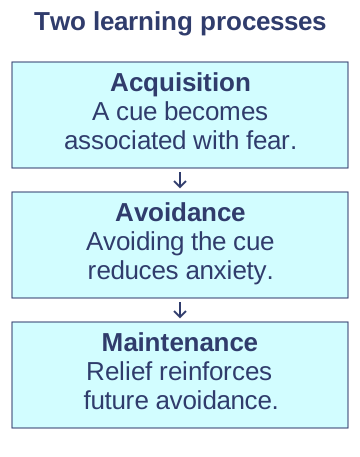
The two-process model — The two-process account links acquisition of fear through classical conditioning with its maintenance through operant conditioning. These are different explanatory stages. An account is stronger when it specifies how a fear began and why avoidance continues rather than using conditioning as a single vague label.Classical conditioning can explain acquisition; negative reinforcement can maintain avoidance. Relief increases avoidance, so it is not punishment.
Acquiring an association — A previously neutral stimulus paired with an aversive event may later elicit fear. A dog encountered during a frightening attack can become a conditioned stimulus. The account predicts learned fear without requiring that every phobia follows a remembered direct traumatic pairing.
Generalisation and individual differences — Fear may extend to stimuli resembling the original cue. People exposed to similar events do not always develop the same fear, and some fears develop through observation or information. These limits show why a purely direct-pairing explanation is incomplete.
Negative reinforcement of avoidance — Avoiding the feared cue can remove anxiety in the short term, reinforcing the avoidance. Because the person does not encounter a safe outcome, the threatening expectation may remain unchallenged. Negative reinforcement means removing an aversive state, not punishing the avoidance.
Maintenance versus origin — A person may not recall how fear began yet show a clear avoidance-anxiety cycle now. Evidence about maintaining factors does not establish the original cause. Distinguish a clinically useful maintenance account from proof of one universal acquisition pathway.
Systematic desensitisation — This behavioural treatment uses a planned graded fear hierarchy and relaxation or other competing coping responses during controlled exposure. The person progresses through manageable stages rather than being unexpectedly confronted with the worst fear. It requires informed agreement and suitable professional assessment.
Hierarchy and reciprocal inhibition — A hierarchy orders feared situations from less to more anxiety provoking for that individual. In the classic account, relaxation is incompatible with intense anxiety and can become associated with the cue. A personally meaningful ordering matters more than a fixed universal list.
Flooding — Flooding involves intensive exposure rather than beginning with small graded steps. Anxiety may decline when avoidance is prevented and the expected catastrophe does not occur. It can be distressing and is not suitable for everyone; description of the theory is not an instruction to impose exposure on someone.
Evaluating exposure evidence — Compare symptom change, functioning, acceptability, dropout and follow-up, not simply immediate anxiety. Improvement can support a treatment while leaving the original cause uncertain. Participant selection, therapist expertise and comparison conditions affect effectiveness claims.
Cognitive explanations and depression treatments
Beck's cognitive account — Beck proposed that biased processing and negative schemas can shape how events are interpreted. A setback may be interpreted as proof of personal worthlessness rather than a limited difficulty. The account concerns a pattern of interpretation, not the claim that a person chooses to be distressed.
Negative schemas — A schema organises expectations and can guide attention, memory and interpretation. A negative self-schema may make adverse evidence more salient and positive evidence easier to dismiss. Schemas are inferred explanatory structures, so research must specify their measurement and test alternative directions of influence.
The negative triad — Beck's triad concerns negative views of the self, the world and the future. An individual may see themself as inadequate, experience the world as hostile and expect no improvement. The three components form a connected outlook rather than three independent diagnostic tests.
Cognitive biases — Selective attention to failures or overgeneralising from one event can sustain negative conclusions. A poor mark becoming evidence that every future attempt will fail illustrates overgeneralisation. Explain how the inference goes beyond the evidence rather than describing all pessimism as irrational.
Ellis's ABC model — In Ellis's account, an activating event is interpreted through beliefs, producing emotional and behavioural consequences. Two people can respond differently to the same setback because their beliefs differ. The model does not imply that serious adversity is harmless or that external conditions are irrelevant.
Rigid demands and beliefs — A preference to succeed differs from a rigid demand that one must always succeed to have worth. Such demands can support catastrophic conclusions after setbacks. Evaluation must distinguish an unreasonable inference from an understandable response to a genuinely harmful environment.
CBT and collaborative inquiry — Cognitive behaviour therapy can help examine interpretations and change maintaining patterns through structured collaborative work. A therapist and person can test a prediction against evidence and develop alternative ways of responding. It is not simply reassurance or an order to think positively.
Behavioural components — A cognitive-behavioural plan can also address reduced activity and avoidance that maintain distress. Testing a prediction through an agreed activity provides new evidence as well as a behavioural change. The link between belief, action and outcome should be explicit.
Disputing and evaluating beliefs — In an Ellis-derived approach, beliefs can be examined for logical consistency, evidence and practical consequences. A new belief should be realistic rather than automatically optimistic. Different cognitive therapies share some methods without being identical to each other.
Evaluating cognitive accounts — Associations between negative thinking and mood do not by themselves establish whether thinking caused mood, followed it or interacted with it. Prospective studies and changes during treatment provide additional evidence, but successful therapy does not prove a single original cause. Biological and social factors remain relevant.
Biological explanations and OCD treatments
Genetic vulnerability — A biological account investigates inherited differences associated with vulnerability to OCD. Familial patterns and twin comparisons can inform the account, but shared environments and incomplete concordance matter. Concordance concerns how often both members of a pair have the condition; a rate below 100% shows that sharing genes is not sufficient to guarantee the same outcome. A vulnerability is probabilistic, and there is no simple inference from one relative's experience to another's outcome.
Polygenic and heterogeneous pathways — Many genetic variants may contribute small effects, and different combinations can be associated with similar symptoms. This makes a single-gene explanation inadequate. Gene-environment interaction also means that a risk estimate is not a fixed personal destiny.
Neural explanations — Researchers investigate neurotransmission and activity in circuits involved in evaluating threat, detecting error and inhibiting repetitive responses. A neural correlate is an association, not automatic proof that the difference caused the symptoms. Experience and treatment can also alter neural activity.
Serotonin and drug therapy — Selective serotonin reuptake inhibitors (SSRIs) reduce the reabsorption of serotonin into the releasing neuron, leaving more available for signalling across the gap between neurons (the synapse). Symptom improvement in some people supports investigation of serotonergic mechanisms, but it does not show that every person with OCD originally had one simple serotonin deficiency.
Time course and outcome — Clinical benefit can differ from the immediate biochemical action, and response varies between individuals. Assess symptom reduction, functioning, adverse effects and sustained outcomes using appropriate clinical evidence. These notes explain specification concepts and do not recommend a personal treatment or medication change.
Evaluating medication evidence — Random allocation, appropriate comparison groups, clear outcome measures and follow-up strengthen treatment evidence. Expectancies, incomplete blinding, selective publication and attrition can affect estimates. A mean benefit does not guarantee that a particular person benefits or that all approaches are equivalent.
Combining explanations and interventions — Biological vulnerability, learned avoidance, cognitive interpretation and social experience can interact. An intervention may target a maintaining factor without identifying every cause. Compare appropriateness and effectiveness with explicit criteria and keep individual assessment separate from classroom recall.
Test yourself
50 questions · Random sets of 10. These quick checks support revision; practise longer explanations and justified judgements too.
 Mr Kidman's Classroom