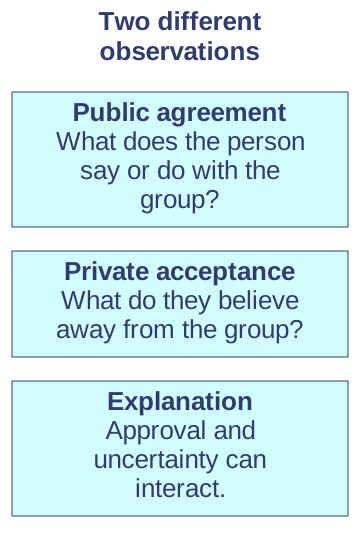
Public action and private belief — Conformity is a change in behaviour or belief in response to a real or imagined group. A person may agree outwardly while privately disagreeing, or genuinely accept the group's view. Establish what changed and whether it persists when the group is absent before naming a type.Public behaviour and private belief require separate evidence. Normative and informational motives are explanations, not identical labels for these observations.
Compliance — Compliance is public agreement without private acceptance. A student laughs at a joke to avoid rejection but still thinks it is unfunny. The behaviour may disappear when the audience leaves; this distinguishes social approval from a changed judgement of truth.
Internalisation — Internalisation involves accepting a group's position privately as well as publicly. A person who checks a group's explanation, accepts it and continues to use it alone illustrates a more lasting change. Persistence alone is suggestive evidence; researchers must still measure the private judgement.
Normative influence — Normative social influence occurs when acceptance or avoidance of rejection motivates agreement. The group is a source of social reward or sanction. It often produces compliance, but the explanation and the type of conformity are different concepts: one is a motive, the other describes the resulting change.
Informational influence — Informational social influence treats others as evidence about reality, especially when a task is ambiguous, the person lacks knowledge or the group appears expert. It can lead to internalisation. Following a crowd during an uncertain evacuation may reflect a search for accurate information rather than a desire to be liked.
Distinguishing motives — The same outward answer can have different causes. Ask whether a participant believes the group is correct, fears disapproval or experiences both. A questionnaire, private response or comparison of easy and difficult tasks can help distinguish explanations, but retrospective self-reports may rationalise the choice.
Asch's task — Asch used an unambiguous line-comparison task with a participant hearing a unanimous majority give incorrect judgements on critical trials. The important comparison is with individual performance without that misleading majority. An incorrect public response is evidence of social pressure, not proof of private belief change.
Group size — Increasing the number in a majority initially increases conformity, but its effect does not rise indefinitely in a simple straight line. A larger group can seem more credible or increase anticipated disapproval. Independence of its members matters: ten people repeating one source are not ten independent pieces of evidence.
Unanimity and an ally — A dissenting person breaks the appearance of complete agreement and can make independent responding easier. An ally need not always supply the correct answer to weaken unanimity. Distinguish social support for disagreement from merely supplying the correct factual answer.
Task difficulty — When comparisons become harder, participants have more reason to doubt their own judgement and use the majority as information. Difficulty can therefore increase informational influence. An explanation should connect the manipulated difficulty to uncertainty, rather than merely stating that conformity rises.
Private responses — If public conformity falls when answers become private, concern about evaluation is a plausible explanation. This does not establish that every original error was normative: privacy can also change attention or expectations. An appropriate control should preserve the task and information while changing exposure to the group.
Generalising conformity evidence — A controlled task can isolate majority pressure, but brief judgements by a restricted sample do not represent every culture, historical period or high-stakes decision. Evaluate population, task meaning and social context separately. Artificiality can reduce everyday relevance without making a controlled finding meaningless.
Obedience and authority
Obedience versus conformity — Obedience follows a direct instruction from an authority figure; conformity responds to group pressure that need not involve an explicit order. A manager ordering a worker to continue differs from colleagues independently choosing to continue. The same setting may contain both processes.
Milgram's procedure — Milgram studied responses to an experimenter's instructions to deliver escalating apparent shocks during a learning task. The learner was a confederate, someone working with the researchers who acted as another participant, and the shocks were simulated; the participant's belief about harm and freedom to withdraw created major ethical concerns. Analyse the participant's perceived situation rather than treating the shocks as actual injuries.
Situational variations — Variations changed features such as the authority's proximity, the learner's proximity and the setting. Compare the relevant condition with its baseline while retaining the procedure's important constants. A difference supports a situational contribution; it does not establish that personality has no effect.
Agentic state — The agentic explanation proposes that people may see themselves as carrying out another person's wishes and displace responsibility onto the authority. They can experience moral strain while continuing. Calling someone an agent describes a proposed psychological state, not an exemption from moral or legal responsibility.
Autonomous state — In an autonomous state a person sees themself as responsible for their actions and chooses according to personal judgement. An agentic shift is the proposed change into acting for an authority. Refusal may involve reclaiming responsibility, but it can also arise from distrust or other situational factors.
Binding factors — Commitment to the task, concern about disrupting the interaction and the gradual escalation of demands may help keep someone in an obedient role despite strain. These factors help explain persistence; they should not be confused with the original reason the authority was accepted.
Legitimacy of authority — People may obey because a society recognises particular roles as entitled to issue instructions. A legitimate role operates within a context and set of limits: a teacher's classroom authority does not confer authority over every private decision. Perceived legitimacy can differ from an instruction's actual lawfulness.
Location — An institutional setting can signal expertise and legitimacy. Moving a procedure to a less prestigious setting tests the contribution of those cues, but location may also change trust or expectations. Explain the mechanism and consider these competing interpretations when evaluating a variation.
Authority proximity — Direct physical presence can make an instruction harder to ignore and maintain the relationship with the authority. Instructions delivered remotely may reduce obedience. The prediction concerns social influence and supervision; physical distance itself is not a universal measure of legitimate power.
Victim proximity — Seeing or hearing a person affected by an action can make consequences harder to disregard and increase moral strain. This can reduce obedience. Distinguish proximity to the person harmed from proximity to the person giving orders, because they predict different mechanisms.
Uniform and role cues — A uniform can signal an authorised social role, increasing the likelihood that an instruction is treated as legitimate. Evaluate whether a study varies clothing alone or also changes expectations, status or perceived sanctions. A role cue is influential without guaranteeing obedience.
Ethics and withdrawal — Deception can undermine informed consent, and repeated prompts can make a stated right to withdraw feel difficult to exercise. Debriefing and follow-up address some consequences but cannot retroactively make distress disappear. Evaluate knowledge gained alongside participant protection and the availability of less harmful designs.
Interpreting obedience evidence — An apparent authority effect depends on whether participants believed the situation and interpreted the instruction as intended. Suspicion can weaken validity, but it should be established with evidence rather than assumed. Differences between variations also require attention to sampling and procedural comparability.
Disposition and resistance
Authoritarian personality — The dispositional account associates obedience with conventionalism, submission to respected authority and hostility towards people seen as lower status. It explains stable individual differences rather than only a momentary setting. Do not infer a personality type merely because someone obeyed one instruction.
Proposed childhood origins — The historical account links harsh discipline and conditional affection to displaced hostility and strong deference to powerful figures. This is a developmental hypothesis, not an established description of every strict family. Retrospective reports, alternative experiences and cultural context complicate causal claims.
Measuring authoritarianism — A scale translates a theoretical trait into responses to items. Acquiescence means tending to agree with statements regardless of their content; social desirability means giving answers that present oneself favourably. Both, alongside ideologically one-sided wording, can distort scores. A correlation between a scale and obedience supports an association but cannot by itself show that childhood experience caused either.
Situations and dispositions together — The same person can obey one authority and resist another, while people in the same situation can respond differently. An interactionist account asks how traits, perceived legitimacy, social support and task meaning combine. Neither a group average nor one case settles a universal personality explanation.
Social support for independence — A person who sees another individual refuse can find an alternative course of action more credible and feel less isolated. The support can weaken normative pressure or supply evidence that resistance is possible. A dissenting model need not control the authority to affect the participant.
Internal locus of control — An internal locus of control is a general expectation that one's actions influence outcomes. Such a person may feel greater responsibility for choosing independently. It is a tendency, not a guarantee of resistance: internal beliefs can also motivate deliberate compliance with a valued instruction.
External locus of control — An external locus of control attributes outcomes more to chance, fate or powerful others. This differs from the agentic state: one is a general expectation, the other a proposed immediate relationship with an authority. A person can be relatively external in outlook while actively resisting a particular demand.
Evaluating resistance predictions — If a study finds lower obedience among people with an internal locus, consider how the locus was measured, whether a third variable explains the relationship and whether the result generalises. Resistance is an observed action; the underlying motive requires separate evidence.
Minority influence and evaluation
Minority influence — A minority can influence a majority by presenting a coherent alternative rather than relying on numerical power. The proposal can provoke attention, conflict and deeper processing. A minority's message is not true simply because it is consistent; accuracy and persuasion must be evaluated separately.
Consistency over time and people — Diachronic consistency means maintaining a position over time; synchronic consistency means agreement among minority members. Together they make the alternative seem less arbitrary. Rigid repetition without reasons can instead invite dismissal, so consistency must be distinguished from inflexibility.
Commitment and sacrifice — A minority member who accepts a personal cost may encourage the majority to consider the message seriously. The augmentation principle describes this increased attention to a position that appears strongly held. Costs can signal sincerity without proving the position is correct.
Flexibility and negotiation — Flexibility involves responding constructively to others rather than conceding every principle or refusing every compromise. A minority may keep a central claim consistent while adapting how it pursues it. This helps explain why both consistency and flexibility can contribute to influence.
Conversion and processing — A minority can encourage private reconsideration that appears later or on related issues rather than immediate public agreement. An immediate show of hands may therefore miss influence. Researchers must specify when and how attitudes are measured before claiming lasting conversion.
Minority research — Colour-judgement research associated with Moscovici compared the effects of consistent and inconsistent minorities. It supports the importance of consistency under controlled conditions. Generalisation to sustained political or scientific change requires attention to message meaning, social identity, power and historical circumstances.
Method and explanation — A difference between consistent and inconsistent conditions is most informative when the message, majority task and response measurement are comparable. If the minority also gives better reasons, message quality is an alternative explanation. Identify the variable rather than listing generic methodological criticisms.
Writing an evaluated answer — State the process, explain why it predicts a response, apply it to the given person's circumstances and use evidence to assess its reach. Distinguish explanation from description and causal evidence from correlation. A balanced judgement can recognise both situational power and individual agency without treating every account as equally supported.
Test yourself
50 questions · Random sets of 10. These quick checks support revision; practise longer explanations and justified judgements too.
 Mr Kidman's Classroom